

Nemotron 3.5 Super VL could be one of NVIDIA’s next developments in multimodal artificial intelligence, with a potential announcement expected at GTC Berlin in October 2026. Recent reporting from TestingCatalog points to the model as a possible addition to NVIDIA’s growing Nemotron family. Meanwhile, NVIDIA’s own technical documentation already contains a model entry for Nemotron 3.5 Super VL, suggesting that the project has progressed beyond a name circulating in online speculation. However, the exact announcement timing, public release and availability should not be treated as confirmed until NVIDIA officially announces them.
The reported model combines a large language model with vision capabilities, potentially enabling it to interpret images and video alongside text. This type of AI could support applications ranging from visual document analysis to video understanding and multimodal retrieval. If NVIDIA introduces the model at GTC Berlin, developers will want to know how its architecture works, what hardware it requires and whether its weights will be publicly available.
What Is NVIDIA Nemotron 3.5 Super VL?

Nemotron 3.5 Super VL is a vision-language model associated with NVIDIA’s Nemotron family of AI models. The “VL” designation stands for vision-language, indicating that the system is designed to process visual information as well as textual input.
Unlike a text-only language model, a vision-language system can analyse information contained in images and video frames. Depending on its supported capabilities, it may be able to describe visual scenes, interpret charts, answer questions about screenshots or connect visual evidence with written instructions.
NVIDIA’s NeMo AutoModel documentation already lists a checkpoint named NVIDIA-Nemotron-3.5-Super-VL-120B-A12B-BF16. This provides a stronger technical indication that the model architecture exists than an unverified social media claim alone. It does not, however, confirm an official launch date or guarantee that downloadable weights are publicly available.
The reported specifications identify Nemotron 3.5 Super VL as a model with approximately 120 billion total parameters and 12 billion active parameters per token. That places it in a substantial model class while using a mixture-of-experts architecture to activate only part of its available parameters during processing.
Is Nemotron 3.5 Super VL Being Announced at GTC Berlin?
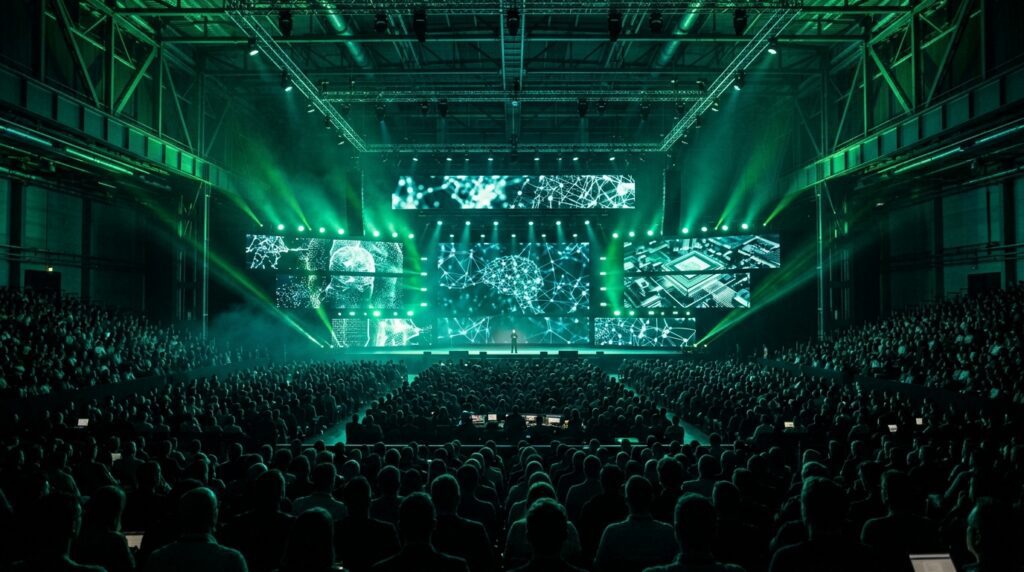
The possible announcement is the central question surrounding Nemotron 3.5 Super VL. TestingCatalog has highlighted the model as a potential announcement at NVIDIA’s upcoming GTC Berlin event, scheduled for October 20–22, 2026.
There is an important distinction between a model appearing in technical repositories and NVIDIA officially announcing its availability. Developers sometimes publish code integrations, configuration files or architecture support before a product is formally launched. These materials can reveal substantial technical details without confirming when the model will become accessible to the public.
As of October 15, 2026, the available evidence supports the existence of a corresponding NVIDIA documentation entry, but the anticipated GTC announcement remains unconfirmed. Readers should follow NVIDIA’s official events information and AI developer news for an announcement, release date or download instructions.
If the model is introduced at GTC Berlin, the most useful details to watch will be the official model card, downloadable weights, licensing terms, supported inference frameworks and recommended hardware. These details will determine whether Nemotron 3.5 Super VL is immediately useful for developers or remains a model to watch.
Key Technical Specifications and Architecture

The technical documentation offers an early look at how Nemotron 3.5 Super VL is structured. Its reported architecture combines a Nemotron-H language backbone with a separate vision encoder and components designed to process visual and temporal information.
The model’s main reported characteristics include:
Approximately 120 billion total parameters: A large model designed for complex multimodal tasks.
12 billion active parameters: A mixture-of-experts approach that activates a subset of parameters during processing.
Hybrid language architecture: A combination of Mamba-based processing and attention or mixture-of-experts components.
RADIO vision encoder: A visual encoder identified in NVIDIA’s documentation as RADIO v2.5-H.
Video-processing components: A separate temporal embedding pathway for representing video information.
No audio encoder in the documented checkpoint: The listed architecture does not support audio input through an integrated audio encoder.
These details matter because Nemotron 3.5 Super VL is not simply a text model with an image upload feature attached. Its architecture incorporates dedicated visual processing, allowing image and video information to be represented before it is combined with language-model reasoning.
The absence of an audio encoder is also worth noting. Vision-language and audio-language capabilities are different, and a model that understands video frames does not necessarily understand the accompanying sound. Developers evaluating Nemotron 3.5 Super VL should check the official model card for the precise supported inputs and limitations.
How Nemotron 3.5 Super VL Could Understand Images and Video

A vision-language model generally processes visual information through a dedicated encoder. The encoder transforms an image into numerical representations that the language model can use alongside text. Additional components help align these visual representations with the model’s language-processing system.
For video, the process can involve representing selected frames and preserving information about their temporal order. This gives the model a way to reason about what appears in a sequence rather than treating every frame as an unrelated photograph.
In Nemotron 3.5 Super VL, NVIDIA’s documented architecture includes a vision encoder and a separate temporal video pathway. These components suggest that the model is designed to handle both still images and video-derived information. Actual performance will depend on its training, supported input formats, resolution handling and inference implementation.
Potential applications include analysing product images, interpreting screenshots, extracting information from visual documents and answering questions about recorded processes. Video understanding could also help with reviewing footage, summarising visual events and building multimodal search systems.
These are potential use cases rather than verified benchmark results. Developers should wait for official evaluations and test the model on representative data before assuming it can outperform other vision-language systems.
Why the Mixture-of-Experts Design Matters

The mixture-of-experts, or MoE, approach is a major part of the reported design of Nemotron 3.5 Super VL. Rather than activating every model parameter for every token, an MoE model routes processing through a smaller selection of specialised components.
This approach can provide a large total model capacity without requiring every parameter to perform computation for each token. For Nemotron 3.5 Super VL, the reported configuration has around 120 billion total parameters but activates approximately 12 billion per token.
However, active parameter count is not the same as total memory usage. Model weights, visual inputs, context length, intermediate computations and inference software all affect hardware requirements. A model with 12 billion active parameters is not automatically equivalent to a conventional dense model of the same active size in terms of memory, speed or quality.
The hybrid architecture also combines different processing approaches. Mamba-based components can help process sequences efficiently, while attention and expert layers contribute to the model’s broader reasoning and representation capabilities. The actual balance of performance, latency and resource use must be established through benchmarks rather than parameter counts alone.
For developers considering Nemotron 3.5 Super VL, the key question will be whether the architecture delivers useful visual reasoning at an acceptable deployment cost.
Potential Use Cases for Developers and Businesses

If the model becomes publicly available with suitable licensing, Nemotron 3.5 Super VL could be relevant to several types of applications.
Document and chart analysis: Businesses could explore using a vision-language model to interpret scanned documents, invoices, diagrams and charts, particularly where the visual arrangement carries information that plain text extraction might miss.
Video analysis: Systems could use visual understanding to search recordings, identify events or produce summaries of video content. Performance would depend on supported video inputs and the quality of temporal reasoning.
Multimodal retrieval: A model that connects visual and textual information could help users find relevant images, screenshots or video segments using natural-language queries.
Industrial inspection: Developers could investigate image-based quality control, defect identification and visual reporting, provided the model is validated against domain-specific data and safety requirements.
AI assistants: Multimodal assistants could accept screenshots or other visual evidence when helping users troubleshoot software, understand interfaces or investigate technical problems.
These applications are opportunities for experimentation, not guarantees of production readiness. Businesses should evaluate accuracy, privacy, latency, cost and failure modes before deploying a new model in customer-facing or operational workflows.
How Nemotron 3.5 Super VL Fits Into NVIDIA’s AI Strategy

NVIDIA’s Nemotron family reflects the company’s broader strategy of providing models, datasets and development tools for building specialised AI applications. Rather than focusing only on a single general-purpose chatbot, the family includes models aimed at different sizes, workloads and capabilities.
For example, NVIDIA has documented Nemotron 3.5 Lightning as an open 30-billion-parameter mixture-of-experts model with 3 billion active parameters, optimised for high-volume execution in AI agents. The company has also documented Nemotron 3 Super as a model for reasoning and agentic workloads.
Nemotron 3.5 Super VL would extend this ecosystem with a stronger emphasis on visual understanding. That could help developers build applications that combine reasoning with image and video inputs instead of relying exclusively on text.
The broader strategy is important because real-world AI systems increasingly combine multiple models, retrieval tools and specialised processing stages. A vision-language model can serve as one component of such a system, while other models handle planning, text generation, audio or task execution.
The model’s actual competitive position will depend on its performance, openness, licensing, supported hardware and ease of deployment. Its appearance in NVIDIA documentation is an encouraging technical signal, but independent evaluations and a confirmed release will be needed to assess its practical value.
What Developers Should Watch for at GTC Berlin
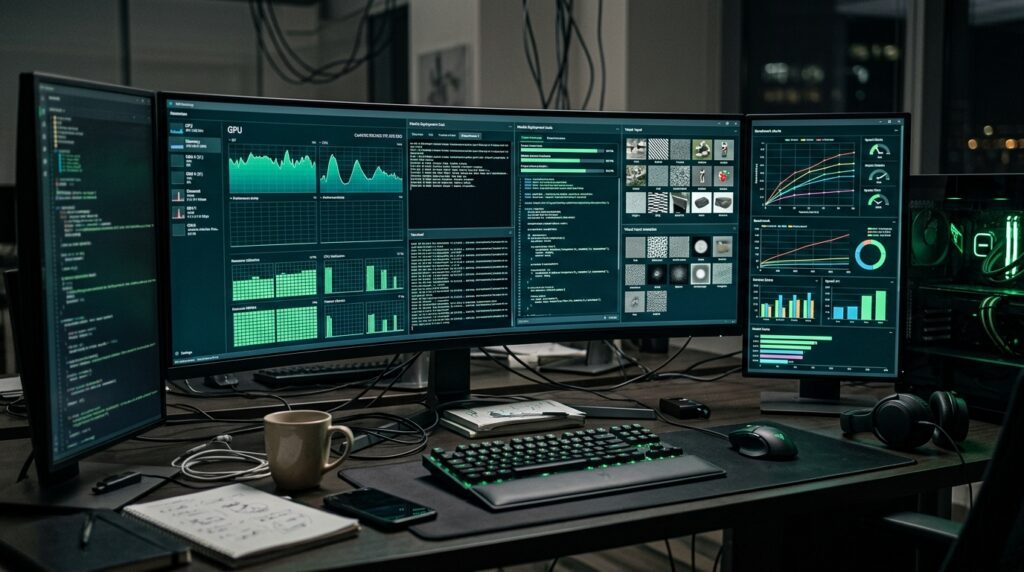
Developers following Nemotron 3.5 Super VL should look beyond the announcement headline and focus on the details that determine whether they can actually use the model.
First, check whether NVIDIA publishes downloadable model weights or offers access through a hosted inference service. Documentation alone does not mean a checkpoint is ready for general use.
Second, review the licence and commercial-use conditions. Open weights do not automatically mean unrestricted usage, and organisations should understand the relevant terms before integrating a model into a product.
Third, examine hardware requirements and supported inference frameworks. The total parameter count, image resolution, context length and video-processing configuration can influence deployment costs substantially.
Fourth, look for independent benchmarks covering visual question answering, document understanding, video reasoning and real-world application tasks. Results on a single benchmark rarely tell the full story.
Finally, verify the release date and version details through NVIDIA’s official channels. Nemotron 3.5 Super VL is a credible model to watch because a corresponding technical documentation entry exists, but the exact launch timing and public availability should remain unconfirmed until officially announced.
Frequently Asked Questions
What is Nemotron 3.5 Super VL?
Nemotron 3.5 Super VL is a documented NVIDIA vision-language model architecture designed to combine language processing with visual understanding. Its technical listing describes a 120-billion-parameter model with 12 billion active parameters per token.
When will Nemotron 3.5 Super VL be released?
A possible announcement at GTC Berlin, scheduled for October 20–22, 2026, has been reported. However, an official public release date has not been confirmed in the evidence discussed here.
Can Nemotron 3.5 Super VL analyse video?
The documented architecture includes a separate temporal video-processing component, suggesting support for video-derived visual information. Developers should check the released model card and supported inference implementation for exact input capabilities.
Does Nemotron 3.5 Super VL support audio?
The documented BF16 checkpoint does not include an audio encoder. That means developers should not assume it can directly process audio inputs simply because it can process video.
Will Nemotron 3.5 Super VL be open source?
Its final distribution model, licence and public availability should be verified through NVIDIA’s official announcement and model repositories. A technical documentation entry alone does not confirm that model weights or training materials are publicly downloadable.
Conclusion
Nemotron 3.5 Super VL is worth watching as NVIDIA continues expanding its open-model ecosystem. The documented architecture points to a substantial vision-language model combining a hybrid language backbone, a dedicated visual encoder and components for processing video information.
A potential GTC Berlin announcement could clarify the model’s capabilities, release plans and deployment requirements. Until NVIDIA confirms those details, developers should distinguish the technical evidence already available from predictions about the launch.
For businesses exploring multimodal AI, the next steps are to monitor official documentation, examine licensing and hardware requirements, and test the model against real workloads when access becomes available.
Explore our IT services: Progressive Robot helps businesses explore software development, AI solutions, cybersecurity and wider IT services.
References
TestingCatalog — NVIDIA expected to announce new Nemotron 3.5 Super VL model at GTC
NVIDIA NeMo AutoModel — Nemotron 3.5 Super VL technical documentation
NVIDIA Developer Blog — Nemotron 3.5 Lightning
More AI coverage: explore Progressive Robot's AI Models, Tools & Releases hub — hands-on reviews, setup guides and benchmarks in one place.










