
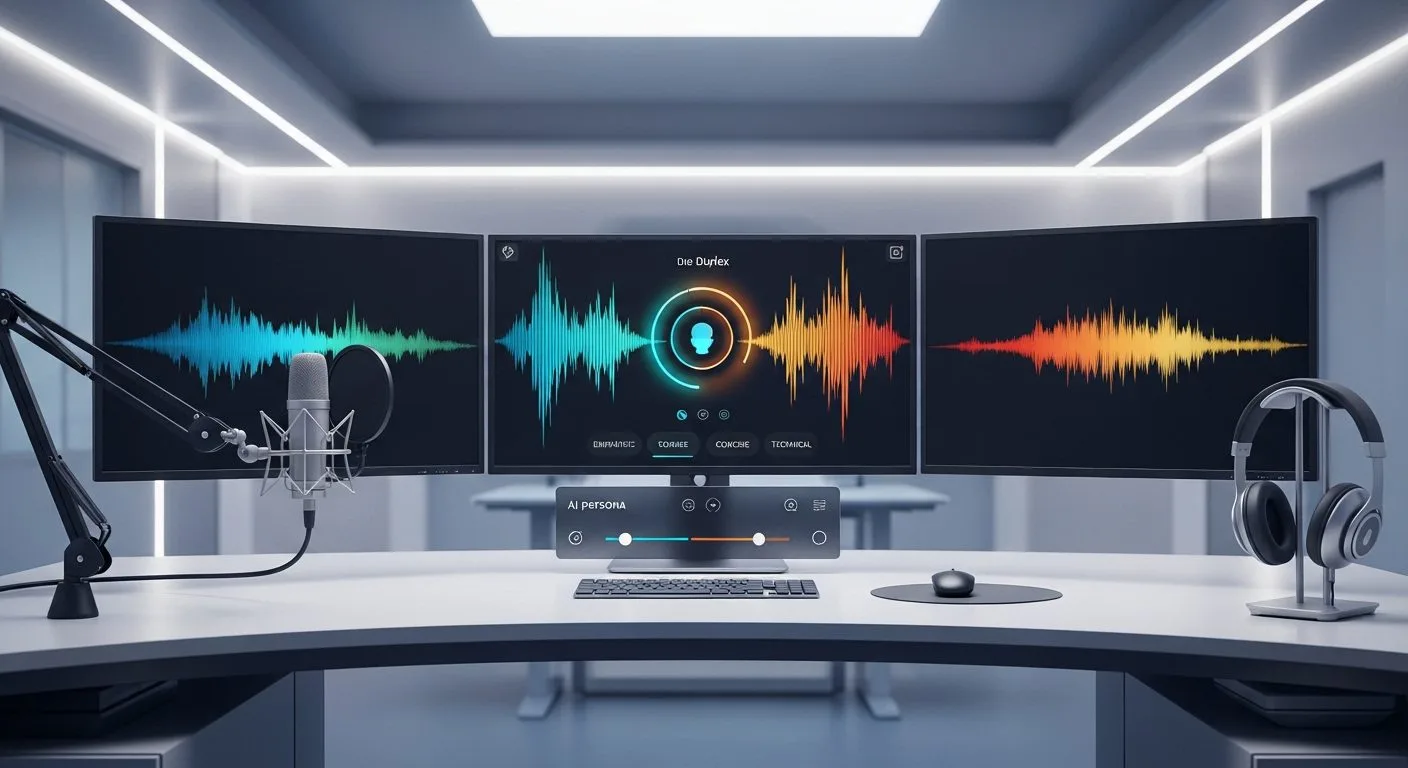
If you are asking what is NVIDIA PersonaPlex, the short answer is that it is NVIDIA’s publicly released 7B full-duplex speech-to-speech conversational model for real-time voice interaction. Instead of chaining separate speech recognition, language generation, and text-to-speech systems together, PersonaPlex is designed to listen and speak at the same time, which makes conversations feel faster and more natural.
This guide uses NVIDIA’s official NVIDIA PersonaPlex project page and release materials as the main references. If you want to understand what is NVIDIA PersonaPlex from a practical point of view, the key idea is simple: NVIDIA is trying to combine natural conversational timing with direct control over both role and voice.
Why understanding what is NVIDIA PersonaPlex matters
If you want a better answer to what is NVIDIA PersonaPlex, it helps to understand the problem it is solving. Traditional voice assistants usually rely on a cascaded stack: automatic speech recognition turns audio into text, a language model creates the reply, and a text-to-speech system reads the answer back out loud. That approach can work, but it often adds latency, weak interruption handling, and robotic turn-taking.
PersonaPlex matters because it is built around live conversational behaviour rather than around a slow handoff between components. It is also designed to keep persona control, which means developers can guide both how the assistant sounds and what role it plays.
If you are looking at voice systems in business workflows, support operations, or agent-based service experiences, Progressive Robot’s article on AI in project management helps frame where faster, more adaptive AI interfaces can create operational value.
What is NVIDIA PersonaPlex in simple terms

What is NVIDIA PersonaPlex in plain English? It is a real-time conversational speech model released by NVIDIA in January 2026 that can carry spoken interactions with lower latency and more natural timing than older voice stacks. It is built on top of Kyutai’s Moshi architecture and uses a full-duplex design so the system can process incoming user speech while generating outgoing speech.
PersonaPlex is controlled by two prompt types:
- A voice prompt that shapes vocal qualities, speaking style, and prosody.
- A text prompt that defines the role, background, and scenario context.
That combination is what makes the model stand out. You are not limited to a fixed assistant personality. In principle, PersonaPlex can sound like one speaker while acting like a tutor, a banking support agent, a medical receptionist, or a casual conversation partner.
How NVIDIA PersonaPlex architecture works

1. It uses a full-duplex speech-to-speech design
The first architectural point to understand is the full-duplex setup. PersonaPlex listens and speaks at the same time. That is what enables interruption handling, overlapping speech, backchannels, and more realistic turn-taking.
This is materially different from a standard pipeline where each stage waits for the previous stage to finish. In a cascaded system, latency builds up across recognition, reasoning, and synthesis. In PersonaPlex, streaming understanding and streaming generation happen together inside one model flow.
2. It is built on Moshi with a dual-transformer stack
NVIDIA states that PersonaPlex is built on the Moshi architecture and uses a Mimi speech encoder, temporal and depth transformers, and a Mimi speech decoder. Audio runs at a 24 kHz sample rate, and the model operates in a dual-stream configuration so user speech and agent speech can coexist during the interaction.
The release materials also point to Helium as the underlying language model layer that supports semantic understanding and broader generalization. That matters because PersonaPlex is not just converting speech. It is modelling a live conversation as it unfolds.
3. It combines text prompting with voice conditioning
Another core part of PersonaPlex is the hybrid prompting setup. NVIDIA describes two inputs that jointly define the conversational behaviour:
- The voice prompt captures speaker identity, vocal texture, and speaking style.
- The text prompt captures the role, context, instructions, and background details.
This hybrid prompting architecture is central to the product story. Full-duplex speech models are good at natural interaction, but persona control is harder. PersonaPlex is important because it tries to preserve both.
4. It blends real and synthetic training data
NVIDIA says PersonaPlex was trained on a mix of real conversations from the Fisher English corpus and large volumes of synthetic assistant and customer service conversations. The real conversations help it learn human-style timing, pauses, and backchannel behaviour. The synthetic conversations give it structured role information, task instructions, and broader scenario coverage.
That training mix explains a lot about the model’s behaviour. PersonaPlex is aiming to sound more natural than a purely synthetic voice system while still following role-specific prompts more reliably than an unstructured open conversation model.
What NVIDIA PersonaPlex can do well
If you are still asking what the model is useful for beyond the architecture, the clearest answer comes from the kinds of workflows it fits.
Real-time AI assistants
PersonaPlex is a strong match for spoken assistants that need fast interruption handling and natural turn-taking. A tutoring assistant, coaching tool, or hands-free productivity interface becomes more usable when the user does not have to wait through rigid speech turns.
Customer service voice agents
NVIDIA highlights banking and service-style interactions in its examples. That makes PersonaPlex relevant for booking flows, account support, order questions, and other voice workflows where the assistant needs to keep role-specific facts active while responding naturally.
Reception and intake scenarios
Medical office reception is one of the example roles NVIDIA showcases. More broadly, that points to structured intake use cases such as capturing names, dates of birth, allergies, eligibility details, or service needs while maintaining a calm, professional speaking style.
Casual and open-ended conversation
Because PersonaPlex also benefits from the broader conversational competence of its backbone model, it is not limited to rigid enterprise scripts. NVIDIA shows examples of casual discussion, natural backchanneling, and even out-of-distribution role prompts such as a technical space emergency conversation.
Research and voice UX prototyping
The public release includes code, weights, a paper, a demo, a prompt guide, and offline evaluation tools. That makes PersonaPlex useful for developers and researchers testing voice personas, interruption behaviour, and real-time speech interfaces without having to build a complete speech stack from scratch
How PersonaPlex differs from older voice AI stacks
The simplest way to understand PersonaPlex is to compare it with older voice systems.
A conventional voice assistant usually works like this:
- Speech recognition converts audio to text.
- A language model generates the reply.
- A text-to-speech system renders the spoken answer.
That design is flexible, but each handoff adds delay and can flatten conversational rhythm. PersonaPlex instead keeps listening and speaking inside a unified speech-to-speech model. The benefit is not just speed. It is a more fluid interaction style where acknowledgments, pauses, interruptions, and conversational overlap can feel more human.
The other major difference is persona control. NVIDIA explicitly positions PersonaPlex as a system that can combine a chosen voice with a chosen role. That matters because businesses and product teams rarely want one generic assistant voice for every scenario.
Benchmarks and performance claims that matter
Any serious explanation of PersonaPlex should include the evaluation story, not just the demos. NVIDIA reports that PersonaPlex outperforms other open-source and commercial systems on conversational dynamics, interruption latency, response latency, and task adherence in assistant and customer service settings.
The public materials reference FullDuplexBench for smooth turn-taking, pause handling, and interruption behaviour, and NVIDIA also describes an extended customer-service benchmark called ServiceDuplexBench. The important point is that PersonaPlex is being measured as a live conversational system rather than as a text-only assistant with speech layered on top.
That distinction matters. In spoken interfaces, lower latency and stronger turn-taking often improve the user experience more directly than another small increase on a text benchmark.
Limitations and deployment considerations
A balanced explanation of PersonaPlex also needs the constraints.
- The released model is focused on English speech input and English speech output.
- NVIDIA’s model card points to Linux as the preferred operating system.
- Supported or preferred deployment hardware centers on NVIDIA GPU systems such as Ampere and Hopper.
- The model weights require acceptance of the NVIDIA Open Model License.
- Domain-specific testing, safety review, and workflow validation are still necessary before production deployment
NVIDIA’s model card also says the release is ready for commercial use, but that should not be confused with zero-risk deployment. Voice systems used in finance, healthcare, support, or regulated workflows still need careful validation, escalation handling, and policy controls.
The impact of NVIDIA PersonaPlex on voice AI

The broader impact of PersonaPlex comes from three changes happening at once.
First, it pushes public voice AI further toward real conversational timing instead of staged turn-by-turn exchange. That matters because latency is still one of the main reasons voice systems feel artificial.
Second, it separates persona from a fixed assistant identity. Developers can control how the agent sounds and what role it plays without rebuilding a completely different voice pipeline for every use case.
Third, it lowers the barrier to experimentation. Because NVIDIA released code, a paper, a demo, and model weights, more teams can explore advanced speech-to-speech interaction patterns in support, coaching, education, accessibility, and hands-free computing.
The likely long-term impact is that users will start expecting voice systems to act less like command-response bots and more like responsive conversational partners. PersonaPlex is not the only model moving the field in that direction, but it is one of the clearest releases showing how fast that shift is happening.
Who should pay attention to PersonaPlex?
PersonaPlex is most relevant for:
- AI product teams building voice interfaces.
- Developers exploring speech-to-speech agents.
- Researchers studying interruption handling and turn-taking.
- Customer experience teams evaluating next-generation voice automation.
- Businesses that need role-specific spoken agents rather than one generic assistant.
If your priority is a simple chatbot or a static text assistant, PersonaPlex may be more than you need. But if natural spoken interaction is part of the product surface, it is worth close attention.
Frequently asked questions
Is PersonaPlex just text-to-speech with a prompt?
No. PersonaPlex is a speech-to-speech conversational model. It processes incoming audio continuously and generates spoken responses while the conversation is still underway.
Is PersonaPlex open source?
The code is released publicly under the MIT license, while the model weights are released under the NVIDIA Open Model License. That makes it more accessible than fully closed voice systems, but the code and weights do not share the same license.
Can PersonaPlex be customised?
Yes. PersonaPlex is designed around two conditioning signals: a voice prompt and a text prompt. That is how it controls both the sound of the agent and the role it is supposed to play.
What is NVIDIA PersonaPlex best suited for right now?
The clearest fits today are real-time assistants, customer service agents, structured intake flows, and research prototypes that need low-latency spoken interaction with interruptibility and persona control.
Final thoughts
If you came here asking what is NVIDIA PersonaPlex, the short answer is that it is NVIDIA’s full-duplex speech-to-speech model for real-time conversational AI with controllable voice and role. The longer answer is that it represents a practical move away from slow, cascaded voice stacks toward integrated voice systems that can feel more natural in live interaction.
Its architecture, training strategy, and evaluation focus all point in the same direction: voice AI is becoming less about stitching together separate components and more about designing for conversational behaviour from the start. For teams working on spoken interfaces, that makes PersonaPlex one of the more important voice AI releases to watch in 2026.
More AI coverage: explore Progressive Robot's AI Models, Tools & Releases hub — hands-on reviews, setup guides and benchmarks in one place.










