
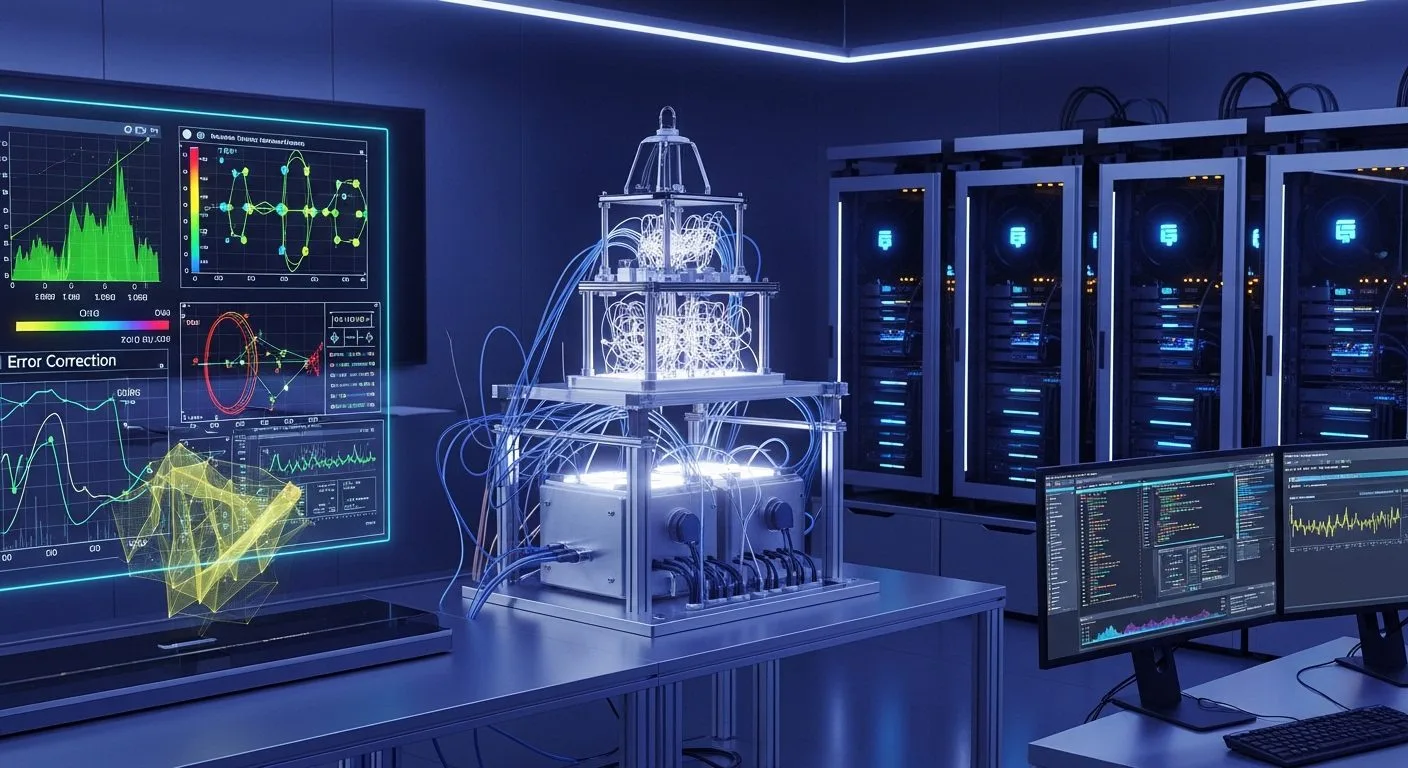
If you are asking what is NVIDIA Ising, the short answer is that it is NVIDIA’s open AI model family for quantum computing, designed to accelerate quantum processor calibration and quantum error correction decoding. Instead of being a general-purpose chatbot or coding model, NVIDIA Ising is purpose-built for the noisy, data-heavy workflows that stand between today’s quantum processors and useful large-scale quantum systems.
This guide uses the official NVIDIA Ising solution page, NVIDIA’s April 2026 press release, and NVIDIA Developer materials as the main references. If you want to understand what is NVIDIA Ising in practical terms, the key idea is simple: NVIDIA is trying to make AI part of the control layer for quantum hardware, not just another layer of software around it.
6 key facts at a glance
- NVIDIA launched Ising on April 14, 2026 as what it describes as the first family of open AI models for accelerating the path to useful quantum computers.
- The initial release focuses on two model domains: Ising Calibration for quantum processor tuning and Ising Decoding for quantum error correction.
- Ising Calibration is a 35B parameter vision-language model fine-tuned to infer calibration actions from quantum processor experimental data.
- Ising Decoding includes two small 3D CNN pre-decoder models, optimised either for speed or for higher accuracy in real-time error correction workflows.
- NVIDIA says Ising Decoding can deliver up to 2.5x faster performance and up to 3x higher accuracy than traditional decoding approaches, while Ising Calibration outperforms compared models on NVIDIA’s QCalEval benchmark.
- NVIDIA is releasing not just model weights, but also training frameworks, datasets, benchmarks, deployment recipes, and fine-tuning guidance so teams can adapt the models to their own quantum hardware.
Why understanding what is NVIDIA Ising matters
If you want a better answer to what is NVIDIA Ising, it helps to understand the bottlenecks it is aimed at. Quantum processors are powerful in theory, but they are also fragile. They drift, they need constant calibration, and they generate error patterns that have to be decoded fast enough for quantum error correction to work in practice.
That matters because quantum computing progress is no longer only about qubit counts or headline research milestones. It is also about the classical control and correction stack that makes those qubits usable. NVIDIA Ising matters because it targets two of the hardest operational problems in quantum computing rather than offering another general AI demo.
If you want a broader view of why this category matters beyond the lab, Progressive Robot’s article on why businesses are interested in quantum computers is useful context.
What is NVIDIA Ising in simple terms

What is NVIDIA Ising in plain English? It is NVIDIA’s attempt to bring purpose-built AI models into the day-to-day work of building and operating quantum processors.
The release starts with two practical jobs:
- Calibration, which means reading quantum processor measurement results and deciding what tuning actions should happen next.
- Decoding, which means processing quantum error signals quickly enough for error correction systems to keep up with the hardware.
So the easiest way to think about NVIDIA Ising is not as a consumer AI product, but as a specialised AI toolkit for quantum hardware teams.
How NVIDIA Ising works across quantum workflows

1. NVIDIA Ising Calibration turns QPU data into recommended actions
The first part of the release is NVIDIA Ising Calibration, which NVIDIA describes as a 35B parameter vision-language model built to understand quantum computing experiment outputs and infer next-step calibration actions.
This matters because quantum calibration is not a one-time setup task. Quantum processors drift and need repeated adjustment to stay within useful operating ranges. NVIDIA says Ising Calibration can be used inside an agentic workflow that responds to measurement results and keeps tuning the quantum processor until performance returns to the desired specification.
In the press release, NVIDIA says this can reduce calibration time from days to hours. That should still be treated as a vendor claim until validated in a user’s own environment, but it makes clear what the product is for: automation of a traditionally manual, expert-heavy workflow.
2. NVIDIA Ising Decoding is built for real-time quantum error correction
The second part of the release is NVIDIA Ising Decoding, a pair of open 3D CNN models used as pre-decoders for quantum error correction.
Why does that matter? Because a useful fault-tolerant quantum computer needs classical systems to process massive streams of measurement data in real time. If the decoding step is too slow or too inaccurate, error correction becomes a bottleneck.
NVIDIA’s fast model has roughly 0.9 million parameters, while the more accurate model has roughly 1.8 million parameters. The fast variant is tuned for lower latency, while the accurate variant trades extra runtime for stronger logical error rate improvements. NVIDIA says these models can outperform the PyMatching baseline on both latency and error-rate performance in the tested scenarios.
3. NVIDIA Ising includes open resources, not just a model announcement
Another important part of what is NVIDIA Ising is the release structure around it. NVIDIA is not only publishing a headline model name. The company is also releasing training frameworks, benchmark data, deployment recipes, and model access points across Hugging Face, GitHub, NVIDIA NIM, and build.nvidia.com.
That is significant because quantum hardware teams rarely want a fixed black-box model. They need to adapt tools to specific noise profiles, hardware architectures, and latency budgets.
NVIDIA says users can retrain, fine-tune, quantize, and deploy for their own systems. The GitHub resources are released under Apache 2.0, while model weights are distributed under the NVIDIA Open Model License. So NVIDIA Ising is more open than a closed hosted model, but teams still need to understand the licensing split rather than assuming every component shares the same terms.
4. It is benchmarked around quantum-specific tasks, not generic AI tasks
NVIDIA Ising is also notable because its evaluation framework is tied to quantum computing problems rather than standard general-model benchmarks.
For calibration, NVIDIA and its partners created QCalEval, which the company describes as the first benchmark for agentic quantum computer calibration using real quantum computer outputs. NVIDIA says Ising Calibration outperforms other compared models on that benchmark.
For decoding, NVIDIA focuses on logical error rate and latency under specific surface-code and physical error-rate settings. In other words, NVIDIA Ising is being judged on whether it helps real quantum workflows, not on whether it writes essays or answers trivia better than general LLMs.
5. NVIDIA Ising is designed to sit inside NVIDIA’s broader quantum stack
NVIDIA positions Ising as part of a larger quantum-GPU supercomputing platform.
The official materials say NVIDIA Ising complements CUDA-Q for hybrid quantum-classical computing, NVQLink for QPU-GPU interconnect, CUDA-Q QEC for quantum error correction workflows, cuQuantum and cuStabilizer for data generation and training, and NVIDIA NIM for easier deployment.
That means what is NVIDIA Ising cannot be fully understood as a standalone model release. It is also an attempt to make NVIDIA’s AI, GPU, and quantum software stack more central to the quantum computing ecosystem.
6. NVIDIA Ising already has visible ecosystem backing
NVIDIA’s press release names a long list of enterprises, universities, and labs adopting or evaluating the models. That list includes Atom Computing, Academia Sinica, EeroQ, Fermi National Accelerator Laboratory, Harvard, Infleqtion, IonQ, IQM Quantum Computers, Lawrence Berkeley National Laboratory, Sandia National Laboratories, UC San Diego, UC Santa Barbara, the University of Chicago, USC, and others.
That does not mean market success is guaranteed, but it does show that NVIDIA is launching Ising with visible ecosystem participation rather than as an isolated research teaser.
What NVIDIA Ising gets right

If you step back from the product details, NVIDIA Ising stands out for a few practical reasons.
First, it targets real bottlenecks. Calibration and error correction are not side problems in quantum computing. They are central engineering constraints.
Second, it treats openness as part of the value proposition. NVIDIA is making the tools easier to inspect, benchmark, fine-tune, and deploy locally, which matters in research and enterprise settings where teams want control over both infrastructure and data.
Third, it connects AI directly to scientific and hardware workflows instead of forcing quantum teams to repurpose generic models for specialised tasks.
Limitations and deployment considerations

A balanced explanation of what is NVIDIA Ising also needs the caveats.
- NVIDIA Ising is specialised. It is not useful in the way a general assistant model is useful.
- The reported gains are benchmark and workload dependent, so teams still need to validate performance against their own QPU design, code distance, noise model, and latency requirements.
- Quantum computing itself remains an emerging field, so better calibration and decoding do not automatically mean broad commercial quantum advantage is close.
- NVIDIA’s openness is meaningful, but it still comes with a mix of licenses and NVIDIA platform dependencies that users should review carefully.
- The strongest value will likely show up in teams that are already working seriously on quantum processor operations, not in casual experimentation.
Who should pay attention to NVIDIA Ising?
NVIDIA Ising is most relevant for:
- Quantum hardware companies building or operating QPUs.
- Research labs working on calibration, control, and error correction.
- Developers building hybrid quantum-classical workflows on NVIDIA infrastructure.
- Enterprises tracking where AI is becoming part of scientific computing and advanced hardware operations.
If your interest in AI is mostly around chatbots, coding assistants, or image models, NVIDIA Ising will feel far outside the mainstream. But if your focus is the engineering stack needed for useful quantum systems, it is one of the more important NVIDIA announcements in that space.
Frequently asked questions
Is NVIDIA Ising a general-purpose AI model?
No. NVIDIA Ising is built for quantum computing workloads, specifically calibration and error correction decoding.
Is NVIDIA Ising open source?
Parts of the release are open in different ways. NVIDIA says the model family is open and provides weights, data, frameworks, and recipes. GitHub resources are released under Apache 2.0, while model weights use the NVIDIA Open Model License.
What is NVIDIA Ising Calibration?
It is NVIDIA’s 35B vision-language model for interpreting quantum processor experiment outputs and recommending calibration actions, including in agentic workflows.
What is NVIDIA Ising Decoding?
It is NVIDIA’s family of small 3D CNN pre-decoder models that help accelerate and improve quantum error correction decoding.
Why does NVIDIA Ising matter right now?
Because it focuses on the operational problems that make scalable quantum computing hard: keeping processors calibrated and decoding errors quickly enough for fault-tolerant systems.
Final thoughts
If you came here asking what is NVIDIA Ising, the most useful answer is that it is NVIDIA’s open AI model family for some of the hardest workflows in quantum processor development: calibration and error correction decoding.
What makes the launch interesting is not just the model names. It is the broader package of benchmarks, training frameworks, deployment recipes, local deployment options, and integration with NVIDIA’s quantum-GPU stack. NVIDIA is clearly trying to position AI as part of the operating layer for quantum systems, not just as a general productivity layer around them.
Whether NVIDIA Ising becomes a long-term standard will depend on how well it performs across real hardware, real noise models, and real quantum operations. But as a product signal, it is a clear example of AI moving deeper into scientific infrastructure and advanced computing rather than staying confined to general-purpose assistants.
More AI coverage: explore Progressive Robot's AI Models, Tools & Releases hub — hands-on reviews, setup guides and benchmarks in one place.










