What is a smart contract standard ERC20?
The ERC20 standard is a technical standard used to create and manage tokens on the Ethereum blockchain. It stands for Ethereum Request for Comment 20 and outlines a set of rules and functionalities that Ethereum-based tokens must follow to ensure compatibility and interoperability within the Ethereum ecosystem.

Uniformity
ERC20 defines a common set of rules that all tokens must follow, making them interoperable with wallets, exchanges, and decentralized applications (dApps).
Simplicity for Developers
Developers can build wallets and other tools more easily without having to create new protocols for basic token functionality.

Wide Adoption
The ERC20 standard is the most commonly used token standard on Ethereum, making it a default choice for creating fungible tokens.
Why is ERC20 Important?

Tokens: Powering the Heart of Blockchain Technology
Tokens are the foundation of blockchain ecosystems, embodying a wide range of assets and utilities. From digital currencies and company shares to service access keys and rare digital collectibles, tokens play a crucial role. But what ensures their secure and decentralized creation and management?






Solidity
Port your existing applications from Ethereum to PGR without modifying your Solidity code.
Liquidity bridges
Deploy established ERC-20 assets and transfer liquidity between Ethereum and PGR.
Staking
Bond your REEF coins and participate in PGR validation and governance.

Community governed
PGR is built with upgradability and long-term sustainable on-chain governance in mind.


Measure Crypto Liquidity
Liquidity is the lifeblood of all tradable assets including cryptocurrency.
It is important because it determines how quickly and efficiently market participants can buy or sell cryptocurrencies.
Highly liquid markets enable smooth and efficient trading, while highly illiquid markets can lead to difficulties entering or exiting a position at a desired price. Consequently, every investor needs to understand how to measure crypto liquidity to reduce risk and improve their trading outcomes.
Crypto Liquidity?
Crypto liquidity refers to the ease and speed with which a coin can be converted into cash or other coins, without substantially moving its price up or down. In other words, it is a measure of the number of buyers and sellers present and how easily transactions can be completed.
Cryptocurrencies that are difficult to exchange for cash or other digital assets are considered illiquid assets, while cryptocurrencies that can be traded right away are considered liquid assets, such as Bitcoin and Ethereum.
Liquid markets are characterised by high stability where participants can trade easily, efficiently, and fairly. In liquid markets, there is both high supply and demand for a given asset, making it easier to find and match buyers with sellers.
On the other hand, illiquid markets are represented by volatility, so investors might struggle to execute buy or sell orders at desired prices. This is because there are fewer market participants and thus fewer available trades at any given price.
Overall, compared to illiquid markets, liquid markets tend to have higher levels of trading activity and a smaller spread between the bid and ask orders. More risk averse traders will tend to avoid trading illiquid markets as the potential large spreads, which can negatively impact the price they trade the asset for, puts any possible profits at risk. In illiquid markets, experienced traders often place limit orders, rather than market orders, to prevent getting burnt by slippage.
What Is the Best Indicator of Market Liquidity?
Trading volume is often considered an important indicator of market liquidity, which is why you’ll hear people use the terms interchangeably.
The volume of trade refers to the total number of coins exchanged between buyers and sellers during trading hours on a given day. The volume of trade is a measure of the market’s activity and liquidity during a set period of time. You’ll often see the measure expressed in US Dollar terms, based on the number of units traded multiplied by the average price over the time period.
A higher trading volume indicates greater interest in a particular cryptocurrency. Cryptocurrencies with high trading volumes are traded (bought and sold) more frequently and rapidly than the ones with lower trading volumes. As a result, a high trading volume generally coincides with deep liquidity for a particular cryptocurrency in the market.
How Does Liquidity Help Traders?
Highly liquid markets enable frictionless entry and exit from positions at a fair price. This is because a busy market makes it easier to find buyers or sellers on the other side of a trade.
Highly liquid markets also see assets priced closer to the true market value. High levels of both supply and demand help to keep the buy and sell prices close together; the difference between the two is called the bid-ask spread.
This pricing concept represents the difference between the highest price a buyer is willing to pay for an asset and the lowest price that a seller is ready to sell at. The spread is collected as a fee by the market maker, which more often is an exchange facilitating the trade. The size of the bid-ask spread is determined by liquidity – a direct factor of the number of buyers and sellers in the market. The more buyers and sellers, the greater the liquidity and the tighter the spread. The ask (the price you can buy the asset for) will always be higher than the bid (the price you can sell the asset for).
All things considered, traders will generally seek liquid markets as they are associated with lower risk and higher stability; the bid-ask spread is less likely to increase as a result of their trade, which can leave them losing value as the trade fills.
Elsewhere, more liquid markets will generally see buy and sell prices closer together across different trading venues for the same assets.
How Much Liquidity Should a Crypto Asset Have?
Unfortunately, there is no perfect answer for how much liquidity a cryptocurrency should have. This is because it largely depends on the investor and their risk appetite, as well as a crypto asset and its supply and demand. As a rule of thumb, more established cryptocurrencies tend to have more liquidity, and newer and more speculative cryptocurrencies tend to have less liquidity.
A potential way to determine whether a cryptocurrency is too illiquid is by comparing its trading volume to Bitcoin’s (BTC) trading volume. This is because Bitcoin is the flagship of the crypto market, surpassing every other cryptocurrency in terms of market capitalization. There are also useful indicators online where you can check what size/value of trade will move the price of an asset and roughly by how much.
More risk-averse investors may only trade cryptocurrencies with larger volumes, like Bitcoin, Ethereum (ETH), or Solana (SOL). Alternatively, investors with larger risk appetites may be comfortable trading cryptocurrencies with significantly smaller trading volumes. This is because the risks associated with low liquidity can be offset by the increased upside of investing in a more speculative cryptocurrency.
Example of Crypto Liquidity
Depth charts are graphical representations of buy and sell orders for a specific asset at a variety of prices. They can provide insight into the liquidity of a cryptocurrency by displaying the amount of supply and demand.
Liquid assets will have depth charts where the green and red sides (buy and sell orders) nearly mirror each other, reflecting almost identical amounts of supply and demand on their respective sides. The following diagram is of a BTC Depth Chart:
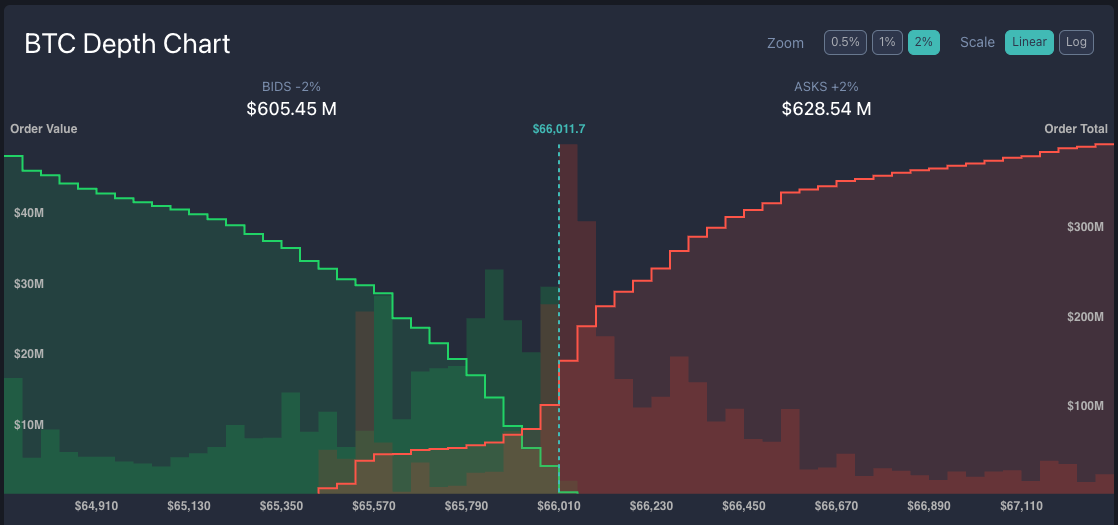
The total order value for bids ($610 million) is approximately equal to the total order value for asks ($620 million). This highlights that the BTC market is extremely liquid given the symmetry between supply and demand.
Factors That Influence Crypto Liquidity
Multiple factors contribute to the overall liquidity of a given cryptocurrency. These factors include:
Popularity
Popular cryptocurrencies are generally highly liquid because of the vast volume that is traded every day. They are also in high demand and supply by both small and large investors, further contributing to their high levels of liquidity.
Number of Exchange Listings
Popular cryptocurrencies are typically driven by active development teams, passionate communities, and strong, real-world utilities — all of which are key determinants of the market demand for a cryptocurrency. Nonetheless, as a cryptocurrency becomes more popular, it will likely be listed on more exchanges.
A higher number of exchange listings increases the overall liquidity of a cryptocurrency. This is because it enables investors and traders to choose from several different markets when buying or selling a specific cryptocurrency, allowing them to access the best price.
Market Making
Market makers refer to individuals or broker-dealers that profit by providing liquidity to the rest of the market. They “make the market” by ensuring that traders can always buy and sell. This is done by actively quoting both sides of the market and providing bids and offers. Market makers boost overall liquidity and market depth.
Market Capitalisation
Market capitalisation (also referred to as market cap) is a metric that measures the relative size of a cryptocurrency. It is calculated by multiplying the total number of coins in circulation with the current price of that specific coin.
Market capitalisation is one of the best ways to check for liquidity because large market cap cryptocurrencies tend to have a higher demand in the cryptocurrency market. Alternatively, low market cap cryptocurrencies have lower liquidity as the demand for the cryptocurrency is comparatively lower.
Liquidity Versus Volume
The difference between trading volume and liquidity is widely misunderstood in the cryptocurrency market. Trading volume represents the number of executed trading transactions, whereas liquidity represents the number of available trades at any given price. Both are often quoted in dollar or fiat value terms.
Liquidity: It Matters
Overall, traders and investors are naturally encouraged to trade markets with high levels of liquidity as they’re less likely to encounter obstacles and oddities when entering or exiting their trades.
The cryptocurrency market is notorious for its volatility and high level of risk, which makes liquidity an even more important consideration. More prudent traders will almost always assess the liquidity of a cryptocurrency market and avoid trading less liquid assets.




Where is the current price,
 is the lower bound of the range, and
  is the upper bound of the range.
is the current price, is the lower bound of the range, and is the upper bound of the range. 
Thus, we can find tick
 via:
via:
via: 
The square roots in this formula cancel out, but since we’re working with  we need to preserve them.
Let’s find the ticks:
1. Current tick: 
2. Lower tick: 
3. Upper tick: 
That’s it for price range calculation!
Last thing to note here is that Uniswap uses Q64.96 number to store  . This is a fixed-point number that has 64 bits for the integer part and 96 bits for the fractional part. In our above calculations, prices are floating point numbers: `70.71`, `67.42`, and `74.16`. We need to convert them to Q64.96. Luckily, this is simple: we need to multiply the numbers by
  (Q-number is a binary fixed-point number, so we need to multiply our decimals numbers by the base of Q64.96, which is ). We’ll get:
. This is a fixed-point number that has 64 bits for the integer part and 96 bits for the fractional part. In our above calculations, prices are floating point numbers: `70.71`, `67.42`, and `74.16`. We need to convert them to Q64.96. Luckily, this is simple: we need to multiply the numbers by (Q-number is a binary fixed-point number, so we need to multiply our decimals numbers by the base of Q64.96, which is ). We’ll get: 


Next, we need to calculate  based on the amounts we'll deposit. This is a tricky part, so hold tight!
based on the amounts we'll deposit. This is a tricky part, so hold tight!
From the theoretical introduction, you remember that:
 However, this formula is for the infinite curve 🙂 But we want to put liquidity into a limited price range, which is just a segment of that infinite curve. We need to calculate specifically for the price range we’re going to deposit liquidity into. We need some more advanced calculations.
To calculate for a price range, let’s look at one interesting fact we have discussed earlier: price ranges can be depleted. It’s possible to buy the entire amount of one token from a price range and leave the pool with only the other token.
However, this formula is for the infinite curve 🙂 But we want to put liquidity into a limited price range, which is just a segment of that infinite curve. We need to calculate specifically for the price range we’re going to deposit liquidity into. We need some more advanced calculations.
To calculate for a price range, let’s look at one interesting fact we have discussed earlier: price ranges can be depleted. It’s possible to buy the entire amount of one token from a price range and leave the pool with only the other token.
However, this formula is for the infinite curve 🙂 But we want to put liquidity into a limited price range, which is just a segment of that infinite curve. We need to calculate specifically for the price range we’re going to deposit liquidity into. We need some more advanced calculations.
To calculate for a price range, let’s look at one interesting fact we have discussed earlier: price ranges can be depleted. It’s possible to buy the entire amount of one token from a price range and leave the pool with only the other token. 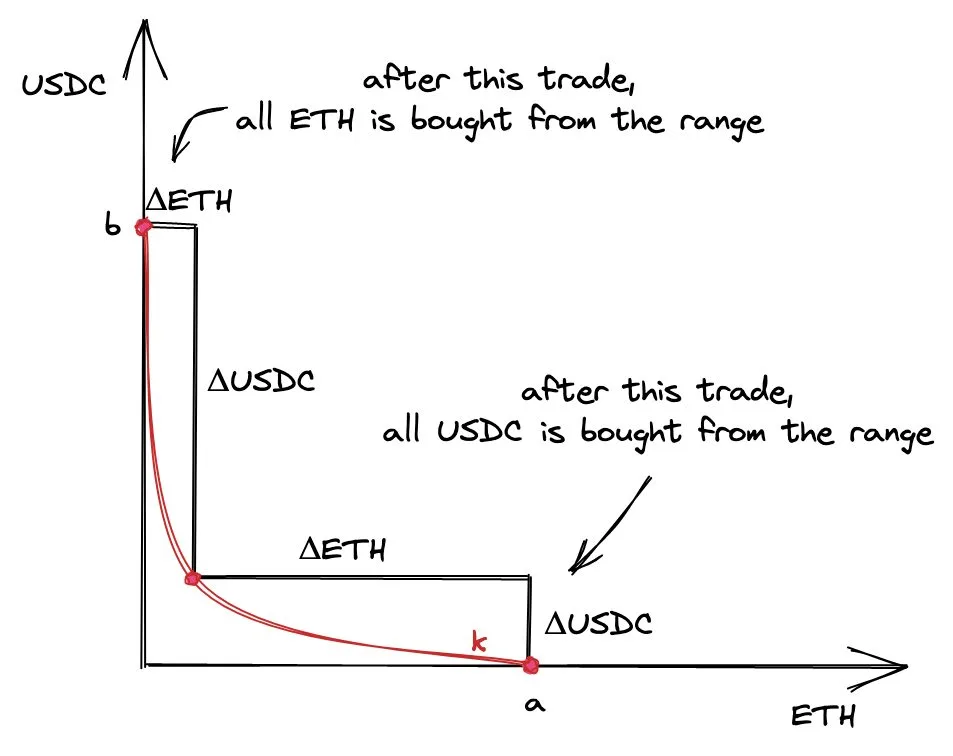
At the points  and
and  , there’s only one token in the range: ETH at the point and USDC at the point .
That being said, we want to find an that will allow the price to move to either of the points. We want enough liquidity for the price to reach either of the boundaries of a price range. Thus, we want to be calculated based on the maximum amounts of  and
and  .
.
Now, let’s see what the prices are at the edges. When ETH is bought from a pool, the price is growing; when USDC is bought, the price is falling. Recall that the price is  . So, at point , the price is the lowest of the range; at point , the price is the highest.
In fact, prices are not defined at these points because there’s only one reserve in the pool, but what we need to understand here is that the price around the point is higher than the start price, and the price at the point is lower than the start price.
Now, break the curve from the image above into two segments: one to the left of the start point and one to the right of the start point. We’re going to calculate two ’s, one for each of the segments. Why? Because each of the two tokens of a pool contributes to either of the segments: the left segment is made entirely of token  , and the right segment is made entirely of token
  . This comes from the fact that, during swapping, the price moves in either direction: it’s either growing or falling. For the price to move, only either of the tokens is needed:
- when the price is growing, only token is needed for the swap (we’re buying token , so we want to take only token from the pool);
- when the price is falling, only token is needed for the swap.
Thus, the liquidity in the segment of the curve to the left of the current price consists only of token and is calculated only from the amount of token provided. Similarly, the liquidity in the segment of the curve to the right of the current price consists only of token and is calculated only from the amount of token provided.

This is why, when providing liquidity, we calculate two ’s and pick one of them. Which one? The smaller one. Why? Because the bigger one already includes the smaller one! We want the new liquidity to be distributed evenly along the curve, thus we want to add the same to the left and to the right of the current price. If we pick the bigger one, the user would need to provide more liquidity to compensate for the shortage in the smaller one. This is doable, of course, but this would make the smart contract more complex.
What happens with the remainder of the bigger ? Well, nothing. After picking the smaller we can simply convert it to a smaller amount of the token that resulted in the bigger –this will adjust it down. After that, we’ll have token amounts that will result in the same .
The final detail I need to focus your attention on here is: new liquidity must not change the current price. That is, it must be proportional to the current proportion of the reserves. And this is why the two ’s can be different–when the proportion is not preserved. And we pick the small to reestablish the proportion.
I hope this will make more sense after we implement this in code! Now, let’s look at the formulas.
Let’s recall how and are calculated:
We can expand these formulas by replacing the delta P’s with actual prices (we know them from the above):
 is the price at the point ,
  is the price at the point , and
  is the current price (see the above chart). Notice that, since the price is calculated as (i.e. it’s the price of in terms of ), the price at point is higher than the current price and the price at . The price at is the lowest of the three.
’s and pick one of them. Which one? The smaller one. Why? Because the bigger one already includes the smaller one! We want the new liquidity to be distributed evenly along the curve, thus we want to add the same to the left and to the right of the current price. If we pick the bigger one, the user would need to provide more liquidity to compensate for the shortage in the smaller one. This is doable, of course, but this would make the smart contract more complex.
What happens with the remainder of the bigger ? Well, nothing. After picking the smaller we can simply convert it to a smaller amount of the token that resulted in the bigger –this will adjust it down. After that, we’ll have token amounts that will result in the same .
The final detail I need to focus your attention on here is: new liquidity must not change the current price. That is, it must be proportional to the current proportion of the reserves. And this is why the two ’s can be different–when the proportion is not preserved. And we pick the small to reestablish the proportion.
I hope this will make more sense after we implement this in code! Now, let’s look at the formulas.
Let’s recall how and are calculated:
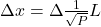



is the price at the point , is the price at the point , and is the current price (see the above chart). Notice that, since the price is calculated as (i.e. it’s the price of in terms of ), the price at point is higher than the current price and the price at . The price at is the lowest of the three.
Let's find the from the first formula:

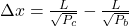
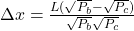
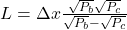 And from the second formula:

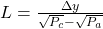 So, these are our two 's, one for each of the segments:
Now, let's plug the prices we calculated earlier into them:
So, these are our two 's, one for each of the segments:
Now, let's plug the prices we calculated earlier into them:
 After converting to Q64.96, we get:
 And for the other :

 Of these two, we'll pick the smaller one.

from the first formula:
And from the second formula:
So, these are our two 's, one for each of the segments:
Now, let's plug the prices we calculated earlier into them:
After converting to Q64.96, we get:
And for the other :
Of these two, we'll pick the smaller one.
Token Amounts Calculation, Again
Since we choose the amounts we're going to deposit, the amounts can be wrong. We cannot deposit any amounts at any price range; the liquidity amount needs to be distributed evenly along the curve of the price range we're depositing into. Thus, even though users choose amounts, the contract needs to re-calculate them, and actual amounts will be slightly different (at least because of rounding).
Luckily, we already know the formulas:

Nominated Proof of Stake
Validators are elected by Nominators via NPoS. At the end of every block production era, Phragmén Validator elections are held.
Upgradability
PGR is self-upgradable through the community elected Technical Council.
Fee burn
PGR incentivizes technological progress in regards to scalability by removing fee market politics.

Governance rewards
Stake PGR coin and earn rewards for participating in Reef governance.