
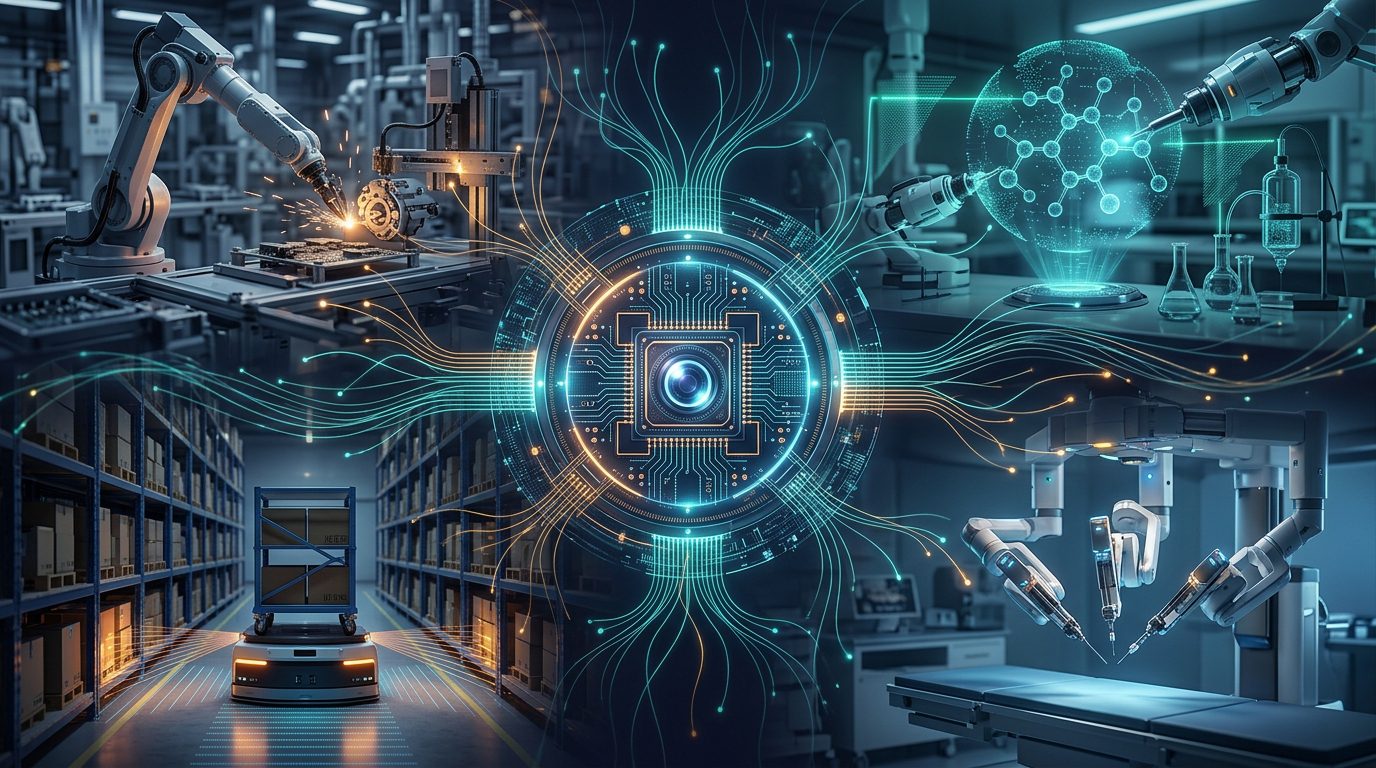
Physical AI is becoming one of the most discussed areas of artificial intelligence, with humanoid robots often taking centre stage. Yet the technology’s potential extends far beyond machines designed to look and move like humans. From factory automation to materials science and life sciences, physical AI could transform how businesses manufacture products, conduct experiments, and solve complex real-world problems.
Amulya Vishwanath, a former NVIDIA robotics product-marketing leader who is now investing in the sector through Techable VC, is taking a broader view of this opportunity. Her perspective challenges the idea that the future of physical AI depends entirely on humanoid robots. Instead, the opportunity lies in developing technologies that solve valuable problems across multiple industries.
This distinction matters for investors, startup founders, and businesses evaluating AI adoption. A robot performing an impressive demonstration may attract attention, but a system that reliably addresses a costly industrial problem could create more lasting commercial value.
What Is Physical AI and How Does It Work?
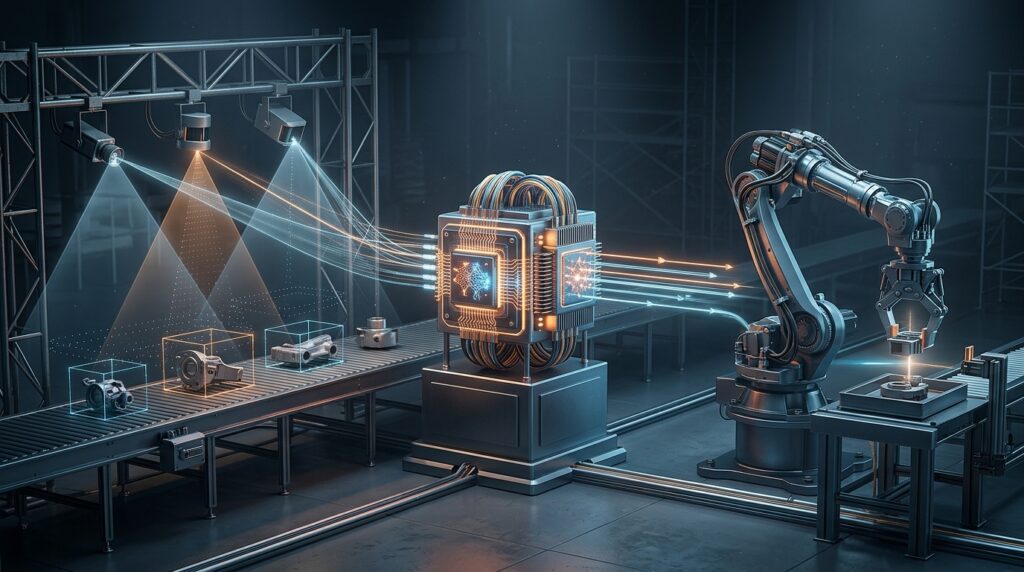
Physical AI describes artificial intelligence systems that interact with, interpret, or help control the physical world. Robotics is an important part of this field, but it is not the only application. The concept can also encompass autonomous machinery, intelligent industrial equipment, and AI-assisted scientific processes.
A conventional language model primarily generates digital outputs, such as text, images, or computer code. A physical AI system may need to interpret camera feeds, understand the position of nearby objects, process sensor measurements, and guide a machine through a real-world task.
This creates a different set of technical challenges. Objects can move unexpectedly, environmental conditions can change, and mistakes can damage equipment or put people at risk. A system must therefore do more than generate a convincing answer. It needs to operate reliably under real conditions.
The broader significance of physical AI is that intelligence becomes connected to physical outcomes. That connection can take the form of a robot, a specialised industrial machine, or a system that helps scientists work with real materials and biological processes.
Why Robotics Is Still in Its “Lego Era”
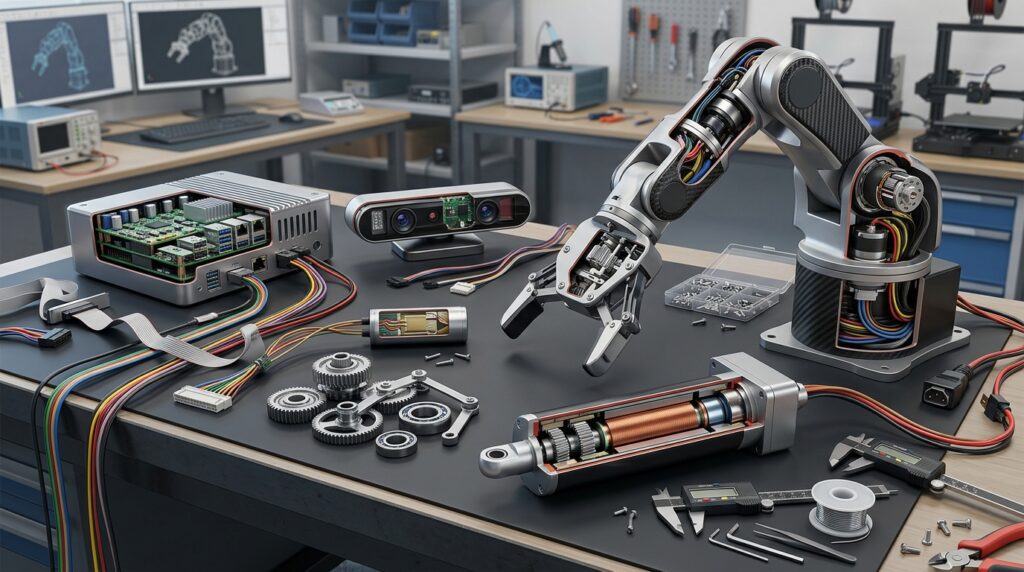
Vishwanath has described robotics as being in its “Lego era,” reflecting a field in which foundational components and systems are still being developed and assembled. The analogy highlights the importance of hardware, software, robotic hands, actuators, and safety technologies in making robots genuinely useful.
Building a robot that performs a controlled demonstration is different from building one that can work reliably in an unpredictable environment. A machine might successfully pick up one object in a laboratory but struggle when the object changes shape, the lighting becomes poor, or nearby items obstruct its movement.
These challenges cannot all be solved by improving the AI model. Engineers must also address mechanical reliability, sensor accuracy, movement control, system integration, and safety. Even a highly capable model needs suitable hardware and dependable mechanisms to carry out its instructions.
For the physical AI industry, this means opportunities exist throughout the robotics supply chain. Companies developing better grippers, sensors, control systems, and integration software may be just as important as those building complete robots.
Why Physical AI Needs More Than a Breakthrough AI Model
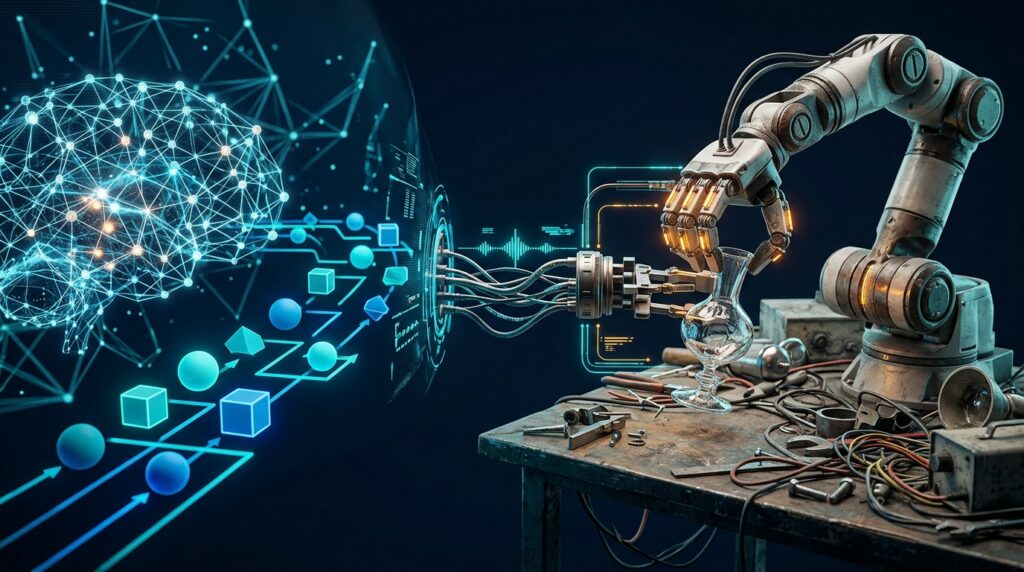
The rapid development of foundation models has encouraged expectations that robotics could experience a sudden leap in capability. Some researchers and companies believe increasingly general AI models will help robots learn new tasks with less specialised programming.
However, physical AI still faces challenges that cannot be addressed through language or reasoning alone. A robot must translate a high-level instruction into precise movements, account for the physical properties of objects, and respond when the environment differs from its training examples.
Consider a robot asked to move a glass bottle. It must identify the bottle, estimate its position, choose a suitable grasp, apply the correct amount of force, and adjust its movements if the bottle slips. Each stage introduces potential failure points.
AI models can help with perception, planning, and generalisation, but reliable execution also depends on sensors, mechanical design, control algorithms, and feedback from the environment. The practical challenge is integrating these elements into systems that consistently work outside demonstrations.
Businesses evaluating physical AI should therefore look beyond impressive videos. Evidence of repeatable performance, safe operation, and measurable improvements in real working environments is far more useful when judging a technology’s readiness.
Where Physical AI Could Transform Manufacturing
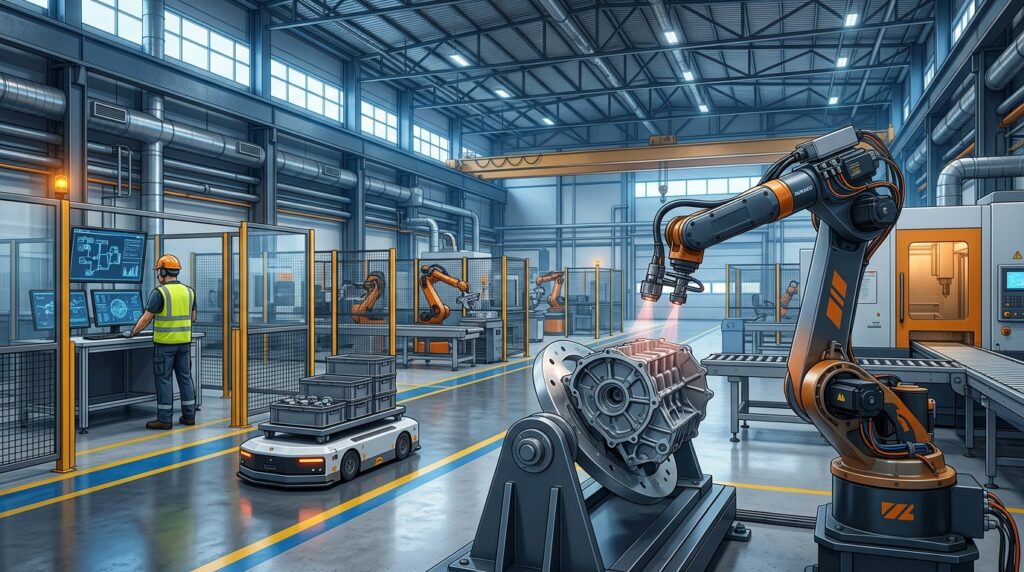
Manufacturing is one of the clearest areas in which physical AI could deliver measurable benefits. Factories frequently rely on repetitive handling, inspection, sorting, and material-transport tasks. Some operations are difficult to staff, while others require consistent precision or expose workers to demanding conditions.
AI-enabled machines could help manufacturers respond to these challenges. Vision systems may identify defects, robotic arms may handle components, and autonomous mobile robots may transport materials between workstations. More advanced systems could adapt to variations in objects or production conditions that previously required extensive manual programming.
Smaller manufacturers may also benefit if robotics becomes easier to deploy and maintain. Historically, sophisticated automation has often required substantial engineering expertise and investment. Improvements in AI software and modular hardware could make certain applications more accessible, although costs and integration requirements will still vary.
The strongest business case usually begins with a clearly defined task. A manufacturer can measure the time required, the error rate, the cost of manual work, and the consequences of downtime. These figures help determine whether physical AI offers a meaningful improvement rather than simply introducing a new technology.
Physical AI Beyond Robots: Materials Science and Life Sciences
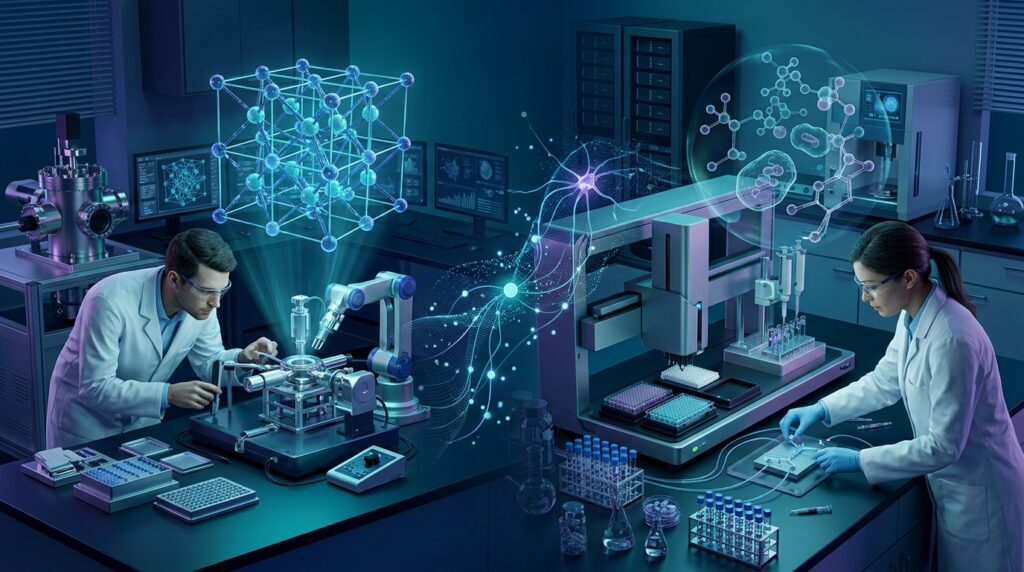
One of the most important aspects of Vishwanath’s investment perspective is the emphasis on applications beyond conventional robotics. Materials science and life sciences involve complex physical systems, expensive experiments, and processes that can be difficult to optimise.
In materials research, AI can help scientists analyse candidate structures, predict selected properties, and identify promising directions for further investigation. Automated laboratory equipment can then support the preparation and testing of samples. Combining computational predictions with physical experiments can help researchers investigate possibilities more efficiently.
Life sciences offers another broad area of opportunity. AI-assisted tools can help researchers analyse biological data, prioritise experiments, and work with increasingly automated laboratory processes. These applications still require appropriate scientific validation, especially when findings could influence medical or biological decisions.
Not every AI application in these fields is physical AI in the narrow robotics sense. The category can include a wider ecosystem of technologies that connect computational intelligence with physical materials, experiments, and real-world processes. That broader perspective helps explain why the investment opportunity may extend well beyond humanoid machines.
Why Techable VC Is Looking Beyond Humanoid Robots

Vishwanath’s experience at NVIDIA gave her exposure to the development and commercialisation of robotics technologies. Through Techable VC, she is now investing in companies working across physical AI-related fields, including robotics, materials science, and life sciences.
This wider investment scope reflects the fact that major technological shifts rarely depend on one product alone. An ecosystem may need better sensors, improved actuators, specialised software, reliable automation equipment, and new approaches to scientific experimentation.
For startups, this creates opportunities to solve specific technical problems rather than compete directly to build the most impressive humanoid robot. A company that makes robotic manipulation more dependable, improves an industrial workflow, or accelerates a research process could provide important value to customers.
Investors will still need to assess commercial fundamentals. A promising technical demonstration does not automatically establish a viable business. Founders must explain who will buy the product, what problem it solves, how well it performs, and whether customers can adopt it without excessive cost or disruption.
The broader lesson is that physical AI is an ecosystem opportunity. Its commercial success will depend on how well individual technologies work together to solve real problems.
What Businesses Should Evaluate Before Adopting Physical AI
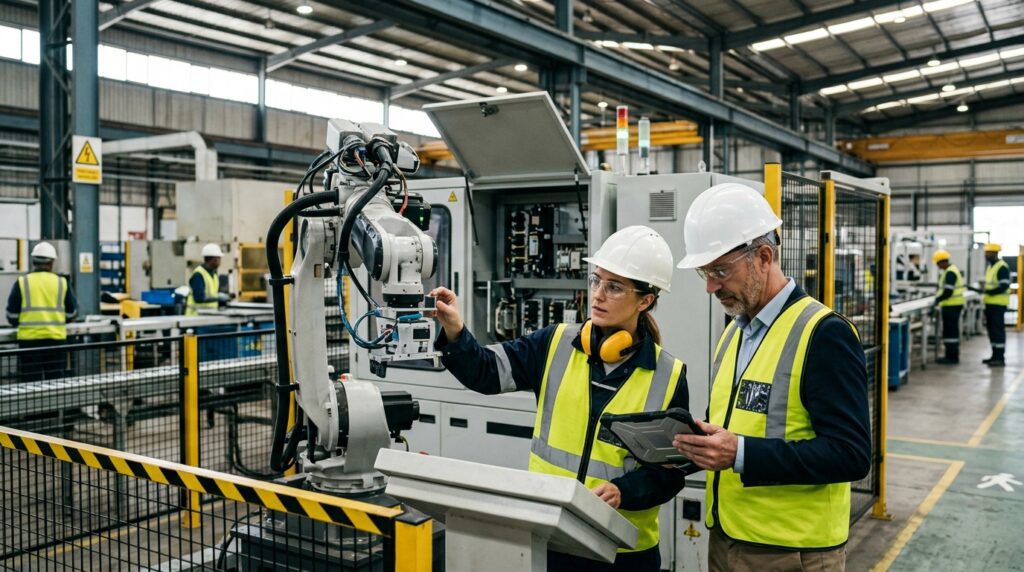
Businesses interested in physical AI should begin by identifying a task that is costly, repetitive, dangerous, or difficult to perform consistently. A specific problem makes it easier to determine whether automation is feasible and to establish measurable success criteria.
Reliability should be a priority. Companies need to understand how the system performs under different operating conditions, what happens when sensors fail, and how the equipment responds to unexpected situations. Maintenance requirements, spare parts, software updates, and staff training should also be included in the adoption plan.
Integration is another important consideration. A new AI-enabled machine may need to communicate with existing manufacturing systems, inventory platforms, or operational software. If integration is difficult, the expected efficiency gains can be reduced by implementation costs and disruption.
Safety and human oversight must be considered from the beginning. Businesses should establish clear procedures for monitoring the system, responding to failures, and determining when a person needs to intervene. The aim is not to adopt AI for its own sake, but to achieve a demonstrable improvement in safety, quality, productivity, or cost.
Conclusion: The Future of Physical AI Is About Solving Real Problems
Physical AI is about much more than building humanoid robots. Vishwanath’s investment perspective highlights a broader opportunity spanning robotics, manufacturing, materials science, life sciences, and other areas where AI can influence real-world outcomes.
The industry’s technical challenges remain significant. Reliable machines require capable AI models, effective hardware, accurate sensing, robust control systems, careful integration, and appropriate safety measures. Progress will depend on these elements developing together rather than on software improvements alone.
For businesses, the most useful starting point is a real operational problem with measurable costs and outcomes. For startup founders, the opportunity may lie in building a missing component or solving a narrow but valuable challenge. For investors, it means looking beyond visual demonstrations to the technologies and businesses that can deliver dependable results.
The most important physical AI breakthroughs may not necessarily look like human beings. They may be specialised machines, research systems, and industrial tools that make complex work more efficient, consistent, and safe.
Frequently Asked Questions
What is physical AI?
Physical AI refers to AI systems that interact with, interpret, or help control the physical world. It includes robotics and can extend to intelligent machinery, industrial automation, and AI-assisted physical or scientific processes.
Who is Amulya Vishwanath?
Amulya Vishwanath is a former NVIDIA robotics product-marketing leader who has moved into venture investing through Techable VC. Her investment interests include robotics, materials science, and life sciences.
Why is physical AI more than humanoid robots?
Humanoid robots are only one possible application. Physical AI can also support specialised industrial machines, factory automation, laboratory workflows, and technologies used to investigate materials and biological systems.
What is the “Lego era” of robotics?
The phrase describes a stage in which robotics still depends on the development and integration of foundational building blocks, including actuators, grippers, sensors, software, control systems, and safety technologies.
How can businesses benefit from physical AI?
Businesses may use physical AI to improve inspection, automate repetitive handling, transport materials, support research, or make selected processes more consistent. Benefits depend on the task, system reliability, implementation costs, and operational requirements.
Explore AI and IT Solutions With Progressive Robot
Progressive Robot helps organisations explore software development, IT solutions, and AI-powered digital services. Visit Progressive Robot or learn more about its AI and automation services.
References
More AI coverage: explore Progressive Robot's AI Models, Tools & Releases hub — hands-on reviews, setup guides and benchmarks in one place.










