

AI agents are moving beyond answering questions and generating content. They are increasingly designed to perform tasks on a user’s behalf, such as researching products, booking travel, managing emails, and navigating websites. But as these tools become more capable, they are encountering an unexpected obstacle: many websites do not want them accessing their services.
The issue is becoming a major challenge for the agentic AI industry. According to The Verge, websites operated by companies including Amazon, Delta Air Lines, JPMorgan Chase, and Charles Schwab have restricted certain AI agent activities because of concerns about security, licensing, or website policies. Other agents encounter automated anti-bot systems that can prevent them from completing ordinary tasks.
For users, this creates a frustrating gap between what an AI assistant promises and what it can actually accomplish. An agent might successfully research a product but fail when it tries to open the retailer’s website, sign in, or complete checkout.
The growing restrictions raise an important question: can AI agents become dependable digital assistants if the websites people rely on are unwilling—or unable—to let them operate?
What Are AI Agents and Why Do They Need Website Access?

Traditional AI assistants primarily respond to prompts. They explain concepts, summarise information, draft messages, or suggest what a user should do next. AI agents are designed to go further by carrying out actions across connected tools and services.
For example, a user might ask an agent to compare hotel options, check travel dates, and prepare a booking. The agent may need to visit multiple websites, retrieve current information, interact with forms, and maintain context as it moves between steps.
This ability to act is what makes AI agents attractive. Instead of manually opening dozens of tabs, copying information, and repeating the same process, users can delegate parts of the workflow to software.
However, those capabilities depend on access. An agent cannot reliably complete a transaction if a website blocks its browser session, refuses automated requests, requires an interaction the agent cannot handle, or prohibits third-party automation.
AI agents therefore depend on more than capable models. They need compatible websites, reliable integrations, appropriate permissions, and clear boundaries around the actions they are allowed to take.
Why Websites Are Blocking AI Agents

Website owners have several reasons to restrict AI agents, and not every restriction has the same purpose.
Security is one major concern. An AI agent may access private accounts, handle sensitive information, or initiate transactions. Financial institutions, in particular, have strong reasons to control how third-party software interacts with customer accounts. Unauthorised or poorly controlled automation could expose users to fraud, privacy breaches, or unintended actions.
Licensing and commercial control also matter. Some websites invest heavily in maintaining databases, product catalogues, reviews, or other information. They may require AI services to obtain permission or enter licensing arrangements before accessing that data at scale.
Website policies create another barrier. A company may decide that only approved integrations or specific types of automated access are permitted. Even if a user wants an agent to perform a task, that does not automatically mean the website authorises the agent to do it.
Finally, many websites use anti-bot systems to defend against spam, scraping, credential attacks, and abusive traffic. Those protections can sometimes mistake legitimate AI agents for malicious automation.
These concerns are related, but they are not interchangeable. A deliberate ban, a licensing requirement, and an automated security challenge are different obstacles that require different solutions.
Amazon, Financial Services, and Travel Sites Are Raising Barriers

The Verge’s report describes a range of restrictions affecting AI agents across consumer websites and sensitive online services.
Amazon has taken a particularly visible position against third-party agentic shopping. Its dispute with Perplexity over an agent that shopped on the retailer’s website has highlighted disagreements over whether an AI agent should be treated as an authorised extension of a customer or as an external service operating under the website owner’s rules. The legal dispute has continued through changing court decisions and further proceedings.
Travel and financial services introduce different concerns. Delta Air Lines has restricted AI agents from booking tickets on users’ behalf, while JPMorgan Chase and Charles Schwab have cited security concerns in restricting agent access to accounts. These examples demonstrate why a website may treat automated purchases, travel bookings, and financial transactions differently from ordinary information searches.
The distinction is important because a website can allow people to browse normally while limiting software that attempts to perform the same actions automatically. Access may also vary depending on the agent, the integration method, the type of account, and the specific task.
For users, the practical outcome is uncertainty. An agent may work on one service but fail on another, or complete research successfully and then stop at the point where an account login or transaction is required.
The Difference Between Blocking AI Agents and Blocking AI Crawlers
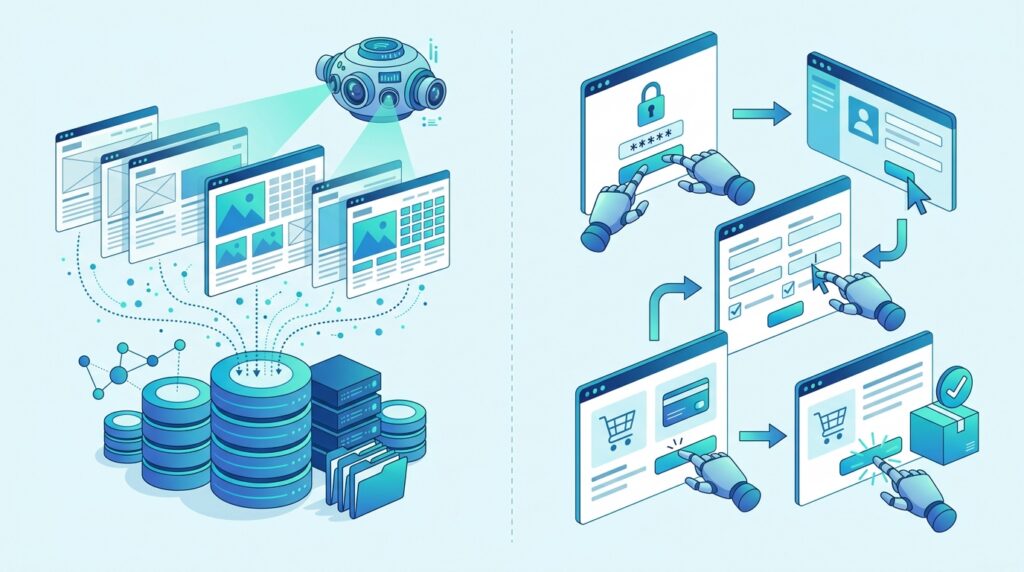
The debate around AI access includes two related but distinct technologies: AI crawlers and interactive AI agents.
An AI crawler automatically visits webpages to collect information. Depending on its purpose and permissions, it might gather material for search, indexing, analysis, or AI training. Website owners may restrict these crawlers because of server costs, copyright concerns, licensing arrangements, or the way collected content is used.
An AI agent, by contrast, attempts to perform tasks. It might open a product page, select an item, interact with a form, sign in through an authorised process, or move through a booking workflow. This activity can trigger security protections designed to detect automated behaviour.
The distinction matters because a website’s policy for content collection may differ from its policy for interactive actions. A publisher might permit a search crawler to index public articles while prohibiting an automated agent from creating accounts or submitting forms.
There is also a difference between an explicitly blocked agent and an agent that fails because a general anti-bot system cannot distinguish it from unwanted traffic. A failed task alone does not prove that a website has introduced a specific ban on that AI service.
As agentic AI grows, website owners will need more precise controls that distinguish permitted automation from harmful activity without unnecessarily disrupting legitimate visitors.
How Anti-Bot Systems Can Accidentally Block Legitimate Users

Not every AI agent failure results from a website deliberately targeting that tool. Many sites use anti-bot protections that assess traffic patterns, browser behaviour, session information, and other signals to identify suspicious activity.
These systems are important because websites face automated spam, scraping, fraud, and attempts to access accounts without permission. However, legitimate automation can share some characteristics with malicious bots, especially when it navigates pages at high speed or interacts with forms in unusual ways.
The result can be a false positive. An AI agent might encounter a verification challenge, lose access to a session, or fail to complete a checkout flow even when the user is making a legitimate request. Human users can also encounter problems when security systems are configured too aggressively.
TechCrunch has reported on this broader issue, including cases where agents faced human-verification barriers on retail websites despite commercial partnerships intended to support agent access. Such cases show that agreeing to support AI agents does not automatically guarantee that every automated workflow will function correctly. <
For website operators, the challenge is to improve detection without making the site difficult to use. For AI developers, the challenge is to build reliable integrations that respect access controls instead of assuming every website can be operated like an ordinary browser page.
What This Means for OpenAI, Google, Meta, and Other AI Companies

Major AI companies want their assistants to do more than answer questions. Agent products promise to manage workflows, research options, and perform actions across online services. Those capabilities become less valuable when agents cannot access the platforms required to complete the job.
The Verge reports that agents associated with companies including OpenAI, Meta, and xAI have encountered restrictions on major websites. These problems reveal a structural challenge: an AI company may control its model and agent software, but it does not control every external website that the agent needs to use.
This creates a fragmented environment. Some businesses may welcome agent traffic through official partnerships, while others require licensing, block automated access, or rely on security systems that are not designed specifically for AI agents.
Partnerships offer one possible solution. Instead of having an agent imitate a human browsing session, a business can provide a supported integration that defines which actions are permitted and how information should be exchanged. This can make access more predictable for both the website and the AI provider.
Industry efforts to develop standards for agent-to-business communication are also emerging. A clearer framework could help websites distinguish authorised agents from malicious automation, while giving users a more dependable way to delegate online tasks.
The challenge for AI companies is no longer just making agents smarter. It is ensuring that those agents can operate within the technical, commercial, and security rules of the services they need.
Can Websites and AI Agents Find a Way to Work Together?

The long-term solution is unlikely to involve every website simply opening its doors to all AI agents. Websites still need to protect accounts, manage commercial data, prevent fraud, and control how their services are used. AI developers, meanwhile, need predictable ways to help users complete legitimate tasks.
Official integrations could provide a more reliable route. A retailer might expose a supported method for an agent to search products, compare availability, and prepare a basket. A travel company might offer an authorised booking interface with clearly defined limits. Financial services would need stricter permissions and safeguards because of the sensitivity of customer accounts and transactions.
Permission controls will be essential. Users should be able to understand what an agent can access, which actions it can take, and when it needs confirmation before doing something consequential. Websites should be able to specify the scope of an agent’s permissions and revoke access when necessary.
AI developers also need to make their systems transparent about their identity and behaviour. Respecting site policies, using authorised interfaces, and providing clear accountability can help reduce the incentive for websites to treat all automated activity as suspicious.
A more compatible web would not remove every restriction. Instead, it would make the rules clearer, the approved access routes more dependable, and the distinction between helpful automation and harmful bot activity easier to enforce.
Conclusion: The Future of AI Agents Depends on Access, Not Intelligence Alone
AI agents promise to make the internet easier to use by handling repetitive tasks and coordinating activities across multiple services. But the growing restrictions described by The Verge show that these capabilities depend on more than advances in AI models.
Websites have legitimate reasons to protect customer accounts, control data access, enforce licensing arrangements, and prevent abuse. At the same time, poorly targeted restrictions can stop useful agents from completing tasks and create frustration for ordinary users.
The next stage of agentic AI will depend on better cooperation between AI developers and the businesses that operate the web. Supported integrations, clear permission systems, stronger accountability, and more precise anti-bot controls could help both sides establish workable rules.
Ultimately, an AI agent is only as useful as the tasks it can reliably complete. Making agents smarter is important, but giving them dependable and authorised access to the services people use every day may prove just as critical.
Frequently Asked Questions
Why are websites blocking AI agents?
Websites may restrict AI agents because of security concerns, data-licensing requirements, commercial policies, or rules against automated activity. Some agents are also blocked by general anti-bot systems that cannot reliably distinguish them from malicious traffic.
Which websites are blocking AI agents?
The Verge has reported restrictions affecting AI agent access to services including Amazon and Delta Air Lines, as well as account-access restrictions at JPMorgan Chase and Charles Schwab. Restrictions vary by service, agent, and type of activity.
Are AI agents and AI crawlers the same thing?
No. AI crawlers primarily collect or index website content, while interactive AI agents attempt to perform tasks such as navigating pages, filling forms, and completing transactions. Websites may apply different rules to each.
Can AI agents still shop online?
Yes, on services that permit their use or provide supported integrations. However, some retailers restrict third-party agents, and general anti-bot protections can sometimes interfere with otherwise legitimate shopping workflows.
Will websites eventually support AI agents?
Some businesses are already experimenting with partnerships and approved integrations. Broader adoption will depend on whether companies can establish reliable access, protect users, manage licensing, and maintain control over automated actions.
Explore AI and Digital Innovation With Progressive Robot
Progressive Robot helps organisations explore software development, IT solutions, and AI-powered digital services. Visit Progressive Robot or explore its AI and automation services.
References
More AI coverage: explore Progressive Robot's AI Models, Tools & Releases hub — hands-on reviews, setup guides and benchmarks in one place.










