

AI food science is changing how researchers investigate the physical and chemical properties of food. Instead of manually reviewing thousands of scientific papers, researchers can use artificial intelligence to extract experimental data, identify patterns, and organize findings into structured databases. This approach allows AI food science projects to examine relationships that might otherwise remain hidden across years of published research.
The growing role of AI food science does not mean that human researchers are becoming less important. Scientists still need to evaluate the quality of extracted data, verify unexpected results, and determine whether a mathematical relationship has a meaningful physical explanation. Combining computational analysis with human expertise can make food research faster while maintaining scientific rigor.
The team then used the organized data to identify a previously unreported mathematical relationship between two properties that describe how food interacts with electromagnetic energy. The relationship appeared across more than 100 different foods, creating a promising lead for further research.
The work demonstrates an important principle: AI can accelerate scientific discovery by making existing evidence easier to collect and analyze, while human specialists remain essential for judging the quality and reliability of that evidence.
The research was reported by Tech Xplore on October 16, 2026, and is available online ahead of its planned publication in the March 2027 issue of the Journal of Food Engineering.
Table of Contents
Why Food Science Needs Better Scientific Data
What Is AgentXtract?
How AI and Human Expertise Work Together
The Discovery: A Relationship Across More Than 100 Foods
How Better Data Can Improve AI Answers
What This Means for Food Technology
Limitations and Remaining Questions
Frequently Asked Questions
Conclusion
Why Food Science Needs Better Scientific Data

Food engineering depends on reliable measurements of physical properties that influence how food behaves during processing, storage and preparation. These properties can affect product quality, safety, texture and other characteristics that matter to both manufacturers and consumers.
The challenge is that the relevant evidence is spread across thousands of scientific papers published over many years. Researchers may need to locate an experiment, interpret its methodology, identify the relevant measurements and determine whether those results can be compared with findings from another study.
Even when the information is publicly available, collecting it consistently can be labor-intensive. Measurements may appear in a paragraph, a complex table, a plotted graph or a mathematical equation. Different researchers may also report results using different units or experimental conditions.
This is where AI food science can make a practical difference. Instead of asking scientists to manually assemble every measurement, AI systems can help retrieve, interpret and organize large quantities of published evidence.
However, simply collecting more data is not enough. The information must retain its scientific context, including how measurements were obtained, which conditions applied and whether the results are reliable. Otherwise, a large database can make inconsistent or misleading evidence easier to access without making it more useful.
The Penn State team addressed this challenge by pairing automated extraction with specialist knowledge. Human food engineers help identify appropriate sources and assess data quality, while AI agents perform much of the repetitive work involved in gathering information at scale.
This approach could be valuable wherever scientific evidence is extensive but difficult to compare across individual studies.
What Is AgentXtract?
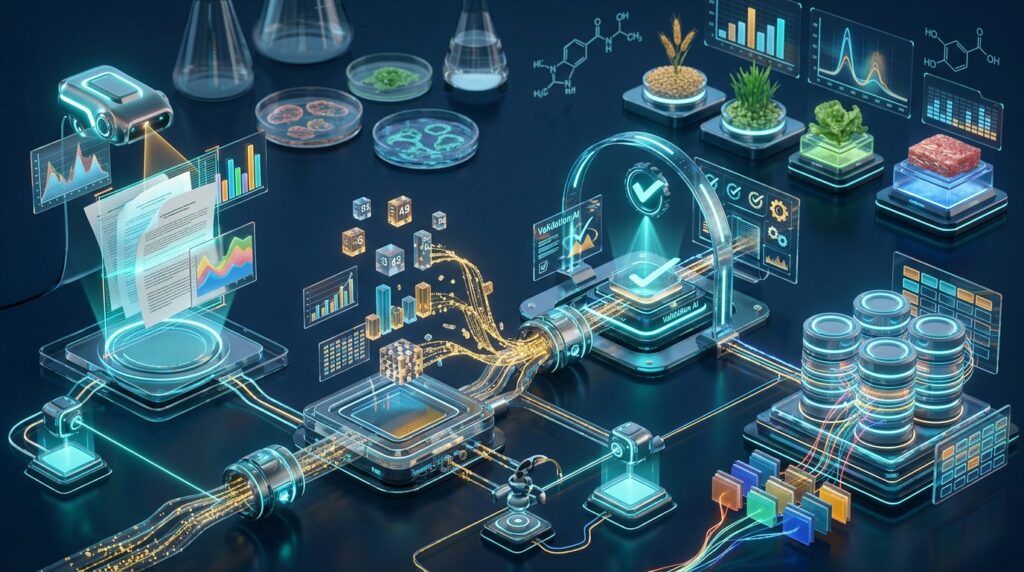
AgentXtract is the AI-assisted framework developed by the research team to extract experimental food-property data from scientific literature and organize it into a searchable database.
Unlike conventional data extraction approaches that rely heavily on finding relevant words in the body of a document, AgentXtract is designed to handle the formats commonly used to communicate experimental results. These include tables, figures and equations, where important measurements may be embedded rather than written out as ordinary prose.
The system uses multiple AI agents with different capabilities to interpret documents, extract numerical information and support the validation and standardization of records. The resulting data can then be organized so researchers can search for relevant measurements and compare findings more efficiently.To evaluate the framework, the researchers tested 10 large language models from OpenAI, Google and Anthropic. They compared factors including accuracy, speed and cost, using manually verified data from human experts as a reference.
The goal was not merely to see whether an AI model could read a scientific paper. The team needed to assess whether the system could extract the right measurements and preserve information reliably enough for scientific analysis.
The reported collection of more than 4,000 experimental records in around 30 minutes illustrates the potential speed advantage. It does not mean every scientific dataset can be processed with the same speed or accuracy; results will depend on document quality, the complexity of the measurements and the validation required.
For researchers working with large collections of published experiments, the key benefit is the possibility of spending less time transferring information manually and more time interpreting the evidence.
How AI Food Science Turns Research Papers Into Useful Data
One of the biggest challenges in AI food science is converting information scattered across scientific publications into a consistent dataset. Researchers often report measurements under different experimental conditions, making direct comparisons difficult. AI-powered extraction systems can help identify relevant measurements, organize them into structured records, and make the information easier to analyze.
In this research, AgentXtract demonstrated how AI food science systems could accelerate the process of examining published experimental data. Rather than treating each paper as an isolated source, researchers could investigate broader patterns across different foods. Human oversight remains essential because incorrect units, missing experimental details, and inconsistent terminology can affect the reliability of scientific conclusions.
How AI and Human Expertise Work Together

A central lesson from this research is that effective AI food science does not require removing human expertise from the process. Instead, the system divides the work according to the strengths of people and AI.
AI agents can process large collections of documents, identify candidate measurements and organize records much faster than a person working manually through every paper. Human researchers contribute the scientific judgment needed to decide which sources are appropriate, how experimental conditions affect interpretation and whether extracted values make sense.
This distinction is particularly important when dealing with scientific measurements. Two numbers that appear to describe the same property may not be directly comparable if the samples were prepared differently, the experiments used different frequencies or the measurement conditions varied.
An automated system might successfully recognize both numbers without fully understanding whether they belong in the same comparison. Specialist oversight helps prevent that kind of error from becoming embedded in the database.
The researchers’ workflow uses manually verified data as a reference for evaluating extraction quality. Their approach also standardizes and validates information before organizing it for further analysis.
Human involvement is therefore more than a final proofreading step. It helps establish the standards that make the extracted information scientifically useful.
This collaboration also offers a model for other research fields. AI may handle the volume and repetition involved in evidence collection, while domain experts guide the search, interpret the context and challenge conclusions that do not align with established knowledge.
The broader opportunity is not to automate scientific judgment completely. It is to give scientists better tools for examining more evidence and asking better questions.
The Discovery: A Relationship Across More Than 100 Foods
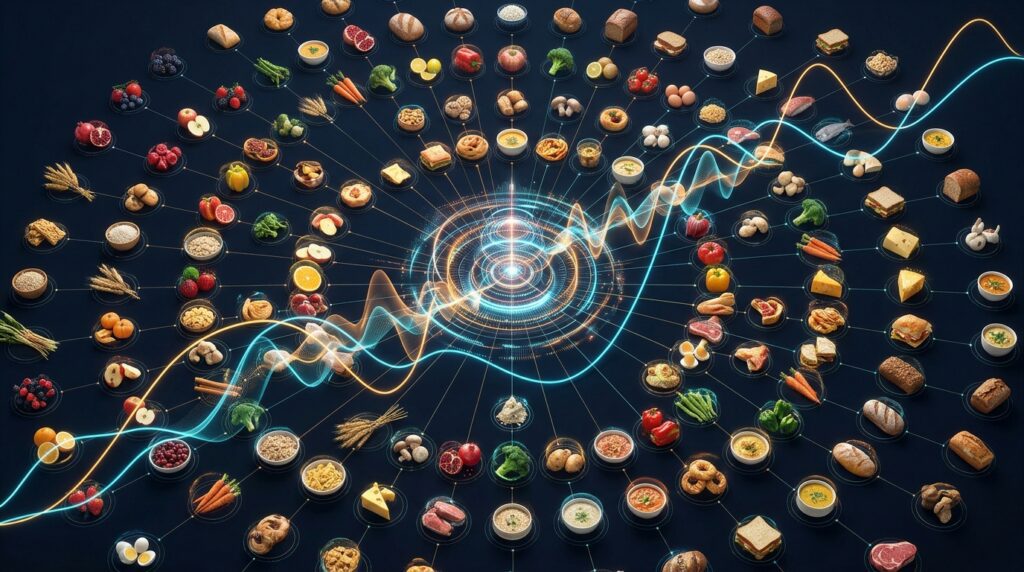
The most significant result was not simply the speed at which AgentXtract collected scientific information. It was what researchers were able to investigate after bringing the measurements together.
By analyzing the organized database, the team identified a previously unreported mathematical relationship between two dielectric properties: the dielectric constant and the dielectric loss factor. The relationship appeared consistently across more than 100 different foods, according to the research report.
These properties help describe how a material interacts with electromagnetic energy.
The dielectric constant is associated with how a material responds to an electric field and stores electrical energy. The dielectric loss factor describes how much electromagnetic energy is dissipated within the material, often as heat.
Both properties are relevant to microwave heating. The way food responds to electromagnetic energy influences how energy is absorbed and converted into heat during processing.
Understanding these properties can help food engineers build mathematical models and computer simulations to study heating behavior, improve processing designs and evaluate how different foods may respond to microwave-based technologies.
The discovery is important because a relationship that is difficult to recognize in isolated experiments may become more visible when measurements from many studies are compared systematically.
The researchers did not claim that AI independently proved a new law of physics. Rather, AI made it practical to assemble and analyze a broad collection of experimental results, allowing the team to identify a pattern that had not previously been reported in this form. Further scientific investigation is needed to determine how broadly the relationship applies and how it should be used.
This is a promising example of AI food science supporting discovery by helping researchers find connections within existing evidence.
What the Discovery Means for AI Food Science
The reported relationship between dielectric properties could help researchers better understand how different foods respond to electromagnetic energy. These properties matter in applications such as microwave heating, where food composition and physical characteristics influence energy absorption and temperature distribution. AI food science can help researchers investigate these relationships by connecting measurements reported across multiple studies.
Identifying a mathematical pattern is only one stage of scientific discovery. Researchers must examine experimental conditions, test whether the relationship holds for additional food types, and establish where the findings can be applied. The value of AI food science lies in helping scientists identify promising hypotheses more efficiently, not in replacing experimental validation or established scientific methods.
How Better Data Can Improve AI Answers
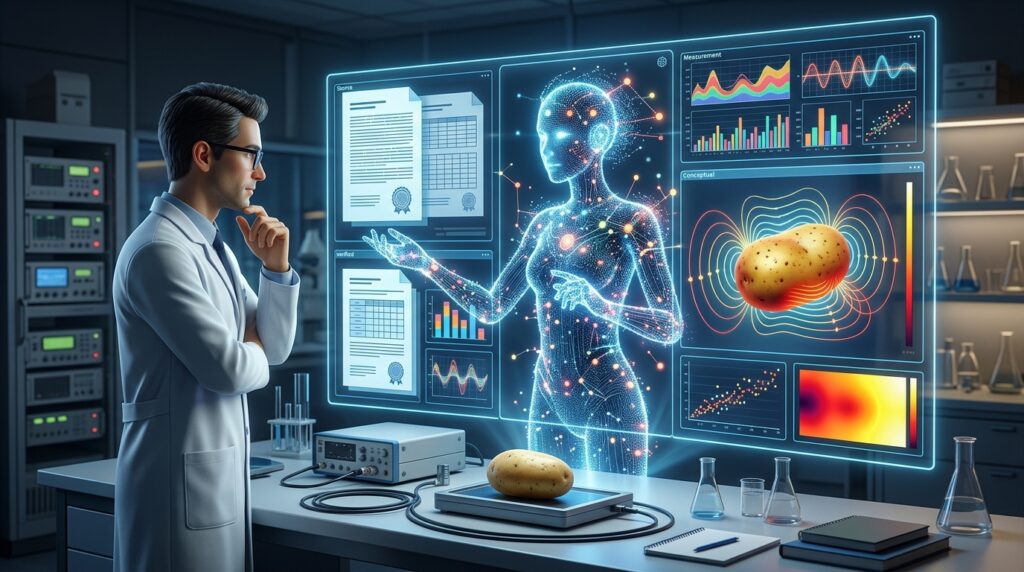
The research team also explored how its database could improve the answers produced by general-purpose AI systems.
Large language models can explain scientific concepts and summarize research, but they do not always retrieve the precise experimental measurements a specialist needs. A model may lack access to a particular dataset, overlook an important paper or produce an answer that does not clearly distinguish established evidence from an uncertain estimate.
To address this problem, the researchers connected the database to a question-answering system using retrieval-augmented generation (RAG).
RAG combines a language model with an external information source. Instead of relying exclusively on knowledge encoded during training, the system retrieves relevant records and uses them to construct an answer.
In this study, a user could ask about the dielectric properties of a potato at a particular frequency. The system could retrieve relevant database entries, provide references and explain how those properties influence microwave heating.
The advantage is traceability. Researchers can inspect the evidence supporting an answer rather than relying only on a fluent explanation generated by an AI model.
A reliable implementation still needs to handle missing measurements, differing experimental conditions and uncertainty correctly. If the database does not contain the requested information, the system should communicate that limitation instead of inventing a value.
For technical work, this distinction is crucial. A confident answer is not necessarily an accurate one, and a citation is only useful if it actually supports the stated result.
By combining verified scientific records with language-model capabilities, the researchers demonstrate one way to make AI food science tools more useful for evidence-based questions.
What This Means for Food Technology
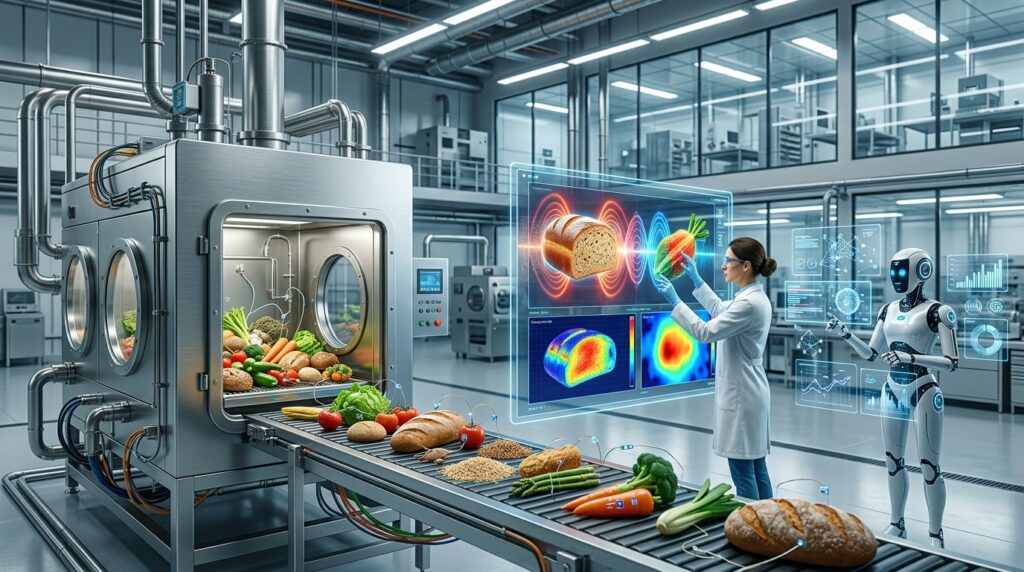
The implications of this work extend beyond one mathematical relationship. Food engineering involves many interconnected properties, and understanding them can influence how researchers design experiments, evaluate processing conditions and develop new products.
For example, more accessible dielectric measurements could help engineers compare the microwave responses of different ingredients or foods. In combination with other experimental information, such data could contribute to better models of energy absorption and heating behavior.
The potential applications include:
Food processing: Supporting simulations and studies of microwave heating and other processing techniques.
Product development: Helping researchers compare physical properties relevant to food formulation and performance.
Scientific literature analysis: Making it easier to identify patterns across studies that would otherwise remain separated.
Research efficiency: Reducing the manual effort required to collect and organize experimental records.
Evidence-based AI tools: Giving scientific assistants access to verified measurements and traceable sources.
These are potential uses of the approach, not proof that AgentXtract has already improved commercial food production or made processing safer. Those outcomes would require additional validation and application-specific testing.
The wider lesson is that scientific progress often depends on the quality and accessibility of the underlying evidence. AI can make it easier to assemble and compare that evidence, helping specialists investigate questions that would otherwise take considerably longer to explore.
Limitations and Remaining Questions
Although the results are promising, AI food science still faces several important challenges.
Data extraction can introduce errors. Scientific figures may be difficult to interpret, tables can contain complex headings, and equations may require careful contextual understanding. An incorrect digit or missing unit can distort later analysis.
Experimental conditions matter. Measurements taken at different temperatures, frequencies or sample conditions may not be directly comparable. Standardization helps, but researchers must retain enough context to interpret the records correctly.
A discovered relationship needs further validation. A mathematical pattern across a large dataset can suggest a useful hypothesis, but it does not automatically establish causation or guarantee that the relationship applies to every food or processing condition.
AI-generated explanations still need evidence. Even when a language model can retrieve scientific records, it may misinterpret them or draw conclusions that go beyond what the data support. Source checking and clear uncertainty reporting remain necessary.
Performance may vary between research domains. The system was developed around food-property data. Applying the same workflow to another field would require suitable source selection, validation methods and expertise specific to that discipline.
These limitations do not diminish the value of the work. They explain why the researchers’ combination of AI-driven scale and human oversight is important. The strongest scientific workflow is not one in which AI is assumed to be correct, but one in which its outputs can be tested against reliable evidence.
The Future of AI Food Science Research
The next stage of AI food science could involve larger research databases, improved data extraction, and tools that allow scientists to ask detailed questions about food properties. Retrieval-augmented generation systems may help researchers locate relevant measurements and supporting studies without manually searching through every publication. Such tools could make specialized scientific knowledge more accessible to food engineers and research teams.
Future progress will depend on data quality, reproducibility, and transparent evaluation. Researchers need to know where extracted measurements originated, which assumptions were used, and whether findings can be independently reproduced. With these safeguards, AI food science could become a valuable research assistant for discovering relationships, generating hypotheses, and guiding experiments across food engineering and related scientific disciplines.
Frequently Asked Questions
1. What is AgentXtract?
AgentXtract is an AI-assisted system developed by researchers led by Pennsylvania State University. It uses AI agents to extract experimental measurements from scientific papers, validate and standardize the information, and organize it in a searchable database.
2. How can AI help discover new food physics?
AI can help researchers collect measurements from thousands of publications and analyze them together. In this study, the organized data revealed a previously unreported relationship between two dielectric properties across more than 100 foods. This demonstrates how AI food science can help researchers identify patterns that are difficult to detect in scattered datasets.
3. What are dielectric properties in food?
Dielectric properties describe how food interacts with electromagnetic fields. The dielectric constant relates to energy storage in response to an electric field, while the dielectric loss factor relates to energy dissipation. Both properties are important for understanding microwave heating.
4. How much data did the researchers collect?
The team reported collecting and organizing more than 4,000 experimental data records in approximately 30 minutes using AI agents. The researchers compared different language models and evaluated extraction performance against manually verified data.
5. Can AI replace food scientists?
No. The research emphasizes collaboration between AI agents and human specialists. AI can accelerate document processing and data organization, while food scientists provide domain knowledge, assess data quality and determine whether the findings are scientifically meaningful.
6. How can AI-generated scientific answers become more reliable?
One approach is retrieval-augmented generation, which allows an AI system to retrieve relevant records from a verified database before generating an answer. This can improve traceability, although the retrieved evidence and the resulting explanation still need appropriate validation.
7. When will the research be published?
The findings were reported online ahead of publication in the March 2027 issue of the Journal of Food Engineering. The associated paper is titled Agentic AI for food property data: From literature to database to new discovery.
Conclusion
This research offers a compelling example of how AI food science can accelerate discovery without removing human expertise from the scientific process. By organizing more than 4,000 experimental records, the Penn State-led team identified a previously unreported relationship between dielectric properties across more than 100 foods.
The AgentXtract framework also demonstrates how verified scientific databases can make AI-generated answers more evidence-based and easier to check. Its potential value extends from food engineering research to other fields where important measurements are scattered across large collections of publications.
However, the findings should be treated as a promising research development rather than a finished commercial solution. Further validation will be needed to establish how broadly the discovered relationship applies and how reliably the system performs across different datasets.
As AI food science continues to develop, combining automated analysis with expert judgment could help researchers investigate more evidence, test new hypotheses and make better use of scientific knowledge that already exists.
How Progressive Robot Can Help
Progressive Robot helps businesses explore AI solutions, software development and digital transformation opportunities. Organisations considering AI-powered research or data workflows can benefit from carefully designed systems that prioritize data quality, traceability and human oversight.
Explore AI services: Progressive Robot AI Services
Discover our technology solutions: Progressive Robot
References
1. Tech Xplore — Can AI help discover new food physics? Researchers pair AI with human expertise. Published October 16, 2026.
2. Penn State University — Can AI help discover new food physics? Researchers pair AI with human expertise. Research announcement and explanation of AgentXtract.
More AI coverage: explore Progressive Robot's AI Models, Tools & Releases hub — hands-on reviews, setup guides and benchmarks in one place.










