
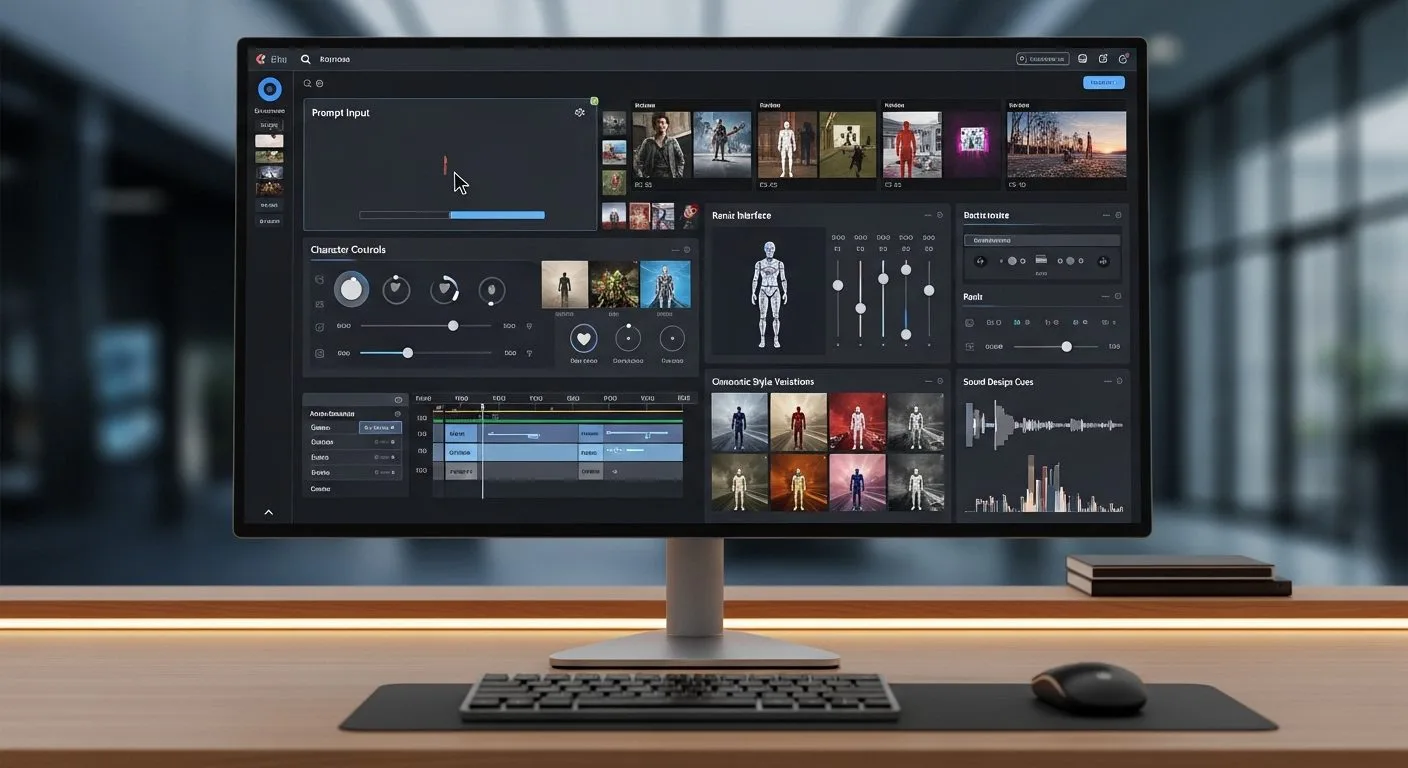
If you are asking what is OpenAI Sora, the short answer is that it is OpenAI’s video generation platform for turning prompts, images, and other creative inputs into short videos with realistic motion, stylized visuals, and increasingly integrated sound. Instead of treating video generation as silent animated output only, OpenAI now positions Sora as a broader creative system that can generate or remix scenes, include synchronised dialogue and sound effects, and even let users place themselves into generated videos through character features.
This guide uses OpenAI’s official Sora page, OpenAI’s Sora 2 launch materials, and official OpenAI help documentation as the main references. If you want to understand what is OpenAI Sora in practical terms, the key point is simple: Sora is OpenAI’s attempt to turn text-, image-, and character-driven prompting into a more controllable video creation environment rather than a one-off demo model.
What is OpenAI Sora? OpenAI’s platform for prompt-based video generation and remixing.
6 key facts at a glance
What is OpenAI Sora at a glance? It is OpenAI’s video generation platform for creating and remixing short videos from prompts, images, and characters.
- OpenAI Sora turns prompts and uploaded media into videos in styles ranging from cinematic to animated, photorealistic, and surreal.
- The current public product story centers on Sora 2, which OpenAI describes as more physically accurate, more realistic, and more controllable than prior systems.
- OpenAI now emphasizes synchronised dialogue, sound effects, and music inside generated videos rather than video-only output.
- Sora includes remix-style workflows, letting users extend, change, or reinterpret existing creations.
- Character features let users cast themselves, friends, pets, or objects into videos with privacy controls and likeness safeguards.
- OpenAI’s public materials show Sora in transition, with a newer Sora 2 app and web direction while older Sora 1 web help documentation is being deprecated.
Why understanding what is OpenAI Sora matters
If you want a better answer to what is OpenAI Sora, it helps to see how much the category has changed. Early AI video tools were often interesting but limited: short clips, inconsistent motion, silent output, weak scene continuity, and very little control once the model started generating. OpenAI’s public framing of Sora is different. It is not just about turning text into moving pixels. It is about turning prompts into short scenes with sound, remixing, style range, character insertion, and stronger physical coherence.
That matters because the value of AI video is not just novelty. It is whether creators can actually use it for ideation, storytelling, experimental social content, visual prototyping, and eventually repeatable content workflows. If you are thinking about how AI tools move from isolated demos into real production systems, Progressive Robot’s guide to workflow automation is useful background.
What is OpenAI Sora in simple terms

What is OpenAI Sora in plain English? It is OpenAI’s tool for making short AI-generated videos from a description, an image, or a remixable starting point.
The practical way to think about Sora is as a creative video engine. You describe a scene, upload an image, or remix an existing clip, and the system generates a short video. In the newer Sora 2 materials, OpenAI also emphasizes that sound is part of the creative output, not just an afterthought.
What is OpenAI Sora for most users? A faster way to turn an idea into a short visual scene with motion and sound.
What is OpenAI Sora in the current OpenAI product story

What is OpenAI Sora inside OpenAI’s broader product strategy? It is the company’s consumer-facing video generation platform and a public step toward richer world-model-style systems.
1. What is OpenAI Sora as a prompt-to-video system?
The first thing to know about what is OpenAI Sora is that it is still fundamentally prompt-driven. OpenAI’s official Sora page says users can start with a prompt or upload an image to create videos in a wide range of styles.
That means Sora is positioned as a creation interface, not only a research demo. The product page is designed around everyday creative use: write an idea, generate a scene, and keep iterating.
2. What is OpenAI Sora as Sora 2?
Another major part of what is OpenAI Sora today is Sora 2. OpenAI’s Sora 2 launch page says the model is more physically accurate, more realistic, and more controllable than prior systems. OpenAI also says Sora 2 is better at following intricate instructions across multiple shots and at persisting world state.
That matters because OpenAI is no longer presenting Sora only as proof that AI can generate video. It is presenting Sora 2 as a meaningful step forward in realism, controllability, and physical consistency.
3. What is OpenAI Sora for sound, dialogue, and full scenes?
One of the clearest answers to what is OpenAI Sora now is that it is not only a silent-video generator. OpenAI’s public Sora page says music, sound effects, and dialogue are automatically included in videos to make each scene feel complete. The Sora 2 launch post also describes the model as a video-audio generation system capable of producing sophisticated background soundscapes, speech, and sound effects.
This is strategically important. It moves Sora closer to a fuller scene-generation tool rather than a motion-only visual toy.
4. What is OpenAI Sora for remixing and iteration?
Another key part of what is OpenAI Sora is remixing. OpenAI’s product page says users can take someone else’s creation and put their own spin on it by swapping characters, changing the vibe, adding scenes, or extending the story.
That matters because it changes the product story from one-shot generation into iterative creation. Instead of asking users to regenerate from zero every time, Sora is being shaped as a system for transformation and reuse.
5. What is OpenAI Sora for characters and likeness control?
What is OpenAI Sora beyond scene generation? It is also a character system. OpenAI’s characters page says users can cast themselves, friends, pets, and objects as characters in videos. The company also emphasizes likeness controls: users decide who can use their character, can set restrictions on how they appear, and can delete videos containing their character.
OpenAI also says drafts with a user’s character cannot be downloaded and that published videos containing a character will always include a watermark, with a limited exception for ChatGPT Pro users downloading videos containing only their own character.
This matters because Sora is not just experimenting with visual generation. It is also addressing consent, likeness control, and character safety inside the product itself.
6. What is OpenAI Sora for access and rollout right now?
The access story is one of the most important parts of what is OpenAI Sora. OpenAI’s public Sora 2 launch page says the new Sora app is available to download, with initial rollout starting in the U.S. and Canada and access opening by invite. OpenAI also says that after a user receives an invite, they can access Sora 2 through sora.com, that Sora 2 is initially available for free with generous starting limits subject to compute constraints, and that ChatGPT Pro users can use a higher-quality experimental Sora 2 Pro model.
At the same time, OpenAI’s help-center billing FAQ says the older Sora 1 web experience is being deprecated. That help article documents plan-specific access for the older experience and says ChatGPT Plus, Business, and Pro users can use it, while Free, Enterprise, and Edu accounts are not eligible for that documented experience. So what is OpenAI Sora access right now? A moving target, but clearly one OpenAI is actively expanding and restructuring around Sora 2.
What is OpenAI Sora good at

What is OpenAI Sora in practical day-to-day use? It is strongest where creators need short, expressive, remixable video scenes rather than full traditional post-production pipelines.
What is OpenAI Sora for concept generation and visual ideation?
One of the clearest uses for what is OpenAI Sora is quick visual ideation. If you need to prototype a mood, test a surreal concept, visualize a prompt, or create an attention-grabbing short scene, Sora is designed for that kind of work.
The model’s style range, from cinematic to photorealistic to animated, makes it especially useful for exploring multiple creative directions without starting from scratch in a conventional animation or VFX workflow.
What is OpenAI Sora for social-style creative content?
Sora 2 is also clearly moving toward social creation and remix culture. OpenAI’s public launch materials talk about a feed, customizable discovery, remixing other people’s generations, and making characters a central part of the experience.
That means the answer to what is OpenAI Sora now includes social creativity, not just isolated generation. OpenAI is building it like a place where creation and remixing can happen together.
What is OpenAI Sora for character-led video experimentation?
Another strong use case in what is OpenAI Sora is character-based experimentation. The ability to create a likeness-controlled character and insert that character into generated scenes changes the product from a generic video model into something that can support personalised storytelling and identity-driven content in a more direct way.
That is one of the clearest ways Sora stands apart from older text-to-video interfaces.
What is OpenAI Sora still limited by

What is OpenAI Sora not perfect at? OpenAI’s own materials make several limits clear.
- Sora 2 is better than earlier systems, but OpenAI explicitly says it is still far from perfect and still makes mistakes.
- Access is still in rollout and transition, so plan and availability details are not yet fully settled across every product surface.
- Compute constraints can affect availability and generation speed.
- Character and likeness tools require careful safety rules and ongoing moderation.
- Stronger video generation does not eliminate the need for taste, review, or post-generation editing judgment.
The safest way to understand Sora is as a major step forward in AI video creation, not as a finished universal filmmaking system.
Frequently asked questions
What is OpenAI Sora in FAQ form? These short answers cover the main practical questions.
Is OpenAI Sora just a text-to-video model?
Not anymore in any narrow sense. OpenAI now presents Sora as a broader platform that supports prompt-based generation, image-based starts, remixing, character insertion, and synchronised sound.
Does OpenAI Sora generate audio too?
Yes. OpenAI’s current Sora materials say music, sound effects, and dialogue are automatically included in videos, and the Sora 2 launch page describes it as a video-audio generation system.
Can OpenAI Sora put you into videos?
Yes. OpenAI’s characters feature lets users create a character of themselves and place that character into generated videos, with privacy controls and deletion rights.
What is OpenAI Sora best understood as right now?
The clearest answer is that it is OpenAI’s evolving video generation platform for creating and remixing short, sound-enabled AI videos, with Sora 2 representing the current flagship direction.
Final thoughts
If you came here asking what is OpenAI Sora, the most useful answer is that it is OpenAI’s platform for turning prompts, images, remix ideas, and characters into short videos with motion, style, and sound. It matters because OpenAI is pushing the category beyond silent clips and into a more interactive, remixable, and socially aware video-creation system.
Whether Sora becomes a mainstream creator tool, a social platform, an API product, or all three, its importance is already clear. OpenAI is treating video generation not as a side experiment but as a serious product direction, and Sora 2 shows that the company is now focused on controllability, realism, sound, and identity-aware creative workflows rather than spectacle alone.
More AI coverage: explore Progressive Robot's AI Models, Tools & Releases hub — hands-on reviews, setup guides and benchmarks in one place.










