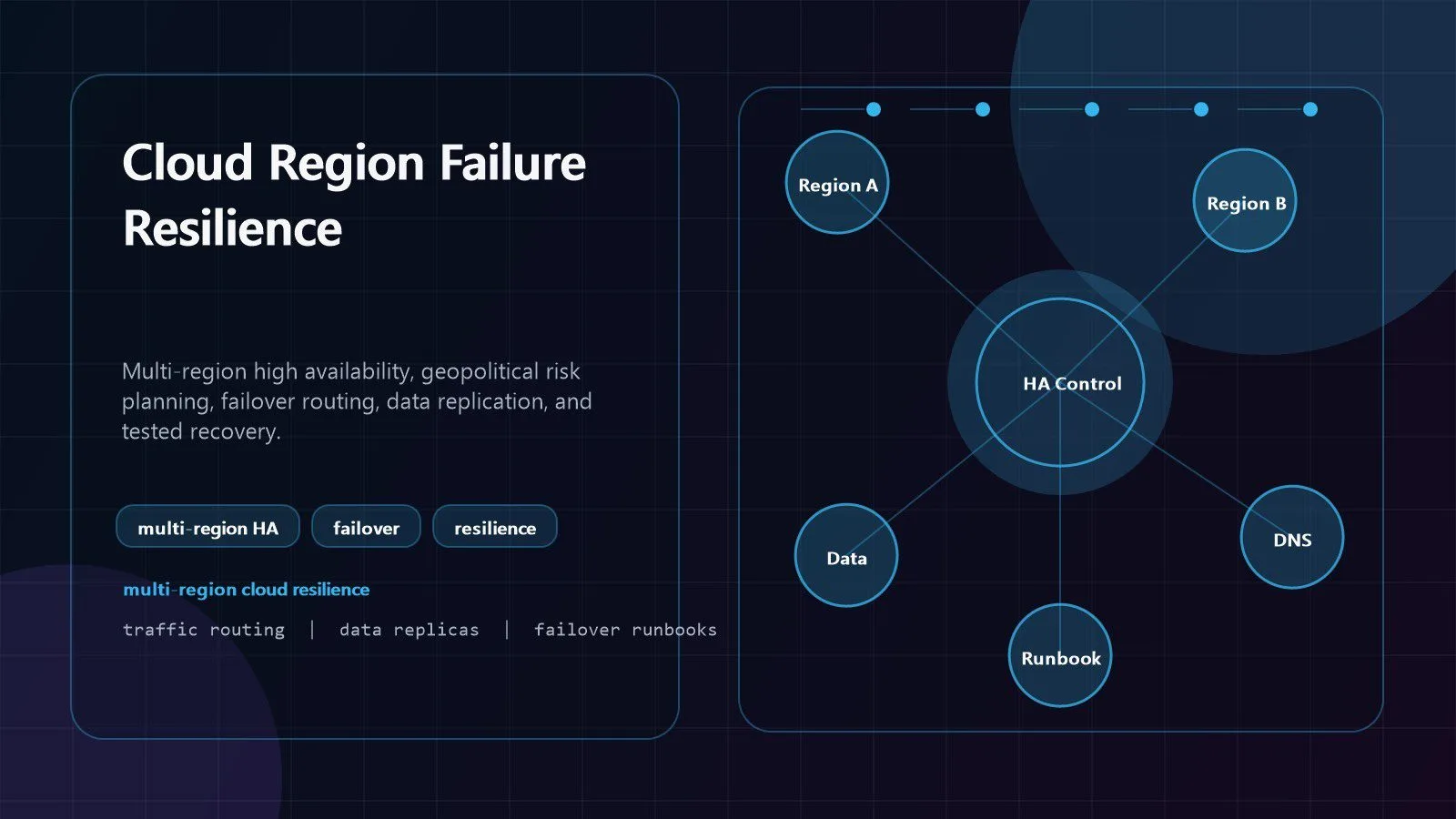
high availability

backup vs disaster recovery vs high availability a blank signpost two arrow boards

Backup vs Disaster Recovery: Simple Guide to Avoid Downtime

Backup, disaster recovery and high availability get used as though they were interchangeable, and they are not. A backup is a copy of your data you can go back to. Disaster recovery is the plan and environment that get a service running again somewhere else. High availability is the redundancy that stops a component failure becoming an outage at all. This guide sets out what each layer really protects against, where backup and disaster recovery genuinely diverge, how RTO and RPO drive the whole decision, what the three approaches cost a UK business in practice, how ransomware has changed the arithmetic, and a five-step framework for deciding which workload deserves which layer.


Read more
How to Secure MySQL 9 on Ubuntu 26.04 — step-by-step Linux tutorial on Progressive Robot

How to Configure MySQL Primary-Replica Replication on Ubuntu 26.04

MySQL primary-replica replication asynchronously copies data from a primary server to one or more replica servers. This improves read scalability, provides a hot standby for disaster recovery, and enables backups from the replica without impacting the primary. This guide sets up replication on Ubuntu 26.04 LTS. Tested and valid on: Ubuntu 26.04 LTS Prerequisites Two […]

Read more
How To Use ProxySQL as a Load Balancer for MySQL on Ubuntu 16.04 — step-by-step Linux tutorial on Progressive Robot

How To Use ProxySQL as a Load Balancer for MySQL on Ubuntu 16.04

ProxySQL is an open-source MySQL proxy server which can improve performance by distributing traffic among a pool of multiple database servers and also improve availability by automatically failing over to a standby if a database server fails. In this guide, you will set up ProxySQL as a load balancer for multiple MySQL servers with automatic failover.

Read more
How To Install and Configure NATS on Ubuntu 16.04 — step-by-step Linux tutorial on Progressive Robot

How To Install and Configure NATS on Ubuntu 16.04

NATS is an open source high performance messaging system, often described as “a central nervous system for the cloud”. In this tutorial you’ll configure gnats, the official NATS server and create a basic server overload warning system that sends out emails when server load gets too high, using `gnatsd` as its message broker.

Read more
How To Create a High-Availability Setup with Heartbeat and Reserved IPs on Ubuntu — step-by-step Linux tutorial on Progressive Robot

How To Create a High-Availability Setup with Heartbeat and Reserved IPs on Ubuntu

Heartbeat is an open source program that provides cluster infrastructure capabilities—cluster membership and messaging—to client servers, which is a critical component in a high availability (HA) server infrastructure. Heartbeat is typically used in conjunction with a cluster resource manager (CRM), such as Pacemaker, to achieve a complete HA setup. However, in this tutorial, we will demonstrate how to create a 2-node HA server setup by simply using Heartbeat and a the cloud provider Reserved IP.

Read more
What is Load Balancing? — step-by-step DevOps tutorial on Progressive Robot

What is Load Balancing?

Load balancing is a key component of highly-available infrastructures commonly used to improve the performance and reliability of web sites, applications, databases and other services by distributing the workload across multiple servers. A web infrastructure with no load…

Read more
CHAT