
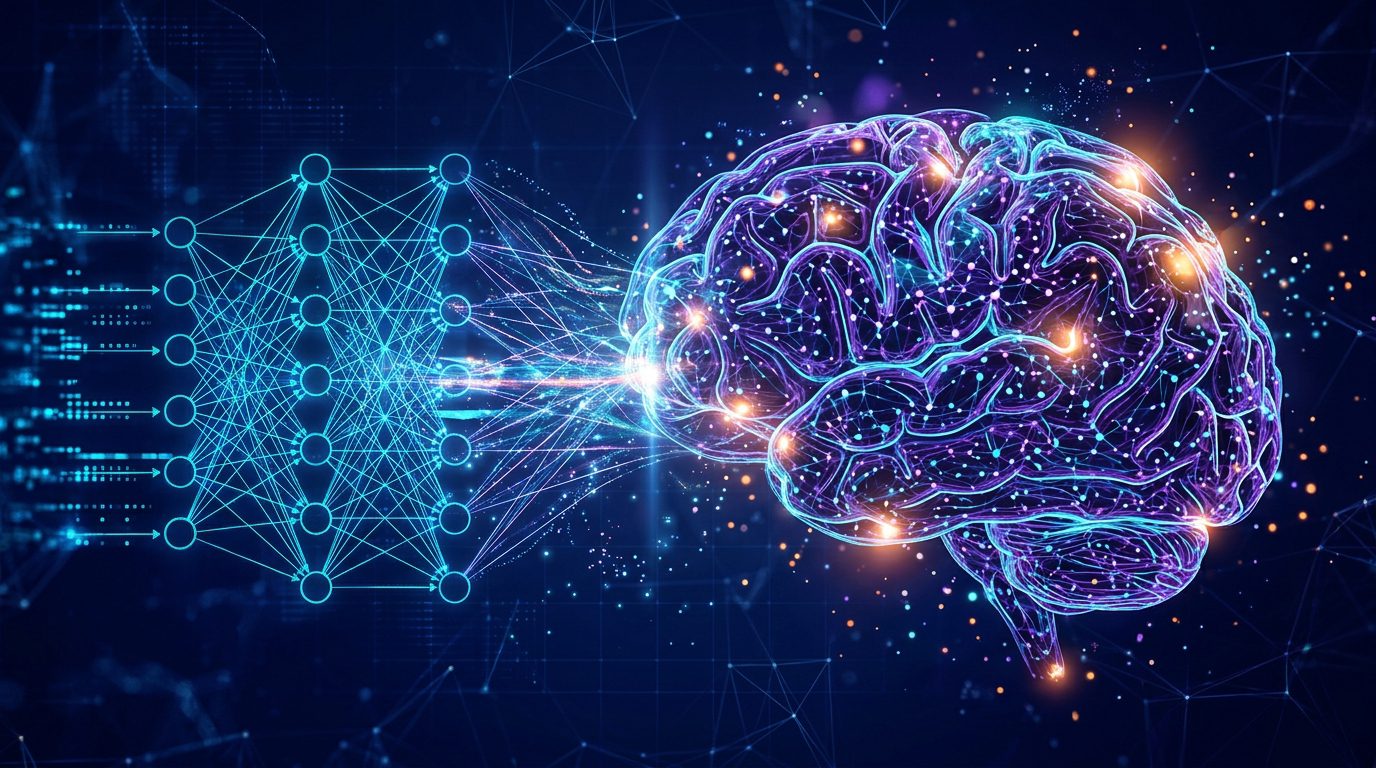
AI and the human mind have long fascinated researchers trying to understand intelligence, creativity and unpredictable thinking. Early artificial intelligence pioneers questioned whether machines could reproduce the messy, irregular processes through which people generate ideas, make associations and sometimes learn from mistakes.
A historical examination by Benjamin Lindquist, an assistant professor in MIT’s History Section, explores how researchers experimented with randomness and artificial neural networks to investigate these questions. Their work helped shape the foundations of technologies that now power generative AI.
The relationship between AI and the human mind remains relevant today. Modern chatbots can produce creative responses, but they can also generate convincing inaccuracies. Understanding how early researchers approached machine creativity offers valuable context for today’s efforts to balance innovation with reliability.
The history of AI and the human mind reveals a persistent tension: the unexpected can inspire discovery, but it can also produce errors. That trade-off remains important as AI systems become increasingly capable and widely used.
Why Did Early Researchers Want AI to Think Unpredictably?

Early computer engineering was strongly associated with calculation, formal logic and systems that produced repeatable results. But researchers interested in creativity wondered whether intelligence could also depend on unexpected connections.
Human thinking does not always follow a strict sequence of logical steps. People draw on associations, memories and experiences to arrive at ideas that may initially seem unrelated. Sometimes an unexpected mistake or unusual perspective leads to a useful discovery.
Lindquist’s research examines how early AI pioneers explored this relationship between creativity and irregularity. Some believed that a machine capable of producing only predictable answers would struggle to reproduce the imaginative aspects of human thought.
This approach to AI and the human mind challenged the assumption that intelligent systems should always follow the most orderly path. Researchers began asking whether carefully introduced randomness could help a computer explore possibilities that conventional algorithms might miss.
The connection between AI and the human mind also raised a fundamental question about how intelligence should be measured. Should a machine be judged only by its ability to reach a correct answer, or should researchers consider its ability to discover an unexpected solution? For early creativity researchers, the second possibility mattered because human thought can involve associations that are difficult to predict in advance. Their experiments explored whether computational systems could generate such possibilities without relying entirely on predefined rules.
How Did Randomness Become Part of Artificial Intelligence?
In the early 1950s, electrical engineer John Pierce, who worked at Bell Labs, explored the relationship between mathematics and artistic creativity. As Lindquist explains, Pierce considered how mathematical methods could introduce unexpected elements into art, allowing creators to move beyond familiar patterns.
The idea was not that randomness automatically creates something meaningful. Rather, an unexpected result might offer a new direction or reveal an association that would otherwise remain unnoticed.
Artificial neural networks became one way to investigate such ideas. Researchers could construct computational models inspired by the brain and examine how networks responded to information and changing conditions.
Some early neural-network researchers were psychologists who hoped that these models might help them understand the workings of cognition. They were interested in how a system could learn, make mistakes and sometimes arrive at productive results.
The connection between AI and the human mind was therefore both technical and philosophical. Researchers were not merely building tools to calculate answers; they were investigating whether computational systems could offer insight into the less predictable processes of thought.
These experiments helped broaden the meaning of AI and the human mind beyond formal reasoning. Randomness could provide a way to explore alternatives, but it still needed structure and interpretation. A machine might generate many unusual outputs, yet researchers had to determine which results were meaningful. This distinction remains important: unpredictability can support exploration, while evaluation is needed to separate useful discoveries from noise.
Did Everyone Agree That Creativity Required Irrationality?
Not all AI researchers shared this view.
Lindquist describes two broad approaches to understanding intelligence. One perspective treated creativity as something that could emerge from unexpected associations, irregularity or unusual leaps of reasoning. Another suggested that creative thinking was essentially ordinary reasoning performed more effectively.
These competing ideas shaped the early debate over machine intelligence. If creativity depended on irrationality, researchers might need to preserve unpredictable behaviour. If it was simply improved reasoning, they could focus on making systems more logical, accurate and efficient.
The distinction still matters when considering AI and the human mind. A system that generates surprising ideas may be valuable for exploration, but surprise alone is not evidence of intelligence or originality. The output must still be assessed for relevance, quality and usefulness.
The disagreement continues to inform how researchers think about AI and the human mind. Creativity may involve both disciplined reasoning and unexpected associations, rather than being reducible to either one. A system’s originality cannot be established simply because its answer is surprising. Researchers must also examine whether the result is relevant, coherent and genuinely useful for the task at hand.
How Did Neural Networks Become Central to Modern AI?

For many years, symbolic AI was a prominent approach to machine intelligence. It represented knowledge through rules, facts and logical relationships, allowing computers to solve problems by manipulating structured information.
Neural networks offered a different method. Instead of relying entirely on explicitly programmed rules, these systems used interconnected computational units to learn patterns from data.
Frank Rosenblatt, a psychologist and influential early neural-network researcher, helped advance the perceptron in the 1950s. Neural networks attracted interest, but their capabilities were constrained by limited computing power, data and technical methods.
They nevertheless remained an important area of research, including within cognitive science. As computing resources and available data expanded, researchers could train increasingly capable networks.
Around 2012, deep-learning systems began achieving major breakthroughs in machine-learning tasks. Continued advances in hardware, training techniques and large datasets helped neural networks become central to modern AI.
This development transformed the practical relationship between AI and the human mind. Neural networks were no longer simply experimental models of cognition; they became the foundation for technologies capable of generating text, images and other forms of content.
The evolution of neural networks also changed how scientists approached AI and the human mind. Instead of attempting to encode every aspect of intelligence as a fixed rule, researchers could train computational models to recognise patterns in data. Modern deep-learning systems are not replicas of human brains, but their development reflects the continuing influence of questions about learning, representation and cognition.
Why Are AI Hallucinations Connected to Creativity?

AI hallucinations occur when a generative system produces information that appears convincing but is inaccurate, fabricated or unsupported. A chatbot might invent a source, misrepresent a fact or provide a confident answer that does not reflect the available evidence.
Lindquist’s historical analysis connects this problem to early experiments in machine creativity. Some researchers valued neural networks because they could generate responses that departed from expectations. Modern users, however, usually want AI systems to provide dependable answers.
This does not mean that randomness alone causes hallucinations. Contemporary generative models can make mistakes for a variety of reasons, including limitations in training data, imperfect reasoning and the way they generate responses.
The historical connection between AI and the human mind highlights a broader trade-off. Developers want models to explore ideas and produce useful, original responses, while also reducing unsupported claims and unwanted behaviour.
Making AI more reliable does not require abandoning creativity. Developers can improve factual grounding, use retrieval systems to access relevant information, evaluate outputs and introduce human oversight when accuracy matters.
The goal is to distinguish productive novelty from errors that could mislead users.
This is where the history of AI and the human mind becomes especially relevant to practical deployment. A chatbot’s ability to produce an unusual response can be useful during brainstorming, but the same flexibility can become a liability when users need verified facts. Developers therefore need to consider not just whether a model can generate an answer, but whether it can communicate uncertainty and support its claims with reliable evidence.
What Can AI’s History Teach Developers Today?
Lindquist’s research offers a caution for modern AI development: improving one characteristic of a system may affect another.
A model designed to be highly predictable may be useful for structured tasks, but open-ended creative work can benefit from a wider range of possibilities. Conversely, a system that generates unusual ideas may need more careful checking before its outputs are used.
For businesses adopting AI, the practical implications depend on the application.
Creative work: AI can help generate alternative concepts, explore unfamiliar approaches and support brainstorming. Human judgement remains essential for selecting and refining ideas.
Research and analysis: Generated claims should be checked against trustworthy evidence, particularly when decisions depend on factual accuracy.
Customer-facing systems: Organisations should evaluate responses for reliability, monitor errors and establish escalation procedures for uncertain or consequential situations.
High-stakes applications: Human review, clear limitations and appropriate safeguards are important wherever incorrect outputs could cause significant harm.
Understanding AI and the human mind does not mean treating a neural network as a human thinker. It means examining the assumptions researchers make about intelligence, creativity and the behaviour they want machines to reproduce.
For organisations, the lessons of AI and the human mind are not purely theoretical. They influence how teams select models, design workflows and decide when human judgement should remain involved. A creative assistant and a factual research tool may require different settings, evaluation criteria and safeguards. Matching the system’s behaviour to its intended purpose is more useful than assuming that maximum creativity or maximum predictability is always the right objective.
Businesses exploring artificial intelligence can also learn how AI and machine learning solutions can support their operations, improve workflows and introduce new capabilities.
Conclusion: Can AI Be Both Creative and Reliable?
The history of AI and the human mind reveals that unpredictability was once considered a possible ingredient of machine creativity. Early researchers explored randomness because they believed it could help computers discover unexpected connections and investigate aspects of human thought.
Modern AI faces a more demanding balance. Users want original ideas, but they also need dependable information and protection against misleading outputs. Creativity alone does not establish that a response is accurate, just as predictability alone does not guarantee that a system is intelligent or useful.
The enduring challenge is to develop AI that can explore unfamiliar possibilities while making its limitations clear. For businesses and researchers, that means evaluating generated results, checking important claims and applying safeguards appropriate to each use case.
As AI continues to evolve, the relationship between AI and the human mind will remain an important area of research. The objective is not simply to make machines more unpredictable or more orderly, but to build systems whose creativity is valuable and whose outputs can be trusted.
Source
MIT News — Q&A: How AI Came to Model the “Messy” Human Mind, 23 October 2026. The article discusses Benjamin Lindquist’s research on randomness, early neural networks, creativity and the history of AI hallucinations.
More AI coverage: explore Progressive Robot's AI Models, Tools & Releases hub — hands-on reviews, setup guides and benchmarks in one place.










