
AI in retro gaming is becoming increasingly controversial as coding assistants and autonomous AI agents make it possible to recreate, recompile and port classic video games in a fraction of the time traditionally required. What once demanded years of painstaking reverse engineering can now move from an experimental project to a playable demonstration much faster.
However, this technological progress is creating tension within the retro gaming community. Developers who have spent years studying original game code argue that AI-generated ports can prioritise speed over accuracy, overlook important technical details and take advantage of work completed by other contributors.
The debate is not simply about whether artificial intelligence belongs in game development. It is about what happens when the tools become powerful enough to flood a small, specialist community with projects that are quick to produce but difficult to maintain, verify or improve.
The growing use of AI in retro gaming presents a genuine opportunity to make old titles accessible on modern hardware. Yet the quality of that work, the recognition given to human contributors and the preservation of technical knowledge remain important questions.
Why AI in Retro Gaming Is Growing So Quickly
Classic game preservation has traditionally required specialised technical knowledge. Developers often need to examine compiled software, understand processor behaviour, reconstruct functions and reproduce the way the original game interacts with hardware.
These tasks can involve enormous amounts of repetitive analysis. Even experienced programmers may spend months or years working through unfamiliar code before they can produce a reliable recreation.
Modern AI coding assistants can help analyse code, generate implementation ideas, identify errors and automate parts of the development process. AI agents can also attempt repetitive tasks, run tests and revise their output based on the results.
This is one reason AI in retro gaming has expanded beyond experimental demonstrations. Developers can use these tools to explore older platforms, build recompilation projects and attempt ports that previously would have required a much larger team.
The benefits are not imaginary. AI-assisted development can reduce the time needed to write routine code and help newcomers begin projects that might otherwise feel inaccessible.
But generating code is not the same as understanding a game. A program that launches successfully may still contain rendering errors, performance problems, broken controls or subtle differences from the original experience.
The Rise of Low-Quality AI Game Ports
The growing volume of AI-assisted ports has intensified criticism from experienced developers. Some projects appear quickly, attract attention through demonstration videos and promise to bring console-exclusive classics to PCs or other platforms. Yet a playable preview does not necessarily demonstrate a stable, complete release.
Developers have raised concerns about crashes, incorrect game behaviour, performance issues and code that becomes difficult to maintain. AI-generated implementations can also introduce technical problems that are not immediately visible during a short test.
This is particularly important for classic games whose behaviour depends on specific timing, memory layouts, graphics routines or hardware characteristics. Reproducing the visible result is only one part of the challenge; preserving the underlying behaviour can be considerably more complicated.
The criticism surrounding AI in retro gaming is therefore not simply resistance to new technology. It reflects a concern that projects may be presented as finished achievements before they have received sufficient testing and technical review.
AI tools can accelerate the early stages of development, but experienced programmers still need to inspect the results, understand the architecture and fix problems that automated systems miss.
Decompilation Is Not the Same as Recompilation
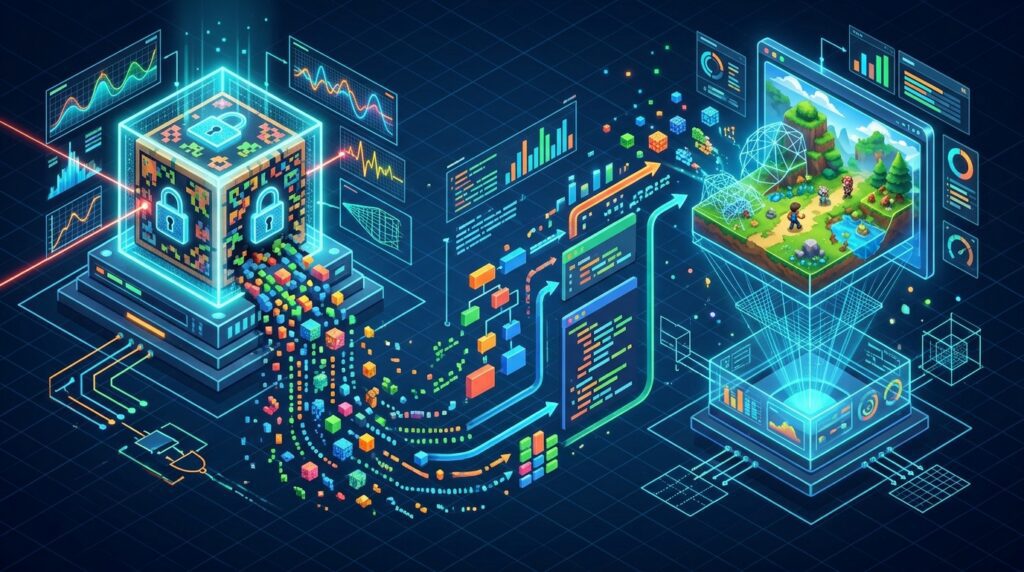
Understanding the technical distinction between decompilation and recompilation is essential to the current debate.
Decompilation involves analysing compiled software to reconstruct a more understandable representation of its code. For retro game developers, this can reveal how original functions work, how systems interact and how particular behaviours are implemented.
Recompilation uses reconstructed or otherwise available code to produce a version that can run on another platform. A successful project may support modern operating systems, improved display options, alternative input devices or additional modifications.
These processes are related, but they are not interchangeable. A decompilation project can be valuable as research even when it has not produced a finished modern port. Conversely, a port may depend on extensive work completed by a research team long before the final application is built.
AI in retro gaming complicates this distinction because automated tools can make it easier to produce a working demonstration without necessarily completing the underlying research to the same standard.
That difference matters to preservationists. The goal is not always to make an old game launch on a new computer; it can also involve documenting how the original software works so that its behaviour can be understood and preserved for the future.
Why Experienced Developers Are Pushing Back
Some developers have criticised the emergence of AI-generated ports because they believe the process can diminish years of community research. A new project may depend on tools, documentation or partially completed work created by other contributors, while offering little recognition of those earlier efforts.
AI-assisted forks create another difficulty. A developer can take an existing project, use AI to accelerate its completion and release a separate version without necessarily contributing improvements back to the original team. This can divide development effort and make it harder for communities to maintain a shared technical foundation.
There are also concerns about maintenance. Code that has been generated without a clear architectural plan may be difficult for another programmer to understand. Future contributors can inherit a complicated project with hidden dependencies, inconsistent implementation choices and bugs that are expensive to diagnose.
For communities built around collaboration, these problems extend beyond individual releases. They can affect trust, incentives and the willingness of experienced developers to share their work.
The controversy over AI in retro gaming illustrates why transparency matters. Clearly explaining which parts of a project were AI-assisted, acknowledging upstream contributions and documenting testing procedures can help users assess the result more fairly.
Can AI Help Preserve Games That Might Otherwise Be Lost?

More AI coverage: explore Progressive Robot's AI Models, Tools & Releases hub — hands-on reviews, setup guides and benchmarks in one place.










