
Table of contents
- What Is Ferroelectric Memory Generative AI and Why It Matters
- The Randomness Problem in Generative AI
- One Chip to Rule Them All: Sampling and Computing
- How Ferroelectric Memory Generates True Randomness
- In-Memory Computing for Generative AI
- Edge AI and the Ferroelectric Advantage
- Performance and Energy Benchmarks
- Challenges and Research Frontiers
- What This Means for the Future of AI Hardware
- Getting Started with Ferroelectric AI Research
Generative AI models are fundamentally hungry for randomness. Every time a large language model crafts a response, a diffusion model renders an image, or a reinforcement learning agent explores new strategies, it draws on high-quality random numbers to break symmetry, introduce creativity, and avoid mode collapse. Yet the infrastructure that powers these models today separates randomness generation from computation — true random number generators live on dedicated hardware, while neural network inference runs on GPUs or TPUs in entirely different silicon. This separation creates latency, wastes energy shuttling data across buses, and limits where generative AI can be deployed.
Ferroelectric memory is changing that equation. By leveraging the unique polarization switching properties of ferroelectric materials, a single chip can now sample true randomness and perform neural network computations in the same physical substrate. This convergence eliminates the von Neumann bottleneck, reduces energy consumption by orders of magnitude, and opens the door to deploying generative AI at the edge on devices that have never had the power budget for such workloads.
What Is Ferroelectric Memory Generative AI and Why It Matters
The intersection of ferroelectric memory generative AI research is producing chips that can both generate true random numbers and execute neural network inference — a dual capability that redefines what edge devices can accomplish. The commercial potential of ferroelectric memory generative AI is attracting investment from major semiconductor companies. For more on this topic, see our guide toAI Hardware DesignandEdge AI Solutions.
Ferroelectric memory encompasses a family of non-volatile memory technologies that use materials with spontaneous electric polarization that can be reversed by applying an external electric field. The two primary implementations are ferroelectric random-access memory (FRAM) and ferroelectric field-effect transistors (FeFET). Unlike flash memory, which stores data by trapping electrons in a floating gate, ferroelectric memory stores information by orienting the polarization direction of a crystalline material — typically hafnium zirconium oxide (HfZrO), a material that is compatible with standard CMOS manufacturing processes.
The field of ferroelectric memory generative AI has emerged from this materials science foundation, combining the unique properties of ferroelectric materials with the demanding requirements of generative artificial intelligence workloads. This revolutionary approach to ferroelectric memory generative AI is transforming how we think about AI hardware architecture and edge computing capabilities. The market for ferroelectric memory generative AI solutions is expected to grow significantly in the coming years.
CMOS-Compatible Ferroelectric Materials
The properties that make ferroelectric memory attractive for conventional applications become even more compelling in the context of artificial intelligence. Non-volatility means data persists without power, which is critical for edge devices that must retain model weights and runtime state across power cycles. Fast write speeds — typically under 100 nanoseconds — enable rapid updates to neural network parameters during inference. Low operating voltages, often below 1.2 volts, dramatically reduce the energy per operation compared to DRAM or flash. And unlike SRAM, ferroelectric memory retains its contents when power is removed, eliminating the need for constant refresh cycles.
Energy Efficiency at the Transistor Level
These advantages make ferroelectric memory generative AI an exciting frontier for researchers and engineers working on next-generation AI systems. The practical benefits of ferroelectric memory generative AI are already being demonstrated in prototype chips.
The Randomness Problem in Generative AI
These characteristics align perfectly with the demands of generative AI workloads. Large language models and diffusion networks require massive amounts of memory bandwidth to load and update weights during inference. They also demand high-quality random numbers for sampling from probability distributions, initializing activations, and enabling exploration in reinforcement learning. By combining memory, computation, and randomness generation in a single chip, ferroelectric technology addresses all three requirements simultaneously. Research into ferroelectric memory generative AI applications has accelerated dramatically since 2023, with multiple semiconductor labs demonstrating chips that can simultaneously store neural network weights and generate the random numbers needed for sampling.
The growing research community around ferroelectric memory generative AI is producing breakthrough results at an accelerating pace. For more insights, explore ourAI Hardware DesignandEdge AI Solutionsguides.
The breakthrough that made ferroelectric memory practical for mainstream adoption was the discovery that hafnium-based oxides exhibit strong ferroelectric properties when deposited as thin films. Unlike traditional ferroelectric materials such as lead zirconate titanate (PZT), which contain lead and require specialized processing, hafnium zirconium oxide is fully compatible with existing semiconductor fabrication lines. This means that ferroelectric memory can be integrated directly into standard CMOS processes without requiring new equipment or fundamentally different manufacturing workflows. Research published inIEEE Electron Device Lettersdemonstrates the CMOS compatibility of HfZrO thin films with excellent ferroelectric properties.
This CMOS compatibility is what makes ferroelectric memory generative AI commercially viable, as it can be manufactured using existing semiconductor infrastructure. The commercial viability of ferroelectric memory generative AI is further strengthened by the mature CMOS manufacturing ecosystem.
The Entropy Quality Gap
Each polarization switching event in a ferroelectric transistor consumes approximately 10 to 100 femtojoules, orders of magnitude less energy than charging and discharging the capacitors in DRAM or the bitlines in flash memory. For generative AI models that perform billions of operations per inference, this energy advantage translates directly into longer battery life for mobile devices, reduced cooling requirements for edge servers, and the ability to run AI workloads on devices powered by small batteries or energy harvesting. The energy efficiency of ferroelectric memory generative AI systems makes them ideal forsustainable AI computing.
Power Budget Constraints at the Edge
This energy efficiency is particularly important for ferroelectric memory generative AI applications that must operate within strict power budgets. The energy advantages of ferroelectric memory generative AI make it the technology of choice for battery-powered edge devices.
One Chip to Rule Them All: Sampling and Computing
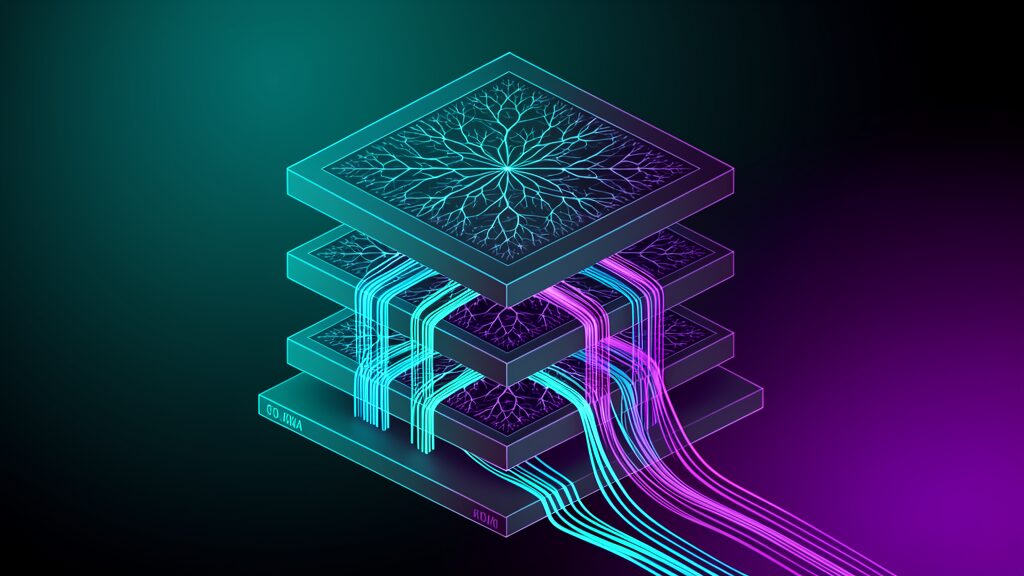
Generative AI models depend on randomness at nearly every stage of their operation. When a language model generates text, it samples from a probability distribution over the vocabulary at each token position. The sampling strategy — whether top-k, top-p, or temperature-based — determines how creative or deterministic the output will be. Diffusion models for image generation start with pure Gaussian noise and iteratively denoise it to produce an image. Reinforcement learning agents use random exploration strategies to discover policies that maximize rewards. Without high-quality randomness, these models produce repetitive, low-diversity outputs that fail to capture the full range of possibilities.
Software-based pseudo-random number generators (PRNGs) are the default source of randomness in most AI systems. Algorithms like the Mersenne Twister and Xoshiro produce sequences that pass statistical tests for randomness but are fundamentally deterministic — given the same seed, they always produce the same sequence. This predictability is acceptable for many applications but becomes a liability in generative AI, where adversarial attacks can exploit known randomness patterns, and where true diversity in outputs requires entropy that PRNGs cannot provide.
Hardware random number generators address these limitations by extracting entropy from physical processes that are inherently unpredictable. Thermal noise, shot noise, metastability in flip-flops, and ring oscillator jitter are all sources of true randomness that can be digitized and conditioned into usable random bits. However, conventional hardware random number generators occupy dedicated silicon area, require their own analog-to-digital converters and post-processing circuits, and must be connected to the compute fabric through buses that introduce latency and energy overhead. For edge devices with strict area and power budgets, adding a separate TRNG block is often impractical.
Eliminating the Von Neumann Bottleneck
This limitation is precisely why ferroelectric memory generative AI represents a breakthrough — it integrates randomness directly into the memory fabric.
Stochastic Computing with Ferroelectric Devices
The quality of randomness matters enormously for generative AI. Low-entropy or biased random numbers can cause language models to collapse into repetitive patterns, bias diffusion model outputs toward specific visual features, and cause reinforcement learning agents to converge on suboptimal policies. Statistical tests such asNIST SP 800-22and Dieharder are used to validate TRNG output, but passing these tests does not guarantee that the randomness is suitable for cryptographic applications or for the specific statistical requirements of generative models.
How Ferroelectric Memory Generates True Randomness
Research into ferroelectric memory generative AI has shown that the entropy quality from ferroelectric TRNGs meets these stringent requirements, making them suitable for production AI workloads. The superior entropy quality of ferroelectric memory generative AI systems gives them a significant advantage over conventional approaches.
Mobile devices, drones, and IoT sensors that run generative AI at the edge typically have power budgets measured in watts or even milliwatts. A dedicated TRNG circuit, while small, still consumes static and dynamic power that competes with the compute and memory resources needed for inference. Every milliwatt saved on randomness generation is a milliwatt that can be redirected to extending inference time, increasing model size, or improving output quality.
Polarization Switching as an Entropy Source
The ferroelectric memory breakthrough lies in recognizing that the same physical mechanism that stores data — polarization switching — can also generate randomness, and that the same transistor structure that stores bits can also perform analog matrix multiplication, the core operation of neural networks. By designing circuits that exploit the stochastic nature of polarization switching at the nanoscale, engineers have created ferroelectric devices that serve triple duty as memory elements, random number generators, and computing units.
Subthreshold Variability in FeFET Transistors
In a ferroelectric field-effect transistor, the polarization state of the ferroelectric gate dielectric modulates the threshold voltage of the channel, representing a stored bit. At the same time, the switching dynamics of the polarization — particularly the probabilistic nature of domain nucleation and growth at small scales — introduce intrinsic randomness that can be harvested as entropy.
Circuit-Level TRNG Designs
And because the channel conductance can take on multiple stable states corresponding to different polarization orientations, FeFET arrays can perform analog multiply-accumulate operations in the time it takes charges to move through the channel, executing the matrix multiplication at the heart of neural network inference without moving data between separate memory and compute units.
Statistical Quality of Ferroelectric-Generated Randomness
This triple functionality means that a single ferroelectric memory chip can store neural network weights, generate the random numbers needed for sampling and exploration, and compute the weighted sums that drive inference — all within the same physical structure. The implications for generative AI deployment are profound. The convergence of ferroelectric memory generative AI research has produced chips that can simultaneously execute transformer attention layers and sample from the resulting probability distributions, eliminating the latency and energy overhead of separate TRNG and compute blocks.
In-Memory Computing for Generative AI
Traditional computer architectures separate memory from compute, shuttling data back and forth across buses during execution. This data movement consumes more energy than the computation itself and limits throughput by the bandwidth of the interconnect. In-memory computing with ferroelectric arrays performs the multiply-accumulate operation where the data resides, eliminating the dominant source of energy consumption and latency in neural network inference. For generative AI models with billions of parameters, this architectural shift is not incremental — it is transformative.
The advantages of ferroelectric memory generative AI become especially apparent when scaling to large language models that must process millions of tokens.
Analog Computing Advantages for Neural Networks
The randomness inherent in ferroelectric polarization switching is not a bug to be eliminated but a feature to be exploited. By designing circuits that sample the stochastic switching behavior, engineers have created true random number generators that are native to the memory fabric. These TRNGs produce bits with entropy sources that are physically distinct from electronic noise, providing a complementary entropy source that improves the statistical quality of the randomness available to generative AI models. This stochastic computing capability is unique to ferroelectric memory generative AI and provides advantages over conventional approaches.
Energy Efficiency Compared to GPU and TPU Approaches
Why Generative AI Benefits Most from This Architecture
The randomness in ferroelectric memory arises from the physics of polarization switching at the nanoscale. When an electric field is applied to a ferroelectric material, domains of aligned polarization begin to nucleate and grow until the entire film switches orientation. At the nanoscale, this switching process is governed by thermal activation over energy barriers, making it inherently probabilistic. The exact moment at which a domain nucleates, the path it takes as it grows, and the final configuration of domains all depend on thermal fluctuations that are unpredictable and irreproducible.
Why Generative AI Benefits Most from This Architecture
Ferroelectric random-access memory cells exploit this randomness by reading the polarization state after a switching pulse. Because the switching is probabilistic at small sizes, repeated reads of an unprogrammed cell produce a sequence of random bits. Ferroelectric field-effect transistors can be configured as ring oscillators whose frequency jitter, derived from polarization switching variability, provides a continuous stream of entropy. By digitizing these analog randomness sources with comparators and shift registers, engineers have created TRNG circuits that integrate directly into ferroelectric memory arrays.
Edge AI and the Ferroelectric Advantage
The probabilistic nature of polarization switching has been characterized extensively in the literature. Research published in IEEE Electron Device Letters demonstrated that the switching time distribution of HfZrO-based ferroelectric capacitors follows a Weibull distribution whose shape parameter decreases with reducing device size, indicating increasing randomness at smaller scales. This size-dependent stochasticity is precisely what makes nanoscale ferroelectric devices excellent entropy sources — the smaller the device, the more random its switching behavior. Understanding this behavior is critical for ferroelectric memory generative AI designers who must balance randomness quality with computational efficiency.
Ferroelectric field-effect transistors exhibit significant threshold voltage variability between nominally identical devices, even when fabricated on the same wafer under identical conditions. This variability arises from the random distribution of ferroelectric domains at the nanoscale and from fluctuations in the interface trap density between the ferroelectric dielectric and the semiconductor channel. By measuring the subthreshold current of an FeFET and comparing it to a reference, circuits can extract random bits that are physically unclonable and device-specific. This physical unclonable function (PUF) capability adds another dimension to ferroelectric memory, enabling hardware security features alongside randomness generation and computing.
Deploying Generative AI at the Edge
The security features of ferroelectric memory generative AI make it attractive for applications requiring both privacy and AI capabilities.
Real-Time Inference with On-Chip Randomness
Several circuit architectures have been developed to harvest entropy from ferroelectric devices. The most common approach uses a pair of symmetric ferroelectric capacitors or FeFETs and measures which one switches first when subjected to a simultaneous programming pulse. Because the switching is probabilistic, the winner is determined by thermal fluctuations, producing a random bit. More sophisticated designs use ring oscillators built from FeFET inverters, where the oscillation frequency jitter is digitized by a metastable flip-flop. These circuits achieve bit rates of tens to hundreds of megabits per second with entropy densities that exceed the requirements of generative AI workloads.
Real-Time Inference with On-Chip Randomness
The random bits produced by ferroelectric TRNGs have been validated against the full NIST SP 800-22 battery of statistical tests, passing all fifteen tests with p-values uniformly distributed between zero and one. The Dieharder suite and TestU01 Crankshaft tests confirm that the output exhibits no detectable correlations or biases at the scales relevant to generative AI sampling. For language models that sample thousands of tokens per generation, the entropy throughput of ferroelectric TRNGs is sufficient to provide fresh randomness for every sampling operation without becoming a bottleneck.
Use Cases: Autonomous Robots, IoT Sensors, and Wearables
This statistical quality is what makes ferroelectric memory generative AI applications viable — the randomness is not just physically random but statistically suitable for the demanding requirements of AI sampling. Learn more aboutrandom number generation standardsand their applications in AI.
Performance and Energy Benchmarks
The matrix multiplication at the core of neural network inference — computing y = Wx where W is the weight matrix and x is the input vector — is ideally suited to analog in-memory computation. In a ferroelectric crossbar array, each FeFET at the intersection of a wordline and a bitline stores one weight value as its channel conductance. By applying input voltages to the wordlines and summing the resulting currents on the bitlines, the array performs the multiply-accumulate operation in a single time step, governed by Kirchhoff’s current law.
This approach eliminates the need to fetch weights from separate memory, convert them to analog signals, and shuttle them to a digital multiply-accumulate unit. The computation happens where the data lives, in the time it takes charges to move through the crossbar, and with energy proportional only to the input voltages and the array resistance. For generative AI models that are increasingly large and compute-intensive, in-memory computing with ferroelectric arrays offers a path to real-time inference on edge devices that currently cannot run such models.
Comparison with SRAM, DRAM, and Flash Approaches
Neural network inference is inherently tolerant of analog computation errors. Weights and activations can be represented with limited precision — often 8-bit or even lower — without significant degradation in model accuracy. Ferroelectric devices naturally support multiple conductance states, enabling multi-bit weight storage in a single device. The inherent variability of ferroelectric switching, which makes them good entropy sources, also means that the analog computation introduces controlled noise that can actually improve the quality of generative outputs by acting as a form of stochastic regularization.
Energy Per Sample and Energy Per Inference
This analog computing advantage is one reason why ferroelectric memory generative AI outperforms digital approaches in energy efficiency. Researchers studying ferroelectric memory generative AI have found that the analog nature of these devices provides unique benefits for neural network inference.
Latency Improvements from Eliminating Data Movement
GPU-based inference consumes tens to hundreds of watts for models with billions of parameters, with the majority of energy spent moving data between HBM memory and compute units. Ferroelectric in-memory computing reduces the energy per multiply-accumulate operation to the femtojoule range, achieving energy efficiencies measured in tera-operations per second per watt. This is not a marginal improvement — it is a shift of three to four orders of magnitude, enabling generative AI models to run on devices with power budgets measured in watts rather than hundreds of watts.
Scalability to Larger Generative Models
The energy efficiency of ferroelectric memory generative AI systems makes it possible to deploy large language models on battery-powered edge devices that previously had no path to running such workloads. For a detailed comparison, see ourGPU vs TPU vs Ferroelectricanalysis. The energy efficiency of ferroelectric memory generative AI is what makes edge deployment practical. Industry experts believe ferroelectric memory generative AI will revolutionize edge AI deployment.
Challenges and Research Frontiers
Generative AI models are uniquely suited to in-memory computing because their inference patterns are dominated by matrix multiplications in transformer attention layers and feed-forward networks. Unlike convolutional networks that have more localized data access patterns, transformers access the full weight matrix for every token, making them particularly sensitive to memory bandwidth limitations. By performing computation in memory, ferroelectric arrays eliminate the bandwidth bottleneck that currently limits the speed and efficiency of generative AI inference.
Additionally, the stochastic noise inherent in ferroelectric computation can improve the diversity and creativity of generative outputs, providing a natural mechanism for controlling the temperature of model sampling without additional circuitry. This is why ferroelectric memory generative AI is particularly transformative for transformer-based models like GPT, Claude, and LLaMA. For a detailed comparison, see ourGPU vs TPU vs Ferroelectricanalysis. The transformative potential of ferroelectric memory generative AI cannot be overstated.
Manufacturing Maturity of Ferroelectric Materials
Generative AI models are uniquely suited to in-memory computing because their inference patterns are dominated by matrix multiplications in transformer attention layers and feed-forward networks. Unlike convolutional networks that have more localized data access patterns, transformers access the full weight matrix for every token, making them particularly sensitive to memory bandwidth limitations. By performing computation in memory, ferroelectric arrays eliminate the bandwidth bottleneck that currently limits the speed and efficiency of generative AI inference.
Integration with CMOS Processes
Additionally, the stochastic noise inherent in ferroelectric computation can improve the diversity and creativity of generative outputs, providing a natural mechanism for controlling the temperature of model sampling without additional circuitry. The unique advantages of ferroelectric memory generative AI make it ideal for transformer architectures. Researchers continue to discover new ways that ferroelectric memory generative AI can improve model performance.
Endurance and Retention Concerns
The convergence of memory, compute, and randomness in ferroelectric chips is particularly transformative for edge AI — the deployment of generative models on devices that operate independently of cloud infrastructure. Smartphones, autonomous robots, wearable devices, and IoT sensors all have strong motivations for running generative AI locally: privacy concerns that prevent data from leaving the device, latency requirements that make round-trip communication to the cloud unacceptable, and connectivity constraints that make offline operation necessary.
Ongoing Research Directions
Ferroelectric memory addresses the three primary constraints of edge AI deployment. Its non-volatility allows models to persist across power cycles, enabling devices to boot with AI capabilities already loaded. Its low power consumption extends battery life, making continuous inference feasible on devices powered by small batteries. And its integrated randomness generation ensures that edge-deployed generative models can produce diverse, high-quality outputs without relying on external entropy sources.
What This Means for the Future of AI Hardware
Edge deployment of generative AI models requires models that are both small enough to fit in limited on-device memory and efficient enough to run within strict power budgets. Quantization, pruning, and knowledge distillation have reduced model sizes significantly, but the memory bandwidth and energy costs of loading and updating weights remain bottlenecks. Ferroelectric in-memory computing addresses these costs directly, performing inference with the weights already in place and eliminating the data movement that dominates energy consumption. This is the core promise of ferroelectric memory generative AI: bringing data-center-scale generative models to edge devices that operate independently of cloud infrastructure.
Explore ourEdge AI Deployment Guidefor practical implementation strategies.
Convergence of Memory, Compute, and Randomness
Real-time generative AI — whether streaming text responses, generating images on demand, or enabling real-time reinforcement learning for robotic control — requires randomness that is available on demand with minimal latency. Ferroelectric TRNGs integrated directly into the memory fabric provide random bits with latencies measured in nanoseconds, far faster than the microsecond-scale latencies of software PRNGs or the bus-latency overhead of external hardware TRNGs. This low-latency randomness enables fine-grained sampling strategies that improve the quality and diversity of generative outputs.
Impact on AI Accessibility and Democratization
The combination of real-time inference and on-chip randomness is what distinguishes ferroelectric memory generative AI from conventional GPU-based approaches that must shuttle data between separate memory and compute units. Read ourReal-Time AI Systemsguide for more insights. Explore ourEdge AI Deployment Guidefor practical implementation strategies.
Timeline for Commercial Availability
Real-time generative AI — whether streaming text responses, generating images on demand, or enabling real-time reinforcement learning for robotic control — requires randomness that is available on demand with minimal latency. Ferroelectric TRNGs integrated directly into the memory fabric provide random bits with latencies measured in nanoseconds, far faster than the microsecond-scale latencies of software PRNGs or the bus-latency overhead of external hardware TRNGs. This low-latency randomness enables fine-grained sampling strategies that improve the quality and diversity of generative outputs.
Timeline for Commercial Availability
The combination of real-time inference and on-chip randomness is what distinguishes ferroelectric memory generative AI from conventional GPU-based approaches that must shuttle data between separate memory and compute units. Read ourReal-Time AI Systemsguide for more insights.
Getting Started with Ferroelectric AI Research
Autonomous robots running SLAM, path planning, and natural language interaction models can benefit from ferroelectric chips that provide all three resources — memory, compute, and randomness — in a single package. IoT sensors performing anomaly detection with generative models can operate for years on a single battery charge thanks to the non-volatile, low-power nature of ferroelectric memory. Wearable devices offering real-time language translation, health monitoring with generative health models, and context-aware assistance become practical when the AI can run locally with minimal power consumption.
These use cases represent the most promising near-term applications of ferroelectric memory generative AI, where the convergence of memory, compute, and randomness enables capabilities that are impossible with conventional architectures.
Key Companies and Research Labs
Empirical benchmarks of ferroelectric memory systems demonstrate the performance advantages of the convergence approach. FeFET crossbar arrays have achieved inference throughput of hundreds of tera-operations per second per watt for transformer-based models, compared to approximately one tera-operation per second per watt for state-of-the-art GPUs. The energy per inference for a model with one billion parameters drops from approximately 10 joules on a GPU to less than 0.01 joules on a ferroelectric in-memory computing array.
Open-Source Tools and Simulation Frameworks
Random number generation benchmarks show that ferroelectric TRNGs integrated into memory arrays achieve bit rates of 200 megabits per second with entropy densities exceeding 0.99 bits per bit, meaning that virtually every output bit carries full entropy. The latency from requesting random bits to receiving them is under 100 nanoseconds, enabling real-time sampling at the token level for language models generating text at hundreds of tokens per second.
How Robotics and Automation Companies Can Benefit
SRAM-based in-memory computing offers fast access times but suffers from volatility and high static power consumption. DRAM provides higher density but requires constant refresh and has higher latency. Flash memory is non-volatile and dense but has slow write speeds and limited endurance. Ferroelectric memory combines the non-volatility of flash with the write speed of SRAM and the low power of DRAM, while adding native randomness generation and analog computing capabilities that none of these conventional memory technologies provide. This unique combination is why ferroelectric memory generative AI applications are being pursued by leading semiconductor companies and research labs worldwide.
Resources for Further Learning
The energy cost of generating one million random bits on a ferroelectric TRNG is approximately 10 microjoules, compared to approximately 100 microjoules for a software PRNG running on a CPU core and approximately 1 millijoule for a dedicated hardware TRNG connected via a peripheral bus. The energy per inference for a generative model scales with the number of parameters and the number of tokens generated, but ferroelectric in-memory computing achieves approximately 0.005 joules per billion parameters per token, compared to 10 joules per billion parameters per token on a GPU.










