

It’s wild to think how far phones have come. Twenty years ago, polyphonic ringtones were a big deal — now artificial intelligence in mobile phones lets devices recognise faces, predict words, translate speech, and edit photos in seconds. AI has turned our pocket gadgets into personal assistants that learn, adapt, and think almost like humans.
By 2015, fingerprint recognition and mobile wallets became the new benchmark for innovation, and according to Deloitte, nearly half of smartphone users (47%) now make in-store payments with their devices. Yet today, smartphones have gone even further — they can predict your next word, recognise faces, translate languages in real time, and even edit your photos automatically. The invisible force behind these capabilities is none other than artificial intelligence (AI).
For smartphone manufacturers, the ability to embed AI-powered features is no longer a luxury — it’s a necessity. As the share of AI-capable smartphones grows exponentially, Artificial Intelligence in Mobile Phones has become one of the most crucial differentiators in product design and performance.
This article explores how AI actually works inside mobile devices, what technologies drive it, and how companies like Progressive Robot are helping businesses harness this intelligence to build next-generation mobile applications.
Understanding Artificial Intelligence in Mobile Phones

Artificial Intelligence in Mobile Phones refers to the integration of intelligent algorithms that allow devices to learn from user behaviour, analyse patterns, and make human-like decisions in real time. Rather than being defined purely by hardware, AI in smartphones is recognised by what it enables — smarter cameras, personalised recommendations, intelligent voice assistants, and seamless automation.
Unlike AI-enabled PCs that focus on hardware accelerators and AI-specific chips, smartphones are defined by user-facing intelligence. It’s not about having an NPU (Neural Processing Unit) — it’s about what that NPU can do. Whether it’s suggesting the best photo filters, anticipating your next text, or detecting anomalies in your usage, AI has quietly transformed the mobile experience into something deeply personal and intuitive.
How Artificial Intelligence Works Inside Smartphones
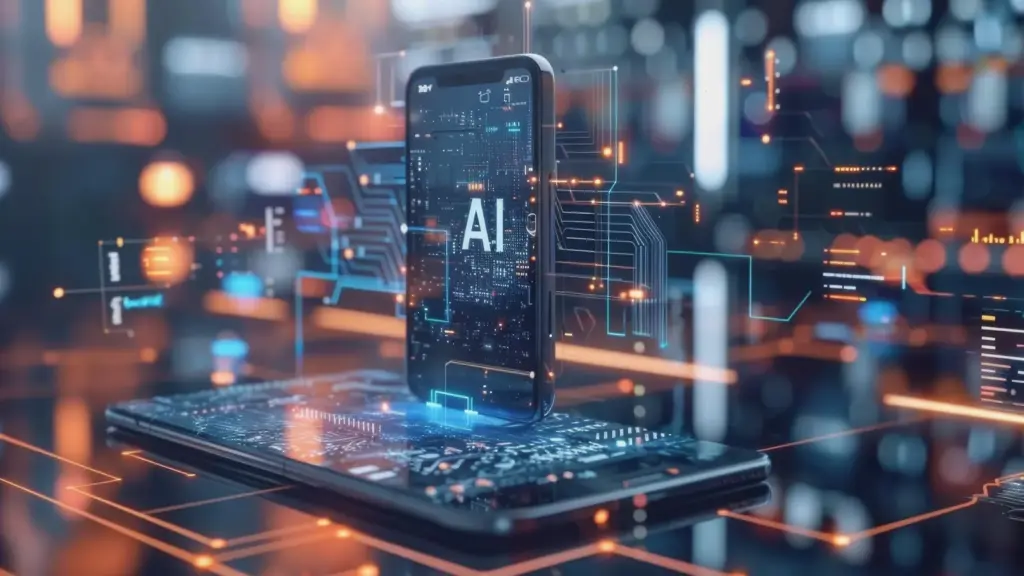
The way AI operates inside a smartphone is a complex interplay between on-device processing and cloud-based computation.
On-device AI handles immediate, lightweight tasks — things like facial recognition, text prediction, or voice command interpretation. These tasks are processed locally, meaning they don’t rely on an internet connection, allowing for faster responses and better privacy.
Cloud AI, on the other hand, manages more computationally demanding processes, such as large-scale data analysis, deep learning model updates, and natural language understanding at scale. Most modern smartphones now use a hybrid AI approach — combining local processing for speed with cloud-based intelligence for depth.
Under the hood, Artificial Intelligence in Mobile Phones relies on several foundational technologies — machine learning (ML), deep learning (DL), and neural networks. These work together to analyse vast amounts of user data and improve accuracy over time. Neural networks mimic the way the human brain processes information, while deep learning leverages multiple layers of these networks to interpret more complex patterns such as speech, gestures, or images.
Large language models, the same kind that power advanced AI chatbots, are now being fine-tuned for real-time text generation and translation directly on smartphones.
Core AI Technologies Powering Modern Smartphones
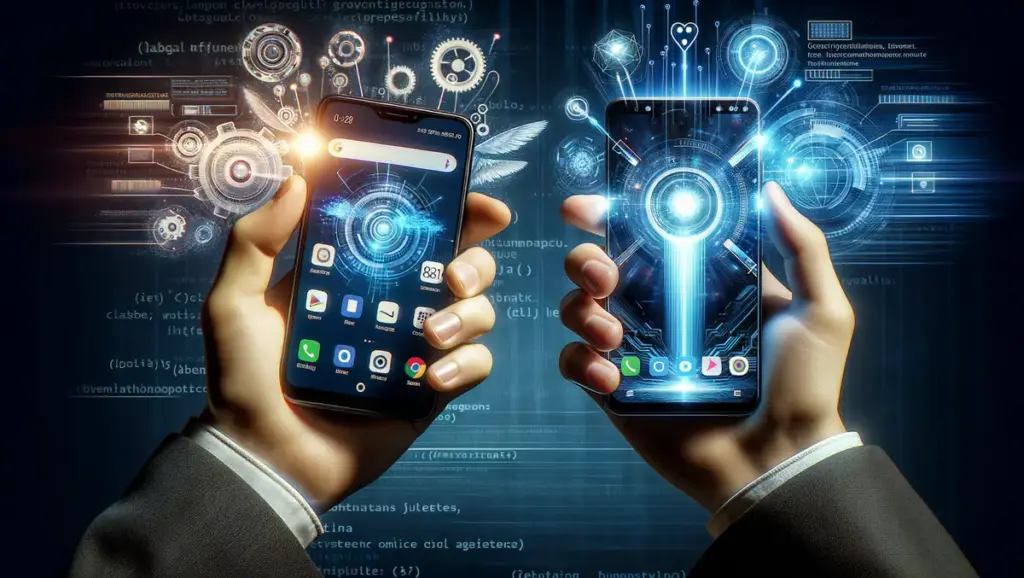
At the center of AI’s evolution in smartphones lies specialised hardware and sophisticated algorithms that make these intelligent experiences possible.
Neural Processing Units (NPUs)
An NPU is a specialised chip designed to handle AI tasks like photo enhancement, speech recognition, or predictive typing. Unlike CPUs and GPUs that process general tasks, NPUs execute thousands of AI-specific computations simultaneously. This parallelism not only accelerates performance but also improves battery efficiency and privacy by keeping computations on-device.
Natural Language Processing (NLP)
NLP enables smartphones to understand, interpret, and generate human language. It’s what powers voice assistants such as Siri, Bixby, and Google Assistant. With NLP, devices can detect tone, context, and even emotional nuance — transforming simple voice commands into meaningful interactions. Beyond voice, NLP also fuels smart replies, text summarization, and real-time translations.
Computer Vision and Image Recognition
Computer vision allows smartphones to “see” and comprehend visual information. Using convolutional neural networks (CNNs), devices can detect faces, classify objects, and even distinguish entire scenes. This technology powers features like Face ID, portrait mode, night photography, and real-time image enhancement. AI-based vision systems have made photography not just automatic, but truly intelligent.
Edge AI
Edge AI processes data directly on the smartphone rather than sending it to remote servers. This local processing improves speed and privacy while reducing dependency on constant internet connectivity. Apple’s Neural Engine and Google’s Tensor chip exemplify Edge AI, enabling real-time translations, photo processing, and predictive text — all without sending sensitive data to the cloud.
Everyday Applications of Artificial Intelligence in Mobile Phones

From photography to gaming, AI has revolutionized almost every corner of the mobile experience.
Photography and Videography
AI has turned mobile photography into a professional-grade experience. When users snap a photo, the phone’s NPU instantly analyzes the scene — adjusting exposure, focus, and color balance in milliseconds. AI can detect whether you’re capturing a sunset, a face, or a cityscape, and fine-tune every setting accordingly.
Portrait mode blurs backgrounds with precision through semantic segmentation, while night mode layers multiple frames to produce noise-free results. Google’s Pixel devices, for example, use computational photography and machine learning to render lifelike skin tones and remove unwanted objects.
Voice Assistants and Conversational AI
Voice assistants like Siri, Alexa, and Google Assistant combine NLP and speech recognition to interpret natural language and respond conversationally. These systems learn context from user habits — such as asking for weather updates every morning — and proactively deliver information. They’ve evolved from passive responders into intelligent digital companions that can handle scheduling, reminders, and navigation seamlessly.
Predictive Typing and Smart Text
AI-driven keyboards rely on recurrent neural networks (RNNs) or transformer models to predict the next word in a sentence. They adapt to a user’s writing style, suggesting words, emojis, and even tones that match previous messages. Context-aware autocorrect now understands intent — correcting “meting” to “meeting” — and learns from user feedback, getting smarter with each keystroke.
Personalisation and Adaptive Experience
Artificial Intelligence in Mobile Phones also enables deep personalisation. Smartphones learn daily patterns — suggesting apps based on time or location, adjusting brightness automatically, and recommending songs or videos. Reinforcement learning models study behaviour to tailor experiences in real time, making every interaction more intuitive.
Security and Authentication
AI secures devices through facial recognition, fingerprint scanning, and behavioral analysis. Facial recognition uses deep neural networks to map thousands of facial data points, ensuring precision even under varied lighting. Meanwhile, behavioral biometrics analyse how users hold or swipe on their phones, adding another invisible layer of protection against fraud.
Mobile Gaming and Augmented Reality
AI creates more immersive mobile gaming experiences by making non-player characters (NPCs) smarter and more responsive. In augmented reality (AR), AI enhances spatial awareness, allowing applications to understand physical surroundings and anchor digital objects naturally — the technology behind apps like Pokémon GO and AR navigation tools.
Automation and Smart Efficiency
From silencing notifications during meetings to enabling adaptive battery management, AI automates everyday tasks. These intelligent routines save energy, improve usability, and streamline how users interact with their devices.
Benefits and Challenges of Artificial Intelligence in Smartphones
The rise of Artificial Intelligence in Mobile Phones brings undeniable benefits. Telecom operators and manufacturers see AI as a core driver of innovation. Nearly 90% of businesses globally have integrated AI into at least one operational area, aiming to boost productivity and user experience.
AI boosts performance through specialised hardware like Apple’s Neural Engine and Google’s Tensor, which reduce latency and energy consumption. It enhances device security through intelligent authentication, strengthens privacy with Edge AI, and cuts operational costs by automating system processes.
However, these advantages come with challenges. Building AI systems is expensive, requiring powerful hardware, large datasets, and skilled developers. Smaller brands often struggle to keep up with the scale and resources of industry giants. Fragmentation between different operating systems, processors, and AI frameworks adds further complexity.
Power consumption also remains an issue — as AI grows more capable, it demands more processing power. Developers now use advanced techniques like model pruning and quantization to make AI models lighter without compromising performance.
Privacy and Ethical Concerns
With great intelligence comes great responsibility. As AI becomes more embedded in smartphones, concerns around privacy, bias, and transparency continue to rise.
AI in mobile devices relies heavily on personal data — from location and usage patterns to facial and voice recognition. This makes it a target for misuse or unauthorized access. Regulatory frameworks like GDPR and CCPA impose strict penalties on data violations, forcing companies to handle user data responsibly.
There’s also the issue of bias. If an AI model is trained on incomplete or skewed data, its decisions — such as facial recognition accuracy — can be unfair or discriminatory.
Moreover, deep learning models often function as “black boxes,” offering little insight into how they make certain decisions. This opacity raises accountability questions, especially in sectors like finance and healthcare. To mitigate these risks, transparency, data minimization, and responsible AI governance are becoming key components of mobile AI development.
AI Integration by Leading Smartphone Brands (2025 Edition)
By 2025, every major smartphone brand is doubling down on AI as a cornerstone of its ecosystem.
Apple has integrated Apple Intelligence, a powerful suite combining writing tools, live translation, image generation, and privacy-centric assistants. Partnering with OpenAI, Apple now brings ChatGPT-like capabilities directly into iOS while keeping most computations on-device for user privacy.
Google continues to lead innovation with its Tensor chipset and AI-first features like Magic Eraser, real-time translation, and adaptive performance. Its Pixel devices exemplify AI’s full potential — blending deep learning with seamless usability.
Samsung’s Galaxy AI offers real-time transcription, live translation, camera editing, and contextual assistance across its ecosystem. Huawei, OnePlus, and Xiaomi follow closely, leveraging AI for improved imaging, smart notifications, and optimised performance through custom neural engines.
Future of Artificial Intelligence in Mobile Phones
The future of AI in mobile technology lies in intelligent on-device ecosystems. With the expansion of NPUs, even mid-range smartphones will soon handle advanced AI tasks offline. Generative AI will become a standard feature, enabling phones to create text, summarize conversations, and even generate personalised media.
AI will also extend beyond smartphones into connected devices — from wearables and earbuds to smart glasses and vehicles — forming an intelligent network that adapts to users across all touchpoints.
Why Choose Progressive Robot for AI Development

Progressive Robot is at the forefront of AI-driven software innovation. With over 25 years of development experience, the company helps businesses build intelligent mobile solutions powered by machine learning, computer vision, natural language processing, and on-device AI.
The team at Progressive Robot designs and deploys AI solutions using industry-leading frameworks like TensorFlow Lite, Core ML, and ONNX Runtime Mobile, ensuring maximum performance on smartphones. For privacy-sensitive clients, Progressive Robot implements local large language models (LLMs) such as LLaMA or Mistral and integrates Retrieval-Augmented Generation (RAG) pipelines for more accurate, context-aware results.
From strategy and model development to fine-tuning and deployment, Progressive Robot provides end-to-end AI consulting — ensuring your mobile applications are fast, secure, and future-ready.
Frequently Asked Questions (FAQs)
What does AI do in smartphones?
AI helps phones learn user behaviour, optimise performance, and automate tasks such as photo correction, text prediction, and app recommendations.
What is an NPU and why is it important?
A Neural Processing Unit accelerates AI workloads, processing tasks like image recognition or speech analysis efficiently while saving battery life.
How is Edge AI different from Cloud AI?
Edge AI performs computations locally on the device, enhancing privacy and speed. Cloud AI processes data remotely for more intensive operations.
Are there privacy risks with AI in phones?
Yes, AI systems rely on user data, which poses risks if not handled securely. Responsible data management and encryption are essential.
What does the future hold for AI in smartphones?
Future smartphones will integrate generative AI, real-time creativity tools, and predictive assistance — turning phones into proactive digital companions.
Conclusion
From predicting your next message to capturing the perfect photo, Artificial Intelligence in Mobile Phones has transformed how we interact with technology. What was once science fiction is now standard in our pockets. As devices grow more intelligent, they also grow more personal — learning, adapting, and responding to us in ways that redefine connectivity.
The next wave of innovation will see smartphones evolve from responsive tools into proactive partners. With companies like Progressive Robot leading AI development, the mobile future promises to be smarter, faster, and more human than ever before.
More AI coverage: explore Progressive Robot's AI Models, Tools & Releases hub — hands-on reviews, setup guides and benchmarks in one place.










