

What Is an Agentic AI Bot?
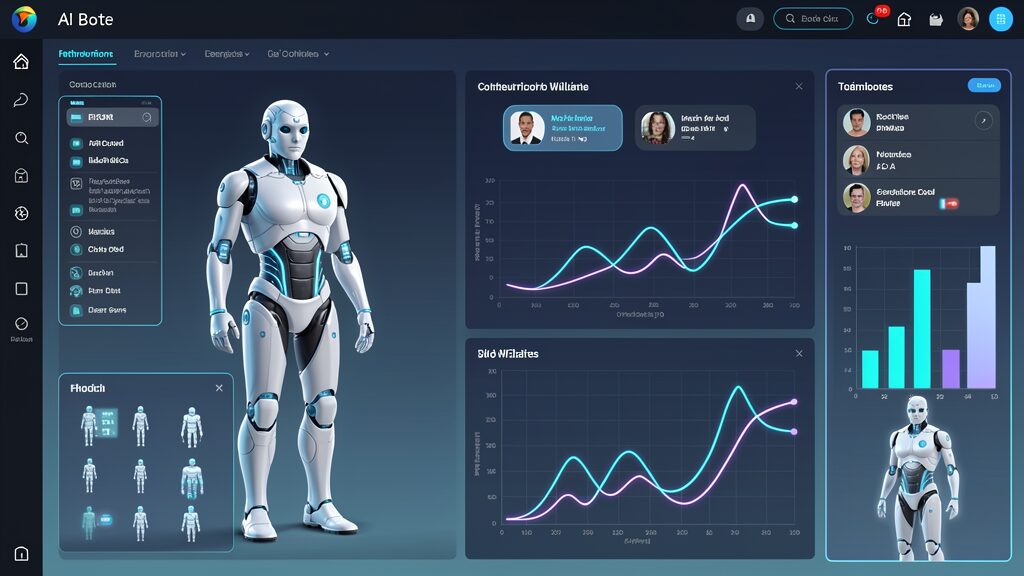
Agentic AI bots represent a revolutionary leap in artificial intelligence technology. Unlike traditional AI systems that simply respond to prompts, an agentic AI bot can independently plan, execute, and refine complex tasks. For scientists working in laboratories, this means having a digital assistant that understands research objectives and can communicate directly with robotic systems to carry out experiments.
Learn more about AI Automation. Learn more about Robotics Services. Read more on Nature
These autonomous AI agents combine advanced natural language processing with sophisticated reasoning capabilities. They can interpret scientific instructions, translate them into precise robotic commands, and adapt their approach based on real-time feedback from laboratory equipment. This capability is transforming how researchers design and conduct experiments across multiple scientific disciplines.
Understanding Autonomous AI Agents
Autonomous AI agents are software systems that can perceive their environment, make decisions, and take actions to achieve specific goals without continuous human intervention. An agentic AI bot takes this concept further by incorporating multi-step reasoning, memory of past interactions, and the ability to coordinate with physical robotic systems. This makes them particularly valuable in laboratory settings where precision and repeatability are paramount.
Key Differences from Traditional AI
Traditional AI systems, like chatbots and language models, primarily process information and generate responses. They operate in a reactive mode, waiting for human input before taking action. In contrast, an agentic AI bot is proactive—it can initiate actions, monitor progress, and adjust strategies autonomously. This fundamental difference enables agentic AI bots to manage entire experimental workflows from start to finish.
Why Scientists Need Agentic AI Bots
Modern scientific research demands increasingly complex experimental setups that require precise coordination of multiple instruments and procedures. Scientists spend countless hours programming robots, monitoring experiments, and
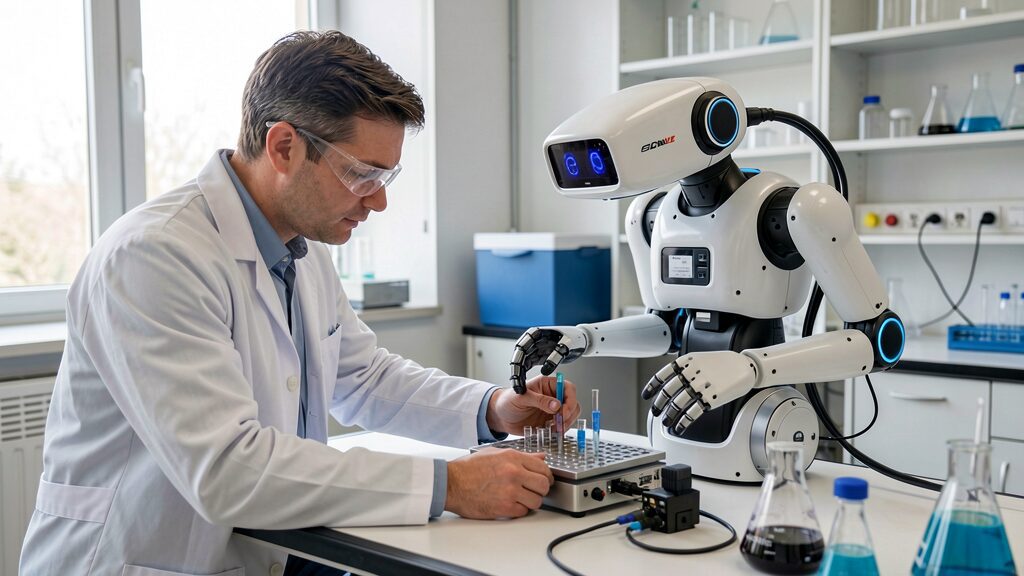
collecting data—tasks that could be streamlined significantly with an agentic AI bot. By automating routine experimental procedures, researchers can focus on higher-level analysis, hypothesis generation, and creative problem-solving.
How Agentic AI Bots Communicate with Robots
The ability of an agentic AI bot to communicate effectively with robotic systems is what makes laboratory automation truly transformative. This communication happens through sophisticated natural language processing (NLP) systems that can interpret scientific instructions and translate them into executable robotic commands.
Natural Language Processing in Robotics
Modern NLP systems enable agentic AI bots to understand complex scientific instructions expressed in everyday language. When a scientist says “prepare a serial dilution of the sample and run spectrophotometric analysis,” the agentic AI bot parses this instruction, identifies the required steps, and generates the appropriate robotic commands. This eliminates the need for scientists to learn specialized programming languages or robotic control interfaces.
Command Translation and Execution
The command translation process involves several sophisticated steps. First, the agentic AI bot analyzes the scientific instruction to identify key operations and parameters. Next, it maps these operations to specific robotic capabilities and available laboratory equipment. Finally, it generates optimized execution sequences that account for dependencies, safety constraints, and equipment limitations. This entire process happens in seconds, enabling rapid experiment iteration.
Real-Time Feedback Systems
Effective communication requires two-way information flow. An agentic AI bot doesn’t just send commands—it continuously monitors robotic performance and experimental outcomes. If a robot encounters an obstacle or an experiment produces unexpected results, the agentic AI bot can adjust its appr

oach in real-time. This adaptive capability ensures experiments proceed smoothly even when conditions change.
Multi-Robot Coordination
Advanced laboratories often employ multiple robotic systems working in concert. An agentic AI bot can coordinate these systems, assigning tasks based on availability, expertise, and current workload. For example, one robot might handle sample preparation while another performs analysis, with the agentic AI bot managing the handoff between processes to maximize throughput.
Accelerating Laboratory Experiments with AI
The integration of an agentic AI bot into laboratory workflows dramatically accelerates the pace of scientific discovery. By automating routine procedures and enabling rapid experiment iteration, researchers can explore more hypotheses in less time.
Automated Experiment Design
An agentic AI bot can assist in designing experiments by analyzing existing literature, identifying optimal parameters, and suggesting experimental protocols. It can automatically set up multi-factor experiments that would be impractical to run manually, exploring vast parameter spaces systematically. This capability is particularly valuable in fields like materials science, where thousands of material combinations need testing.
Rapid Data Collection and Analysis
Traditional experiments often involve manual data recording and analysis, which introduces delays and potential errors. An agentic AI bot automates data collection from laboratory instruments, performs real-time quality checks, and begins preliminary analysis while experiments are still running. This immediate feedback loop allows researchers to adjust experimental parameters on the fly, optimizing results without waiting for post-experiment processing.
Reducing Human Error
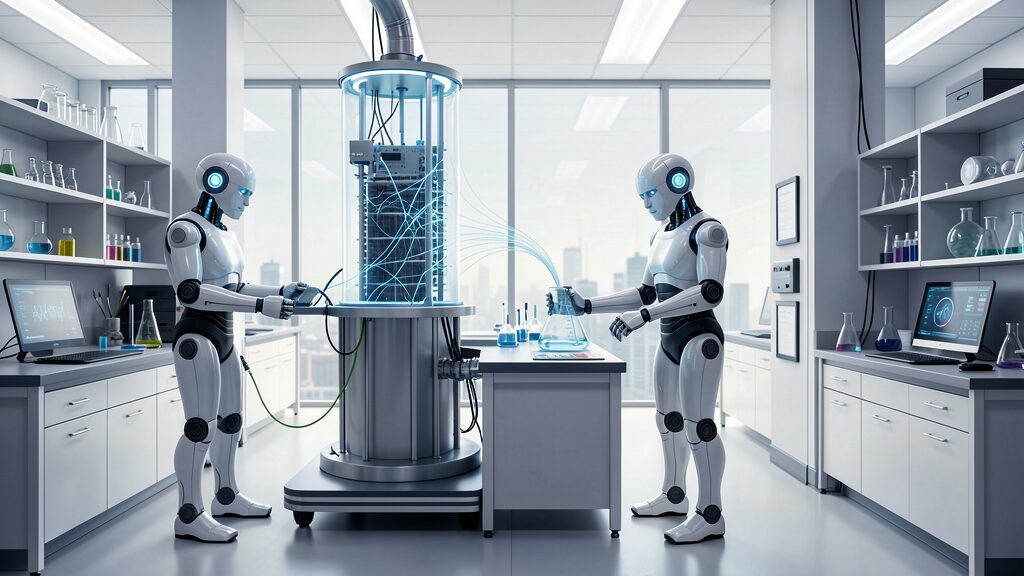
in Procedures
Human error remains one of the biggest sources of variability in scientific research. Pipetting mistakes, timing inconsistencies, and documentation errors can compromise experimental results. An agentic AI bot eliminates these sources of error by executing procedures with mechanical precision. Every step is performed consistently, ensuring high-quality, reproducible results.
24/7 Laboratory Operations
Unlike human researchers who need rest, an agentic AI bot can operate laboratory robots around the clock. This continuous operation capability means experiments that would take weeks with human supervision can be completed in days. The ability to run experiments overnight or over weekends significantly accelerates research timelines and increases laboratory throughput.
Real-World Applications in Scientific Research
Agentic AI bots are already making significant impacts across multiple scientific disciplines. Their ability to communicate with robots and automate complex procedures is opening new frontiers in research.
Pharmaceutical Research and Drug Discovery
In pharmaceutical research, an agentic AI bot can automate compound screening, optimize formulation conditions, and manage complex multi-step synthesis procedures. Drug discovery involves testing thousands of compounds against biological targets—a process that benefits enormously from robotic automation. Agentic AI bots can design and execute these screening campaigns, analyze results, and suggest next compounds to test based on emerging patterns.
Materials Science and Chemistry
Materials scientists use agentic AI bots to automate the synthesis and characterization of new materials. These AI systems can explore vast compositional spaces, identifying promising material formulations that would be impossible for humans to test exhaustively. In chemistry, agentic AI bots manage complex reaction conditions, optimize yields, and ensure safety protocols are followed throughout experiments.
Biological and Genetic Research
Biology laboratories benefit from agentic AI bots in areas like high-throughput screening, cell culture management, and genetic analysis. These AI systems can handle delicate biological samples with precision, maintain sterile conditions, and track experimental variables across thousands of samples. This capability is accelerating research in genomics, proteomics, and personalized medicine.
Environmental Monitoring
Environmental scientists deploy agentic AI bots to manage autonomous monitoring systems that collect data from field sensors, water sampling robots, and atmospheric measurement equipment. These AI systems can correlate data from multiple sources, identify anomalies, and trigger follow-up investigations automatically. This continuous monitoring capability is essential for understanding complex environmental systems.
Benefits of AI-Driven Laboratory Automation
The adoption of an agentic AI bot in laboratory settings delivers substantial benefits across multiple dimensions of research operations.
Increased Research Speed and Efficiency
Perhaps the most obvious benefit is the dramatic increase in research speed. Experiments that previously took weeks can now be completed in days or even hours. An agentic AI bot enables parallel processing of multiple experiments, optimizing resource utilization and maximizing laboratory output. This acceleration is crucial in time-sensitive research areas like pandemic response and climate change mitigation.
Cost Reduction in Laboratory Operations
While initial investment in AI and robotic systems can be significant, the long-term cost savings are substantial. Automated experiments require fewer human hours, reduce reagent waste through precise dosing, and minimize costly errors. Over time, the return on investment for an agentic AI bot system can be substantial, particularly in high-throughput research environments.
Improved Accuracy and Reproducibility
Reproducibility is a major challenge in modern science. An agentic AI bot ensures that experiments are performed with consistent precision every time, eliminating the variability introduced by human operators. This consistency improves data quality and makes it easier for other researchers to reproduce and validate findings.
Scaling Research Capabilities
An agentic AI bot enables laboratories to scale their operations without proportionally increasing staff. A single researcher can oversee multiple automated experiments running simultaneously, dramatically expanding individual productivity. This scalability is particularly valuable for small research teams that need to compete with larger institutions.
Challenges and Considerations for Implementation
While the benefits are compelling, implementing an agentic AI bot in a laboratory environment requires careful planning and consideration of several factors.
Integration with Existing Laboratory Systems
Most laboratories already have established workflows and equipment. Integrating an agentic AI bot with existing systems requires careful assessment of compatibility, data formats, and communication protocols. Successful integration often involves custom development to ensure seamless communication between the AI system and legacy laboratory equipment.
Training Scientists to Work with AI Bots
Scientists need to develop new skills to effectively collaborate with agentic AI bots. This includes understanding AI capabilities and limitations, learning to formulate instructions that AI systems can execute, and developing intuition for when to trust automated decisions versus applying human judgment. Comprehensive training programs are essential for successful adoption.
Data Security and Privacy Concerns
AI systems that communicate with robots and collect experimental data raise important security considerations. Sensitive research data must be protected from unauthorized access, and robotic systems must be secured against potential cyber threats. Laboratories implementing agentic AI bots need robust cybersecurity measures and clear data governance policies.
Regulatory Compliance and Standards
Certain research areas, particularly in pharmaceuticals and clinical research, operate under strict regulatory frameworks. Automated experiments must meet validation requirements and maintain comprehensive audit trails. An agentic AI bot system must be designed to comply with relevant regulations, including Good Laboratory Practice (GLP) standards where applicable.
The Future of AI and Robotics in Research
The convergence of agentic AI bots and robotics represents just the beginning of a transformation in how scientific research is conducted. Several trends point to even more dramatic changes in the coming years.
Emerging Trends in Autonomous Research
Future agentic AI bots will become increasingly sophisticated in their ability to design and execute novel experiments. They will incorporate deeper domain knowledge, better understanding of scientific principles, and enhanced creative problem-solving capabilities. Some researchers envision fully autonomous laboratories where AI systems identify research questions, design experiments, and generate new scientific knowledge with minimal human intervention.
AI-Human Collaboration Models
The most effective research environments will likely feature close collaboration between human scientists and agentic AI bots. Humans excel at creative thinking, contextual understanding, and ethical judgment, while AI systems excel at pattern recognition, data processing, and precise execution. The future of research lies in leveraging the complementary strengths of both.
Predictions for the Next Decade
Over the next decade, we can expect agentic AI bots to become standard tools in research laboratories worldwide. The cost of AI and robotic systems will continue to decrease, making them accessible to smaller institutions. We may see the emergence of “cloud laboratories” where researchers remotely design experiments that are executed by AI-managed robotic systems anywhere in the world.
Ethical Considerations in AI Research
As AI systems take on more autonomous roles in research, important ethical questions arise. Who is responsible for errors in AI-conducted experiments? How do we ensure AI systems are used for beneficial research rather than harmful applications? These questions require thoughtful consideration from the scientific community, policymakers, and ethicists as the technology evolves.
How Progressive Robot Can Help Your Lab Adopt AI
At Progressive Robot, we specialize in helping organizations harness the power of AI and robotics to transform their operations. Our expertise in AI automation and robotic systems positions us to help your laboratory capitalize on the opportunities presented by agentic AI technology.
Our AI and Robotics Expertise
Our team brings deep expertise in artificial intelligence, machine learning, and robotic automation. We have successfully implemented AI-driven solutions across multiple industries, from manufacturing to healthcare. Our understanding of both the technical and practical aspects of AI implementation ensures that your laboratory can adopt agentic AI technology smoothly and effectively.
Custom Laboratory Automation Solutions
Every laboratory has unique requirements, and we develop custom solutions tailored to your specific needs. Whether you need to automate a single experimental procedure or transform your entire laboratory workflow, our team can design and implement systems that deliver maximum value. We work closely with your scientists to understand their research objectives and develop AI solutions that enhance their capabilities.
Implementation and Support Services
Implementing an agentic AI bot system involves more than just installing software and robots. Our comprehensive implementation services include needs assessment, system design, integration, testing, training, and ongoing support. We ensure that your team is fully prepared to use the new systems effectively and that the technology delivers the promised benefits.
Getting Started with AI-Powered Research
If you’re interested in exploring how an agentic AI bot can accelerate your research, we’d love to hear from you. Contact our team to discuss your laboratory’s needs and explore how our AI and robotics expertise can help you achieve your research goals faster and more efficiently than ever before.
Real-World Applications of Agentic AI in Research
The practical applications of an agentic AI bot extend far beyond theoretical concepts. Researchers across multiple disciplines are already experiencing the transformative power of autonomous AI systems in their daily work. From drug discovery to materials science, these intelligent systems are accelerating breakthroughs that would have taken years or decades just a few years ago.
Drug Discovery and Development
Pharmaceutical research represents one of the most promising domains for agentic AI automation. Traditional drug discovery involves screening thousands of compounds, analyzing molecular interactions, and optimizing formulations through iterative experimentation. An agentic AI bot can coordinate robotic systems to perform these experiments continuously, analyzing results in real-time and adjusting protocols without human intervention. This capability dramatically reduces the time from initial hypothesis to validated results.
Recent studies have demonstrated that AI-driven drug discovery platforms can identify promising compound candidates in weeks rather than months. When combined with autonomous robotic laboratories, these systems can validate findings through physical experimentation, creating a closed-loop research process that continuously generates and tests new hypotheses.
Materials Science Innovation
The development of new materials with specific properties requires extensive experimentation with different compositions, processing conditions, and structural configurations. Agentic AI systems can design experimental matrices, operate synthesis equipment, characterize resulting materials, and refine their approach based on observed outcomes. This autonomous approach enables researchers to explore vast chemical spaces that would be impossible to investigate manually.
Research institutions utilizing autonomous AI laboratories have reported discovering novel materials with enhanced properties in significantly shorter timeframes compared to traditional research approaches. The ability of an agentic AI bot to maintain consistency across thousands of experiments while adapting to unexpected results makes it an invaluable research partner.
Benefits of Autonomous AI Research Systems
Understanding why an agentic AI bot represents such a significant advancement requires examining the specific benefits these systems bring to scientific research. The advantages extend beyond simple time savings to encompass improved accuracy, reproducibility, and the ability to explore research spaces that were previously inaccessible.
Enhanced Experimental Reproducibility
One of the persistent challenges in scientific research is ensuring that experiments can be reproduced consistently across different laboratories and time periods. Human researchers may introduce subtle variations in technique, timing, or environmental conditions that affect outcomes. An agentic AI bot performs experiments with machine-level precision, ensuring that every parameter is controlled exactly as specified.
This reproducibility is crucial for building reliable scientific knowledge and for enabling other researchers to validate findings. When an agentic AI bot documents every aspect of an experiment and executes protocols with consistent precision, it creates a level of transparency and reliability that strengthens the scientific process.
24/7 Research Capability
Human researchers require rest, and traditional laboratory operations are typically limited to working hours. An agentic AI bot operating with robotic systems can conduct experiments continuously, collecting data and generating insights around the clock. This continuous operation multiplies research output without requiring proportional increases in resources or personnel.
Laboratories equipped with autonomous AI systems have reported achieving research throughput increases of 10x to 100x compared to traditional approaches. The ability to run hundreds of experiments simultaneously, each optimized based on results from previous runs, creates exponential rather than linear research progress.
Data-Driven Decision Making
Agentic AI systems excel at processing and analyzing the vast amounts of data generated during complex experiments. Machine learning algorithms can identify patterns, correlations, and anomalies that might escape human observation. When integrated with autonomous robotic systems, these analytical capabilities enable real-time experimental optimization, where each iteration builds intelligently on previous results.
This data-driven approach transforms research from a hypothesis-testing exercise into a continuous learning process. An agentic AI bot can generate new hypotheses based on observed patterns, design experiments to test them, and refine its understanding through iterative experimentation, all without human direction.
Challenges and Considerations
While the potential of an agentic AI bot to transform scientific research is enormous, several challenges and considerations must be addressed to ensure successful implementation and responsible use of these powerful systems.
Initial Investment and Infrastructure
Implementing autonomous AI research systems requires significant investment in hardware, software, and personnel training. Robotic laboratory equipment, high-performance computing resources, and specialized AI software represent substantial capital expenditures. Additionally, organizations must develop the infrastructure needed to support continuous automated operations, including reliable power, environmental controls, and safety systems.
However, the return on investment for these systems is often realized within months through accelerated research timelines and reduced labor costs. Organizations that have adopted autonomous AI research capabilities report payback periods ranging from 6 to 18 months, depending on the scale of implementation and research intensity.
Skill Requirements and Training
Working effectively with agentic AI systems requires a different skill set than traditional laboratory work. Researchers need to understand AI system capabilities and limitations, be able to formulate research problems in ways that autonomous systems can address, and possess the analytical skills to interpret AI-generated results. Training programs and interdisciplinary collaboration are essential for building these capabilities.
The most successful implementations involve teams that combine domain expertise in specific scientific fields with AI and robotics knowledge. This interdisciplinary approach ensures that autonomous systems are applied to well-defined research problems and that results are properly validated and interpreted.
Ethical and Safety Considerations
As autonomous AI systems take on more complex research tasks, important ethical and safety questions arise. Researchers must ensure that AI systems operate within appropriate safety boundaries, particularly when working with hazardous materials or complex biological systems. Clear protocols for human oversight, emergency intervention, and ethical decision-making are essential components of any autonomous research implementation.
Additionally, the scientific community must address questions about authorship and credit when AI systems contribute significantly to research discoveries. Establishing clear guidelines for acknowledging AI system contributions while maintaining scientific integrity is an ongoing challenge that requires input from researchers, institutions, and policymakers.
The Future of AI-Driven Scientific Research
The evolution of agentic AI bots and autonomous research systems points toward a future where human scientists and AI systems work in increasingly sophisticated partnerships. This collaboration will amplify human creativity and intuition while leveraging the precision, speed, and analytical power of artificial intelligence.
Emerging Trends and Developments
Several emerging trends are likely to accelerate the adoption and capabilities of agentic AI systems in research. Multi-agent systems, where multiple AI bots coordinate to tackle complex research problems, are already showing promise in fields requiring diverse expertise. Federated learning approaches enable AI systems to learn from distributed data sources while preserving privacy and security.
Advances in natural language processing are making it easier for researchers to communicate with AI systems using everyday language, reducing the technical barriers to adoption. Similarly, improvements in robotic dexterity and perception are expanding the range of experiments that autonomous systems can perform, from simple liquid handling to complex surgical procedures and delicate material manipulations.
Collaborative Research Networks
The future of agentic AI research extends beyond individual laboratories to encompass global collaborative networks. AI systems can coordinate experiments across multiple facilities, share findings in real-time, and build comprehensive knowledge bases that accelerate progress across entire research communities. This interconnected approach has the potential to dramatically reduce duplication of effort and accelerate the translation of discoveries into practical applications.
International initiatives are already exploring the creation of shared autonomous research infrastructure, where laboratories equipped with agentic AI systems can be accessed remotely by researchers worldwide. Such networks would democratize access to cutting-edge research capabilities and enable collaboration on problems of global significance.
Getting Started with Agentic AI Research
For research organizations considering the adoption of agentic AI systems, a strategic approach to implementation can maximize benefits while minimizing risks and disruption to ongoing research programs.
Assessment and Planning
The first step is conducting a thorough assessment of research needs, existing infrastructure, and organizational readiness. Identify specific research challenges that would benefit most from autonomous AI assistance, evaluate the compatibility of current laboratory systems with AI integration, and develop a roadmap for gradual implementation that builds capability over time.
Engaging with AI vendors and technology providers early in the planning process can provide valuable insights into available capabilities, implementation requirements, and best practices from organizations that have already adopted similar systems.
Starting Small and Scaling Up
Successful implementations typically begin with focused pilot projects that demonstrate value in specific research areas before expanding to broader applications. Start with well-defined experiments that have clear success criteria, measure outcomes carefully, and use these early wins to build organizational support and secure funding for larger investments.
As confidence and capability grow, organizations can expand the scope and complexity of autonomous research operations, eventually achieving comprehensive AI-driven research programs that transform how scientific discovery happens.










