
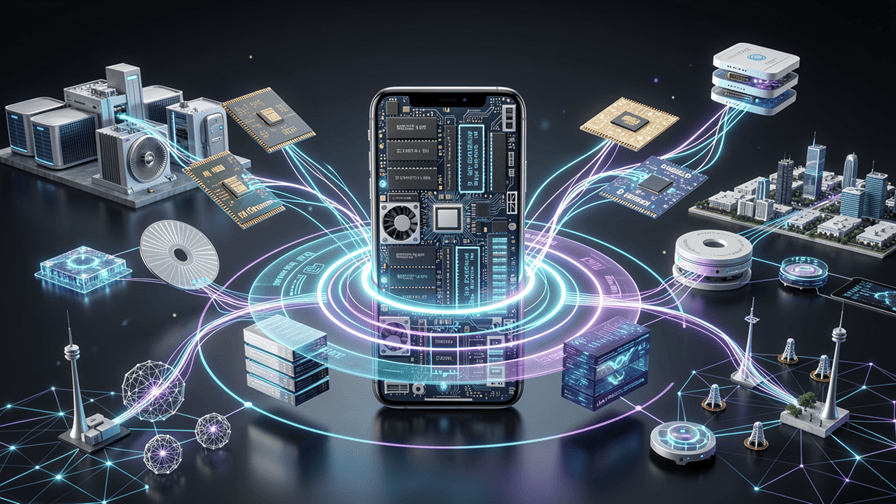
Artificial intelligence is rapidly transforming the global smartphone industry. While consumers often focus on new AI-powered features such as intelligent photo editing, real-time translation, voice assistants, on-device image generation, and advanced productivity tools, manufacturers face an equally important challenge behind the scenes—memory capacity. Modern AI applications require significantly more RAM, faster storage, and higher memory bandwidth than traditional mobile software, creating new pressure across the smartphone supply chain.
The growing discussion around AI Smartphone Memory highlights how AI adoption is influencing hardware decisions throughout India’s smartphone market. As device manufacturers race to deliver increasingly sophisticated AI capabilities, demand for high-performance memory components has surged, affecting production costs, smartphone pricing, supply chains, and future device specifications.
Unlike earlier generations of smartphones that relied primarily on cloud computing, today’s AI-enabled devices increasingly perform complex processing directly on the device. This allows users to experience faster responses, improved privacy, offline functionality, and reduced latency. However, these advantages also require significantly greater memory resources, making AI Smartphone Memory one of the most important hardware considerations for manufacturers.
India has become one of the world’s largest smartphone markets, with millions of consumers upgrading their devices every year. According to Counterpoint Research’s India Smartphone Tracker, India remains one of the fastest-growing smartphone markets, with AI features increasingly influencing consumer purchasing decisions. As AI becomes a standard feature across flagship, mid-range, and eventually entry-level smartphones, memory suppliers, semiconductor manufacturers, device makers, and retailers must adapt to rapidly changing market demands.
The impact extends beyond consumers. Component suppliers, mobile chipset developers, cloud service providers, AI software companies, and smartphone manufacturers are all responding to increased demand for larger memory configurations and faster storage technologies capable of supporting advanced AI workloads.
The AI Smartphone Memory trend also reflects a broader transformation in mobile computing. Smartphones are evolving into intelligent personal assistants capable of understanding context, generating content, editing media, summarizing documents, translating languages, and assisting with productivity—all while processing increasingly complex AI models locally.
Although larger memory capacities unlock new AI experiences, they also introduce challenges involving manufacturing costs, supply chain constraints, thermal management, battery efficiency, and device affordability. Understanding these opportunities and limitations will help consumers and businesses better prepare for the next generation of AI-powered smartphones.
In this comprehensive guide, we’ll explore what AI Smartphone Memory means, how AI increases memory requirements, why India’s smartphone market is experiencing this shift, the benefits and challenges of AI-enabled devices, future trends, and what consumers can expect as mobile AI continues evolving.
Key Takeaways
- AI Smartphone Memory is increasing demand for larger RAM and faster storage.
- On-device AI processing requires significantly more memory resources.
- India’s smartphone market is rapidly adapting to AI-enabled devices.
- AI hardware requirements are influencing manufacturing and pricing.
- Future smartphones will prioritize memory alongside processors.
- AI-driven mobile computing is reshaping consumer expectations.
What Is AI Smartphone Memory?

AI Smartphone Memory refers to the increased memory capacity and storage performance required to support modern artificial intelligence features on smartphones.
Unlike conventional mobile applications, AI-powered capabilities rely on large language models, neural networks, computer vision systems, multimodal AI, and intelligent assistants that consume considerably more RAM and storage resources.
Manufacturers are therefore equipping devices with larger memory configurations to ensure smooth AI performance while maintaining responsive multitasking and battery efficiency.
The AI Smartphone Memory trend reflects the growing importance of hardware optimization as AI becomes central to everyday smartphone experiences.
Why AI Requires More Smartphone Memory
Artificial intelligence processes significantly larger amounts of information than traditional mobile applications.
Modern AI workloads may include:
- On-device language models.
- AI image generation.
- Intelligent photo editing.
- Voice recognition.
- Real-time translation.
- Predictive text generation.
- Computer vision.
- Personal AI assistants.
These capabilities require high-speed memory to load, execute, and manage complex AI models efficiently.
As a result, the AI Smartphone Memory trend is becoming a defining factor in future smartphone hardware design.
How AI Smartphone Memory Works

The AI Smartphone Memory ecosystem is built around the growing demand for intelligent mobile computing. Unlike traditional smartphone applications that primarily execute simple instructions, modern AI features continuously process images, language, voice, video, and contextual information using complex neural networks. These workloads require substantially more RAM, faster storage, higher memory bandwidth, and efficient data management to deliver smooth user experiences.
As smartphone manufacturers increasingly integrate generative AI, multimodal AI, computer vision, and intelligent assistants directly into mobile devices, memory becomes one of the most critical hardware components. The AI Smartphone Memory trend reflects the industry’s transition from cloud-dependent AI toward powerful on-device intelligence capable of operating faster, more privately, and even without continuous internet connectivity.
Modern smartphones now balance processors, neural processing units (NPUs), graphics processors (GPUs), RAM, storage, and software optimization to create responsive AI experiences.
Larger RAM for AI Processing
Artificial intelligence models require considerably more working memory than conventional mobile applications.
The AI Smartphone Memory trend has encouraged manufacturers to introduce smartphones with larger RAM configurations capable of supporting multiple AI workloads simultaneously.
Higher RAM enables devices to:
- Run large language models.
- Support AI assistants.
- Improve multitasking.
- Process images faster.
- Handle real-time translation.
- Manage AI editing tools.
- Reduce application reloads.
- Improve overall responsiveness.
As AI capabilities expand, memory capacity will continue becoming a key differentiator between smartphone models.
Faster Storage Technologies
RAM alone cannot support modern AI experiences.
The AI Smartphone Memory ecosystem also relies on high-speed storage capable of rapidly loading AI models and application data.
Modern smartphones increasingly use advanced flash storage technologies that improve:
- Application loading.
- AI model initialization.
- File transfers.
- Photo processing.
- Video editing.
- System responsiveness.
- Background operations.
- Data retrieval.
Faster storage reduces delays when AI applications access large datasets during processing.
On-Device AI Inference
One of the most important developments driving the AI Smartphone Memory trend is on-device AI inference.
Instead of sending every request to cloud servers, smartphones increasingly perform AI computations locally.
On-device processing offers several advantages:
- Lower latency.
- Better privacy.
- Offline functionality.
- Faster responses.
- Reduced cloud dependence.
- Lower bandwidth usage.
- Improved reliability.
- Enhanced personalization.
These benefits require larger memory resources because AI models remain loaded directly on the device.
Memory Optimization
Smartphone operating systems increasingly optimize memory specifically for AI applications.
The AI Smartphone Memory architecture may include intelligent resource management techniques such as:
- Dynamic memory allocation.
- AI workload prioritization.
- Background optimization.
- Intelligent caching.
- Memory compression.
- Efficient application switching.
- Predictive resource allocation.
- Adaptive system management.
These optimizations improve AI performance without unnecessarily increasing power consumption.
AI Hardware Integration
Modern smartphones combine several specialized processors that work together.
The AI Smartphone Memory ecosystem integrates:
- Central Processing Units (CPU).
- Graphics Processing Units (GPU).
- Neural Processing Units (NPU).
- Digital Signal Processors (DSP).
- AI accelerators.
- High-speed RAM.
- Flash storage.
- Memory controllers.
Efficient communication between these components enables advanced AI features to operate smoothly.
Benefits of AI Smartphone Memory
Greater memory capacity provides numerous advantages for both manufacturers and consumers.
Key benefits include:
- Faster AI processing.
- Better multitasking.
- Improved photo editing.
- More responsive AI assistants.
- Enhanced gaming performance.
- Longer software lifespan.
- Better productivity.
- Future-ready hardware.
The AI Smartphone Memory trend allows smartphones to support increasingly sophisticated AI capabilities while maintaining smooth overall performance.
Industry Applications
The impact of AI Smartphone Memory extends across the entire mobile technology ecosystem.
Smartphone Manufacturing
Manufacturers design new hardware capable of supporting larger AI models and future software updates.
Mobile Photography
AI-powered cameras perform advanced image enhancement, object recognition, and computational photography.
Productivity
AI assists with writing, scheduling, translation, summarization, and document management.
Mobile Gaming
Intelligent graphics optimization and AI-enhanced gameplay benefit from higher memory capacity.
Enterprise Mobility
Businesses increasingly deploy AI-powered smartphones for secure productivity, customer engagement, and workflow automation.
Consumer Applications
Everyday users benefit from intelligent assistants, personalized recommendations, voice interaction, and offline AI features.
Challenges and Limitations of AI Smartphone Memory

Although the AI Smartphone Memory trend is enabling a new generation of intelligent mobile experiences, it also introduces several technical, economic, and manufacturing challenges. As artificial intelligence becomes a standard feature across smartphones, manufacturers must balance performance, affordability, battery efficiency, thermal management, and long-term scalability.
Modern AI workloads consume significantly more hardware resources than conventional mobile applications. Running language models, computer vision systems, AI assistants, image generation tools, and real-time translation directly on smartphones requires larger RAM capacities, faster storage, more powerful chipsets, and advanced cooling technologies. Meeting these requirements while maintaining competitive pricing remains one of the industry’s biggest engineering challenges.
For India’s highly competitive smartphone market, where affordability remains a major purchasing factor, the AI Smartphone Memory transition requires manufacturers to deliver advanced AI capabilities without making devices prohibitively expensive.
Rising Manufacturing Costs
One of the most significant challenges behind the AI Smartphone Memory trend is the increasing cost of premium memory components.
As demand grows for higher-capacity RAM and faster flash storage, manufacturers may face:
- Increased component costs.
- Higher production expenses.
- Supply shortages.
- Greater inventory management complexity.
- More expensive flagship devices.
- Reduced profit margins.
- Component price volatility.
- Longer production cycles.
These factors may eventually influence smartphone retail prices, particularly in AI-enabled premium devices.
Global Memory Supply Constraints
The growing popularity of AI smartphones is increasing pressure on the global semiconductor supply chain.
Memory manufacturers must now serve demand from multiple industries including:
- Smartphones.
- AI servers.
- Data centers.
- Personal computers.
- Automotive technology.
- Industrial automation.
- Cloud infrastructure.
- Consumer electronics.
As competition for advanced memory chips increases, supply chain disruptions could affect smartphone production schedules and product availability.
Battery Consumption
Artificial intelligence requires continuous computational activity.
Although specialized AI processors improve efficiency, larger AI workloads may still increase power consumption.
The AI Smartphone Memory ecosystem must balance:
- AI performance.
- Battery life.
- Background processing.
- Thermal efficiency.
- Resource management.
- Power optimization.
- Charging speed.
- Overall device endurance.
Manufacturers continue developing more efficient hardware and software to minimize AI-related battery impact.
Heat Management
Running advanced AI models directly on smartphones generates additional heat.
The AI Smartphone Memory architecture therefore depends on improved thermal management technologies.
Manufacturers increasingly implement:
- Vapor chambers.
- Graphite cooling layers.
- Thermal interface materials.
- Intelligent workload balancing.
- AI power optimization.
- Dynamic frequency control.
- Efficient chip design.
- Adaptive cooling systems.
Maintaining stable performance during extended AI workloads remains an important engineering priority.
Software Optimization
Additional memory alone does not guarantee better AI experiences.
The AI Smartphone Memory trend also requires software developers to optimize applications for available hardware resources.
Poor optimization may result in:
- Slower AI responses.
- Excessive memory usage.
- Background process conflicts.
- Higher battery consumption.
- Reduced multitasking performance.
- Storage inefficiencies.
- Application instability.
- Inconsistent user experiences.
Effective software engineering remains just as important as hardware improvements.
Consumer Upgrade Costs
As AI features become more demanding, consumers may need newer smartphones with larger memory capacities.
This creates challenges including:
- Higher upgrade costs.
- Faster device replacement cycles.
- Increased electronic waste.
- Greater affordability concerns.
- Market segmentation.
- Unequal AI access.
- Budget device limitations.
- Consumer purchasing decisions.
The AI Smartphone Memory transition may therefore influence long-term smartphone ownership patterns.
Best Practices When Buying AI Smartphones
Consumers can maximize the benefits of AI-ready devices by considering several important factors.
Prioritize RAM Capacity
Choose smartphones with sufficient RAM to support future AI software updates and multitasking performance.
Select Faster Storage
High-performance storage improves application responsiveness, AI processing, and overall system speed.
Evaluate Software Support
Long-term software updates help ensure compatibility with future AI capabilities.
Compare AI Features
Different manufacturers implement AI differently, making it important to evaluate practical functionality rather than marketing claims alone.
Balance Price and Performance
Select hardware that offers enough memory and processing power without exceeding your actual usage requirements.
The Evolution of Mobile AI Hardware
The AI Smartphone Memory trend represents a broader evolution in smartphone engineering.
Future mobile hardware is expected to prioritize:
- Larger memory capacities.
- Faster storage.
- AI accelerators.
- Efficient neural processors.
- Better battery optimization.
- Advanced thermal management.
- On-device intelligence.
- Scalable AI performance.
These improvements will enable smartphones to perform increasingly sophisticated AI tasks while maintaining efficient everyday operation.
The Future of AI Smartphone Memory

The AI Smartphone Memory trend is expected to reshape smartphone hardware over the coming decade as artificial intelligence becomes one of the primary drivers of mobile innovation. Instead of viewing RAM and storage as simple hardware specifications, manufacturers are increasingly treating memory as a critical foundation for delivering advanced AI experiences. Larger memory capacities, faster storage technologies, and intelligent resource management will become essential for supporting increasingly capable on-device AI systems.
As foundation models become smaller and more efficient, smartphones will execute more AI workloads locally rather than relying exclusively on cloud services. This evolution will allow users to experience faster responses, stronger privacy protections, improved personalization, and reliable offline functionality. The AI Smartphone Memory ecosystem will therefore continue evolving alongside advances in processors, neural processing units, and software optimization.
Future smartphones are likely to integrate dedicated AI hardware capable of dynamically allocating memory resources based on workload requirements. Intelligent operating systems will predict user behavior, preload AI models, optimize background memory usage, and automatically balance performance with battery efficiency. These improvements will make AI features feel increasingly seamless while reducing overall resource consumption.
India’s smartphone market is expected to play a major role in this transformation. As one of the world’s largest mobile markets, India will continue influencing global smartphone design, pricing strategies, manufacturing priorities, and memory component demand. Smartphone vendors serving Indian consumers will increasingly compete by offering better AI capabilities supported by larger memory configurations across flagship, mid-range, and eventually budget devices.
Future developments may include:
- Larger default RAM capacities.
- Faster next-generation storage technologies.
- More powerful neural processing units.
- AI-optimized operating systems.
- Intelligent memory management.
- Personalized on-device AI assistants.
- Enhanced multimodal AI capabilities.
- Greater offline AI functionality.
The AI Smartphone Memory transition represents a long-term evolution in mobile computing rather than a temporary hardware trend.
Strategic Takeaways
The AI Smartphone Memory movement demonstrates how artificial intelligence is transforming smartphone hardware as much as software.
Key insights include:
- AI Smartphone Memory is becoming a fundamental requirement for modern AI-enabled smartphones.
- Larger RAM and faster storage improve AI responsiveness and multitasking.
- On-device AI processing increases privacy while reducing cloud dependence.
- India’s smartphone market is accelerating demand for AI-ready hardware.
- Memory optimization will become increasingly important alongside processor performance.
- Future smartphones will prioritize AI capability as a core purchasing consideration.
Conclusion
The AI Smartphone Memory trend reflects a significant transformation in the smartphone industry as artificial intelligence becomes central to everyday mobile experiences. From intelligent assistants and real-time translation to AI-powered photography, productivity, and content generation, modern smartphones increasingly depend on larger memory capacities and faster storage to deliver responsive performance.
While greater memory requirements introduce manufacturing challenges, higher component costs, and supply chain pressures, they also create opportunities for more capable and personalized mobile computing. As smartphone manufacturers continue optimizing hardware and software together, users can expect AI experiences to become faster, smarter, more secure, and increasingly independent of cloud connectivity.
India’s rapidly growing smartphone market will remain an important catalyst for this evolution, encouraging manufacturers to develop AI-capable devices that balance performance, affordability, and efficiency. Organizations throughout the semiconductor, mobile hardware, and AI software ecosystems will continue investing heavily in technologies that support the next generation of intelligent smartphones.
Ultimately, the AI Smartphone Memory revolution is not only about adding more RAM or storage—it is about enabling smartphones to become truly intelligent computing platforms capable of supporting the future of mobile artificial intelligence.
Frequently Asked Questions (FAQs)
What is AI Smartphone Memory?
AI Smartphone Memory refers to the increased RAM capacity, faster storage technologies, and optimized memory management required to support advanced artificial intelligence features on smartphones.
Why do AI smartphones need more memory?
AI applications process complex language models, computer vision systems, voice recognition, and image generation, requiring significantly more memory than conventional mobile applications.
Does larger RAM improve AI performance?
Yes. More RAM enables smartphones to keep larger AI models active, improve multitasking, reduce application reloads, and provide faster AI responses.
How does AI Smartphone Memory affect India’s smartphone market?
Growing demand for AI-enabled devices is increasing demand for advanced memory components, influencing manufacturing strategies, hardware specifications, pricing, and supply chains across India’s smartphone industry.
Will future smartphones require even more memory?
Most likely. As AI capabilities become more sophisticated and more processing occurs directly on devices, future smartphones are expected to include larger RAM capacities and faster storage technologies.
Build Smarter Mobile Experiences with Artificial Intelligence
Artificial intelligence is redefining mobile computing. Whether you’re developing AI-powered mobile applications, integrating on-device intelligence, optimizing smartphone performance, or building next-generation AI solutions, our experts can help you create scalable, secure, and future-ready mobile AI experiences.
More AI coverage: explore Progressive Robot's AI Models, Tools & Releases hub — hands-on reviews, setup guides and benchmarks in one place.










