
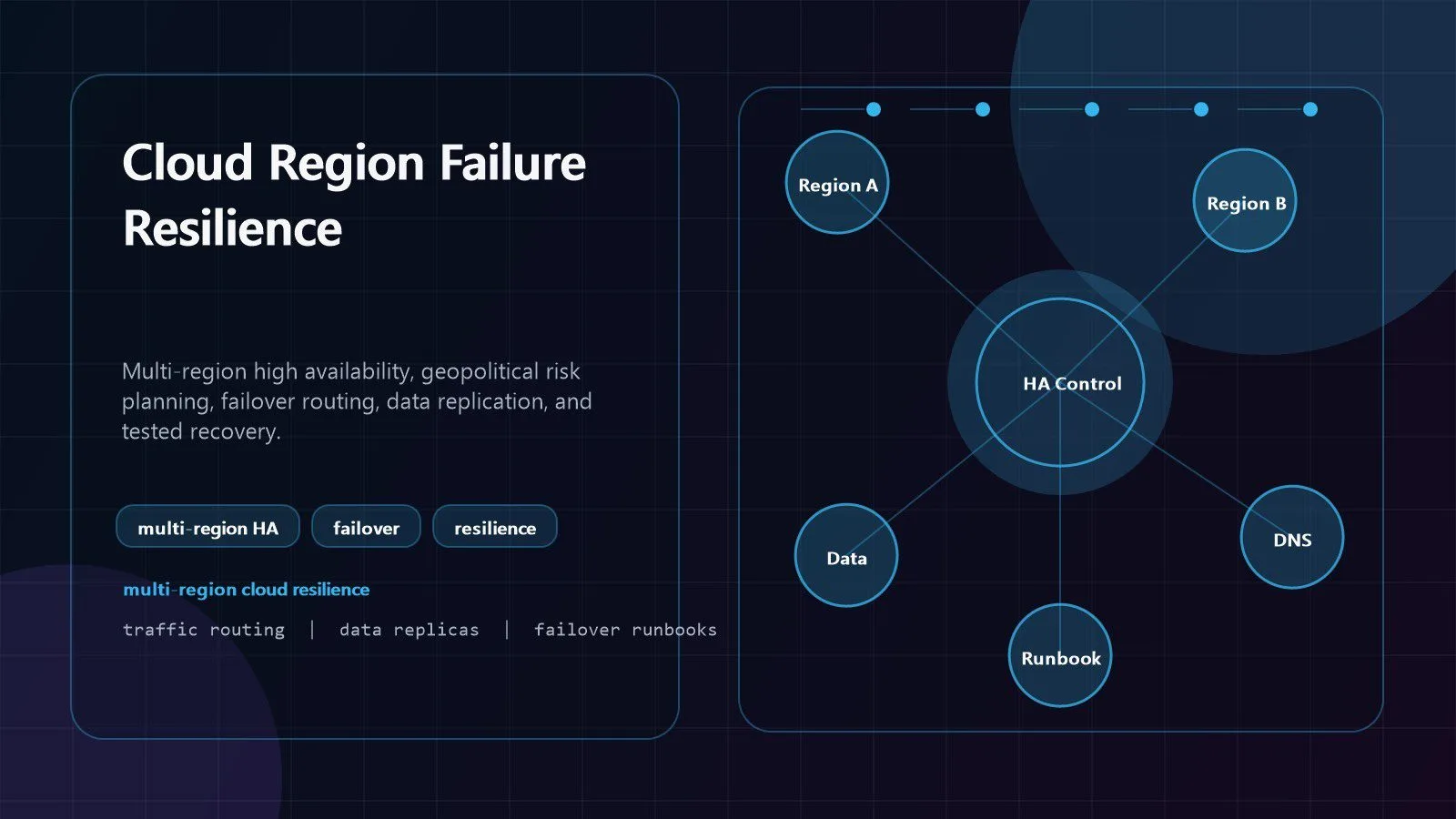
Cloud region failure used to sound like an edge case reserved for regulated banks, global platforms, and hyperscale engineering teams. That assumption is no longer safe. When a major cloud region goes dark, becomes unreachable, suffers capacity constraints, or is affected by geopolitical pressure, ordinary businesses can lose revenue, customer trust, and operational control within minutes.
The hard lesson is that high availability is not just an uptime setting inside one provider console. It is a business continuity discipline that includes architecture, data replication, failover routing, identity, vendor exposure, legal boundaries, and executive decision-making. In a geopolitically unstable world, cloud region failure planning must account for technical outages and political disruption at the same time.
This article connects practical resilience design with official guidance from Microsoft Azure reliability documentation and the Google Cloud Architecture Framework for reliability. It also connects the topic to Progressive Robot work around DevOps services, business process automation, workflow automation, and AI strategy because resilience is now part of how digital operations are designed.
| Planning question | Practical answer |
|---|---|
| What can fail? | Region power, networking, control plane APIs, storage, identity, provider capacity, or cross-border access |
| What matters first? | Customer-facing continuity, data safety, payment flows, identity access, and critical operations |
| What metric guides design? | Recovery time objective, recovery point objective, and maximum tolerable downtime |
| What is the core pattern? | Reduce blast radius, replicate data, route traffic, and rehearse failover |
| What is new? | Geopolitical risk turns cloud architecture into board-level resilience planning |
What a cloud region failure really means
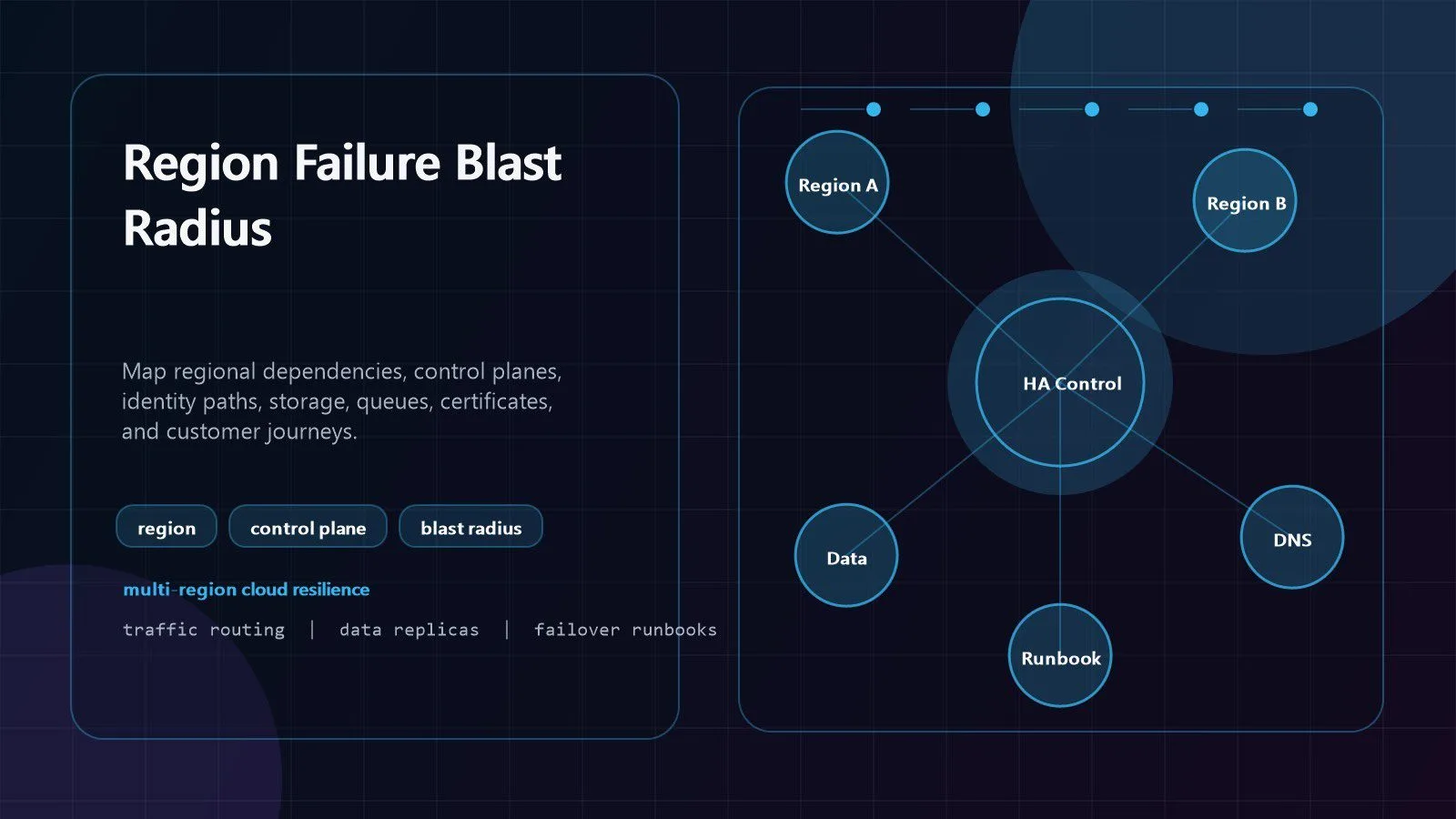
A cloud region failure does not always mean every server in a geography disappears. It can mean degraded networking, storage unavailability, a control plane incident, partial zone loss, identity service disruption, capacity exhaustion, or a dependency failure that prevents new resources from being created.
This distinction matters because many teams design for virtual machine or container failure but not for regional dependency failure. A workload might run across multiple availability zones and still rely on one regional database endpoint, one secrets service, one container registry, or one identity path.
The safest way to think about cloud region failure is as a blast-radius problem. Which business functions stop when one region becomes unavailable? Which dependencies are regional even if the application looks distributed? Which recovery steps require a control plane that might also be impaired?
That is why cloud region failure planning should be reviewed before procurement, migration, or major platform consolidation decisions are finalized.
High availability begins with an inventory of those assumptions. Teams should map applications, data stores, queues, third-party APIs, DNS records, certificates, observability tools, deployment pipelines, and privileged access paths. Without that map, failover plans are mostly hope.
Why geopolitics changes high availability planning
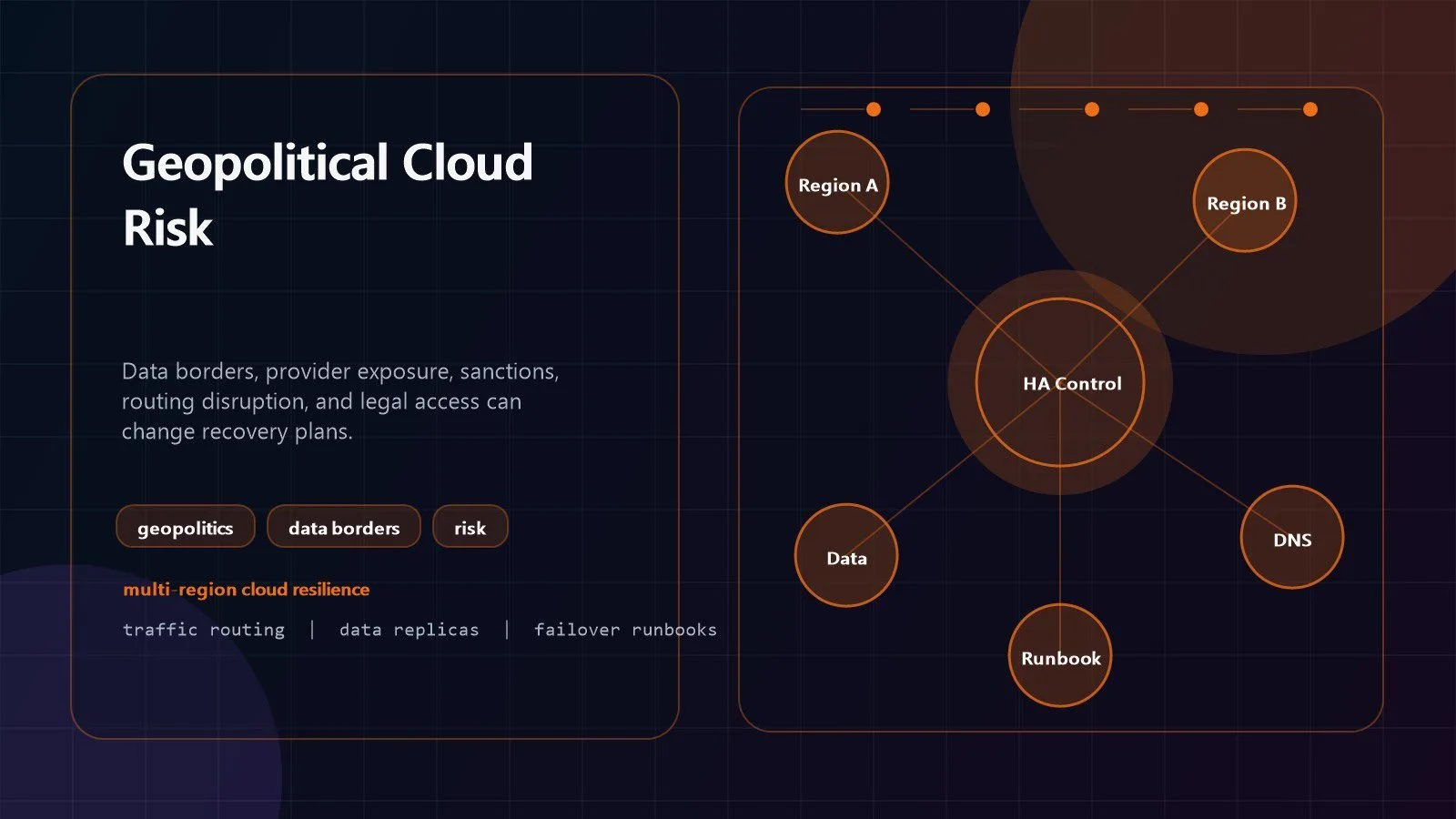
Traditional resilience planning focuses on fires, floods, fiber cuts, software defects, and human error. Those risks still matter. The newer problem is that geopolitical instability can affect cloud operations through sanctions, export controls, regional conflicts, internet fragmentation, data localization, provider restrictions, and emergency policy changes.
A cloud region failure in this context may be triggered by infrastructure damage, but it may also appear as restricted access, blocked routes, unexpected compliance constraints, or a sudden need to move data processing inside a different jurisdiction. That is not a normal uptime incident. It is an operating-model shock.
This is why critical workloads need a geopolitical dependency review. Where is data stored? Which countries host active and standby regions? Which laws control customer records? Which providers, payment processors, DNS services, certificate authorities, and identity vendors could be affected by the same political event?
The goal is not to predict every crisis. The goal is to avoid hidden concentration. A multi-region design that keeps all backups, keys, monitoring, and operators inside one legal or network boundary may still fail when the external environment changes.
Multi-region design patterns that reduce blast radius
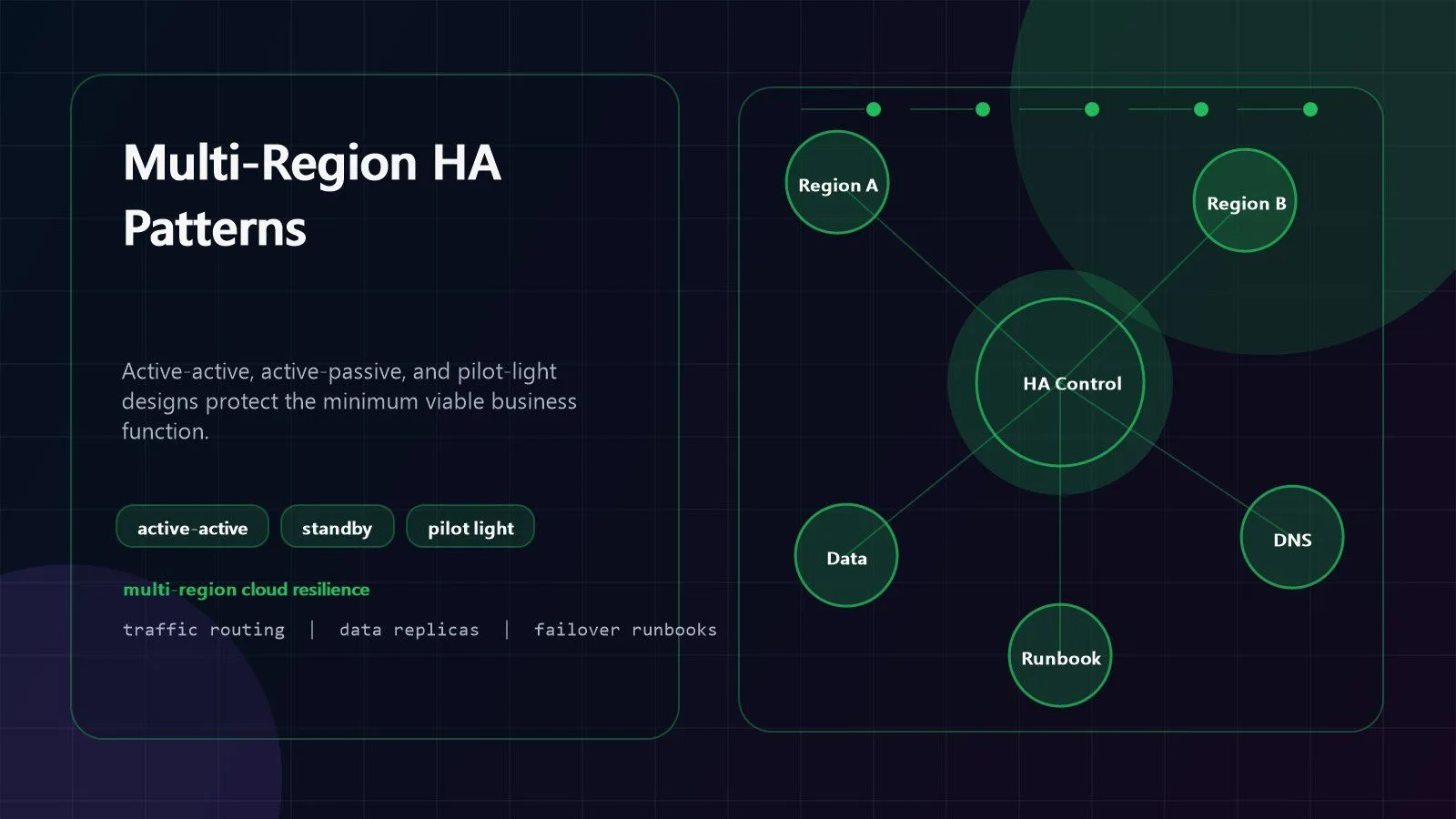
A strong response to cloud region failure usually starts with multi-region architecture, but the design pattern depends on business need. Active-active systems serve traffic from more than one region at the same time. Active-passive systems keep a warm or cold standby ready for failover. Pilot-light systems keep only the minimum critical services running until activation.
Active-active can reduce downtime, but it is harder to build. It requires global traffic management, distributed data strategy, idempotent writes, conflict handling, strong observability, and operational maturity. For many businesses, active-passive is a more practical first step because it improves recoverability without forcing every component into distributed consistency complexity.
Cloud region failure planning should also distinguish application availability from business availability. A website may load while checkout fails. A dashboard may open while identity, payments, or customer notifications are broken. The real design target is the minimum viable business function during disruption.
Teams should prioritise tier-one journeys first: login, orders, payments, support access, production dashboards, and compliance-critical reporting. Once those paths have credible regional failover, lower-priority functions can follow.
Data replication, RPO, and RTO trade-offs
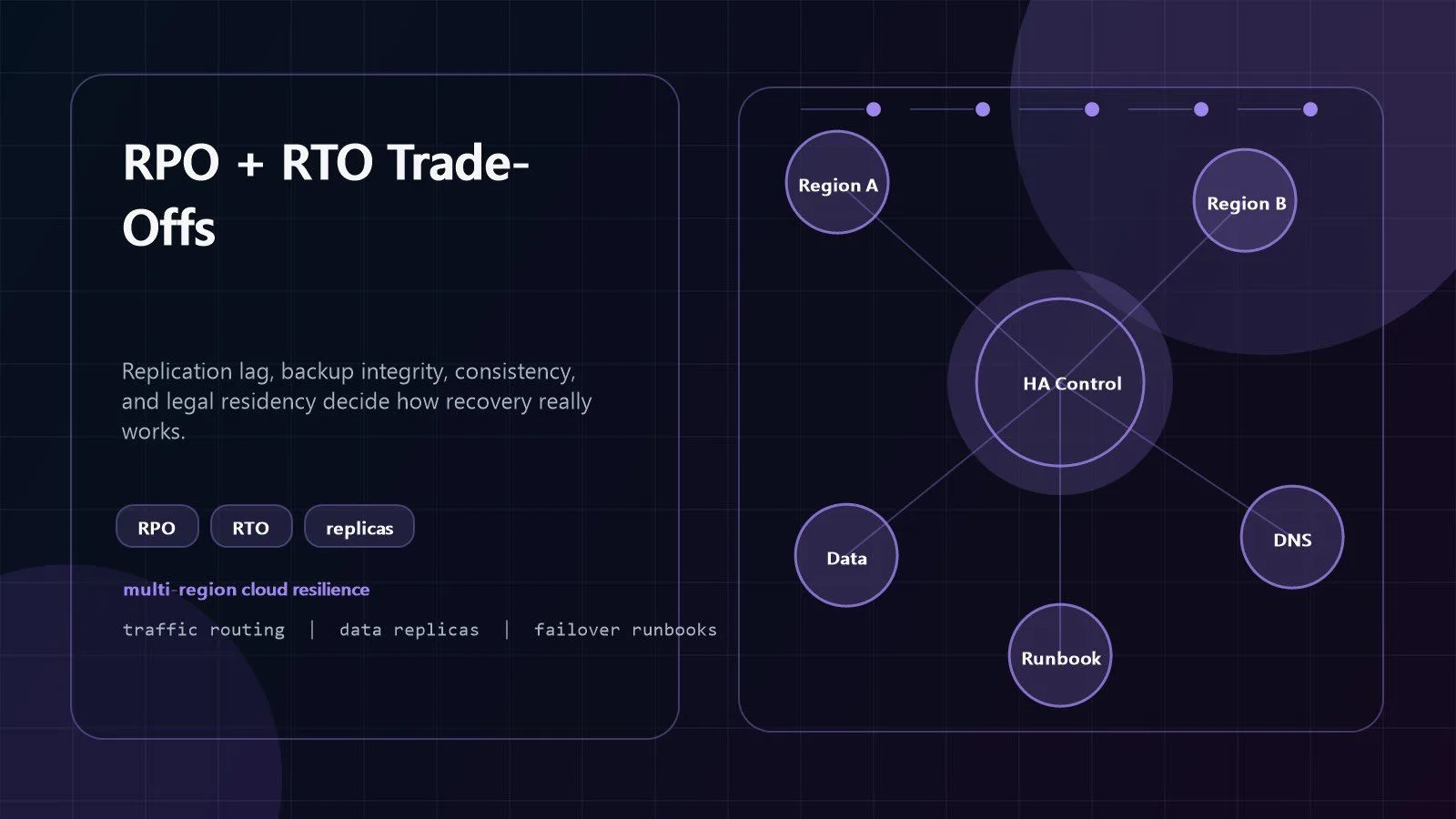
Data is the hardest part of high availability. Compute can often be rebuilt. Stateless services can be redeployed. Data consistency, replication lag, backup integrity, and legal residency are much more difficult to fix during a crisis.
Every cloud region failure plan needs two numbers: recovery time objective and recovery point objective. Recovery time objective asks how quickly the service must return. Recovery point objective asks how much data the business can afford to lose. A customer portal, payment ledger, clinical record system, and marketing website will not share the same answers.
Synchronous replication can reduce data loss, but it increases latency and can create tight coupling between regions. Asynchronous replication improves performance and distance options, but it introduces lag and possible data loss. Backups help with corruption or deletion, but they are not the same as a hot replica.
The right answer is usually workload-specific. Critical ledgers may need stronger consistency and explicit write controls during failover. Content systems may tolerate short replication lag. Analytics systems may pause ingestion while operational systems recover first.
DNS, traffic routing, and failover runbooks
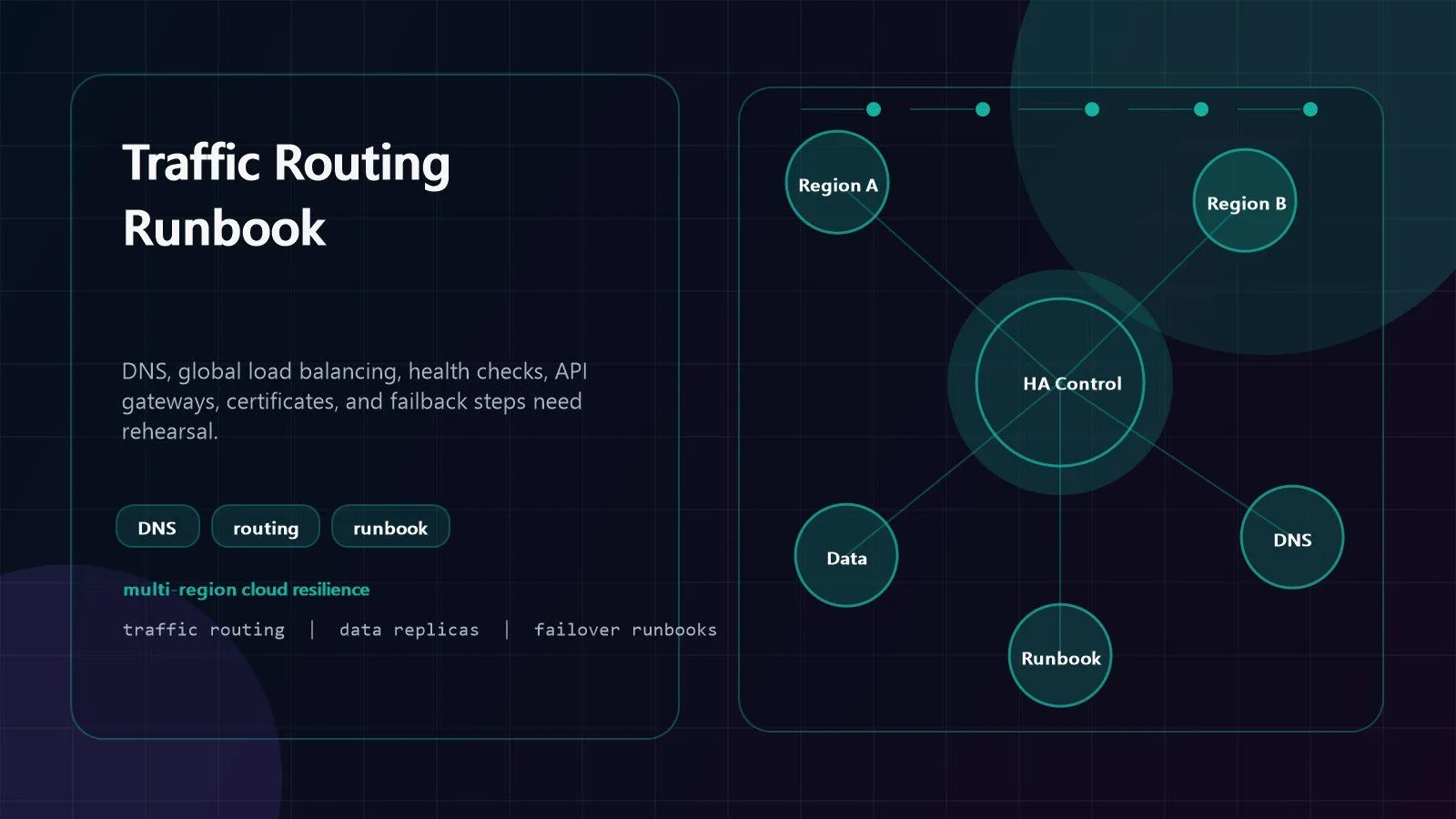
Even a well-replicated application can fail customers if traffic cannot move cleanly. DNS, global load balancing, health checks, CDN configuration, API gateways, firewall rules, certificates, and identity callbacks all become part of the failover path.
Cloud region failure response should be written as a runbook, not remembered as tribal knowledge. The runbook should define who declares failover, what signals trigger it, which systems move first, what gets frozen, how customers are notified, and how engineers confirm that the standby region is truly healthy.
Automation helps, but fully automatic failover is not always best. If data replication is lagging, a quick automatic switch might create split-brain behaviour or data inconsistency. For many businesses, a human-approved failover with automated steps is safer than an uncontrolled flip.
Runbooks should also include failback. Returning to the original region can be more dangerous than the first failover because data may have changed in the recovery region. Teams need reconciliation steps, backup checkpoints, and a clear decision owner before traffic returns.
Testing cloud region failure before the crisis
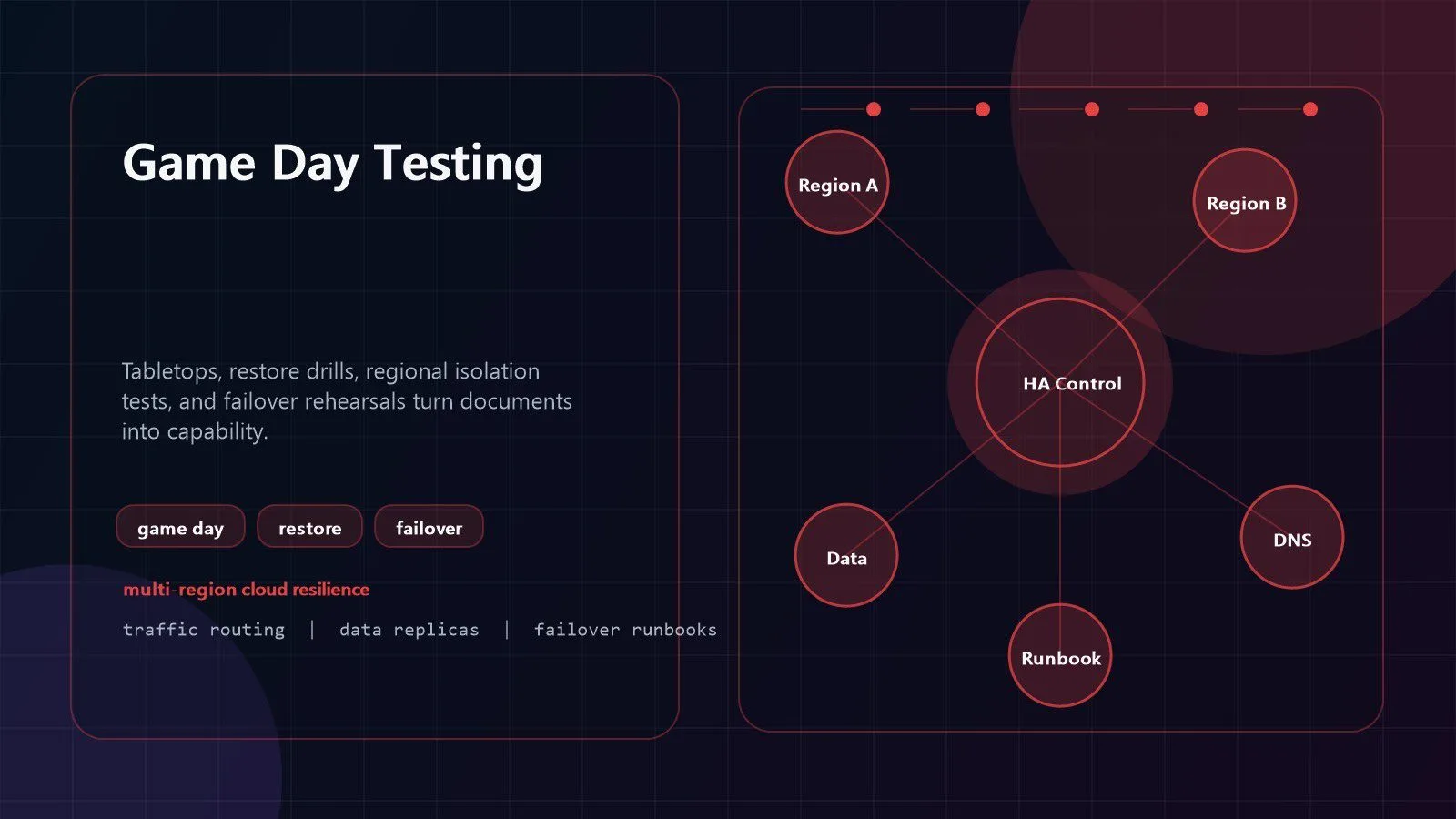
A cloud region failure plan that has never been tested is a document, not a capability. Resilience requires rehearsal. Teams should run tabletop exercises, dependency reviews, backup restores, regional isolation tests, traffic-routing drills, and game days that simulate realistic degradation.
Testing should start safely. First verify backups and restore procedures. Then test read-only standby systems. Then route a small percentage of traffic to the secondary region. Eventually, run controlled failover tests during planned windows with observers from engineering, security, support, and business operations.
The best tests measure more than uptime. They measure decision time, detection quality, alert noise, customer communication, data integrity, cost impact, and staff readiness. Those details reveal whether the organisation can operate under pressure.
Geopolitical scenarios should be included too. What if a region is technically online but legally unavailable? What if staff in one country cannot access the provider console? What if a supplier, payment gateway, or identity provider is affected by the same crisis? Cloud region failure exercises should include those second-order effects.
Cloud region failure FAQ
Is availability zone redundancy enough?
No, not for every workload. Availability zones reduce the impact of local datacenter failures inside a region, but they do not fully solve regional control plane, networking, geopolitical, or provider-wide dependency risks.
Does every application need active-active multi-region design?
No. Active-active design is expensive and complex. Many applications are better served by active-passive or pilot-light recovery patterns with clear recovery objectives and tested runbooks.
What should be tested first?
Start with backup restores, identity access, DNS changes, database replication status, and the minimum viable customer journey. Those checks reveal the biggest resilience gaps quickly.
How does geopolitics affect cloud disaster recovery?
Geopolitics can affect connectivity, legal access, data residency, provider operations, staffing, payments, sanctions, and supply chains. Disaster recovery should account for those non-technical constraints.
Who should own the plan?
Ownership should be shared across engineering, operations, security, legal, compliance, finance, and executive leadership. Cloud region failure response is a business continuity issue, not only an infrastructure ticket.
Cloud region failure planning is becoming a strategic resilience issue because digital operations now depend on globally distributed but politically situated infrastructure. The cloud is powerful, but it is not immune to geography, regulation, conflict, or provider concentration.
The practical path is disciplined: map dependencies, classify workloads, set RPO and RTO targets, design multi-region patterns where they matter, test failover, and keep business owners involved. If your organisation needs help turning resilience goals into an actionable architecture, contact Progressive Robot to plan a high-availability roadmap before the next regional shock.
More AI coverage: explore Progressive Robot's AI Models, Tools & Releases hub — hands-on reviews, setup guides and benchmarks in one place.