
Hybrid cloud vs multi-cloud is one of the most important infrastructure choices a growing business will make in 2026. The decision affects cost, speed, security, resilience, compliance, vendor leverage, data movement, and how quickly teams can launch new digital products.
The confusion starts because both models sound similar. A hybrid cloud connects private infrastructure with public cloud services. A multi-cloud strategy uses services from more than one public cloud provider. Many organizations eventually use both, but the best starting point depends on growth goals, workload patterns, operating maturity, and regulatory pressure.
This guide explains hybrid cloud vs multi-cloud in practical business terms, then walks through seven moves that help leaders choose the right strategy. It also connects the decision to Progressive Robot services for cloud computing services, cloud strategy, cloud architecture, cloud migration, and cost optimization because the right model must support growth without adding unnecessary complexity.
| Growth goal | Better starting point | Why it usually fits |
|---|---|---|
| Keep sensitive systems close while scaling digital services | Hybrid cloud | Connects private control with public cloud flexibility |
| Reduce dependence on one hyperscaler | Multi-cloud | Spreads selected services across providers |
| Modernize legacy platforms gradually | Hybrid cloud | Lets teams migrate in phases |
| Use best-of-breed AI, data, and developer services | Multi-cloud | Allows provider-specific service selection |
| Control predictable infrastructure costs | Hybrid cloud | Keeps stable workloads near private capacity |
| Improve regional resilience | Multi-cloud or hybrid cloud | Depends on data, routing, and operations maturity |
Hybrid cloud vs multi-cloud at a glance
Hybrid cloud vs multi-cloud should start with definitions, not vendor pitches. Hybrid cloud means the business operates a connected environment across private infrastructure and at least one public cloud. The private side may be an owned data center, colocation facility, private cloud, managed hosting platform, or dedicated infrastructure. The public side may be AWS, Microsoft Azure, Google Cloud, Oracle Cloud, or another provider.
Multi-cloud means the business uses more than one public cloud provider. That does not automatically mean every application runs across every cloud. In a practical multi-cloud strategy, one workload might use Azure identity and productivity integrations, another might use Google Cloud analytics, and another might use AWS marketplace or managed services.
The simplest distinction is control versus choice. Hybrid cloud usually solves placement, compliance, data gravity, and legacy modernization. Multi-cloud usually solves provider leverage, best-of-breed services, regional options, and concentration risk. The strongest strategy is the one that matches the business problem instead of copying a fashionable architecture diagram.
Use hybrid cloud vs multi-cloud as a practical lens for deciding which constraints deserve architecture investment first.
Move 1: Start with growth goals, not cloud labels
The first move in hybrid cloud vs multi-cloud planning is to define the growth outcome. Infrastructure is not the goal. Growth is the goal. A retailer may need faster ecommerce releases. A manufacturer may need edge connectivity and uptime near plants. A healthcare provider may need compliant data control. A SaaS company may need global expansion and developer velocity.
Each growth goal points to a different cloud operating model. If the business needs to modernize core systems without disrupting stable operations, hybrid cloud often makes sense. If the business needs to access specialized AI, data, or regional services across providers, multi-cloud may be stronger. If the business needs both control and provider flexibility, a staged hybrid-to-multi-cloud roadmap may be the most realistic answer.
Leaders should write the business goals before evaluating platforms. Good goals include measurable outcomes: reduce launch time by 30%, keep regulated data inside approved environments, cut latency for regional users, improve disaster recovery, reduce vendor concentration, or lower unit infrastructure cost. When the goals are clear, hybrid cloud vs multi-cloud becomes a decision framework rather than a debate about brands.
That clarity keeps hybrid cloud vs multi-cloud discussions tied to revenue, risk, and execution instead of abstract platform preference.
Move 2: Choose hybrid cloud when control and continuity matter most
Hybrid cloud is usually the better fit when the business must keep specific workloads close to private infrastructure while still gaining public cloud agility. Common examples include legacy applications, regulated databases, manufacturing systems, healthcare records, financial workloads, latency-sensitive operations, and systems with expensive data movement.
In those cases, hybrid cloud vs multi-cloud is less about provider variety and more about safe modernization. The private side protects systems that are stable, sensitive, or hard to move. The public cloud side supports new applications, analytics, automation, dev/test environments, backup, burst capacity, and customer-facing innovation.
Hybrid cloud can also reduce migration risk. Instead of forcing a full move to public cloud, teams can connect environments, standardize identity, automate deployment, and migrate one capability at a time. That approach is especially useful when business units cannot tolerate long freezes or when data dependencies are too complex for a big-bang migration.
The trade-off is operating discipline. Hybrid cloud requires clear network architecture, identity federation, security monitoring, backup design, data synchronization, and governance across private and public systems. Without that discipline, the organization gets the worst of both worlds: private infrastructure complexity plus public cloud sprawl.
If continuity is the main growth constraint, hybrid cloud vs multi-cloud analysis often points toward a hybrid foundation first.
Move 3: Choose multi-cloud when choice and leverage matter most
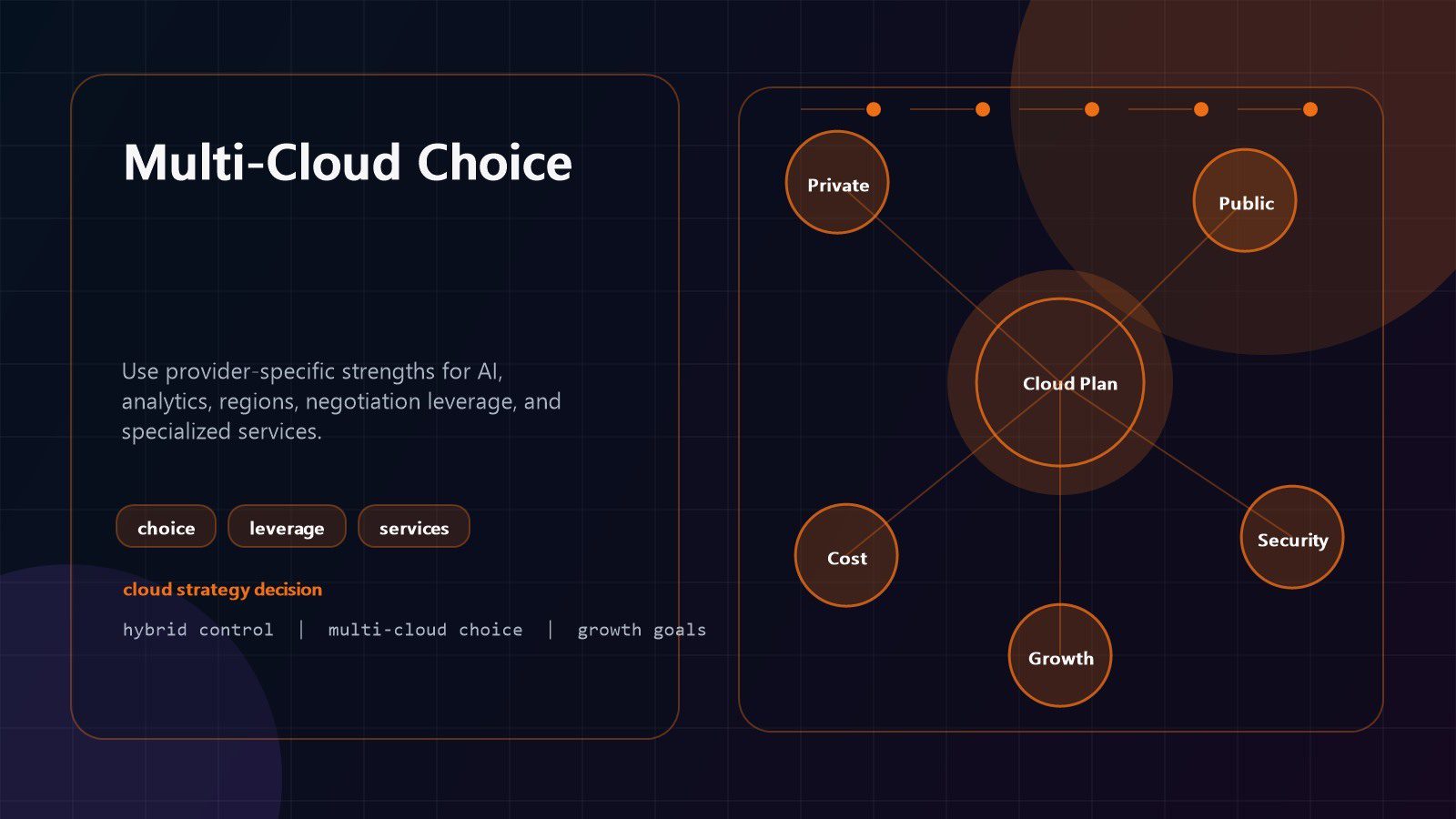
Multi-cloud is usually the better fit when the business wants provider flexibility, differentiated services, regional options, or negotiation leverage. A company may prefer Azure for identity and Microsoft ecosystem integration, Google Cloud for analytics or AI, and AWS for marketplace depth or mature service coverage.
In hybrid cloud vs multi-cloud planning, multi-cloud becomes compelling when the growth strategy depends on picking the best platform for each product capability. It can also reduce the risk of depending too heavily on one provider’s pricing, roadmap, outage profile, or policy changes.
However, multi-cloud is not automatically resilient or cheaper. Running the same application across several clouds can increase engineering work, security complexity, data transfer cost, observability noise, and incident response difficulty. Multi-cloud works best when each provider has a clear role and teams avoid unnecessary duplication.
The practical question is whether provider choice creates enough value to justify additional operating complexity. If the answer is yes, start with a governed multi-cloud pattern: shared identity standards, centralized logging, common tagging, infrastructure as code, cost allocation, security baselines, and a clear owner for each cloud relationship.
If differentiated services drive growth, hybrid cloud vs multi-cloud planning may justify selective multi-cloud adoption earlier.
Move 4: Map workloads before making the architecture decision
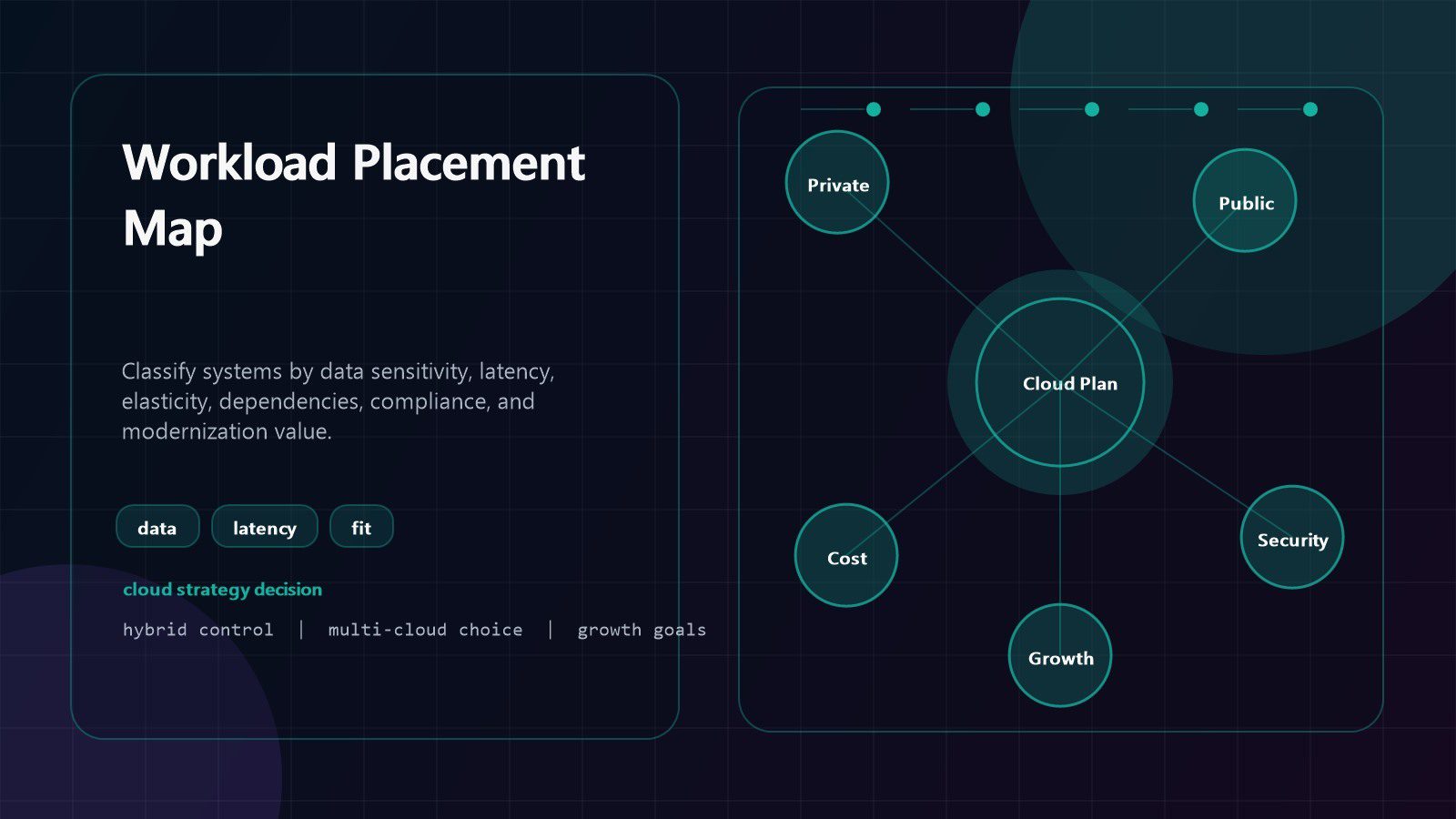
The fourth move is workload mapping. Before choosing hybrid cloud vs multi-cloud, list the systems that will actually run in the environment. For each workload, capture business owner, data sensitivity, uptime target, latency needs, dependencies, peak demand, integration points, compliance rules, cost profile, and modernization priority.
This map often changes the conversation. A business may think it needs multi-cloud for resilience, then discover that the biggest risk is an old database tied to one private network. Another business may think it needs hybrid cloud for compliance, then discover that modern cloud regions and encryption controls can satisfy requirements for selected workloads.
Workload mapping should include data movement. Data gravity can decide the architecture faster than slogans. If a large dataset lives in one environment and many applications depend on it, moving compute closer to that data may be cheaper and safer than replicating everything. If different teams need provider-specific services against different datasets, multi-cloud may be easier to justify.
Use a simple classification model: keep, modernize, migrate, replace, or retire. Stable workloads with predictable demand may stay private or move to optimized infrastructure. Fast-changing products may move to public cloud. Specialized analytics may use a specific provider. The right hybrid cloud vs multi-cloud decision emerges from this portfolio view.
This portfolio view prevents hybrid cloud vs multi-cloud strategy from becoming a one-size-fits-all mandate.
Move 5: Build the operating model before adding platforms
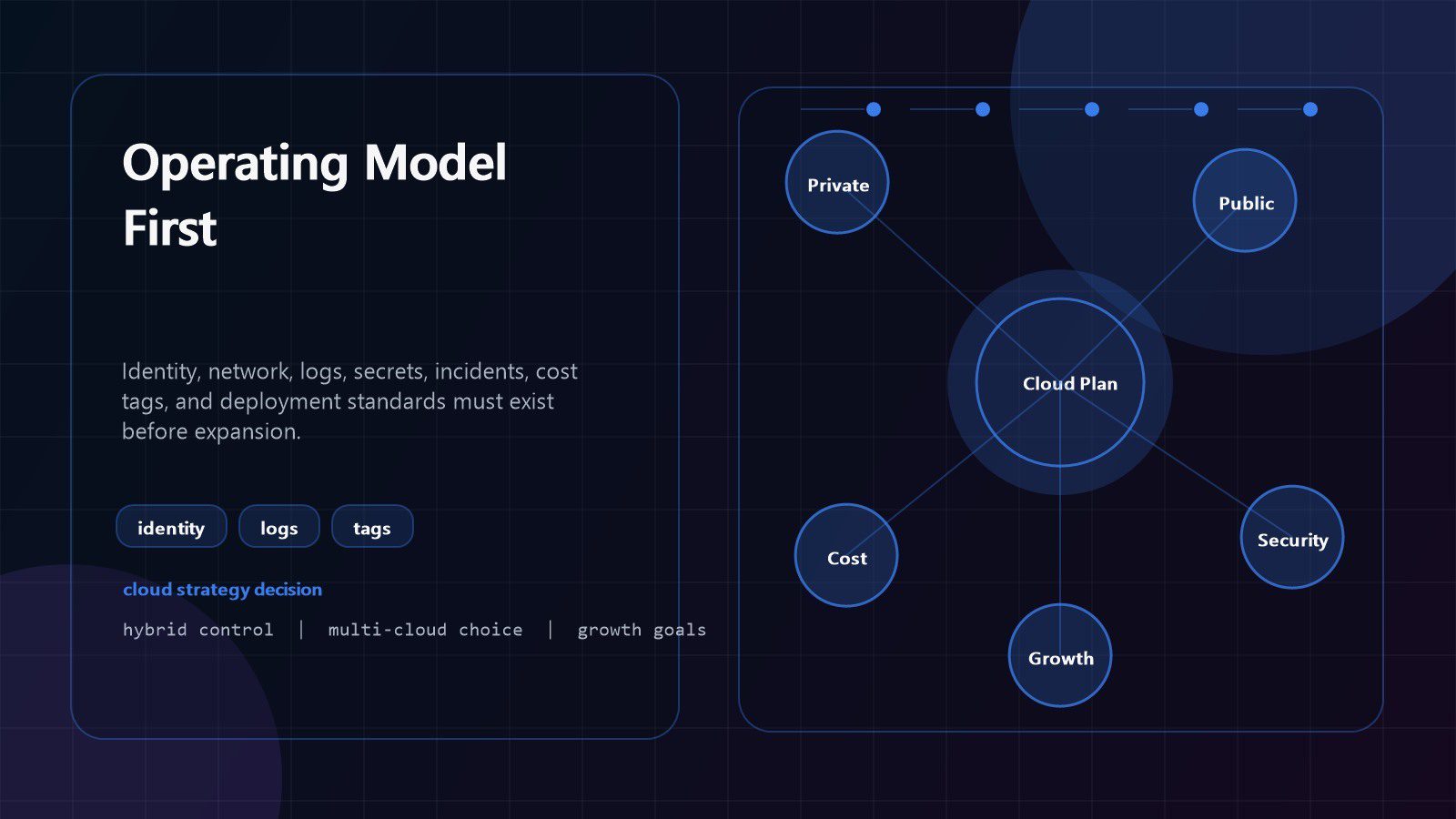
The fifth move is to design the operating model. Cloud strategy fails when teams add platforms faster than they add governance. A business can buy a second cloud account in minutes, but it may take months to build the security, cost, and operational controls needed to run it safely.
For hybrid cloud vs multi-cloud success, define the control plane. Who approves new environments? How are identities managed? Which network paths are allowed? How are secrets stored? How are logs collected? How are incidents routed? How are costs tagged? Which teams can deploy production resources? Which standards are mandatory for every platform?
The NIST definition of cloud computing is still useful because it highlights measured service, resource pooling, broad network access, rapid elasticity, and self-service. A growth strategy should preserve those advantages where possible. If a hybrid model makes provisioning slow and manual, it may block growth. If a multi-cloud model creates disconnected toolchains, it may slow engineers down.
The operating model should also include skills. Hybrid cloud needs people who understand private infrastructure, networking, identity, and cloud automation. Multi-cloud needs people who can standardize across providers without flattening every platform into the lowest common denominator.
Skill readiness is often the deciding factor in hybrid cloud vs multi-cloud execution.
Move 6: Compare cost, resilience, and security together
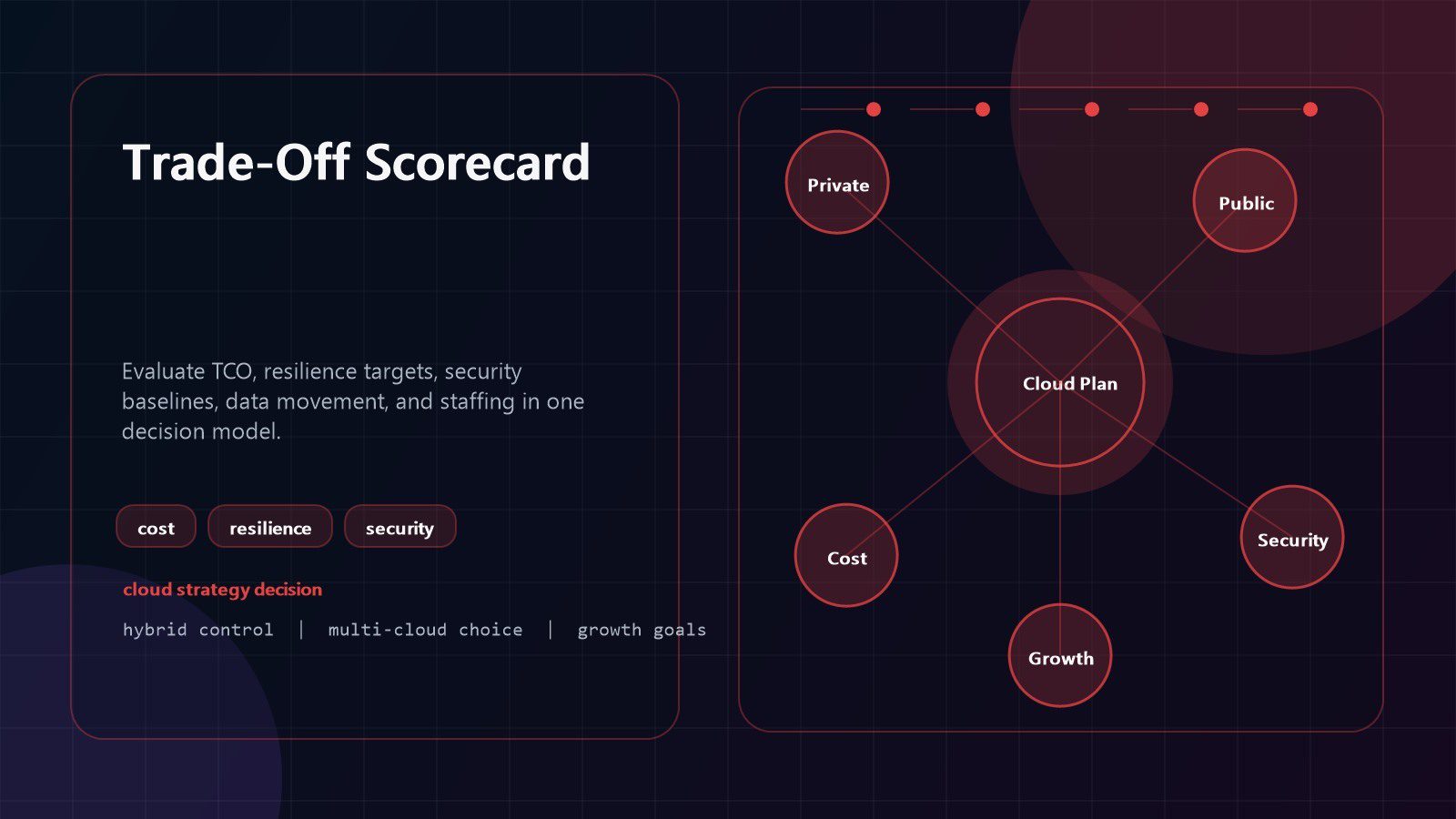
The sixth move is integrated trade-off analysis. Hybrid cloud vs multi-cloud decisions should not be made by finance alone, security alone, or engineering alone. Cost, resilience, and security interact.
Hybrid cloud may reduce cost for predictable workloads, but private capacity must be purchased, patched, monitored, and refreshed. Multi-cloud may improve provider leverage, but duplicated tooling and data transfer can raise total cost. Hybrid cloud may improve data control, but cross-environment network paths can create security blind spots. Multi-cloud may improve regional optionality, but inconsistent identity and logging can weaken response.
Use total cost of ownership instead of invoice comparison. Include compute, storage, networking, data egress, monitoring, backup, licensing, staffing, training, security tooling, migration labor, managed services, and downtime risk. The FinOps Foundation framework can help finance and engineering align around allocation, forecasting, accountability, and optimization.
Security should be evaluated the same way. Require identity federation, least privilege, encryption, key management, vulnerability scanning, policy-as-code, audit logs, backup testing, and incident runbooks. A platform choice that cannot be governed consistently is not ready for growth.
The safest hybrid cloud vs multi-cloud choice is the one your team can secure, observe, and recover under pressure.
Move 7: Use a phased roadmap instead of a one-time bet
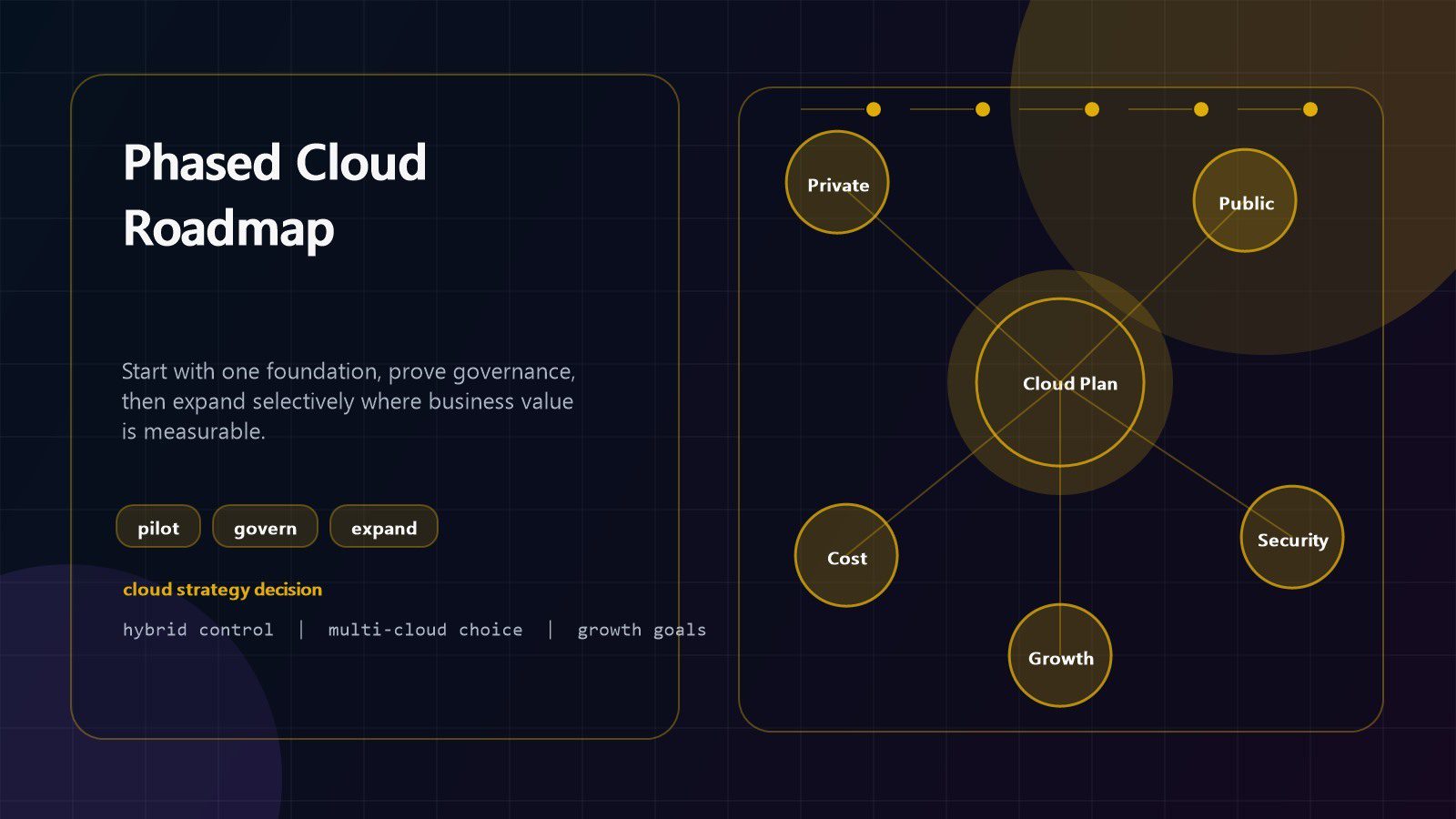
The seventh move is to treat hybrid cloud vs multi-cloud as a roadmap, not a permanent label. Most businesses do not need to choose one model forever. They need a sequence that reduces risk and supports growth.
A practical roadmap starts with one strong foundation. For some businesses, that foundation is hybrid cloud: connect private systems to public services, modernize identity, automate deployment, and migrate selected workloads. For others, the foundation is a primary public cloud with strict governance, followed by selective multi-cloud adoption where business value is clear.
Avoid launching multiple clouds and hybrid connections at the same time unless the organization already has mature platform engineering. Start with one or two high-value use cases. Prove security, cost allocation, deployment automation, monitoring, and support. Then expand based on measured outcomes.
The roadmap should include exit criteria. When should a workload move from private infrastructure to public cloud? When should a team add a second cloud? When should provider-specific services be allowed? When should a tool be retired? Growth-friendly cloud strategy makes those decisions repeatable.
Those exit criteria turn hybrid cloud vs multi-cloud planning into an operating discipline rather than a one-time architecture slide.
Decision matrix: which strategy best suits your growth goals?
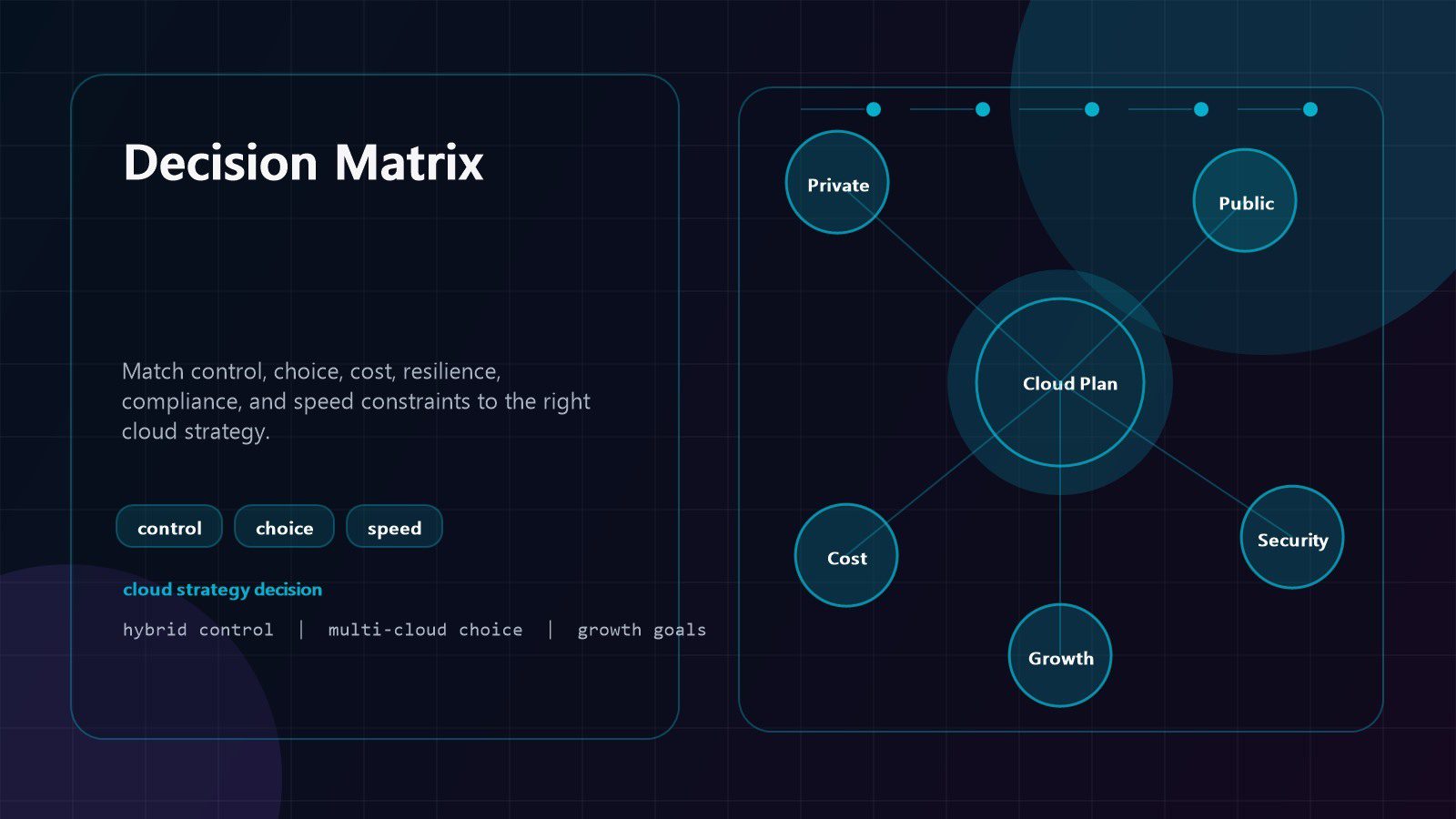
The best hybrid cloud vs multi-cloud choice depends on the constraint that matters most. If data control, legacy modernization, private connectivity, or predictable workload cost is the main constraint, hybrid cloud is often the stronger starting point. If provider flexibility, specialized services, global options, or concentration risk is the main constraint, multi-cloud may fit better.
Use this executive test: if the business is asking, “Where should this workload live?” the answer is often hybrid cloud strategy. If the business is asking, “Which provider gives this product the best capability?” the answer is often multi-cloud strategy.
For many growth-stage companies, the winning answer is staged. Build a reliable hybrid foundation for critical systems, then add multi-cloud selectively for analytics, AI, customer expansion, or resilience. That avoids premature complexity while keeping future options open.
The wrong answer is unmanaged sprawl. A business that uses one private platform, three public clouds, five identity patterns, and six monitoring tools without governance does not have a strategy. It has complexity. Hybrid cloud vs multi-cloud should simplify growth decisions, not hide them.
When leaders keep hybrid cloud vs multi-cloud tied to measurable growth goals, the architecture stays easier to defend and improve.
90-day action plan for leaders
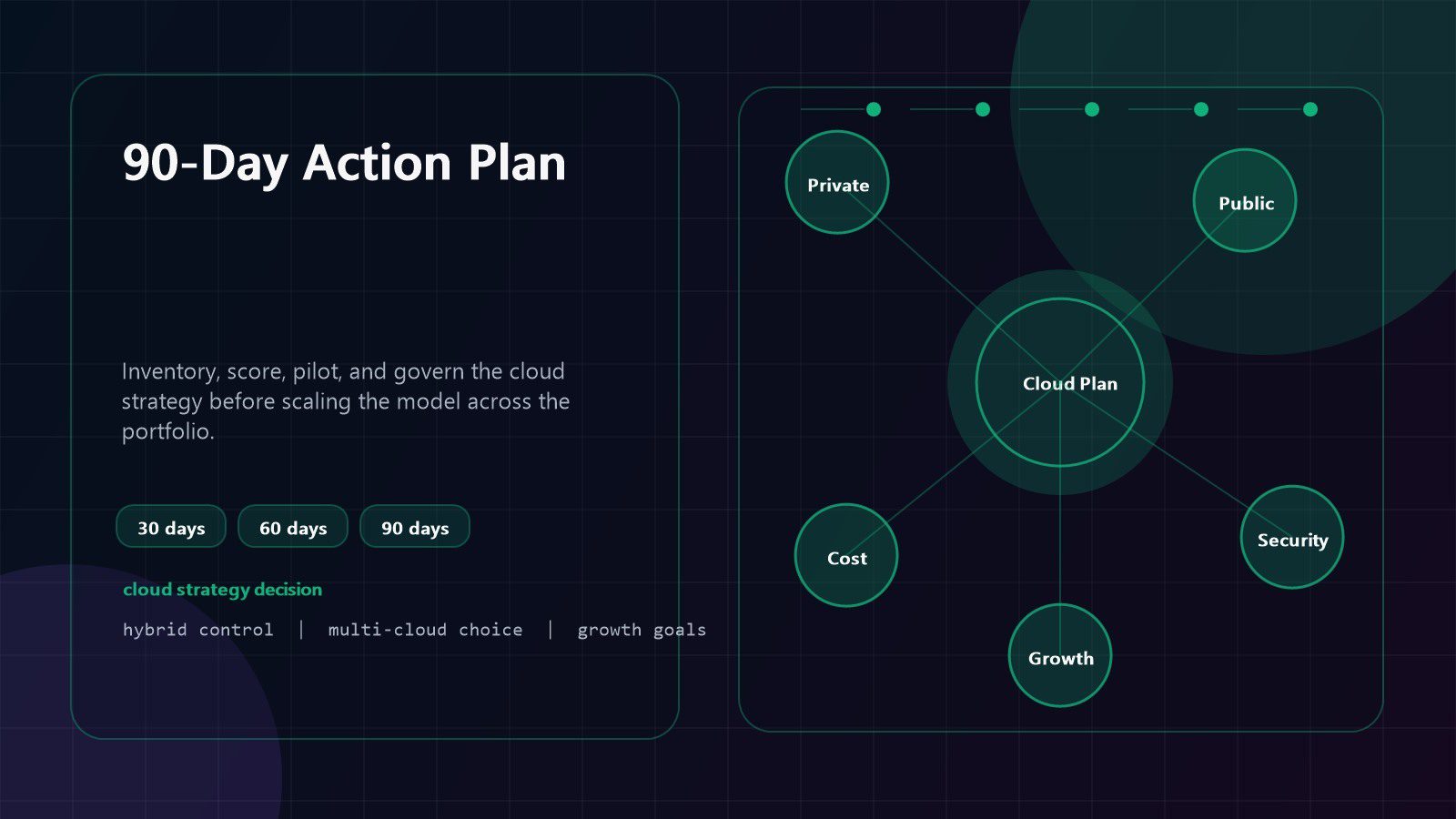
The fastest way to make progress is a focused 90-day assessment. In the first 30 days, inventory workloads, cloud accounts, private infrastructure, data stores, contracts, security controls, costs, and business owners. Identify the top five growth goals that infrastructure must support.
In days 31 to 60, score workloads against placement criteria: data sensitivity, latency, elasticity, compliance, cost, modernization value, vendor dependency, and resilience. Use the score to create a target architecture for hybrid cloud vs multi-cloud decisions. Include quick wins such as removing unused resources, tightening identity access, and standardizing tags.
In days 61 to 90, choose one pilot. A hybrid pilot might connect a private system to a public analytics service. A multi-cloud pilot might place a bounded data, AI, or disaster recovery workload in a second provider. Keep the pilot narrow, measurable, and reversible.
By the end of the 90 days, leadership should have a clear cloud growth roadmap, a governance baseline, a cost model, a risk register, and a short list of migration waves. If your organization needs help turning that plan into execution, contact Progressive Robot to design a cloud strategy that supports growth without unnecessary complexity.
Hybrid cloud vs multi-cloud FAQ
Is hybrid cloud the same as multi-cloud?
No. Hybrid cloud connects private infrastructure with public cloud services. Multi-cloud uses services from more than one public cloud provider. A business can use either model alone, or it can combine them when there is a clear reason.
Which strategy is cheaper?
Neither strategy is always cheaper. Hybrid cloud can reduce cost for predictable or data-heavy workloads, while multi-cloud can improve leverage and service choice. The only reliable answer comes from a total cost model that includes staffing, tools, migration, security, networking, and operations.
Which strategy is better for compliance?
Hybrid cloud is often easier when strict data control, legacy systems, or local processing are required. Multi-cloud can also support compliance if governance, encryption, identity, audit logging, and data residency controls are consistent across providers.
Does multi-cloud prevent vendor lock-in?
It can reduce vendor concentration, but it does not eliminate lock-in automatically. Applications built deeply around provider-specific databases, AI services, or event systems can still be hard to move. Good architecture, contracts, and data portability matter.
Can small and mid-sized businesses use these strategies?
Yes, but they should keep the scope practical. Small and mid-sized businesses usually need a primary platform, clear governance, and selective expansion. They should avoid complex multi-cloud designs unless the business value is obvious.
What is the safest first step?
Start with a workload and cost assessment. Map systems, data, dependencies, compliance needs, and growth goals before choosing platforms. That assessment will show whether hybrid cloud, multi-cloud, or a staged combination is the safest path.
How often should the strategy be reviewed?
Review the strategy at least twice a year, and after major growth events such as acquisitions, new regions, new compliance obligations, platform outages, or large product launches. Cloud strategy should evolve with the business.
Hybrid cloud vs multi-cloud is not a winner-take-all decision. It is a way to align infrastructure with growth. The right answer balances control, choice, cost, resilience, and team maturity. Start with business goals, map workloads, build governance, and expand only where the value is clear. Revisit hybrid cloud vs multi-cloud choices as those growth goals change.