
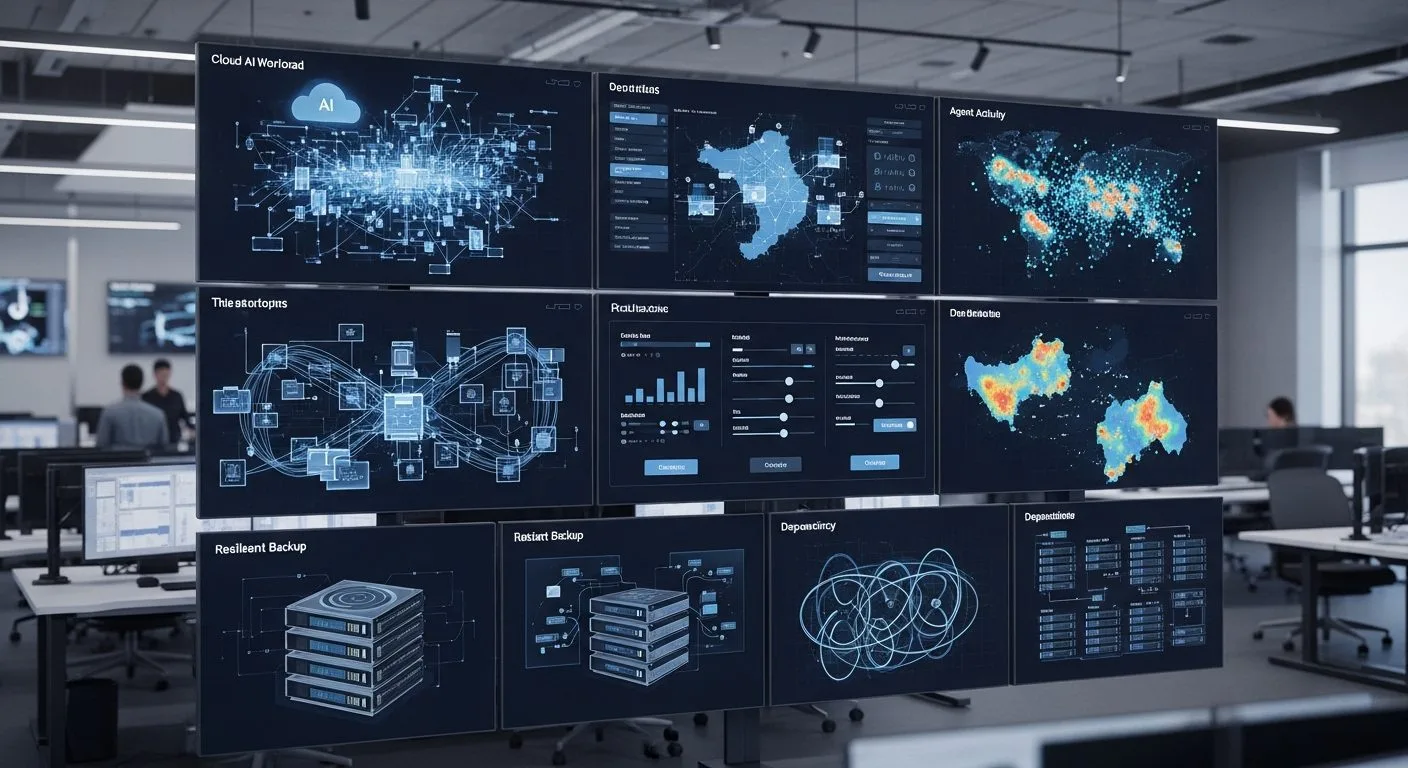
Commvault launches Ctrl-Z for cloud AI workloads with AI Protect, a new governance and recovery capability aimed at enterprises deploying AI agents across live systems. The company says the platform is designed to discover agents, understand what data and infrastructure they touch, identify protection gaps, and guide recovery when agent-driven changes create operational or security risk.
The company presented the launch as part of a broader AI resilience push that also includes Data Activate and AI Studio. In that framing, AI Protect is meant to give security and operations teams a clearer view of what autonomous systems are touching and a more structured way to recover if those systems create problems.
That matters because enterprise AI risk is becoming operational, not only analytical. Once agents can query live data, modify configurations, trigger workflows, and chain actions across environments, teams need more than model monitoring. They need inventory, protection context, and a practical way to recover affected assets when things go wrong.
This guide uses AI News’ April 2026 coverage of Commvault launching a ‘Ctrl-Z’ for cloud AI workloads, Commvault’s official April 2026 press release on secure, controlled agentic transformation, Commvault’s official blog post AI Agents Are Everywhere. Do You Know What They’re Doing?, and Commvault’s official Protect and Leverage AI page as the main references.
In plain English, Commvault wants enterprises to see what AI agents are doing across cloud systems and restore impacted environments to a known good state when those agents cause trouble.
Table of Contents
- What Commvault launches Ctrl-Z means in practice
- Why Commvault launches Ctrl-Z matters
- 7 key facts behind Commvault launches Ctrl-Z
- In simple terms
- FAQ on Commvault launches Ctrl-Z
- Final thoughts on Commvault launches Ctrl-Z
What Commvault launches Ctrl-Z means in practice
At the center of the announcement is AI Protect, Commvault’s new governance and resilience capability for AI agents.
- AI Protect is Commvault’s newly announced governance and resilience capability for AI agents.
- Commvault says it is designed to discover agents and their dependencies across environments.
- It is intended to show what data, applications, models, and systems those agents touch.
- The platform is meant to surface protection gaps for agent-touched assets.
- It will ingest telemetry and present risk signals in agent-centric context.
- It is supposed to guide recovery when agent-initiated changes cause problems.
- Commvault positions it as part of a broader AI resilience platform alongside Data Activate and AI Studio.
The practical takeaway is that enterprises need to govern AI agent activity with the same seriousness they apply to any other high-impact operational layer.
Why Commvault launches Ctrl-Z matters

The reason this launch matters is straightforward. AI agents do not just answer questions; they can read systems, update configurations, invoke APIs, and chain actions across environments. When that happens at machine speed, traditional backup and governance processes start to look incomplete.
Commvault’s own launch material frames the gap as one of visibility, protection status, monitoring context, and recovery orchestration. That is the more useful way to read the announcement. The problem is not only whether something is backed up. It is whether a team can reconstruct what an agent changed, understand what was exposed, and roll the affected environment back cleanly.
If you want the broader context behind why this matters, Progressive Robot’s page on autonomous AI agents is useful background. The more enterprises let agents act across real systems, the more observability and recovery start to matter as much as the model itself.
7 key facts behind Commvault launches Ctrl-Z

1. The launch is fundamentally an AI Protect announcement
The first point to get clear is that Commvault did not launch a literal universal rollback button for AI. It launched AI Protect and wrapped it in a recovery metaphor. That distinction matters because the announcement should be read as a governance-and-resilience offering, not as a magical reversal feature.
According to Commvault’s April 2026 press release, AI Protect is one of several new capabilities intended to help enterprises safely activate AI, discover and govern AI agents, and recover from agent-driven changes. The launch language is ambitious, but the product category itself is relatively clear.
2. Discovery and inventory are central to the pitch
Commvault’s own AI Protect blog makes clear that the core problem is not simply AI adoption. It is unmanaged AI adoption.
The company says AI Protect will discover AI agents and their dependencies across connected environments on an ongoing basis. That includes the execution environment plus the data sources, models, configurations, applications, and infrastructure each agent interacts with.
That matters because governance is difficult when teams do not have a clean inventory of what exists, what it touches, and how it is connected to the rest of the stack.
3. Commvault is tying observability to protection status
Another important part of the announcement is that Commvault is not presenting AI Protect as generic observability. The company says the platform will surface whether agent-touched assets are protected, partially protected, or unprotected and recommend remediation steps to close those gaps.
That is a stronger operational claim than basic monitoring. It connects visibility to recovery readiness, which is ultimately the promise behind the Ctrl-Z framing.
4. The recovery claim is broader than a simple data restore
This is the part of the launch that makes the headline memorable. Commvault says AI Protect will surface recovery point availability for impacted assets and guide teams through the appropriate recovery action, whether that involves restoring data, applications, or configurations.
The company also says teams will be able to recover the full AI stack, not just a model or dataset, but the connected data, dependencies, and underlying systems that support it. If Commvault can execute on that claim, it would make AI Protect more than a monitoring layer.
5. The product is designed to make telemetry more useful
Commvault’s blog says AI Protect will ingest agent activity from audit, event, and telemetry sources and present it in agent-centric context rather than as raw logs.
The company says teams will get time-ordered activity timelines and flagged risk signals when agents access sensitive data, interact with unprotected assets, or show unusual patterns. That matters because AI incidents can generate plenty of data but still leave teams without a clear operational narrative.
6. Much of the launch is still forward-looking
It is also worth keeping the company wording in perspective. Across the press release and supporting materials, Commvault often describes what AI Protect will do, is designed to do, or is intended to enable. That suggests the announcement should be read partly as product direction and platform thesis, not only as a mature, universally deployed capability.
That does not weaken the strategic significance of the launch, but it does matter for how seriously readers should separate the recovery narrative from present-day product availability.
7. The launch sits inside a wider AI resilience strategy
AI Protect was not presented in isolation. Commvault positioned it alongside Data Activate, which is meant to prepare governed backup data for AI pipelines, and AI Studio, which is intended to help organisations build and deploy governed agents.
Taken together, the message is that Commvault wants to extend its backup and cyber recovery footprint into a broader AI resilience platform. That is strategically important because it reframes the company from a pure recovery vendor into a control point for enterprise AI operations.
In simple terms

If you strip away the launch language, the idea is straightforward. Enterprises are letting AI agents operate inside live systems, and Commvault wants to be the layer that helps them see what those agents touched and recover when those actions create problems.
That is why AI Protect matters. It shifts the conversation from whether organisations can deploy agents to whether they can operate them safely at scale.
FAQ on Commvault launches Ctrl-Z
What did Commvault actually launch?
The core launch is AI Protect, which Commvault describes as a governance and resilience capability for AI agents operating across enterprise, SaaS, and cloud environments.
Is this literally an undo button for AI?
No. The Ctrl-Z phrasing is a metaphor. Commvault is talking about discovery, monitoring, impact analysis, and guided recovery back to known good states.
What clouds or environments is AI Protect supposed to cover?
According to Commvault’s AI Protect blog FAQ, it is designed to work across hyperscaler environments such as AWS, Microsoft Azure, and Google Cloud, along with SaaS platforms and internal enterprise systems.
Does AI Protect only restore data?
No. Commvault says the goal is broader full-stack recovery, including data, applications, configurations, and dependencies affected by agent activity.
Is AI Protect fully shipped and generally available right now?
The official materials are more cautious than the headline coverage. Commvault presents AI Protect as part of newly announced and forthcoming AI capabilities and often describes what it will do rather than what is already generally available.
Why does this matter to enterprises?
Because it reflects a real shift in enterprise risk. Once AI agents are allowed to act across live systems, organisations need to know what those agents touched, whether those assets were protected, and how to recover quickly if something goes wrong.
Final thoughts on Commvault launches Ctrl-Z
It is Commvault’s view that AI adoption now needs the same rigor around visibility, protection, and recovery that cyber resilience teams already apply elsewhere in the stack.
If Commvault can execute on the discovery, protection-context, and guided-recovery claims in its launch material, AI Protect could become a credible control point for enterprises moving from pilot agents to production AI operations. If it cannot, the Ctrl-Z framing will remain clever branding rather than durable product differentiation.
More AI coverage: explore Progressive Robot's AI Models, Tools & Releases hub — hands-on reviews, setup guides and benchmarks in one place.










