
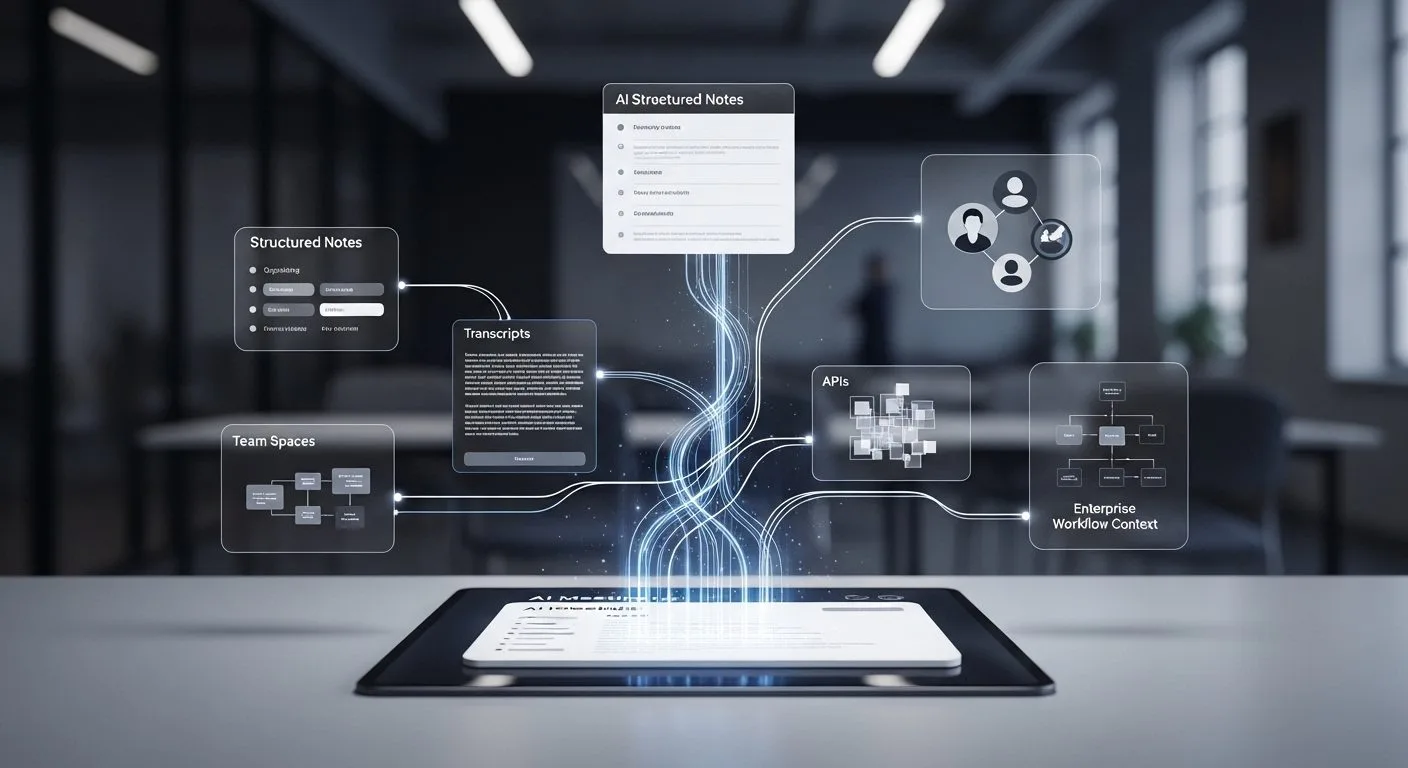
If you are asking what is Granola AI, the clearest answer is that it is an AI meeting notepad designed for people in back-to-back meetings. Officially branded simply as Granola, the product combines your own notes with transcript-based AI assistance so you can stay engaged in the conversation and still leave the meeting with structured, usable output.
That positioning matters because Granola AI is not trying to win by acting like just another meeting bot. The product was built around a more specific idea: people often dislike extra bots visibly joining their calls, but they still want transcription, summaries, action items, and reusable meeting context. The product uses that gap as its wedge.
This guide uses TechCrunch’s 2026 report on Granola’s $125 million Series C and $1.5 billion valuation, TechCrunch’s 2024 launch report on Granola’s AI notepad, Granola’s official homepage, official pricing page, official enterprise page, official security page, and the company’s official Series C announcement as the main references. If you want related context on why meeting capture and AI-generated follow-up matter operationally, Progressive Robot’s article on AI in project management is the best internal companion read because it shows how meeting transcripts and summaries can become structured work rather than disposable notes.
In practical terms, it is an AI note layer that sits around meetings and tries to turn spoken context into something people and teams can actually use afterward.
Granola AI at a glance

The product can be summarized in a few key points.
- Granola AI is an AI notepad for meetings, not just a meeting recorder.
- It lets users write their own notes while AI fills in missing context from the transcript.
- It transcribes computer audio directly instead of adding a meeting bot to the call.
- It works across major meeting platforms including Zoom, Google Meet, Teams, Slack, Webex, and more.
- It has expanded from an individual meeting product into a broader team context platform with Spaces, folders, APIs, and MCP support.
- TechCrunch reports
- Granola AI raised $125 million in March 2026 at a $1.5 billion valuation, less than a year after its prior $43 million round.
- Granola AI currently offers a free Basic plan, a $14 per-user Business plan, and a $35 per-user Enterprise plan.
- Its security posture includes SOC 2 Type 2, GDPR commitments, notes-private-by-default sharing, no stored audio recordings, and model-training controls.
Why Granola AI matters

Granola AI matters because meetings are one of the largest sources of business context and one of the worst places to lose information. Product feedback, hiring signals, sales objections, research insights, budget details, and next steps often show up first in conversation. But raw conversation is messy. People either do not take notes, take incomplete notes, or spend time rewriting everything afterward.
That is where Granola AI is trying to be different. The product does not ask users to surrender the whole meeting to automation. Instead, it gives them a lightweight note surface, then enhances what they wrote with transcript-backed context after the meeting ends. That collaborative model is a big part of why it has been able to stand out in a crowded AI note-taking market.
It also matters because the company is clearly moving beyond note cleanup. Its newer pitch is about company context: organising notes, sharing them in spaces, querying them across folders, and feeding them into AI workflows and other tools. That is exactly the kind of progression that makes meeting software strategically more interesting than a simple transcription utility. Once meeting output becomes reliable, it stops being just documentation and starts becoming operational input.
What Granola AI is in simple terms
In plain English, Granola AI is like Apple Notes for meetings, except it also transcribes what was said, improves what you wrote, and lets you ask questions about the meeting afterward.
That simplicity is a major part of the appeal. It is not framed as a giant meeting operating system on the front page. It is framed as a calmer, more usable way to survive back-to-back meetings. But underneath that simple interface, the product is increasingly behaving like a context platform rather than a notepad alone.
So if you are still asking what is Granola AI, the shortest honest answer is this: it is an AI note-taking product that began as a collaborative meeting notepad and is now evolving into a broader layer for team memory and workflow context.
7 critical facts behind Granola AI

1. It was built around a collaborative AI model, not full automation
The first thing to understand about Granola AI is that the product philosophy has been different from many AI note-taking tools from the start.
TechCrunch’s 2024 launch article explains the core concept clearly. The app lets users type their own notes or bullet points during the meeting, then uses AI and the transcript to expand and refine those notes afterward. It can clean up typos, infer missing context, and link notes back to the transcript for fact-checking.
That matters because Granola AI is not asking people to completely trust a black-box summary. It preserves user judgment inside the workflow. This was also part of co-founder Chris Pedregal’s design argument in the launch article: AI is most useful when people still feel in control rather than fully outsourcing their thinking to the model.
2. Its no-bot approach is one of its strongest product advantages
The no-bot design is not a minor implementation detail. It is one of the main reasons the product became popular.
TechCrunch’s 2026 funding report says users may not like visible bots in meetings taking notes, but many are more comfortable with an app on someone’s computer doing the transcription instead. Granola AI leans fully into that preference. On the official site and security page, the company says Granola transcribes your computer’s audio directly and does not add a meeting bot to the call.
This shapes both the user experience and the brand. It feels more like a personal work tool than a third-party meeting participant. That distinction may sound small, but in practice it changes comfort level, meeting dynamics, and perceived friction.
3. It came from founders thinking hard about how AI should fit real work
It is not a random side project that caught a trend at the right moment.
According to TechCrunch’s launch coverage, Chris Pedregal previously founded Socratic, an AI tutoring app that was acquired by Google. After working at Google, he kept experimenting with ways AI could help in daily work. He later teamed up with co-founder Sam Stephenson, who had worked at note-taking startup Ideaflow. The two founded Granola in March 2023 around the very specific problem of meeting overload.
That background helps explain why Granola AI feels opinionated. The founders were not just trying to bolt AI onto note-taking. They were working on the harder question of how AI can help with knowledge work while still leaving room for human structure and judgment.
4. Its fundraising trajectory has been unusually fast
The funding curve behind Granola AI is one of the clearest signs that investors think the product has moved beyond a clever feature.
TechCrunch’s 2024 article says Granola launched with a $4.25 million round led by Lightspeed. By March 2026, TechCrunch reports the company had raised a $125 million Series C led by Danny Rimer at Index Ventures, with Mamoon Hamid at Kleiner Perkins participating. Existing investors including Lightspeed, Spark, and NFDG also joined again. That round took Granola AI to a $1.5 billion valuation, up from $250 million as of the prior round, and brought total funding to $192 million.
That is a sharp rise for a company that initially looked like a focused prosumer note-taking app. It suggests investors are underwriting a much larger platform story than meeting summaries alone.
5. It is shifting from personal notes to company context
This is probably the most important strategic fact about Granola AI today.
Both TechCrunch’s 2026 report and Granola’s own Series C announcement describe the company as moving from a meeting notetaker toward an enterprise AI app or company context layer. The official announcement says conversation transcripts are one of the richest sources of context across a company, and that Granola wants to make that context usable both inside the app and across other tools.
That vision now shows up in concrete features. The product introduced Spaces for organising and sharing notes with a team, folders with more granular access controls, Granola Chat across shared notes, a personal API, an enterprise API, and updated MCP support. It also connects with tools like Claude, ChatGPT, Lovable, Figma Make, Replit, Manus, v0, Bolt.new, Duckbill, and Dreamer.
That is a major shift in category position. Granola AI is no longer only saying, “we help you take notes.” It is increasingly saying, “we help your company use meeting context as structured intelligence.”
6. Its pricing shows it is no longer just a founder tool
Granola AI may still appeal strongly to founders, VCs, product managers, and other people buried in meetings, but its pricing now reflects a broader market.
The official pricing page currently lists three tiers. Basic is free at $0 per user per month and includes AI meeting notes, limited meeting history, AI chat within and across meetings, shared folders, custom templates, multilingual support, and opt-out of model training at any time. Business costs $14 per user per month and adds unlimited history, access to more advanced AI models, integrations with Attio, Notion, Slack, HubSpot, Affinity, and Zapier, plus MCP integration and a personal API. Enterprise starts at $35 per user per month and adds SSO, enterprise API access, org-wide deletion periods, admin controls, priority support, and teamwide model-training controls.
That structure tells you a lot about its commercial direction. It still wants easy individual adoption, but it now clearly expects teams and companies to standardise on the product once context sharing, integration, and governance start to matter.
7. Its privacy story is nuanced and stronger than most summaries suggest
The final critical fact is that Granola AI has a more nuanced data story than the usual “secure AI app” marketing line.
On the official security page, Granola AI says it meets SOC 2 Type 2 standards and is committed to GDPR compliance. It also says the product does not store audio recordings from meetings. Instead, it transcribes in real time on desktop, or after the meeting using temporarily cached audio on iPhone, and stores only the transcript and user notes.
The model-training policy is especially important to state accurately. Granola AI says third-party providers such as OpenAI or Anthropic are not allowed to use customer data to train their models. Granola itself says it trains on anonymized user data to improve the product, but users can opt out in settings, and enterprise model training is off by default. Notes are private by default until shared, and users can delete individual notes or request deletion of all their data.
That matters because it is increasingly selling to teams and enterprises. Once a note-taking product becomes a company context product, privacy, retention, sharing controls, and admin visibility stop being footnotes and become part of the core product.
Where it makes the most sense

Once you understand the product direction, the best-fit use cases become much clearer.
Product, research, and customer conversations
Granola AI is especially well suited to discovery interviews, one-on-ones, user research, planning conversations, recruiting calls, and feedback-heavy meetings where the nuance matters and the follow-up work matters too.
Founders, executives, and people buried in meetings
The product is clearly built for people who live in back-to-back meetings and need a fast, low-friction way to leave each conversation with something reliable.
Teams building shared organizational memory
With Spaces, folders, APIs, and MCP, Granola AI becomes more attractive when the goal is not just private note-taking but shared context across a team or company.
Companies feeding meeting context into other AI workflows
Granola AI becomes more strategically useful when transcripts and notes are treated as input for other tools, prompts, automations, and AI workflows rather than as dead-end artifacts.
Limits and open questions
Even with strong momentum, there are still some important limits to keep in view.
- The product operates in an increasingly crowded market where meeting transcription and summarization are becoming standard features.
- The company itself appears to understand this, which is why it is moving toward context infrastructure, APIs, and enterprise workflows.
- Some of the strongest usage and customer-prestige signals are company claims or testimonials, so they should not be treated as neutral benchmarks.
- Its long-term platform ambition is larger and harder than its initial notepad wedge, which means execution risk rises as the product expands.
- The company has already had tension around local data access for AI agent workflows, which is part of why its API and MCP roadmap now matters more.
So the right way to think about Granola AI is not as a finished category winner. It is a fast-rising product that found a strong user-experience wedge and is now trying to convert that wedge into a broader context platform for teams and enterprises.
Frequently asked questions about Granola AI
Is Granola AI just another AI meeting bot?
No. Granola AI’s most distinctive design choice is that it does not add a visible meeting bot to your call. It transcribes computer audio directly and works more like a private AI notepad.
Is it fully automated?
Not really. One of the product’s core ideas is collaboration between user notes and AI enhancement. You can guide the output with your own headings, bullets, and emphasis instead of depending entirely on an automated summary.
Is Granola AI free?
Yes. Granola AI has a free Basic tier. It also sells Business at $14 per user per month and Enterprise starting at $35 per user per month.
What changed with Granola AI in 2026?
The biggest shift is strategic. Granola AI raised a $125 million Series C at a $1.5 billion valuation and pushed further into shared context, APIs, Spaces, and enterprise workflows instead of staying just a personal meeting note app.
Does Granola AI train on user data?
Its official policy is nuanced. Third-party model providers do not use customer data for training. Granola AI says it may train on anonymized data to improve the product, but users can opt out, and enterprise training is off by default.
Final thoughts
The original wedge was smart: no bots, low friction, collaborative notes, and better post-meeting output. But the bigger opportunity for Granola AI is not just cleaner notes. It is turning conversation into durable, queryable company context. If the company executes well on that shift, it will matter less as a note-taking app and more as one of the key places where organizational memory gets captured and reused.
More AI coverage: explore Progressive Robot's AI Models, Tools & Releases hub — hands-on reviews, setup guides and benchmarks in one place.










