

An AI radio host Coyotec is attracting attention in Los Angeles by doing something that traditional broadcasters do not always find easy: combining Spanish-language entertainment with outspoken support for immigrant communities. The artificial intelligence personality, developed by media company Entravision, has become a co-host on José 97.5 FM’s morning programme, demonstrating how AI can influence the future of radio.
Coyotec is not simply an automated voice reading headlines. It has a distinctive personality, uses conversational Spanish and English, discusses local culture and current affairs, and exchanges spontaneous remarks with human broadcaster Geraldine “GeeGee” Guzman. Its growing audience suggests that AI-generated personalities may have a place in community broadcasting, although their popularity also raises questions about employment, trust and the human connection at the heart of radio.
Why AI Radio Host Coyotec Was Created

The story behind the AI radio host Coyotec began during a period of heightened concern about immigration enforcement in the United States. In Los Angeles, footage of immigration raids, deportations and protests prompted Entravision executives to consider how their Spanish- and English-language stations could address the experiences of their audiences.
Eduardo Maytorena, who became Entravision’s president of audio, explained that the company wanted its on-air personalities to acknowledge what immigrant communities were experiencing. However, human broadcasters could face professional or other consequences when speaking publicly about sensitive issues.
Coyotec offered another approach. As an artificial intelligence personality, it could be designed to discuss difficult subjects while delivering the station’s usual mix of entertainment, cultural commentary and news.
The character debuted with a solo weekend programme in September 2025 before joining Guzman on Al Aire y Sin Permiso. The show’s conversational format gave Coyotec an opportunity to become more than a pre-recorded voice: it could respond to its human co-host and contribute opinions during the programme.
How Coyotec Speaks Spanish and Connects With Listeners

The AI radio host Coyotec was designed to sound familiar to the communities it serves. Its personality draws inspiration from life along the US-Mexico border and neighbourhoods such as Boyle Heights in Los Angeles, incorporating regional expressions, conversational Spanish and cultural references.
That local character is central to the programme’s appeal. Instead of sounding like a generic digital assistant, Coyotec uses informal language, jokes with Guzman and discusses topics ranging from the Los Angeles Dodgers and Mexican food to racism, migrant workers and immigration enforcement.
Guzman has played an important role in refining the personality. She helped improve Coyotec’s Spanish pronunciation and conversational style, working to make its delivery sound closer to everyday speech used by Spanish-speaking families.
The result is a co-host that can be entertaining and unpredictable. However, the system still has limitations. Coyotec can respond to Guzman in real time, but it cannot independently take listener calls or interact directly with callers on air.
Its conversational ability also does not make it human. The voice may sound natural, but its responses are generated through AI systems rather than lived experience or personal understanding.
AI Radio Host Coyotec Helps Expand a Morning Show
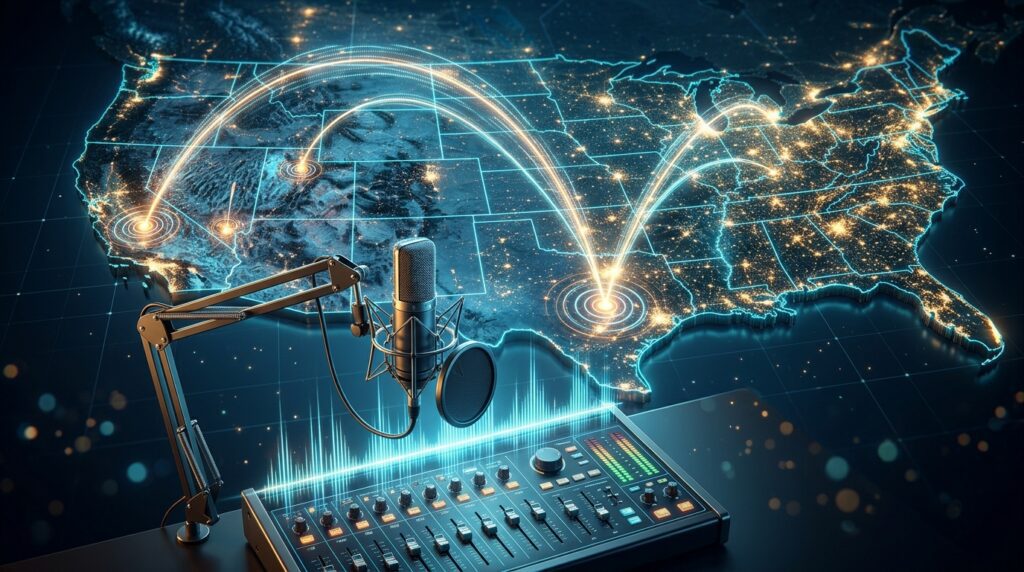
The AI radio host Coyotec has become part of a wider programming change at José 97.5 FM. According to reporting by WIRED, Al Aire y Sin Permiso expanded from a one-hour Saturday programme to a weekday morning slot running from 8 a.m. to 10 a.m., replacing a syndicated programme.
The show also expanded into five additional markets across California, Nevada and Texas, increasing its potential reach beyond Los Angeles.
Entravision reported substantial audience growth during the period following the programme’s expansion. In Los Angeles, cumulative listenership among Hispanic audiences rose by 21.6% between August and September 2026. The number of listeners aged 18 to 34 increased by 84.9%, while Hispanic female listenership in that age group grew by 500%.
These figures are encouraging for the broadcaster, particularly because younger audiences are important to a radio industry competing with streaming services, podcasts and social media. However, the figures reflect a specific period and market; they do not establish that AI alone caused the growth.
The partnership between Coyotec and Guzman is an example of how broadcasters are testing AI as part of a programme rather than relying entirely on automated content. Human presentation, editorial choices and a recognisable local identity remain important elements of the format.
The AI Technology Behind Coyotec

The AI radio host Coyotec combines several AI technologies to generate its voice, responses and visual identity.
Entravision has identified Claude Haiku as the language model used for live response generation, while ElevenLabs provides voice technology. OpenAI and ChatGPT were used for initial scriptwriting, and Midjourney helped develop visual concepts for the character.
These components support different parts of the experience. A language model generates conversational responses, voice synthesis converts text into speech, and image-generation technology helps establish the personality’s appearance.
The workflow demonstrates how multiple AI services can be combined to create a recognisable media character. It also illustrates the growing role of generative AI in broadcasting, where organisations can use the technology for scripting, production assistance, audio content and interactive presentation.
Nevertheless, live AI broadcasting requires human oversight. Generated responses can be unpredictable, and a system designed for spontaneous conversation may produce unsuitable language or inaccurate statements. Guzman has described the need to guide Coyotec’s behaviour, including occasional problems with swearing.
For broadcasters, technical capability must therefore be balanced with editorial review, audience expectations and compliance with broadcasting rules.
AI Radio Host Coyotec Raises Questions About Jobs and Trust
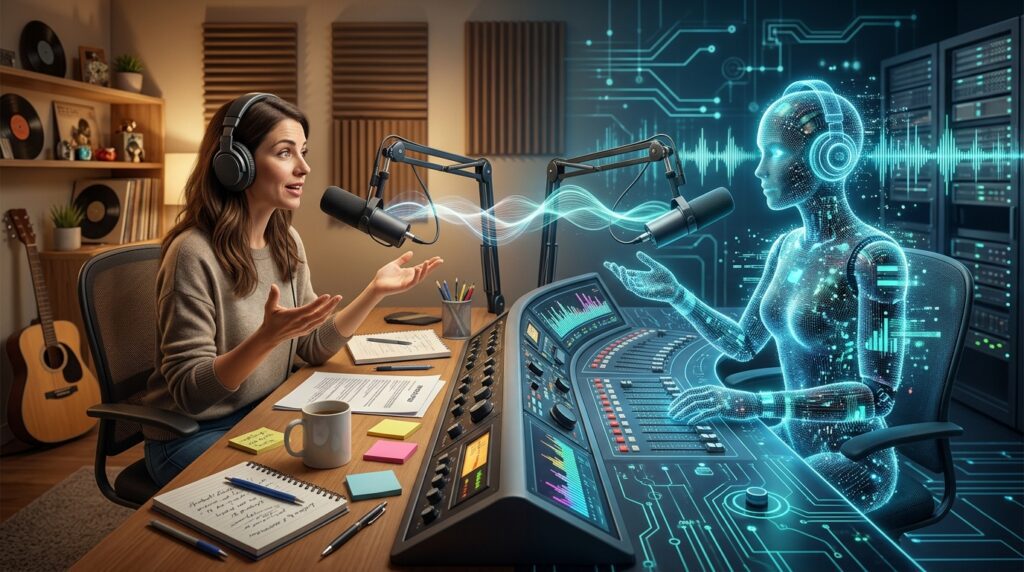
The popularity of the AI radio host Coyotec comes with concerns about what synthetic presenters could mean for broadcasting jobs.
Radio companies face pressure to reduce production costs and compete for advertising revenue. AI can help automate repetitive tasks, generate scripts and produce voices for certain programmes. For some broadcasters, these capabilities offer a way to maintain output with fewer production resources.
But radio professionals and labour organisations have warned that synthetic presenters could displace workers and weaken the personal connection audiences expect from human broadcasters.
The debate is not limited to radio personalities. Voice-over artists, writers, producers and other creative professionals are also assessing how generative AI could affect their work.
Entravision has said it has not dismissed staff because of AI and has argued that its use of the technology is intended to inform, entertain and connect with audiences rather than track them. However, concerns about employment and the use of AI in surveillance remain part of the wider debate, particularly in immigrant communities that may already feel vulnerable to monitoring.
The challenge for broadcasters is to establish clear standards for how AI is used, disclose when audiences are interacting with synthetic personalities and preserve meaningful human oversight.
What Coyotec Could Mean for the Future of Radio
The AI radio host Coyotec highlights a possible direction for the industry: combining automated technology with human-led programming and local cultural knowledge.
AI personalities could help stations develop bilingual content, produce material more efficiently and experiment with formats that would otherwise require additional resources. They may also allow broadcasters to respond more quickly to emerging topics and adapt content for different audiences.
However, the success of such experiments will depend on more than convincing voices or clever responses. Audiences need reliable information, transparent disclosure and a clear understanding of when a digital personality is speaking. Stations must also decide who is accountable when an AI presenter makes an error or produces inappropriate content.
Coyotec’s development suggests that a distinctive personality and a strong human co-host can help an AI character become part of a familiar broadcast experience. Its popularity does not eliminate the concerns surrounding automation, but it offers a real-world example of how broadcasters are exploring the technology.
For media organisations, the central question is not simply whether AI can speak naturally. It is whether the technology can contribute something valuable while maintaining the trust, cultural understanding and human accountability that make local radio meaningful.
Final Thoughts
The rise of the AI radio host Coyotec shows how artificial intelligence is moving beyond background production tools and into public-facing entertainment. Its Spanish-language personality, conversations with GeeGee Guzman and focus on issues affecting immigrant communities have helped a Los Angeles morning programme reach new audiences.
At the same time, the experiment highlights the need to address AI transparency, employment concerns and editorial responsibility. As more broadcasters test synthetic presenters, the most sustainable approach may be one in which AI supports human creativity and community connection rather than treating them as expendable.
For more developments in artificial intelligence and emerging technology, explore Progressive Robot’s AI and technology services.
Sources
More AI coverage: explore Progressive Robot's AI Models, Tools & Releases hub — hands-on reviews, setup guides and benchmarks in one place.










