

AI materials science is moving beyond systems that learn primarily from scientific papers and written descriptions. Researchers at the Massachusetts Institute of Technology (MIT) have developed a multimodal AI approach designed to connect the three-dimensional structures of crystalline materials with descriptions of their properties, processing requirements, and potential uses. The research could help scientists identify promising materials more effectively and improve the way artificial intelligence reasons about the physical world.
Published by MIT News on October 18, 2026, the research addresses an important limitation in existing AI systems: understanding a material’s name or chemical composition is not the same as understanding how its atoms are arranged in three dimensions. That arrangement can influence how a material behaves, how it can be manufactured, and whether it is suitable for a particular application.
The researchers’ approach combines structural information with language-based descriptions, giving AI models a more informative representation of materials than text alone can provide. The team demonstrated that this method could improve the identification of crystals suited to specific functions, including materials being investigated for solid-state lithium-ion battery electrolytes.
The work highlights a growing opportunity for AI materials science: helping researchers move from searching existing scientific knowledge toward identifying and evaluating materials that could address practical engineering challenges.
Why Traditional AI Models Struggle to Understand Materials

Large language models have become effective at processing technical documents, summarising research, and answering questions using patterns learned from text. However, materials science presents a different challenge because much of the information scientists need is inherently structural.
Crystalline materials contain atoms arranged in repeating three-dimensional patterns. These arrangements influence properties such as stability, conductivity, strength, and how a material responds to changes in temperature or pressure. Important structural information is often stored in specialised computational databases rather than expressed fully in ordinary written language.
A text-only model may recognise the chemical formula of a material or retrieve descriptions of its known uses without developing a sufficiently detailed representation of its atomic geometry. It may therefore struggle to connect a particular arrangement of atoms with the properties that make the material useful.
Another challenge is bias in available research data. Scientific literature does not cover every possible material equally. Some crystal families have received considerably more attention than others, potentially encouraging AI systems trained on published papers to favour familiar examples.
The MIT research aims to address these limitations by connecting structural representations with meaningful language descriptions. Rather than asking an AI model to infer everything from existing text, the researchers provide a bridge between the geometry of a crystal and the scientific knowledge associated with it.
This distinction matters because useful materials discovery depends on understanding relationships between composition, structure, processing, and performance—not simply identifying terms that frequently appear together in research papers.
How MIT’s Multimodal AI Model Works

The central idea behind the research is to help an AI model learn from two complementary forms of information: the three-dimensional geometry of a crystalline material and a natural-language description of what that material is, how it behaves, and why it may be useful.
According to MIT News, the research team developed a vision-language approach for crystalline materials. The system uses generated descriptions to connect structural information with scientific language, creating a shared representation that can help the model relate atomic arrangements to material functions.
One important part of this process is contrastive learning. In simplified terms, this training technique teaches a model to recognise which examples belong together and which do not. Here, the model learns relationships between crystal structures and their corresponding textual descriptions.
When the representations are aligned effectively, the AI can use a description of a desired property to search for structures that may be relevant. It can also learn relationships between geometric patterns and scientific concepts that would be difficult to capture through text alone.
The researchers compared a model trained with AI-generated descriptions of crystal structures against a version trained using text from research papers alone. Their reported results showed that the model trained with the generated descriptions learned to align crystal geometry with text descriptions more successfully.
This is an important distinction in AI materials science. The goal is not simply to feed a model more data, but to represent that data in a way that makes the underlying scientific relationships easier to learn.
The method also illustrates how multimodal AI can extend beyond conventional image recognition. In this setting, the model is not merely identifying what a picture contains. It is learning to connect a structured three-dimensional representation with information about physical properties and potential applications.
Why Three-Dimensional Crystal Structures Matter

A material’s chemical composition is only one part of its identity. The way its atoms are positioned and connected can also determine its behaviour. Two materials with related compositions can exhibit different properties when their structures differ.
For materials scientists, this makes structural understanding essential. A potential material for an electronic component, battery, catalyst, or industrial application must do more than contain the right elements. Its atomic arrangement must support the characteristics required for that particular use.
Traditional computational approaches can represent crystals as graphs, in which atoms and their connections form a mathematical structure. These representations are valuable, but connecting them to the language scientists use to describe material behaviour presents a separate challenge.
The MIT approach seeks to build that connection. By aligning geometric information with natural-language descriptions, AI materials science systems may become better equipped to identify relationships between atomic structure and material function.
This capability could be useful when researchers investigate materials they have not previously studied in depth. Rather than relying entirely on familiar examples in published literature, a model with stronger structural representations may help identify less obvious candidates for further investigation.
However, understanding a crystal’s structure does not automatically guarantee accurate predictions of its performance in real-world conditions. Properties can depend on temperature, pressure, defects, impurities, manufacturing methods, and other environmental factors. Computational predictions still require appropriate testing and validation.
The research therefore represents progress toward more scientifically informed AI, rather than a replacement for laboratory experiments or expert materials engineering.
How AI Materials Science Could Accelerate Battery Research

One of the practical examples described by MIT involves identifying crystalline materials suitable for solid-state lithium-ion battery electrolytes. These materials are important because solid-state battery technologies aim to use a solid electrolyte instead of the conventional liquid electrolyte found in many lithium-ion batteries.
Finding suitable solid electrolytes is challenging. Researchers must consider properties such as ionic conductivity, chemical stability, compatibility with other battery components, and the ability to manufacture the material reliably.
AI materials science could help narrow the search by identifying candidate structures associated with desired properties. In the MIT study, the model’s top results for a solid-state lithium-ion battery electrolyte query included materials that had independently been identified as promising candidates.
That result is encouraging because it suggests the model can retrieve relevant materials using a description of the required function. Instead of relying exclusively on names or phrases appearing in scientific papers, the model can use learned connections between material geometry and language.
For battery researchers, such tools could support early-stage screening, helping prioritise candidates for computational analysis and experimental testing. This may be particularly valuable when the number of possible crystal structures is too large for researchers to evaluate manually.
Nevertheless, identifying a promising candidate is not the same as producing a commercially viable battery. A proposed material must still be assessed for performance, safety, durability, cost, scalability, and compatibility with manufacturing processes.
The broader opportunity is to make the search process more targeted. By using AI to help organise and interpret complex structural information, researchers may spend less time examining unsuitable candidates and more time investigating materials that warrant closer attention.
What Makes This Approach Different From Text-Only AI?

Text-only AI systems learn primarily from language. They can be useful for searching scientific literature, summarising research findings, explaining technical concepts, and identifying relationships described in published documents.
But the scientific world contains information that is not naturally expressed as prose. Molecular geometry, crystal lattices, spatial relationships, and physical configurations can be difficult to communicate completely through written descriptions.
The MIT research takes a different approach by linking structural data with language. This gives the model another way to learn about materials and creates a shared representation that supports comparisons between crystal geometry and the descriptions of its properties.
The distinction is significant for AI materials science because researchers often need to move between different types of information. A scientific question may begin as a sentence describing a desired property, while the answer must ultimately point toward a particular material structure.
A model that can connect those representations has the potential to make such searches more effective. It may also help researchers explore materials whose relevance is not obvious from text alone.
This does not mean multimodal systems will always outperform text-based models. Performance depends on the quality of the training data, the task being evaluated, and the reliability of the underlying scientific representations. Some research questions may still be better handled through conventional databases, physics-based simulations, or specialised computational tools.
The value of this work is that it addresses a specific weakness in how AI learns about materials: the separation between written descriptions and three-dimensional atomic structures.
The Role of Synthetic Narratives in Training AI

An important element of the MIT research is the use of synthetic narratives: descriptions generated to explain the characteristics and significance of crystalline structures.
Scientific papers provide valuable information, but they do not necessarily cover every material or describe every structure in a consistent way. Some potentially useful crystal structures are available in computational databases even when their properties and applications receive limited attention in published literature.
Synthetic narratives offer a way to bridge that gap. They can provide language-based descriptions associated with structural data, giving the model additional examples from which to learn relationships between geometry and material function.
The researchers used these descriptions to train a model to align crystal structures with text. Their comparison with a paper-text-only baseline indicated that the narrative-based training approach helped the model learn this alignment more effectively.
There are still important limitations. AI-generated descriptions can contain inaccuracies, omit important qualifications, or introduce assumptions that are not supported by the underlying data. Their usefulness depends on the reliability of the process used to create and validate them.
A robust system therefore needs appropriate quality controls, trustworthy structural information, and scientific evaluation. Synthetic narratives should complement verified data rather than become an unchecked substitute for experimental evidence.
When developed carefully, this approach could help researchers make better use of existing computational databases and connect information that might otherwise remain separated across different scientific formats.
Could This Research Lead to an AlphaFold Moment for Materials Science?

MIT Professor Ju Li compares the research direction with AlphaFold, the AI system that helped researchers predict protein structures and advance structural biology. The comparison reflects a shared objective: connecting the structure of a physical system with information about its function.
Even so, the comparison illustrates why structural understanding matters. In both fields, AI becomes more useful when it can connect a complex physical representation with meaningful information about what that structure does.
For materials science, future advances could support the search for improved battery electrolytes, specialised electronic materials, catalysts, and other crystals with useful properties. Researchers may also be able to use these systems to explore candidate materials that have received less attention in the existing literature.
The next steps involve demonstrating that such models remain reliable across a broad range of materials and research tasks. Scientists will need to assess prediction quality, test candidate structures, and determine how well model outputs translate into measurable performance.
If those capabilities continue to improve, AI materials science could become a valuable part of the research workflow, helping scientists generate hypotheses, prioritise experiments, and discover connections that are difficult to identify through conventional searches alone.
What the Research Means for Businesses and Technology Developers

Although the research is focused on scientific modelling, its implications extend to industries that depend on materials innovation. Battery developers, semiconductor manufacturers, energy companies, aerospace engineers, and advanced manufacturing firms all need materials with carefully defined performance characteristics.
AI materials science could help these organisations explore potential candidates more efficiently by connecting desired properties with possible atomic structures. It may also help research teams organise large volumes of structural data and identify materials worth investigating further.
For technology companies, the immediate opportunity is not to assume that AI can independently invent a production-ready material. It is to evaluate how AI-assisted discovery can complement existing simulation software, laboratory testing, materials databases, and engineering expertise.
Businesses considering this technology should focus on measurable outcomes. Relevant questions include whether a model improves candidate selection, reduces unnecessary experiments, generalises to unfamiliar materials, and provides results that researchers can independently verify.
Data quality is another critical consideration. An AI model is only as useful as the structural representations, descriptions, and validation methods supporting it. Organisations should assess how their scientific data is generated, stored, documented, and checked before incorporating model outputs into important engineering decisions.
For Progressive Robot, this research is an example of how specialised AI systems can deliver value beyond general-purpose chatbots. The most useful applications often arise when AI is adapted to a specific domain, supplied with relevant data, and evaluated against real-world requirements.
The broader lesson is that successful AI adoption requires more than choosing a model. It requires the right data, appropriate technical integration, and a clear method for measuring results.
Limitations and Challenges That Still Need to Be Addressed
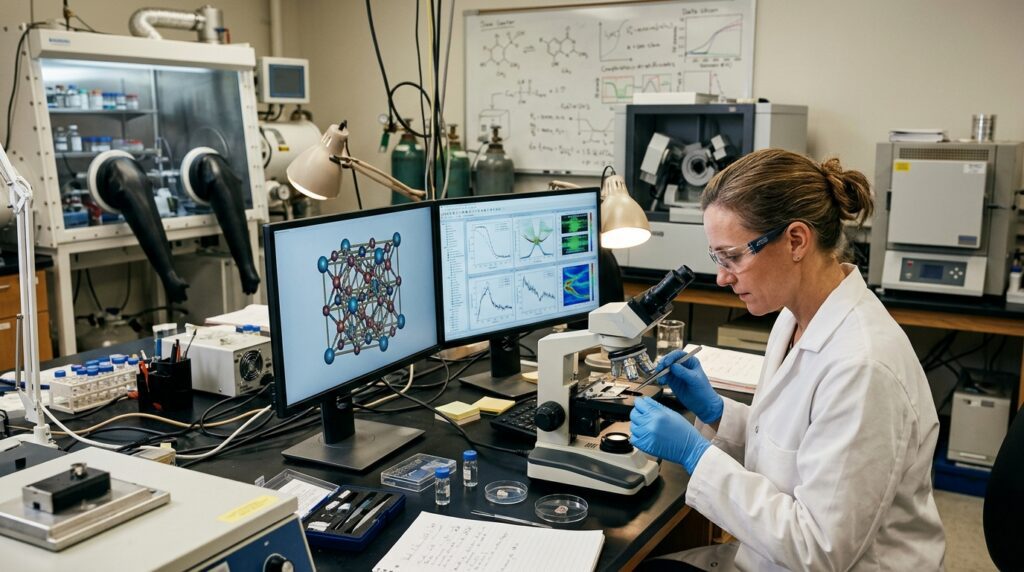
Despite its potential, this approach does not remove the fundamental difficulties of materials research.
First, prediction quality must be established for different material classes. A model that performs well on selected crystalline structures may not deliver the same results across every chemistry, crystal family, or application.
Second, structural data must be reliable. Missing information, inconsistent representations, or inaccurate descriptions can weaken the relationship between a crystal and its predicted properties.
Third, real-world performance depends on more than ideal crystal geometry. Defects, impurities, manufacturing conditions, environmental exposure, and interactions with other materials can affect how a material behaves outside a computational model.
Finally, researchers must distinguish between finding a promising candidate and demonstrating that it works. Computational screening can help narrow the search, but experiments and appropriate physical simulations remain essential for validating material performance.
The MIT work demonstrates a promising way to connect structural and linguistic information. It does not establish that every prediction will be accurate, that experimental discovery can be bypassed, or that the approach is ready to replace established materials engineering processes.
These limitations are not reasons to dismiss the research. They are important factors in determining how AI materials science should be developed, tested, and deployed responsibly.
Conclusion: AI Is Learning to Understand Materials More Deeply
MIT’s research points toward a more structurally informed approach to artificial intelligence. By connecting three-dimensional crystal geometry with natural-language descriptions, the team has developed a method that helps AI models learn relationships between material structures and their potential functions.
The reported battery-electrolyte example provides an encouraging demonstration of how this approach could help identify relevant candidates. More broadly, the work suggests that AI materials science can benefit from models that learn from the physical structure of materials rather than relying exclusively on written scientific knowledge.
The practical impact will depend on further validation, the quality of training data, and how well these systems perform across different materials and applications. Researchers will still need to test predictions and establish whether proposed materials meet real engineering requirements.
Nevertheless, the direction is promising. As AI systems become better at connecting structural information with scientific reasoning, they could help researchers search larger spaces of possible materials, formulate stronger hypotheses, and direct experimental work toward the most promising opportunities.
The next major advance may not come from a model that simply knows more scientific facts, but from one that can connect those facts to a deeper representation of the physical world.
Frequently Asked Questions
What is AI materials science?
AI materials science is the use of artificial intelligence and machine learning to analyse, predict, design, or discover materials. Applications include screening crystal structures, predicting properties, and identifying candidates for batteries, electronics, and other technologies.
What did MIT researchers develop?
MIT researchers developed a multimodal AI approach that connects three-dimensional crystalline structures with natural-language descriptions. The method aims to help AI models understand relationships between atomic geometry, material properties, processing, and potential applications.
Why is three-dimensional crystal information important?
The arrangement and connections between atoms influence how a crystalline material behaves. Incorporating this geometry can help AI systems learn structural relationships that may be difficult to capture from scientific text alone.
How does contrastive learning help the model?
Contrastive learning helps a model learn which structural representations and descriptions correspond to one another. In this research, it supports alignment between crystal geometry and language, making it easier to relate material structures to scientific descriptions.
Can AI discover new battery materials?
AI can help identify and prioritise candidate materials with desired properties. The MIT research reported promising results when searching for crystalline materials suited to solid-state lithium-ion battery electrolytes. However, candidate materials still require further scientific evaluation and testing.
Will AI replace materials scientists?
No. These systems are better understood as research tools that can support searching, screening, and hypothesis generation. Materials scientists remain essential for interpreting results, designing experiments, validating performance, and determining whether a candidate can be manufactured and used safely.
What is the main limitation of this research?
The method’s performance must be assessed across different materials and applications. Data quality, prediction reliability, real-world conditions, and experimental validation remain important challenges before AI-generated recommendations can be trusted for practical engineering decisions.
Sources and Further Reading
-
MIT News: Giving AI a “crystal clear” view of the materials world — the original report on the research, published October 18, 2026.
-
Nature Communications: Scaling multimodal materials representation learning with synthetic narratives — the research paper title reported by MIT. Use the publisher’s search to locate the specific paper and verify its full bibliographic details before citing it in a formal research publication.
More AI coverage: explore Progressive Robot's AI Models, Tools & Releases hub — hands-on reviews, setup guides and benchmarks in one place.










