
Anthropic Claude Opus 4.7 is now generally available, and Anthropic says it is the company’s most capable generally available model for complex reasoning and agentic coding.
If you want the short version, Anthropic Claude Opus 4.7 is a direct upgrade over Opus 4.6 with stronger coding, better long-running agent performance, higher-resolution vision, and the same API pricing. But the new model also introduces migration changes around tokenization, thinking behaviour, sampling controls, and prompt handling that developers need to test carefully.
That is why Anthropic Claude Opus 4.7 matters beyond a normal model refresh. This release is not only about benchmark gains. It also changes how teams should budget tokens, tune effort, handle vision inputs, and migrate existing Claude-based products.
This article draws on Anthropic’s official Introducing Claude Opus 4.7 announcement, the current Claude Opus page, Anthropic’s What’s new in Claude Opus 4.7 documentation, the Models overview, the migration guide, and the Claude Platform release notes.
Anthropic Claude Opus 4.7 at a glance
Anthropic Claude Opus 4.7 can be summed up in a few clear points.
- Anthropic Claude Opus 4.7 launched on April 16, 2026 as Anthropic’s most capable generally available model.
- The model uses the ID
claude-opus-4-7. - It supports a 1M token context window and 128k max output tokens.
- It keeps the same API pricing as Opus 4.6: $5 per million input tokens and $25 per million output tokens.
- It is available across Claude products, the Claude API, Amazon Bedrock, Google Cloud Vertex AI, and Microsoft Foundry.
- It is the first Claude model with high-resolution image support up to 2576 pixels on the long edge, or about 3.75 megapixels.
- It adds a new
xhigheffort level and launches task budgets in beta. - It removes some old request patterns, including extended thinking budgets and non-default sampling controls.
Why Anthropic Claude Opus 4.7 matters

Anthropic Claude Opus 4.7 matters because Anthropic is not positioning it as a narrow benchmark bump.
The company is presenting Anthropic Claude Opus 4.7 as a more dependable model for the hardest coding, agentic, and enterprise tasks. That matters because teams using Claude at scale usually care less about a single leaderboard number and more about whether the model can carry work across long sessions, use tools reliably, and avoid falling apart on complex workflows.
The release also matters because the price stayed flat while the capability claims moved up. That changes the economics for teams already paying Opus 4.6 rates.
If you are tracking how these models fit into broader workflow automation and autonomous AI agents, this launch is one of the clearest 2026 examples of a model vendor optimising for long-running production work instead of only chat quality.
7 critical facts behind Anthropic Claude Opus 4.7

1. Anthropic Claude Opus 4.7 is Anthropic’s most capable generally available model, but not its absolute most powerful preview model
The first thing to understand about Anthropic Claude Opus 4.7 is the positioning.
Anthropic says Opus 4.7 is its most capable generally available model. That wording matters. In the same launch materials, Anthropic also says Mythos Preview remains more broadly capable and better aligned overall, but Mythos is still limited rather than broadly released.
So Opus 4.7 is the new flagship for broad use, not the ceiling of everything Anthropic has in research preview.
2. Anthropic Claude Opus 4.7 keeps Opus 4.6 pricing while expanding across Anthropic’s full product stack
The model is available today across Claude’s paid products and across the main developer platforms Anthropic supports.
According to Anthropic’s official pages, it is available for Pro, Max, Team, and Enterprise users in Claude, and for developers through the Claude Platform, Amazon Bedrock, Google Cloud Vertex AI, and Microsoft Foundry.
The pricing point stayed the same as Opus 4.6. It costs $5 per million input tokens and $25 per million output tokens. That same-price upgrade story is one of the strongest commercial angles in the launch.
3. Anthropic Claude Opus 4.7 is mainly a coding and agentic-work release
The release is being sold first as a model for hard software and agent workflows.
Anthropic says the model is a notable improvement on Opus 4.6 in advanced software engineering, especially on difficult long-running tasks. The company and its early-access partners cite a range of gains, including a 13% lift on a 93-task coding benchmark, stronger results on CursorBench, better task completion on Rakuten-SWE-Bench, and fewer tool errors in longer multi-step workflows.
Those are mostly Anthropic and partner-reported evaluations, so they should be read carefully. But the directional signal is clear. Opus 4.7 is being optimised for production coding, long-horizon planning, and agent reliability more than for casual chat.
4. Anthropic Claude Opus 4.7 brings the biggest vision upgrade in the Claude line so far
One of the most important non-coding changes in Opus 4.7 is vision.
Anthropic says the model is the first Claude model with high-resolution image support. The maximum image resolution increases from 1568 pixels on the long edge to 2576 pixels, or roughly 3.75 megapixels. Anthropic also says image coordinates now map 1:1 with actual pixels, which simplifies screenshot and computer-use workflows.
That is a real upgrade for diagrams, dense screenshots, document analysis, and visual tool use. But it also makes image-heavy workloads more expensive, because full-resolution inputs can use up to about three times as many image tokens as prior models.
5. Anthropic Claude Opus 4.7 introduces new control levers for intelligence, effort, and long-run budgeting
This is not just a smarter model. It also changes how developers are expected to control it.
Anthropic added a new xhigh effort level between high and max, and the docs recommend high or xhigh for coding and agentic use cases. It also launches task budgets in beta, which let teams give the model an advisory token budget across a full agentic loop instead of only setting a hard max_tokens ceiling.
It still supports adaptive thinking, but adaptive thinking is off by default unless you explicitly enable it. That is an important detail for teams expecting thinking behaviour to appear automatically.
6. Anthropic Claude Opus 4.7 has real migration-breaking changes that developers cannot treat as minor
This is the part many launch summaries skip.
The model removes extended thinking budgets, so the old thinking: {type: "enabled", budget_tokens: N} pattern now returns a 400 error. It also rejects non-default temperature, top_p, and top_k values, omits thinking text by default unless you opt in, and uses a new tokenizer that may consume roughly 1.0x to 1.35x as many text tokens as Opus 4.6.
Anthropic also says assistant-message prefills remain unsupported on this model, just as they were on Opus 4.6. In practical terms, it is a better model, but it is not a drop-in replacement if your product depends on old reasoning settings, token assumptions, visible thinking traces, or custom sampling parameters.
7. Anthropic Claude Opus 4.7 is also part of Anthropic’s staged cyber-safety rollout
The release matters for safety policy as well as product performance.
Anthropic says the model is the first less-capable model on which it is deploying the new safeguards that automatically detect and block prohibited or high-risk cybersecurity requests. The company says what it learns from real-world deployment of those safeguards will help it move toward broader release of Mythos-class models later.
Anthropic’s safety write-up says Opus 4.7 is modestly better than Opus 4.6 on some measures such as honesty and prompt-injection resistance, modestly weaker on some others, and overall similar in safety profile. That makes the launch more nuanced than a simple “bigger and better” story.
What teams need to check before upgrading to Anthropic Claude Opus 4.7

This is a direct upgrade in capability, but teams should still test a few things before moving production traffic.
- Re-benchmark token usage, because the model uses a new tokenizer.
- Re-tune
max_tokens, especially on long traces and image-heavy workloads. - Replace old thinking-budget patterns with adaptive thinking plus effort.
- Remove non-default sampling parameters from requests.
- Decide whether your product needs visible thinking summaries, because it omits them by default.
- Re-test prompts for more literal instruction following and a more direct tone.
- Downsample images if full-resolution input is unnecessary.
For teams already using Opus 4.6 heavily, the best reading is that this upgrade offers more upside, but only if the migration work is done properly.
Artificial Analysis intelligence comparison
The comparison below uses the live Artificial Analysis API on April 17, 2026. Where Artificial Analysis lists multiple rows for the same Claude family, this section uses the highest published Artificial Analysis Intelligence Index for that family so the comparison reflects the strongest currently benchmarked configuration.
Two gaps in the API matter right now. Claude Mythos is not currently exposed in the free Artificial Analysis LLM API, and Claude Opus 4.7 appears in the API but its intelligence benchmarks are still null, so both are listed as pending rather than assigned invented scores.
Source and attribution: Artificial Analysis via the LLM models API.
| Requested model | Artificial Analysis row used | Intelligence Index | Coding Index | GPQA | MMLU-Pro | Speed (tok/s) | Blended price ($/1M) | API status |
|---|---|---|---|---|---|---|---|---|
| Claude 3 Opus | Claude 3 Opus | 18.0 | 19.5 | 0.489 | 0.696 | 0.0 | 30.0 | Published |
| Claude 3 Sonnet | Claude 3 Sonnet | 10.3 | N/A | 0.400 | 0.579 | 0.0 | 6.0 | Published |
| Claude 3 Haiku | Claude 3 Haiku | 12.3 | 6.7 | 0.374 | N/A | 128.0 | 0.5 | Published |
| Claude 3.5 Sonnet | Claude 3.5 Sonnet (Oct ’24) | 15.9 | 30.2 | 0.599 | 0.772 | 0.0 | 6.0 | Published |
| Claude 3.5 Haiku | Claude 3.5 Haiku | 18.7 | 10.7 | 0.408 | 0.634 | 0.0 | 1.6 | Published |
| Claude 3.7 Sonnet | Claude 3.7 Sonnet (Reasoning) | 34.7 | 27.6 | 0.772 | 0.837 | 0.0 | 6.0 | Published |
| Claude Sonnet 4 | Claude 4 Sonnet (Reasoning) | 38.7 | 34.1 | 0.777 | 0.842 | 43.4 | 6.0 | Published |
| Claude Opus 4 | Claude 4 Opus (Reasoning) | 39.0 | 34.0 | 0.796 | 0.873 | 34.3 | 30.0 | Published |
| Claude Opus 4.1 | Claude 4.1 Opus (Reasoning) | 42.0 | 36.5 | 0.809 | 0.880 | 34.2 | 30.0 | Published |
| Claude Sonnet 4.5 | Claude 4.5 Sonnet (Reasoning) | 43.0 | 38.6 | 0.834 | 0.875 | 43.0 | 6.0 | Published |
| Claude Haiku 4.5 | Claude 4.5 Haiku (Reasoning) | 37.1 | 32.6 | 0.672 | 0.760 | 108.1 | 2.0 | Published |
| Claude Opus 4.5 | Claude Opus 4.5 (Reasoning) | 49.7 | 47.8 | 0.866 | 0.895 | 51.8 | 10.0 | Published |
| Claude Opus 4.6 | Claude Opus 4.6 (Adaptive Reasoning, Max Effort) | 53.0 | 48.1 | 0.896 | N/A | 44.4 | 10.0 | Published |
| Claude Sonnet 4.6 | Claude Sonnet 4.6 (Adaptive Reasoning, Max Effort) | 51.7 | 50.9 | 0.875 | N/A | 51.6 | 6.0 | Published |
| Claude Mythos | Not available | N/A | N/A | N/A | N/A | N/A | N/A | Not exposed in Artificial Analysis free LLM API |
| Claude Opus 4.7 | Claude Opus 4.7 (Adaptive Reasoning, Max Effort) | N/A | N/A | N/A | N/A | 0.0 | 0.0 | Listed in API, score pending |
Intelligence Index graph
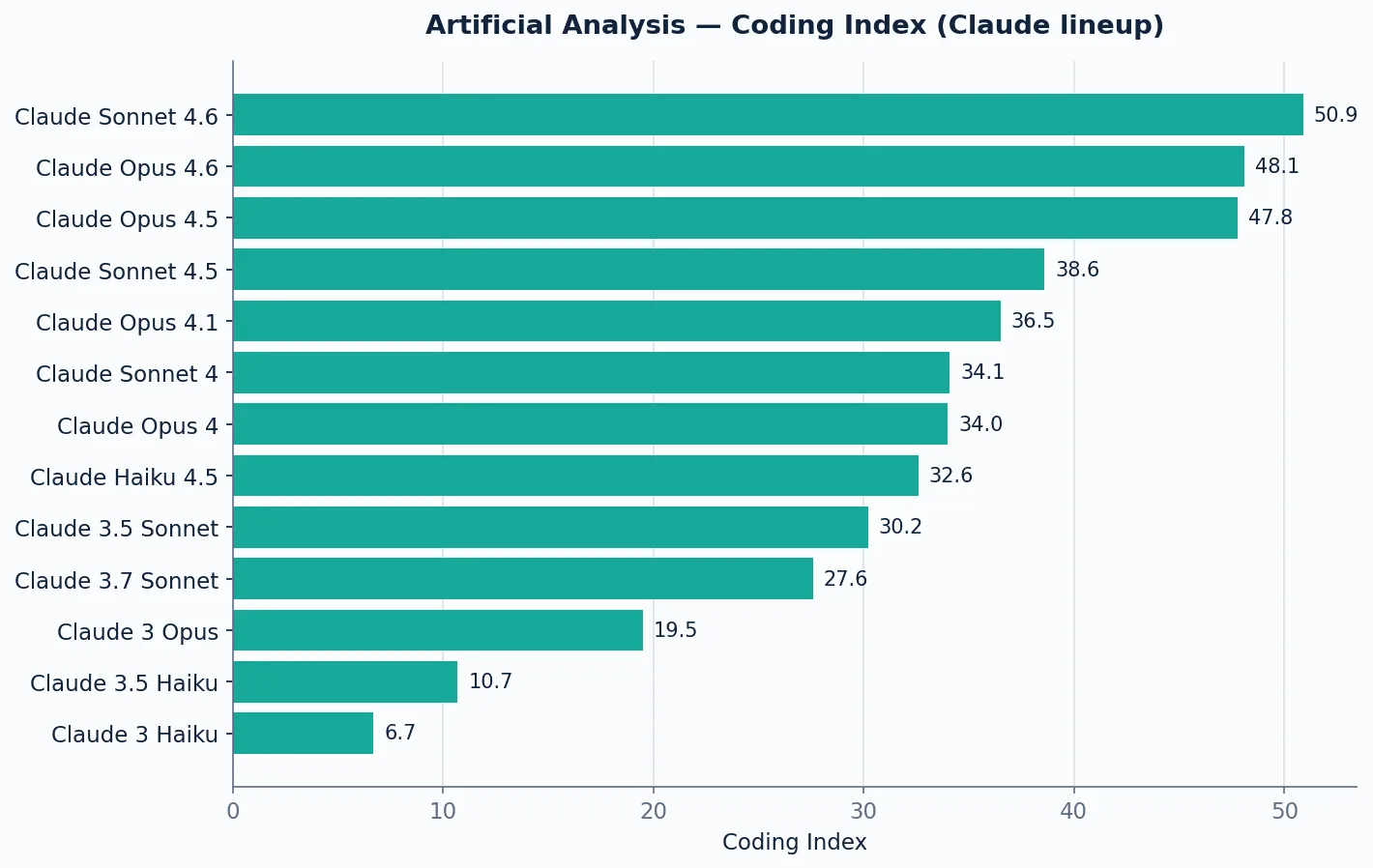
Coding Index graph
Intelligence vs price graph
Claude Opus 4.5 vs 4.6 vs 4.7 readiness
Opus 4.5 and Opus 4.6 are fully benchmarked in the Artificial Analysis snapshot above. Opus 4.7 is listed in the API but its Intelligence, Coding, Math, GPQA and MMLU-Pro fields are still null on April 17, 2026, so the readiness view shows Opus 4.7 as a pending bar next to its two predecessors instead of using placeholder scores.
Quick read
- Highest published intelligence score in this set: Claude Opus 4.6 at 53.0 using the row “Claude Opus 4.6 (Adaptive Reasoning, Max Effort)”.
- Highest published coding score in this set: Claude Sonnet 4.6 at 50.9 using the row “Claude Sonnet 4.6 (Adaptive Reasoning, Max Effort)”.
- Lowest published blended price in this set: Claude 3 Haiku at $0.5 per 1M blended tokens.
- Pending API coverage: Claude Mythos, Claude Opus 4.7.
Anthropic Claude Opus 4.7 FAQ
Is Anthropic Claude Opus 4.7 the same as Mythos Preview?
No. It is the company’s most capable generally available model, while Mythos Preview remains a more limited research preview model.
How much does Anthropic Claude Opus 4.7 cost?
It costs $5 per million input tokens and $25 per million output tokens on the Claude API, the same as Opus 4.6.
Does Anthropic Claude Opus 4.7 support a 1M context window?
Yes. It supports a 1M token context window and up to 128k output tokens on the synchronous Messages API.
What is the biggest migration risk with Anthropic Claude Opus 4.7?
The biggest operational risk is assuming it behaves exactly like Opus 4.6. It changes tokenization, removes old extended-thinking budgets, removes non-default sampling parameters, and hides thinking content by default.
When should teams use Anthropic Claude Opus 4.7?
Anthropic recommends it for the hardest tasks, especially advanced coding, complex agent workflows, and high-stakes enterprise work where capability matters more than raw speed.
Final thoughts
Anthropic Claude Opus 4.7 is one of the more important model launches of 2026 because it combines a same-price upgrade story with real capability gains in the workflows that actually drive enterprise AI adoption.
The headline is simple: Anthropic Claude Opus 4.7 is better than Opus 4.6 across coding, agents, vision, and long-context professional work according to Anthropic’s launch materials. The more important detail is that the model also changes how teams should prompt, budget, and migrate.
That is what makes the release worth attention. This is not just a new model name. It is Anthropic’s clearest attempt so far to turn a flagship model into a more dependable engine for real production work.
More AI coverage: explore Progressive Robot's AI Models, Tools & Releases hub — hands-on reviews, setup guides and benchmarks in one place.










