

AI genome research is advancing quickly, with models trained on DNA sequences learning to predict aspects of gene activity and biological function. But scientists are discovering that the human genome is not a straightforward genetic blueprint. Its activity depends on how DNA is folded, which molecules interact with it, what type of cell contains it, and what signals that cell is receiving.
That complexity helps explain why AI can make promising predictions without fully explaining how the genome operates. A model may identify statistical patterns in genetic data, yet still lack the biological context needed to understand what happens inside a living cell. The challenge is not simply processing more DNA. It is understanding how the genome behaves as a changing system.
Why the Human Genome Is So Complicated

The human genome contains roughly three billion DNA letters, but only a small fraction directly encodes proteins. Much of the remaining sequence is involved in regulation, chromosome organization, or other functions that scientists are still investigating. Understanding a gene therefore requires more than identifying its sequence: researchers also need to know when it is active, in which cells, and what controls its activity.
This is a central problem for AI genome research. A model can learn from known examples, but biological regulation often depends on combinations of signals rather than one simple switch. The same gene can behave differently in different cell types or under different conditions.
Gene Regulation Depends on Context

Cells use regulatory proteins called transcription factors to help control whether genes are switched on or off. In complex organisms, these factors can work in combinations, and their effects may vary according to the cell’s circumstances. A regulatory element that activates a gene in one setting may have a different effect in another.
This makes the task difficult for AI genome research models that attempt to infer gene activity from sequence alone. The DNA sequence matters, but the outcome can also depend on which regulatory proteins are present, how they interact, and what other signals the cell is receiving.
Distant DNA Regions Can Control Genes
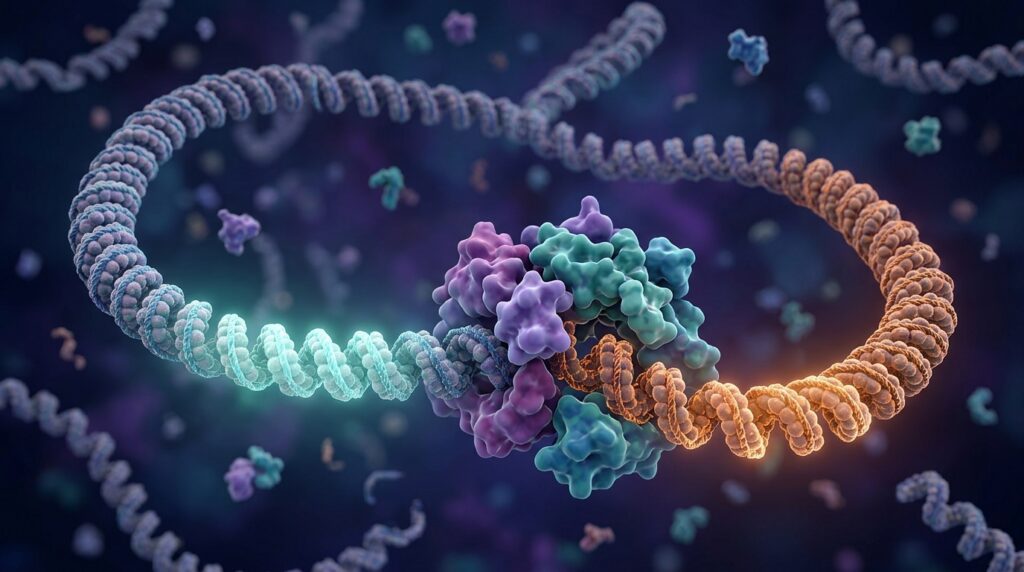
Some DNA elements that influence a gene are located far away from it along the chromosome. These enhancers can interact with their target genes when the DNA folds into loops, bringing distant regions into physical proximity. In some cases, researchers still do not know precisely which enhancer controls which gene or how the interaction changes across cell types.
For AI genome research, this creates a challenge: the relevant relationship may not be obvious from the linear sequence. A model needs information about the genome’s spatial organization and how that organization changes, not just a string of DNA letters.
The Genome Is a Dynamic Three-Dimensional Structure
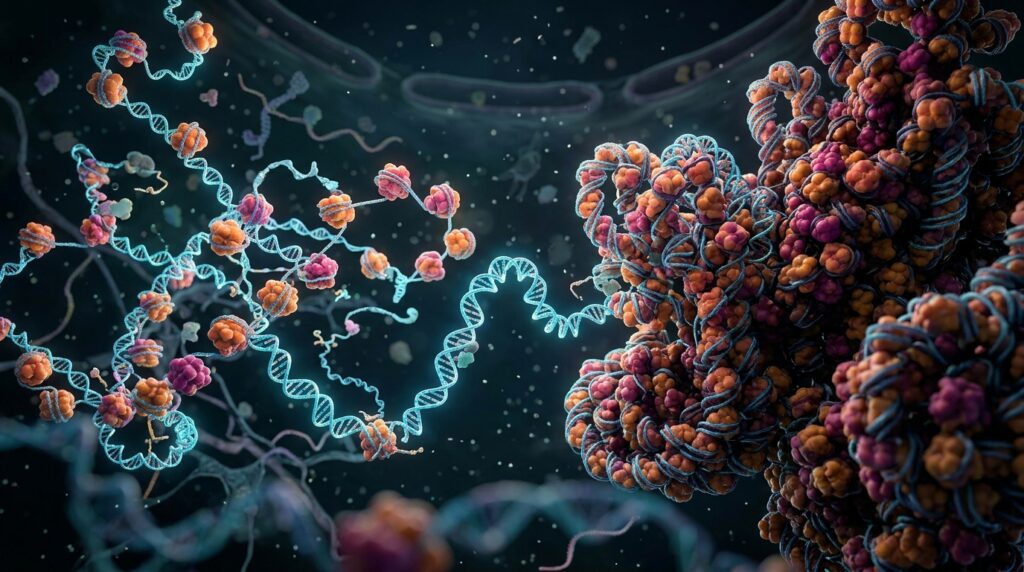
DNA is packaged with proteins into chromatin, which can be more tightly or loosely organized. Tightly packed regions are generally less accessible to the machinery that reads genes, while more open regions can be easier to use. Chromatin also forms larger structures and domains that help organize interactions across the genome.
This organization is not fixed. It can change as cells develop, respond to signals, or perform different functions. AI genome research must therefore account for biological measurements that capture these changing states. A prediction based on one cell type or experimental condition may not apply in another.
Why Genomic AI Models Have Important Limits

Genomic foundation models, including systems such as AlphaGenome, are designed to learn patterns from large collections of biological data and predict how DNA changes may affect molecular processes. These tools could help prioritize research questions and identify promising hypotheses. Their usefulness, however, depends on the quality and breadth of the data used to train and evaluate them.
A model can perform well on a benchmark while still struggling with unfamiliar biological contexts. Machine-learning researchers have warned that genomic datasets can contain biases, confounding factors, and evaluation pitfalls that make performance appear stronger than it really is. AI genome research needs careful validation across different cell types, conditions, and independent datasets before predictions can be treated as reliable biological explanations. <Cite refs={[“turn842507search6″,”turn842507search0”]}/>
The Missing Data Problem
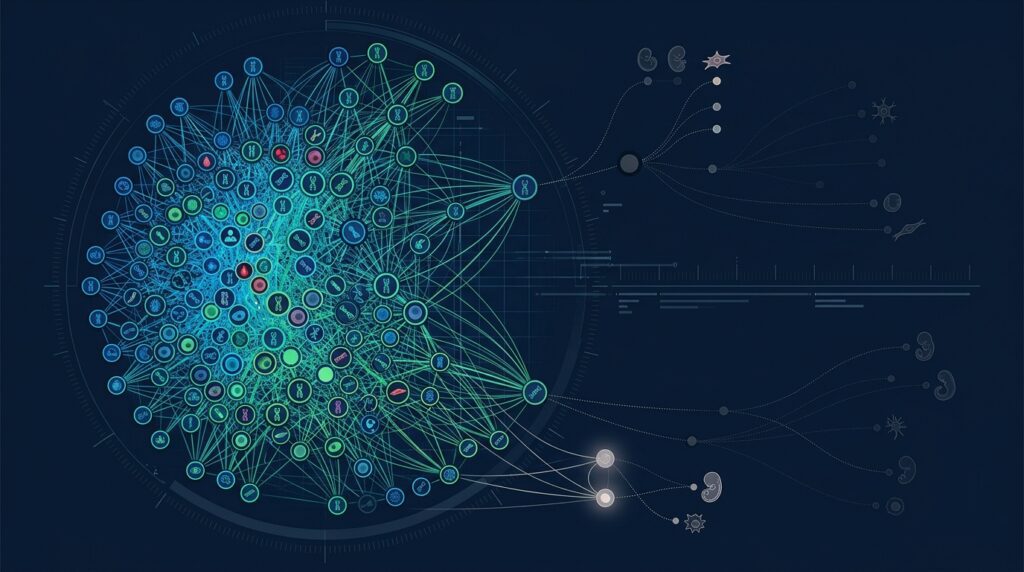
A major limitation is the shortage of comprehensive measurements across the many cell types in the human body and across their development. Scientists may have detailed information for some biological settings but far less for others. Yet gene regulation can change substantially as cells mature, respond to their environment, or transition into new states.
This data gap limits AI genome research because a model cannot reliably learn every relevant interaction from examples it has never seen. Expanding datasets, improving experimental methods, and combining measurements from different biological scales will be important for making predictions more robust.
Genes Are Influenced by More Than DNA Sequence

The way genes function can also be influenced by factors outside the DNA sequence, including cellular signals, environmental conditions, and the state of the surrounding biological system. These influences can affect gene expression and the molecular processes that follow.
That does not mean genomic AI is useless. It means sequence-based predictions answer only part of the biological question. AI genome research will be more informative when models can combine DNA information with relevant measurements of cells, tissues, and environmental conditions.
What AI Can—and Cannot—Do Today

AI can already help scientists analyze large datasets, predict some molecular effects of genetic changes, and prioritize experiments. These capabilities can make research more efficient and help investigators focus on promising possibilities.
But predictions are not the same as a complete explanation of living systems. Researchers still need experiments to test whether a model’s proposed relationships hold in real biological contexts. The most productive path for AI genome research is likely to combine computational predictions with careful measurements, biological reasoning, and independent validation.
Conclusion: Understanding the Genome Requires More Than a Bigger Model

The human genome is not a static code that produces the same result in every situation. It is a dynamic system shaped by gene regulation, chromatin structure, cellular context, and signals from the environment. That complexity makes it difficult for AI models to move from recognizing patterns to explaining how life works.
AI genome research remains valuable: it can help organize evidence, generate hypotheses, and guide experiments. But reliable understanding will require better biological data, models that account for context, and experimental confirmation. AI can support genomics research, yet the genome’s convoluted behavior is a reminder that prediction alone is not the same as explanation.
Frequently Asked Questions
Why is the human genome difficult for AI to understand?
Because gene activity depends on more than DNA sequence. Regulation, three-dimensional chromatin structure, cell type, developmental stage, and environmental signals can all affect how genetic information is used.
Can AI predict what a genetic variant does?
Some models can predict selected effects of DNA changes, but predictions may be uncertain or context-dependent. Experimental validation is needed before drawing strong conclusions about biological effects or health implications.
What is AlphaGenome?
AlphaGenome is a genomic AI model developed by Google DeepMind to predict aspects of how DNA sequences relate to molecular processes. It can support research, but its predictions do not amount to a complete explanation of genome function.
Does this mean AI has no role in genomics?
No. AI can help analyze large datasets, identify patterns, and prioritize experiments. The limitation is that computational predictions need biological context and independent testing.
Explore AI and Digital Innovation With Progressive Robot
Progressive Robot helps organizations explore practical IT solutions, software development, and AI-powered digital services. To learn more, visit Progressive Robot or explore its AI and automation services.
References
More AI coverage: explore Progressive Robot's AI Models, Tools & Releases hub — hands-on reviews, setup guides and benchmarks in one place.










