

AI deepfake detection is becoming increasingly important as artificial intelligence generates videos that are difficult to distinguish from genuine recordings. Researchers at the University of Colorado Boulder have developed a new approach that could make identifying manipulated videos significantly more efficient, potentially bringing real-time protection closer to everyday video calls.
The research team developed a system called DeepSFU that analyses information already present in compressed video instead of reconstructing every frame at full resolution. According to the researchers, this approach achieved comparable detection performance while using 143 times less computing power than existing models in their evaluation.
The findings were presented at the ACM SIGCOMM 2026 conference, a major event focused on computer networking and systems. The work addresses a practical problem: existing detection methods can require substantial processing resources, making widespread deployment expensive and technically challenging.
As realistic AI-generated videos become easier to produce, a more efficient detection method could help businesses, online platforms and individuals identify suspicious video calls before they cause harm.
Why Are AI Deepfakes Becoming Harder to Detect?

Deepfakes are videos, images or audio recordings generated or manipulated using AI to imitate real people or create events that never happened. Modern generative systems can reproduce facial appearance, expressions and speech with impressive realism.
This creates serious risks for organisations that rely on video calls to verify identities or authorise sensitive transactions. Criminals have used synthetic media to impersonate executives, imitate colleagues and manipulate employees into transferring money or disclosing confidential information.
Traditional visual checks are becoming less dependable because obvious signs, such as unnatural facial movements or visible image distortions, may be absent in sophisticated fakes.
Effective AI deepfake detection therefore requires more than asking whether a video looks convincing. Detection systems need to identify technical characteristics that may reveal manipulation even when the footage appears authentic to a human viewer.
The growing realism of manipulated video makes AI deepfake detection a practical challenge for businesses, journalists and everyday users. A convincing fake may preserve natural facial movement, lighting and speech, leaving viewers with few obvious visual clues. More reliable AI deepfake detection therefore needs to examine signals that are difficult to judge by eye, including subtle changes in video data and compression patterns.
How Does the New DeepSFU Detection Method Work?
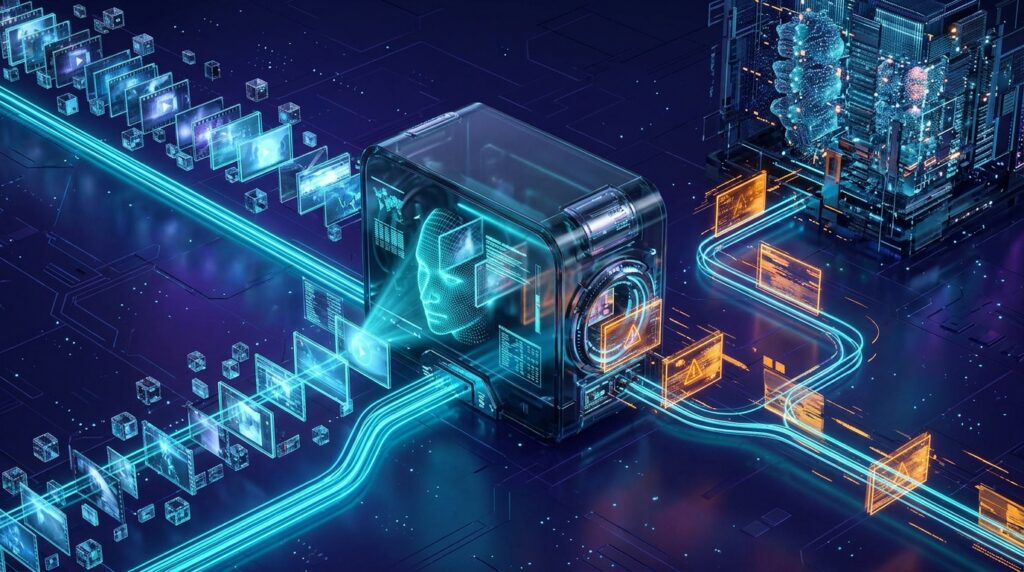
Most conventional video detection systems need to examine the visual content of video frames. To do that, they typically reconstruct compressed video into images that can be processed by AI models. Repeating this process across every frame can consume considerable computing resources.
The researchers discovered that useful clues could already exist in the compressed video data transmitted across a network.
Video compression works by recording changes between frames rather than repeatedly transmitting every pixel in full. Relatively static backgrounds may require little new information, while moving facial features can produce more detailed patterns in the compressed stream.
The DeepSFU system examines how this information is distributed around a person’s face. It measures changes associated with facial appearance and the amount of new information required to represent those changes.
If the data looks suspicious, the system can request a fresh, full-resolution frame from the sender’s device and use an AI model to examine it more closely.
This selective process is central to the new approach. Rather than performing expensive image analysis continuously, the system uses inexpensive preliminary checks to identify moments that deserve further investigation.
The research team reported that it needed to examine data from only one out of every 100 frames for its initial screening stage, potentially reducing the processing burden substantially.
DeepSFU offers a different route for AI deepfake detection by screening compressed video information before requesting a full-resolution frame for closer analysis. This staged approach could make AI deepfake detection less demanding in live calls, where checking every frame with a large model would consume significant computing resources. The system is designed to flag suspicious content for deeper examination rather than treating every frame as equally risky.
How Much More Efficient Is the New System?

The researchers reported that DeepSFU used 143 times less computing power than the existing detection models used for comparison while achieving comparable results in their evaluation.
They also tested the system on a collection of 1,000 online videos containing deepfakes and reported near-perfect accuracy. These findings suggest that analysing compressed video could offer a practical alternative to methods that reconstruct every frame before examining it.
However, the results should be interpreted within the scope of the reported experiments. Performance on a test collection does not guarantee identical accuracy across every camera, video platform, compression format or deepfake-generation technique.
Even so, the reduction in computing requirements could make AI deepfake detection more practical for systems that must process many simultaneous video streams.
For video-conferencing providers, lower processing costs could help reduce the infrastructure needed to screen calls. For businesses, more efficient analysis could potentially support additional security checks without requiring every participant’s video to undergo intensive processing continuously.
The reported efficiency gains matter because AI deepfake detection must operate quickly enough to be useful during real-time communication. By limiting expensive analysis to selected frames, DeepSFU could help AI deepfake detection scale to more video streams without requiring the same level of processing for every frame. The researchers’ results are promising, although performance in broader real-world deployments still needs to be assessed.
Could This Technology Help Protect Video Calls?

Video conferencing has become an essential part of business communication, remote collaboration and financial operations. Unfortunately, a convincing synthetic video can undermine the assumption that seeing someone on screen is sufficient proof of identity.
A more efficient detection system could help conferencing platforms introduce additional checks without processing every video frame at full resolution.
The researchers have discussed adapting their technology for larger-scale video-conferencing deployments. However, the research does not mean DeepSFU is already available as a built-in feature across major meeting platforms.
Its practical value will depend on further engineering, integration with conferencing infrastructure and testing under real-world conditions.
Organisations should also avoid relying on video appearance alone when authorising sensitive actions. Independent identity verification, established approval procedures and confirmation through a separate communication channel can provide additional protection against impersonation.
If integrated into conferencing platforms, AI deepfake detection could provide an additional warning when a caller’s video appears manipulated. Such alerts should support—not replace—identity checks, confirmation through a separate channel and other security procedures. In high-risk meetings, AI deepfake detection may be most useful as one layer in a wider fraud-prevention system.
What Are the Limitations of AI Deepfake Detection?
Even a highly efficient detection system cannot guarantee that every manipulated video will be identified correctly.
Deepfake generation methods continue to evolve, and different models may introduce different technical characteristics. Video compression, network conditions, camera quality and legitimate changes in lighting or facial movement can also affect the data available for analysis.
AI deepfake detection systems must therefore be evaluated against a diverse range of real and manipulated recordings. False positives matter too: incorrectly flagging a genuine participant could disrupt business meetings or create unnecessary suspicion.
The DeepSFU research demonstrates a promising way to reduce computational overhead, but the reported benchmark results should not be interpreted as proof that the system will detect every future deepfake.
A practical deployment would need to balance accuracy, speed, privacy and resource consumption. It would also need clear procedures for handling uncertain results, including additional verification where the consequences of a mistaken identity could be serious.
What Does This Breakthrough Mean for Cybersecurity?
The DeepSFU research highlights an important direction for cybersecurity: detection systems may become more practical when they analyse data more efficiently rather than relying exclusively on increasingly powerful AI models.
For businesses, the development reinforces the need to treat synthetic-media fraud as a security risk. Organisations can strengthen their defences by combining technical detection tools with employee training, multi-step approval processes and independent verification of unusual requests.
Technology providers may also explore ways to incorporate efficient screening into their video platforms. If future testing confirms the reported benefits across a broader range of conditions, lower computing requirements could make large-scale deployment more achievable.
Progressive Robot also provides AI and machine learning services for organisations exploring AI-related capabilities and digital transformation.
Conclusion: A Major Step Towards More Practical Deepfake Detection
The DeepSFU project offers a promising approach to a growing digital security challenge. By analysing compressed video data before reconstructing suspicious frames, researchers at the University of Colorado Boulder demonstrated how deepfake screening could require substantially fewer computing resources.
Their reported 143-fold reduction in computing power and near-perfect results on a collection of 1,000 videos are encouraging, although further testing will be important before the approach can be considered reliable across all real-world environments.
AI deepfake detection is likely to become increasingly important as synthetic video improves and impersonation scams become more convincing. More efficient technology could help bring detection capabilities to a wider range of services, but it should complement rather than replace established security procedures.
Ultimately, protecting people from deepfake fraud will require a combination of technical innovation, independent identity verification and informed decision-making. Research such as DeepSFU brings that goal closer by exploring how detection can become both more efficient and more scalable.
Sources
TechXplore — AI deepfakes are getting more realistic. Scientists developed a better way to spot them
Research paper: DeepSFU: Scalable Deepfake Detection for Video Conferencing, Proceedings of the ACM SIGCOMM 2026 Conference. DOI: 10.1145/3789240.3829184
More AI coverage: explore Progressive Robot's AI Models, Tools & Releases hub — hands-on reviews, setup guides and benchmarks in one place.










