
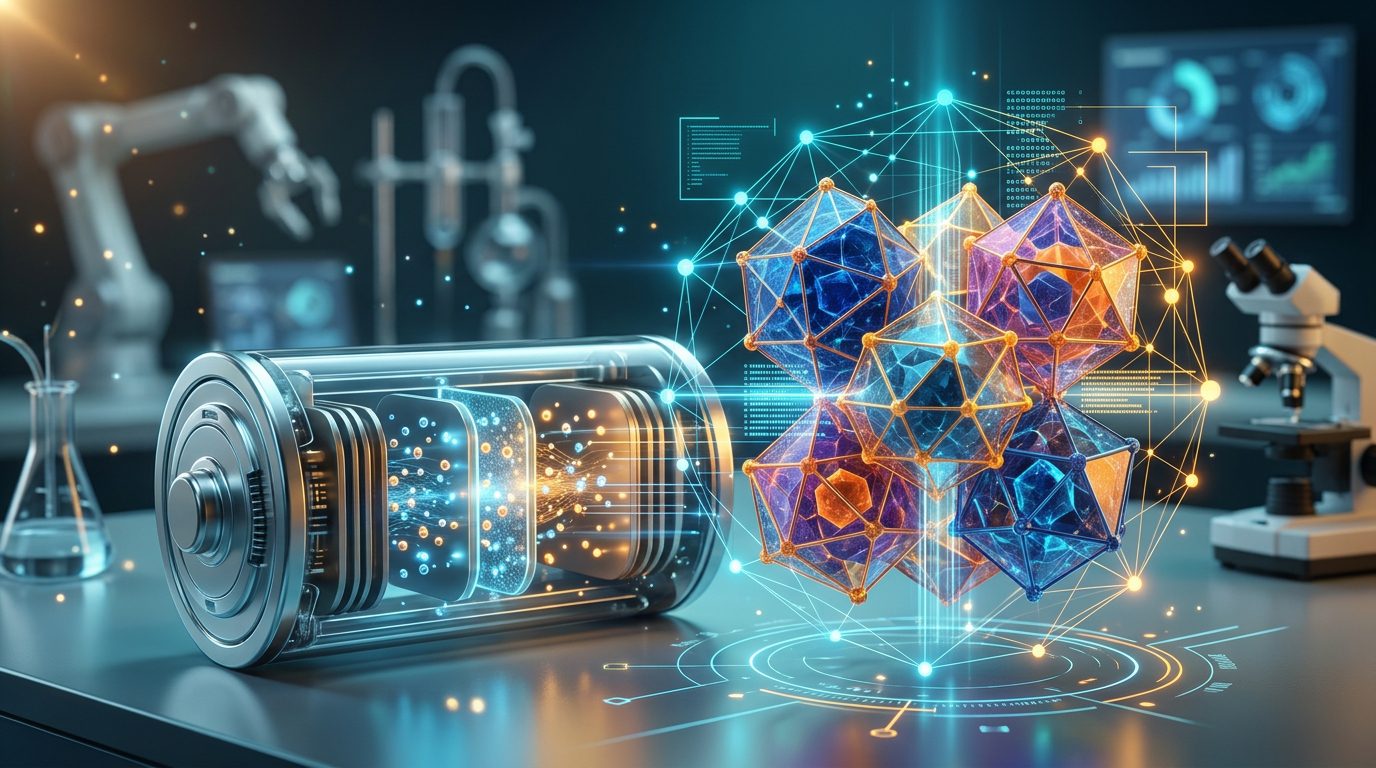
A new library of sodium-ion battery materials could help scientists develop batteries that store more energy, charge faster and maintain their performance for longer. Researchers at the University of Surrey have mapped 28 different compositions of sodium manganese oxide, investigating how small changes in their chemical makeup affect battery performance. The findings could provide valuable experimental data for future artificial intelligence systems designed to discover improved energy-storage materials.
The research, published in Journal of Materials Chemistry A, addresses a significant challenge in battery development: finding materials that deliver several important properties at once. A battery electrode might store substantial energy but degrade quickly, or remain stable over many cycles while struggling to deliver power rapidly. Understanding these trade-offs is essential to designing batteries for practical applications.
Sodium-ion batteries have attracted growing interest because sodium is widely available and could reduce dependence on lithium-based supply chains. However, their wider adoption depends on improving performance, durability and cost. The new research offers a way to explore potential improvements systematically rather than relying exclusively on conventional trial-and-error experiments.
Featured research source: TechXplore’s report on the University of Surrey study.
How Researchers Built the New Materials Library
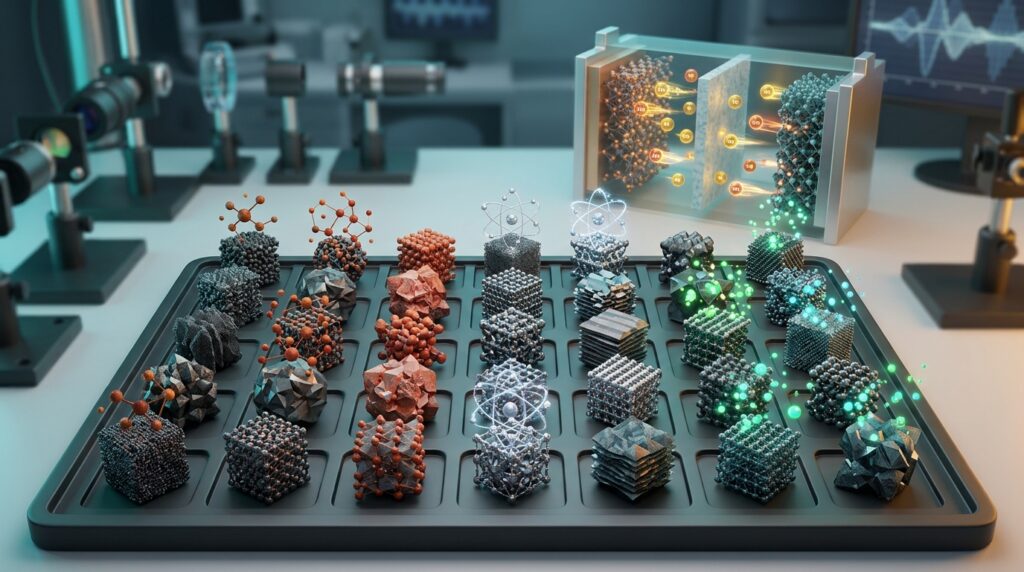
The research team investigated sodium manganese oxide, a compound studied for its potential use as a cathode in sodium-ion batteries. A cathode is one of the battery’s two main electrodes and plays an important role in determining energy storage and electrochemical performance.
Scientists created a library of 28 compositions by replacing some of the manganese with different amounts of iron, titanium and vanadium. They then tested the materials in sodium-ion batteries and compared how their compositions affected performance.
This approach provides more than a list of potentially useful substances. By systematically varying the chemical ingredients, researchers can identify relationships between composition and measurable properties. Those relationships may help explain why a particular material stores more energy, performs better during rapid charging or retains its capacity after repeated use.
The findings also show why developing sodium-ion battery materials requires careful balancing rather than simply maximising one performance measure. A promising composition needs to be assessed against the requirements of its intended application, including energy capacity, power delivery and long-term stability.
Iron, Titanium and Vanadium Affect Battery Performance
The researchers found that the three elements influenced different aspects of battery behaviour.
Iron was associated with higher energy-storage capacity, making it potentially useful when the priority is storing more energy in a given quantity of active material. Vanadium improved stability during repeated charging and discharging, while small amounts of titanium helped materials perform at higher charging and discharging rates.
Some titanium-containing compositions retained more than 90% of their capacity after 100 charge-discharge cycles. This is an encouraging result from the reported experiments, although it does not establish how the materials would perform over the much longer lifetimes required for commercial batteries.
The results illustrate how modest changes in chemical composition can affect several competing performance characteristics. Researchers may be able to use this information to narrow down which formulations deserve further investigation, rather than testing every possible combination.
However, a laboratory result is not the same as proof of commercial readiness. Performance depends on factors beyond the initial composition, including how the material is synthesised, the battery’s electrolyte, electrode design and operating conditions. Further testing will be necessary to establish whether promising formulations can deliver consistent results in practical cells.
The value of this research extends beyond the initial experiments. By documenting how individual ingredients affect performance, scientists can build a more useful reference for future sodium-ion battery materials research. Comparing sodium-ion battery materials under consistent conditions can help researchers distinguish meaningful chemical effects from experimental variation. This makes sodium-ion battery materials easier to evaluate systematically, while the library gives future studies a starting point for investigating additional compositions.
Why AI Could Accelerate Battery Discovery

The team also developed an automated approach to analyse the substantial volume of data generated by its experiments. The resulting dataset was used to train a machine-learning model, creating an initial foundation for data-driven materials research.
Machine learning can examine relationships across experimental results and use them to estimate how candidate compositions might behave. Once researchers have sufficiently large and reliable datasets, models could help identify combinations worth investigating before scientists spend time and resources manufacturing them.
For sodium-ion battery materials, this could make the search process more targeted. Instead of testing every possible composition, researchers might use a model to prioritise candidates that appear most likely to deliver a useful balance of capacity, stability and rate performance. The laboratory would then test those candidates and feed the results back into the dataset.
This process could gradually connect computational predictions with physical experiments. Better experimental data would support more useful predictions, while the predictions would help researchers choose the next experiments. Over time, this approach could reduce unnecessary testing and help scientists explore a wider range of compositions.
The potential benefit is not that AI replaces chemistry expertise. Rather, it can help researchers interpret complex datasets and make better-informed decisions about where to focus their experimental work.
These differences highlight why researchers must assess sodium-ion battery materials against several performance criteria rather than selecting a composition based on capacity alone. When comparing sodium-ion battery materials, scientists also need to consider charging rates, cycle life and the intended application. A balanced evaluation of sodium-ion battery materials can reveal trade-offs that might otherwise be overlooked. This is particularly important when selecting sodium-ion battery materials for practical energy-storage systems.
The Current Dataset Has Important Limitations
The researchers caution that the existing library is too small to support reliable predictions. Twenty-eight compositions provide a useful starting point, but they cannot represent the full range of possible cathode formulations and operating conditions.
AI models generally need enough high-quality examples to distinguish genuine chemical relationships from patterns that appear by chance. If a training dataset covers only a narrow range of compositions, a model may struggle when asked to predict the performance of unfamiliar materials.
Data quality also matters. Comparisons become less reliable when measurements are collected under different experimental conditions or when important details about synthesis and testing are missing. For battery research, composition alone may not explain performance: crystal structure, processing history, electrolyte interactions and electrode design can all influence results.
Expanding the library will therefore require more experiments and consistent documentation. Researchers will need to test additional compositions, record how the materials were produced and evaluate whether model predictions hold up under independent laboratory testing.
These steps are essential before AI-generated recommendations can be treated as dependable guidance for commercial development. The current work is an early stage in building that capability, not evidence that an AI system can already design a finished, high-performance battery on demand.
Machine learning could make the search for sodium-ion battery materials more efficient by identifying patterns across experimental measurements. With more training examples, researchers could compare sodium-ion battery materials and prioritise candidates for laboratory testing. AI predictions about sodium-ion battery materials would still need experimental confirmation, particularly when a proposed composition differs from those in the training data. Combining computational analysis with laboratory results could help sodium-ion battery materials research progress more efficiently.
What Better Sodium-Ion Batteries Could Mean for Energy Storage
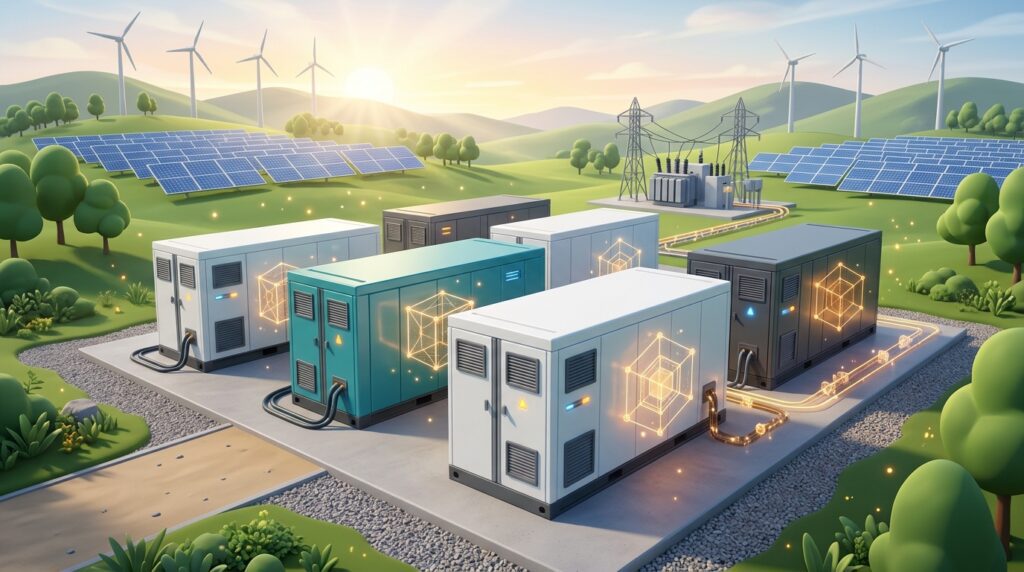
Better battery performance could have implications for grid storage, renewable-energy integration and other applications where cost, availability and durability matter. Sodium is abundant, which makes sodium-ion chemistry attractive as researchers and manufacturers explore alternatives to lithium-based systems.
Nevertheless, sodium-ion batteries are not a universal replacement for lithium-ion technology. Their suitability depends on the specific battery design, energy-density requirements, cost and operating environment. Improvements to cathode materials are one part of a much larger development process that also involves anodes, electrolytes, cell engineering and manufacturing.
A larger and more reliable library of sodium-ion battery materials could help researchers identify formulations suited to different priorities. Some applications may favour greater energy storage, while others may place more importance on fast power delivery or retaining capacity through repeated cycles.
The research could also help establish more systematic methods for developing other energy-storage materials. By connecting carefully controlled experiments with machine learning, scientists may be able to make the discovery process more efficient without sacrificing experimental validation.
Expanding the dataset is therefore essential to improving predictions about sodium-ion battery materials. Researchers need reliable measurements from a wider range of compositions before machine-learning models can generalise confidently. Additional testing would allow sodium-ion battery materials to be compared across more conditions and help reveal where predictions remain uncertain. Until that evidence is available, AI recommendations for sodium-ion battery materials should guide further experiments rather than replace them.
What Happens Next?
The next step is to expand the composition library and improve the quality and breadth of the data available for machine learning. A larger dataset could allow researchers to explore more candidate materials and test whether the relationships observed in the initial experiments remain consistent across a broader range of compositions.
Future work will also need to verify promising predictions experimentally. Models can help prioritise candidates, but researchers must still establish how materials behave under realistic operating conditions and whether they can be manufactured reliably at scale.
For the development of sodium-ion battery materials, this combination of experimentation and AI could provide a more efficient route from an initial chemical idea to a material worth developing further. Its success will depend on the quality of the data, the reliability of the predictions and the ability to translate laboratory findings into practical battery designs.
For manufacturers, advances in sodium-ion battery materials could eventually support batteries tailored to different storage needs. Some applications may prioritise durability, while others require higher capacity or faster charging. More complete data on sodium-ion battery materials could help developers compare these requirements earlier in the design process. However, promising sodium-ion battery materials must still prove their performance, safety and manufacturing consistency before they can be considered commercially viable.
Final Thoughts
The University of Surrey’s research demonstrates how systematically mapping material compositions can reveal useful connections between chemistry and battery performance. The 28-composition library identified promising effects associated with iron, titanium and vanadium, while providing an initial dataset for machine-learning research.
The study does not show that AI has already solved the challenge of designing better batteries. Instead, it establishes an early foundation that could become more valuable as researchers add more compositions, improve data quality and validate predictions through experiments.
If the approach can be expanded successfully, sodium-ion battery materials research could become more targeted and data-driven, helping scientists search for cathodes that balance energy capacity, charging performance and durability. That would be a meaningful step towards developing more capable energy-storage technologies.
Source report: University of Surrey research covered by TechXplore
More AI coverage: explore Progressive Robot's AI Models, Tools & Releases hub — hands-on reviews, setup guides and benchmarks in one place.










