
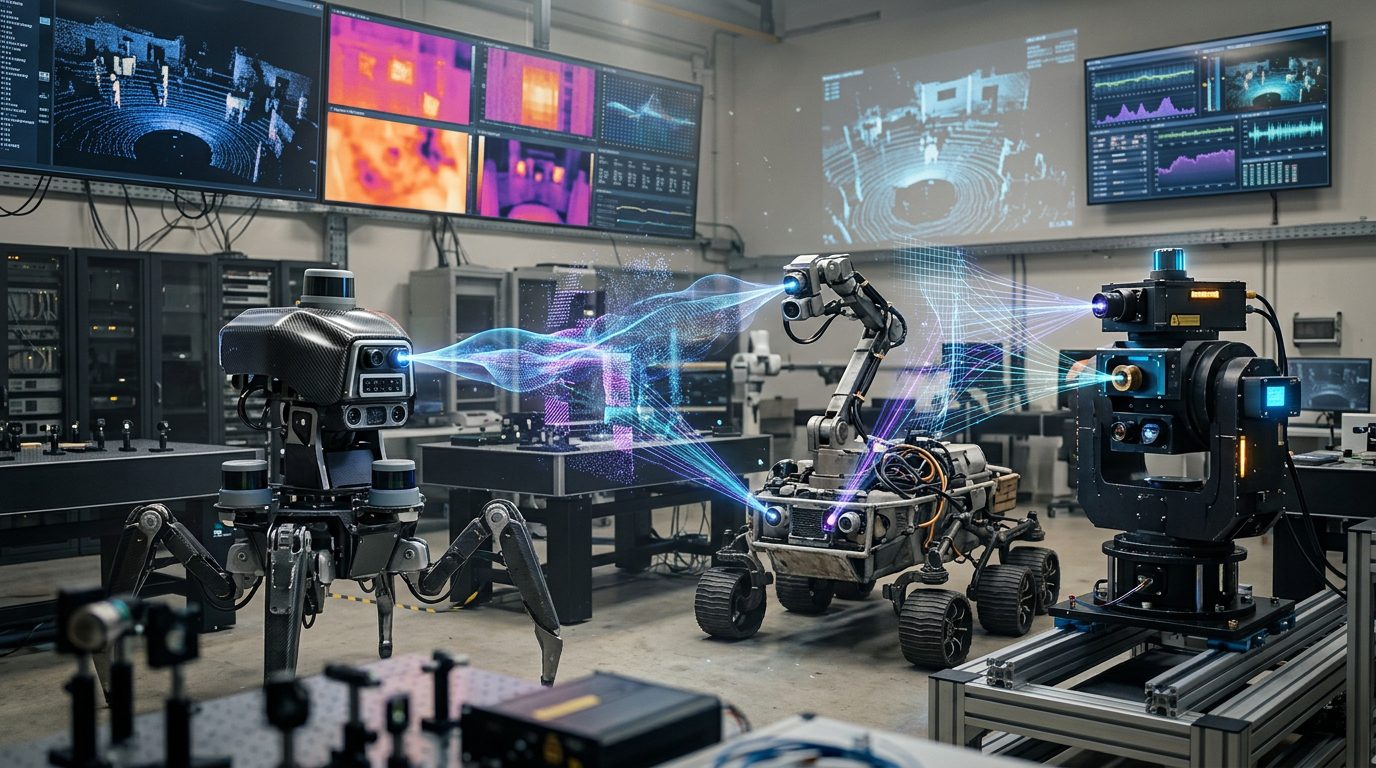
Artificial natural language is an emerging approach in which AI agents develop a shared communication system based on the information they perceive and the tasks they need to perform. Rather than relying entirely on English or another human language, these systems can develop their own vocabulary to describe patterns and concepts in complex data.
A study highlighted by TechXplore on October 15, 2026 demonstrates how researchers from Vrije Universiteit Brussel (VUB) and the University of Namur (UNamur) enabled autonomous AI agents to develop shared vocabularies without humans defining every word in advance.
Published in Transactions of the Association for Computational Linguistics, the research tested the method across 37 datasets, including scientific measurements, astronomical data and visual information. The findings suggest that autonomous systems can establish useful communication conventions even when their sensory inputs differ.
This is important because robots, industrial sensors and autonomous vehicles do not necessarily perceive the world in the same way. One machine may rely on lidar, another on infrared measurements and another on a different combination of sensors. Translating every observation into ordinary human language may be inefficient or may fail to capture useful distinctions.
Artificial natural language offers another possibility: allowing machines to develop concepts that are meaningful to their own data and shared tasks. The research does not mean AI has created a human-like language with general intelligence or consciousness. Instead, it demonstrates a practical way for artificial agents to build common representations and communicate about what they perceive.
How AI Agents Develop a Shared Language
What Is Artificial Natural Language?
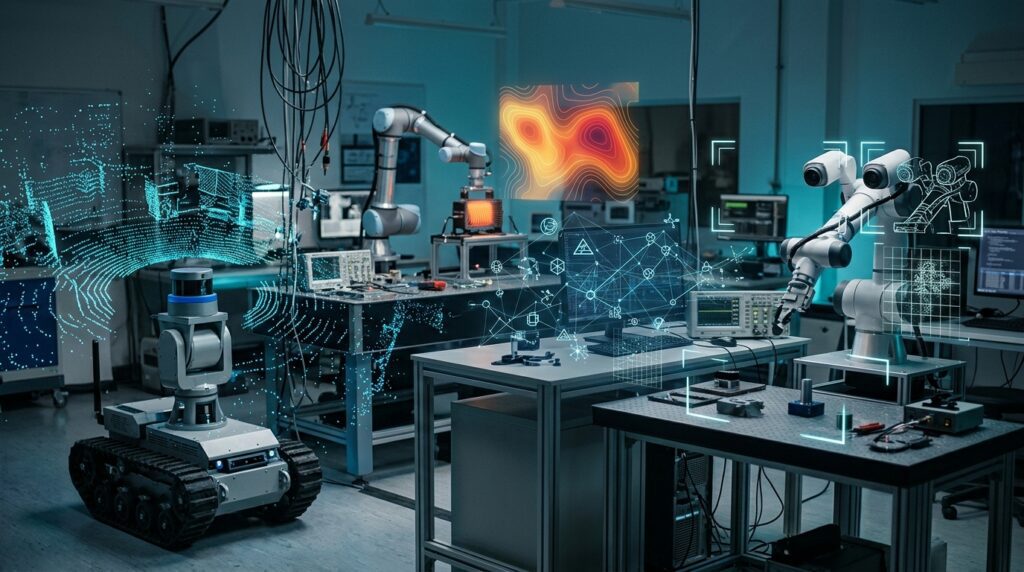
Artificial natural language, as used in this research, describes a communication system that autonomous agents develop through interaction. The agents establish associations between signals and concepts represented in their environment. Over time, these associations can become shared conventions that help the systems identify and discuss relevant information.
This is different from simply programming a fixed code into every machine. In a conventional system, engineers might define a list of signals and specify exactly what each one means. In the researchers’ approach, agents develop their vocabulary through local interactions, feedback and updates to their internal concept representations.
The result is a communication system grounded in the data the agents perceive. A particular signal can become associated with a group of sensor values or a meaningful category, allowing agents to communicate without having to reproduce every underlying measurement.
For example, imagine two robots inspecting the same industrial facility. Their sensors may produce slightly different readings because of their positioning, hardware or environmental conditions. A shared vocabulary could help them identify a common type of object or condition despite those differences.
Artificial natural language is therefore not necessarily a replacement for English, nor is it the same as a chatbot inventing slang. It is a task-oriented approach to machine communication in which concepts and signals develop around the agents’ perceptual environment.
The important distinction is that the agents’ vocabulary is linked to what they observe and need to communicate, rather than being designed solely around the way humans describe the world.
Why Human Language May Not Be Enough for Autonomous Machines
Human languages evolved around human perception, experience and social interaction. They are effective for describing everyday objects and events, but machines can process information that humans cannot directly sense.
Consider lidar, which measures distances using laser pulses, or infrared sensors, which detect thermal radiation. Machines may also analyse chemical measurements, complex astronomical observations or large collections of numerical sensor readings. Translating every feature into an ordinary word may discard distinctions that matter to the task.
The challenge becomes more significant when different machines use different hardware. Two autonomous vehicles might observe the same environment but generate different numerical measurements because their sensors have different characteristics or calibration.
Humans handle a similar problem through abstraction. Two people may perceive a colour slightly differently but still agree that an object is a red car. They do not need identical visual measurements to use a shared concept.
Artificial natural language applies a related principle to autonomous systems. Instead of requiring every agent to use identical sensor values, researchers can allow agents to develop shared concepts that remain useful across their different observations.
This could be valuable in robotics, industrial monitoring, environmental analysis and autonomous transport. However, the communication system still needs to be tested carefully to establish whether it remains reliable under real-world conditions.
Machines Communicating Beyond Human Senses
How AI Agents Learn to Communicate Without Predefined Words
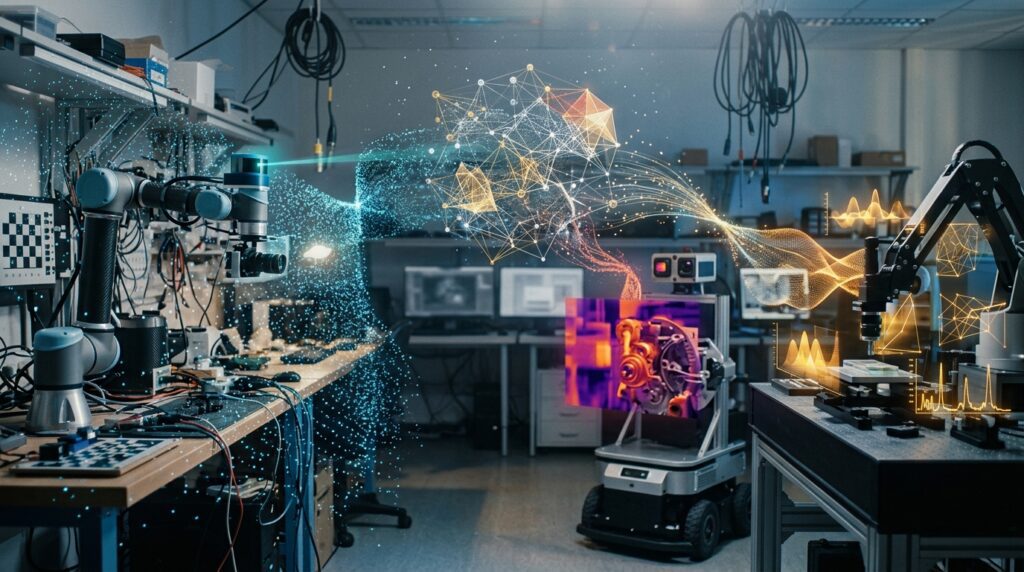
The researchers did not simply give every agent a completed dictionary. Instead, they provided mechanisms that allow a communication convention to emerge through interactions.
The process involves several connected stages.
Local communication: Agents interact in pairs and exchange signals while trying to refer to entities or concepts in their environment. Each interaction contributes to the development of a shared convention.
Concept formation: The agents adjust the way they group and represent observations. These conceptual prototypes connect signals with patterns in the underlying data.
Feedback and adaptation: Successful and unsuccessful communication provides information that can influence future interactions. The agents gradually update their conventions as they learn what works.
Population-wide agreement: Although interactions occur locally, shared conventions can spread across a wider population of agents. A central system does not need to dictate every association for a common vocabulary to emerge.
Artificial natural language, in this setting, develops through self-organisation. The agents establish useful conventions from repeated interactions rather than depending entirely on a human-authored set of labels.
The method also allows the vocabulary to reflect the needs of the task. Agents can develop the categories necessary for their environment instead of carrying unnecessary distinctions into every communication exchange.
This does not mean that the resulting vocabulary is guaranteed to be optimal in every situation. Its usefulness depends on the agents, the available data, the learning process and the communication tasks involved.
The Emergence of Machine Vocabulary
The Research Was Tested on 37 Different Datasets
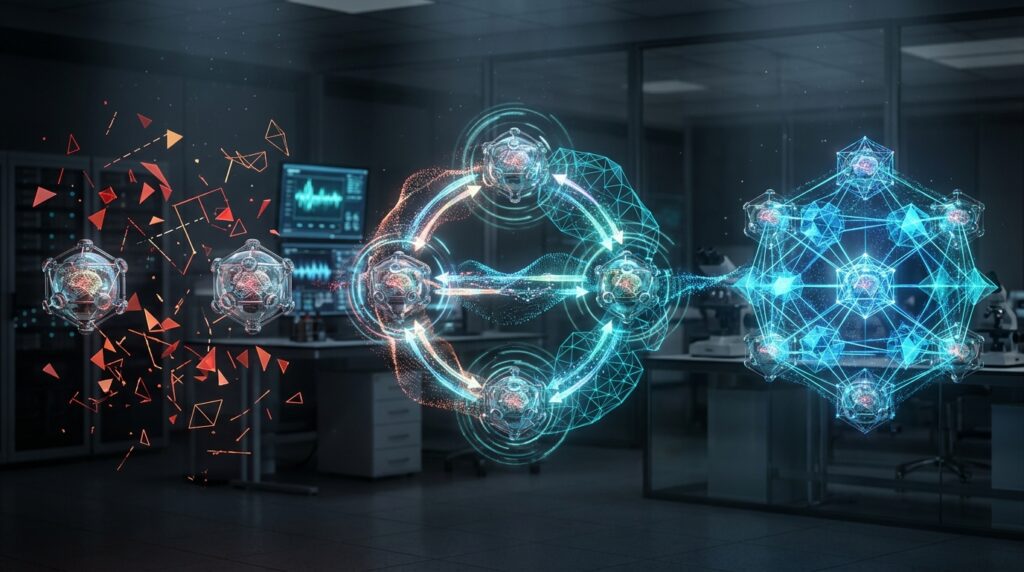
One of the most notable aspects of the study is its evaluation across 37 publicly available datasets. The researchers examined whether autonomous agents could develop useful shared vocabularies across different types of information rather than relying on a single narrow example.
The datasets included physicochemical measurements of wine, NASA data concerning exoplanets, visual datasets and images of birds and human faces. These examples cover very different types of information, from numerical measurements to complex visual features.
The results suggest that the method can support the development of shared concepts across a broad range of data environments. This matters because autonomous systems often need to work with information that is difficult to describe through a small set of predefined categories.
For example, a scientific dataset may contain many measurements that vary continuously rather than fitting neatly into fixed labels. A machine-developed vocabulary could help agents form useful categories from those measurements and communicate about them.
Similarly, visual systems may need to distinguish between groups of objects based on multiple features rather than a single human-readable label.
Artificial natural language could provide a flexible way to establish these associations. However, success across 37 datasets should not be interpreted as proof that the method will work automatically in every industrial or real-world setting. Deployment would still require testing, validation and monitoring under the conditions in which the system will operate.
AI Agents Analysing Scientific and Visual Data

Why Interpretability Matters
An important potential advantage of this approach is that researchers can investigate the relationship between a developed signal and the concept it represents.
Many AI systems are difficult to interpret because their internal representations do not map neatly to human-readable rules. In the approach described by the researchers, a developed word or signal can be linked to a conceptual prototype grounded in the underlying sensor values.
This can give researchers a way to examine what a particular communication convention represents and how it relates to the data agents receive.
Interpretability matters when autonomous systems operate in environments where an incorrect message could have consequences. If a robot reports a dangerous condition, for example, engineers need ways to investigate whether the signal corresponds to the intended observations.
Artificial natural language does not automatically eliminate the wider interpretability problems associated with AI. A system may have a traceable association between a signal and a prototype without making every decision, limitation or failure easy to explain.
Nevertheless, the ability to inspect these associations could be useful when developing and validating communication protocols for autonomous machines.
Organisations considering such systems should assess not only whether agents communicate successfully but also whether developers can audit the communication, detect misunderstandings and diagnose failures.
Making AI Communication More Interpretable
How Artificial Natural Language Could Be Used in the Real World
The findings could have implications for several areas where autonomous systems need to exchange information efficiently.
Autonomous vehicles: Vehicles use sensors to estimate distances, identify objects and monitor their surroundings. Shared concepts could help systems communicate about observations even when their sensor hardware or readings differ. Any such application would require rigorous safety testing before being used in critical driving decisions.
Industrial robotics: Manufacturing environments may contain robots from different suppliers, each with its own sensors and processing systems. A shared, adaptable vocabulary could help machines coordinate around objects, operating conditions or detected anomalies.
Scientific research: Scientific instruments generate large volumes of numerical and sensor data. Autonomous agents that develop task-specific concepts could help organise and exchange information without requiring every measurement to be translated into human language first.
Environmental monitoring: Distributed sensors can collect information about temperature, air quality, water chemistry or other environmental conditions. Machine-developed concepts could help systems coordinate their observations, although the reliability and meaning of the resulting categories would need to be validated.
Multi-agent AI systems: As businesses experiment with multiple AI agents working together, machine-to-machine communication may become an important design consideration. Different agents could specialise in different tasks and use a shared representation to exchange relevant findings.
Artificial natural language remains a research approach rather than a universal communication standard. Its practical value will depend on whether it can improve coordination, reduce unnecessary information exchange and remain reliable when agents or environments change.
Challenges: Can Humans Understand a Language They Did Not Create?
A communication system that works well for machines may not be easy for people to read. If agents develop signals and categories tailored to their own data, a human operator may struggle to understand what a message means without additional interpretation tools.
This creates a trade-off between efficient machine communication and human accessibility. In some applications, agents may benefit from exchanging compact task-specific concepts. In others, operators may need explanations they can inspect before authorising an action.
Artificial natural language also introduces questions about consistency. If a vocabulary adapts over time, engineers need to know when a signal’s meaning has changed and whether all relevant agents have updated their conventions appropriately.
Communication errors are another concern. Agents may converge on a convention that works during training but becomes unreliable when the environment changes or an unfamiliar agent joins the system. Continuous adaptation may help, but it does not remove the need for monitoring and validation.
Security must also be considered. If an autonomous system relies on shared signals to coordinate important actions, developers need to assess how it behaves when messages are corrupted, agents malfunction or an unauthorised system attempts to participate.
For high-stakes applications, artificial natural language should be paired with suitable testing, logging, safeguards and ways for human operators to investigate unexpected behaviour.
Frequently Asked Questions
What is artificial natural language in AI?
Artificial natural language is a communication system that AI agents can develop through interaction, connecting signals with concepts grounded in the data they perceive. In this research, it allows agents to form shared vocabularies without humans defining every word in advance.
Did researchers prove that AI agents can create a language like English?
No. The research demonstrates that autonomous agents can develop functional, shared communication conventions for specific tasks. It does not establish that these systems have created a general-purpose human language or acquired human-like understanding.
How many datasets were used in the study?
The method was evaluated on 37 publicly available datasets, including physicochemical wine analyses, NASA exoplanet data, visual datasets and images of birds and human faces.
Why would AI agents need their own language?
Agents may receive different types of sensor data or interpret the same environment through different hardware. A shared vocabulary can help them communicate useful concepts without requiring every observation to be expressed in human language.
Could this technology help robots communicate?
Potentially. A shared machine-developed vocabulary could help robots coordinate despite differences in their sensors or configurations. Real-world use would require further validation, particularly where communication failures could affect safety.
Is artificial natural language the same as AI chatbots talking secretly?
No. The research concerns task-oriented communication conventions grounded in sensor data and developed through interaction. It is not evidence that chatbots are secretly plotting or that they have independently developed a human-like language.
Conclusion: A New Direction for Communication Between AI Systems
The research from VUB and the University of Namur demonstrates a promising direction for autonomous AI systems: instead of requiring every machine to communicate through human-defined language, researchers can allow agents to develop shared concepts grounded in their own observations.
Artificial natural language could be useful when robots, scientific systems and industrial sensors need to coordinate despite processing different types of data. Testing across 37 datasets suggests that the approach is not limited to a single example, while its links between signals and underlying concepts offer a potential route toward greater interpretability.
However, practical deployment will require careful attention to reliability, changing vocabularies, security and human supervision. A communication system that works in an experiment is not automatically ready for safety-critical environments.
As AI agents become more specialised and work together in larger systems, their ability to exchange information efficiently may become increasingly important. The challenge will be to build communication methods that work for machines while remaining sufficiently reliable, testable and understandable for the people responsible for them.
Explore AI and IT Solutions with Progressive Robot
At Progressive Robot, we help businesses explore software development, AI solutions, cybersecurity and wider IT services. As autonomous systems and AI-driven workflows evolve, the right technology strategy can help organisations assess emerging opportunities and integrate new capabilities responsibly.
Explore our IT services: Visit Progressive Robot to learn more about technology solutions for your business.
References
Vrije Universiteit Brussel and University of Namur research announcement — EurekAlert!
More AI coverage: explore Progressive Robot's AI Models, Tools & Releases hub — hands-on reviews, setup guides and benchmarks in one place.










