
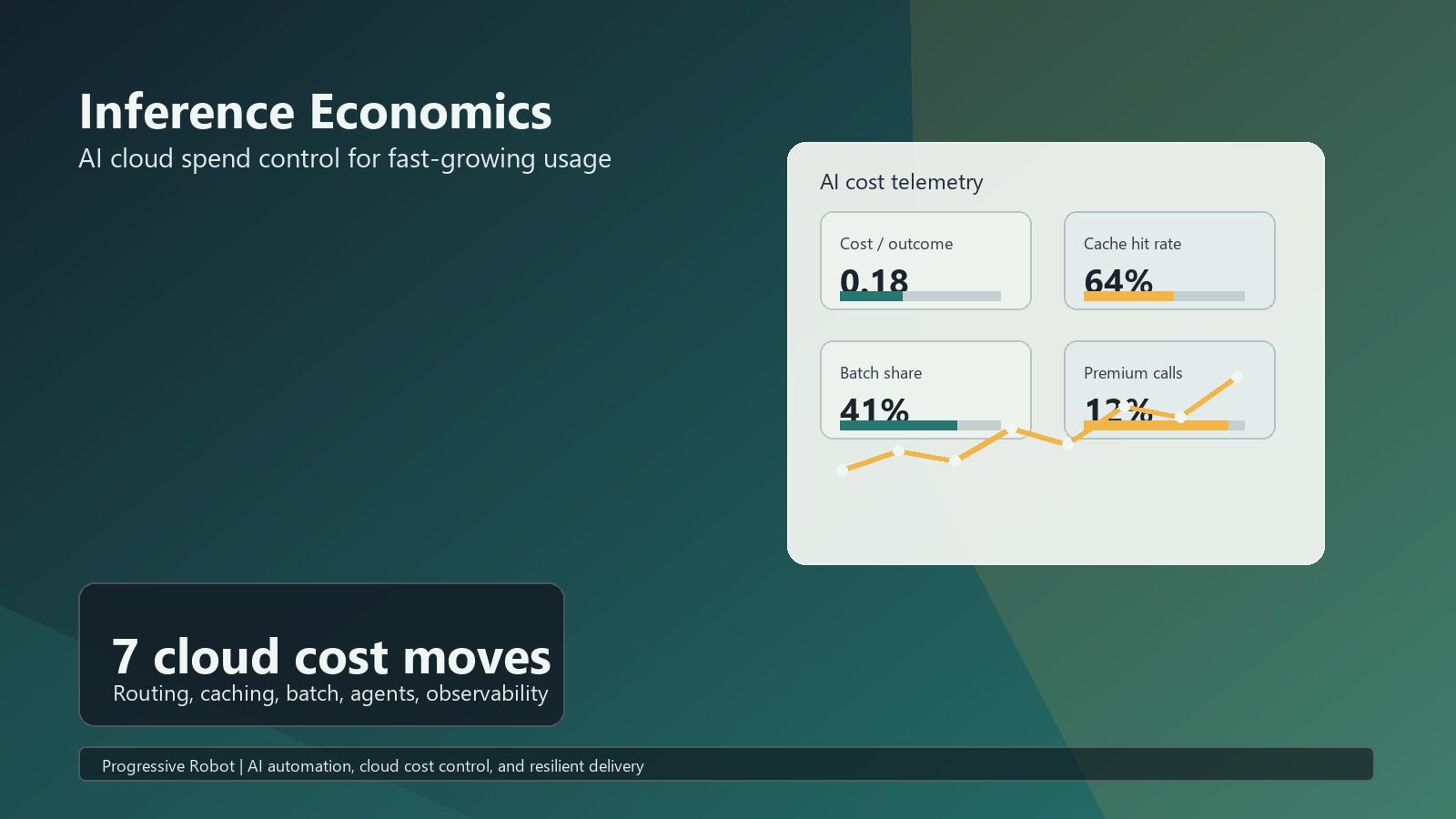
Inference Economics is becoming one of the most important cloud cost disciplines for organisations adopting AI. Token prices are falling, smaller models are improving, and provider discounts for cached or batch inference are becoming easier to use. At the same time, AI usage is expanding from isolated experiments into support desks, finance teams, software delivery, sales operations, knowledge management, compliance, analytics, and internal productivity tools.
That combination creates a trap. Cheaper tokens do not automatically mean lower bills. If every workflow adds AI calls, every employee gains access to copilots, every agent loops through tools, and every application sends long prompts to premium models, total cloud spend can still rise quickly. Inference Economics is the discipline of keeping that growth useful, measurable, and commercially defensible.
The timing matters. Stanford’s 2025 AI Index reported that inference cost for a system performing at the level of GPT-3.5 dropped more than 280-fold between November 2022 and October 2024, while hardware costs and energy efficiency also improved sharply. Its 2026 report says organisational adoption reached 88%, with generative AI spreading faster than earlier general-purpose technologies. Lower unit costs are meeting much higher demand.
This guide explains how CIOs, finance leaders, operations teams, AI product owners, and cloud architects can optimise cloud spend as AI token costs plummet but usage explodes. It focuses on practical governance: unit economics, model routing, prompt control, caching, batch processing, agent budgets, observability, and a 90-day plan.
Inference Economics at a glance
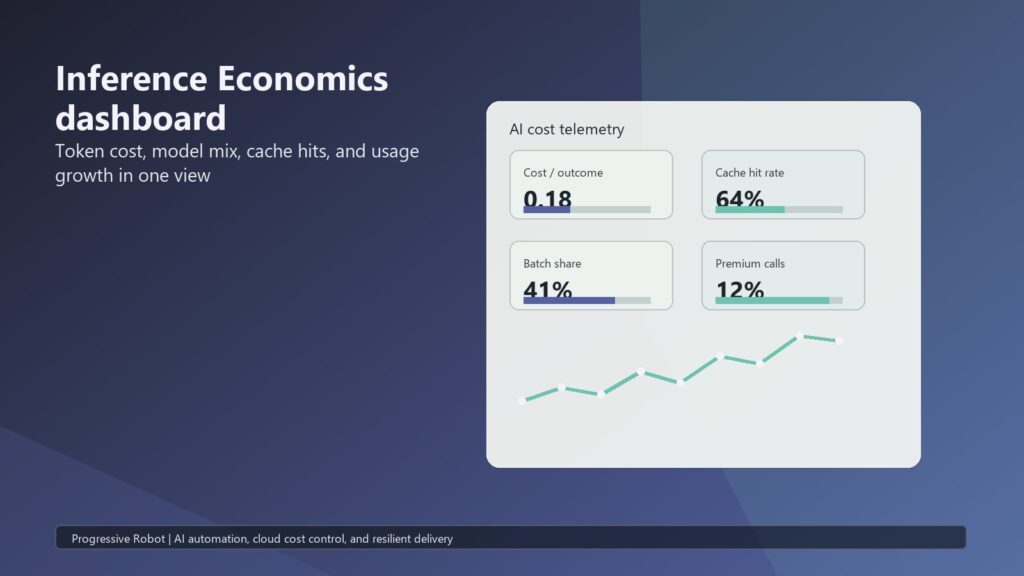
Inference Economics starts with a simple idea: every AI feature needs a unit-cost model before it becomes normal business activity. The cost may be low per call, but the volume can become enormous once a workflow is embedded into daily work.
Traditional cloud cost management often looks at infrastructure: compute instances, storage tiers, network traffic, reserved capacity, managed databases, and idle environments. AI inference adds a different shape of consumption. The bill is usually driven by requests, input tokens, output tokens, cached tokens, tool calls, retrieval operations, image or audio processing, service tiers, and sometimes container or session runtime.
That makes Inference Economics more granular than ordinary cloud budgeting. A single customer service answer may include a user message, conversation history, system instructions, retrieved knowledge base snippets, a classifier call, a generation call, a safety check, and a CRM update. The visible response may be one paragraph, but the cost is the whole chain.
The first Inference Economics task is therefore to define the unit being optimised.
| AI workload | Useful cost unit | Why it matters |
|---|---|---|
| Customer support assistant | Cost per resolved case | Links tokens to service outcome |
| Internal knowledge search | Cost per successful answer | Separates useful answers from repeated queries |
| Software coding assistant | Cost per accepted change or review | Avoids measuring activity without value |
| Document processing | Cost per page, file, or field extracted | Supports batch planning and exception handling |
| Sales research agent | Cost per qualified account or brief | Captures tool use and web retrieval costs |
| Compliance review | Cost per reviewed item and escalation | Tracks human oversight and risk reduction |
The second task is to identify the cost levers. Provider pricing pages now expose several clear options. OpenAI highlights shorter prompts and outputs, smaller model selection, batch processing, and flex processing. Anthropic’s API pricing includes prompt caching where cache reads can cost a fraction of ordinary input tokens, and its Message Batches API applies a 50% discount to standard token prices for asynchronous work. Google Gemini pricing includes context caching and a Batch API option with a 50% cost reduction for paid usage. Amazon Bedrock pricing also points to batch inference at a lower price for selected models.
The third Inference Economics task is to treat AI consumption as product telemetry, not only as a finance report. Inference Economics works when each AI request carries metadata: application, team, use case, model, environment, customer segment, latency tier, token counts, cache status, retrieval calls, tool calls, and business result.
Without that metadata, leaders see a rising provider invoice and argue about whether AI is expensive. With it, they can see which workflows are valuable, which prompts are wasteful, which models are overpowered, and which usage patterns should be redesigned.
Inference Economics is not an argument against AI adoption. It is the way to scale AI without letting cheap unit prices hide poor operating discipline.
Lower token prices can still raise the bill
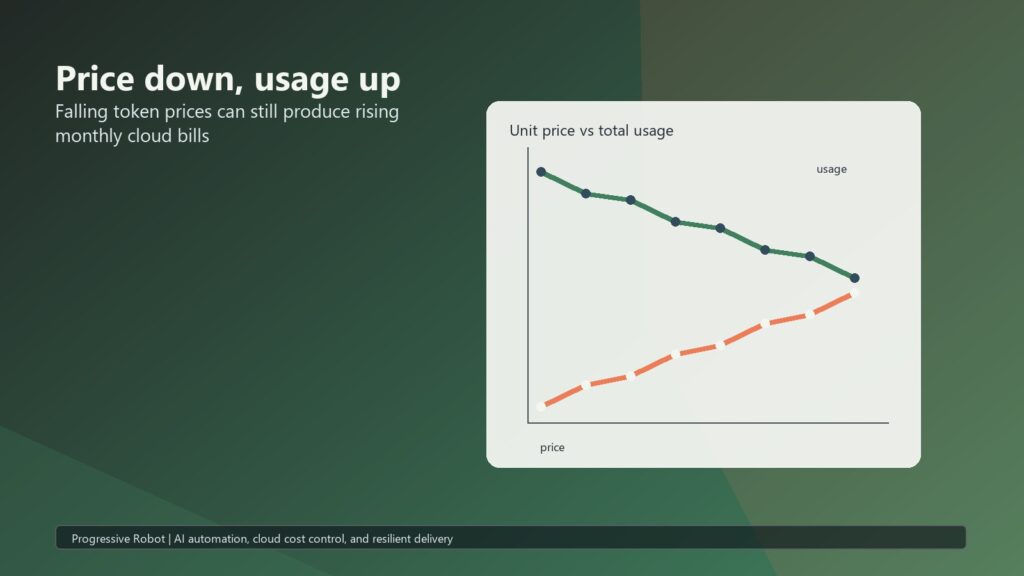
The most important Inference Economics lesson is that unit price and total spend can move in opposite directions. A 90% price reduction is useful, but it does not help if usage grows 30 times and output lengths double. Inference Economics keeps both sides of that equation visible.
This is the same economic pattern seen in other technology waves. When compute becomes cheaper, teams build more compute-intensive systems. When storage becomes cheaper, organisations store more data. When bandwidth becomes cheaper, applications become richer and more continuous. AI inference is following that pattern, but the feedback loop is faster because new use cases can be added with APIs, prompts, and workflow automation rather than long infrastructure projects.
For many organisations, usage growth comes from five sources, which is why Inference Economics needs demand modelling as well as price tracking.
| Growth source | Example | Cost risk |
|---|---|---|
| More users | AI assistants rolled out to every department | Daily prompts become recurring operating cost |
| More workflows | AI added to support, finance, HR, sales, and IT | Spend fragments across many owners |
| Longer context | Documents, histories, and retrieved snippets added to prompts | Input tokens grow silently |
| More agent steps | Planner, tool calls, retries, validators, and summaries | One user action creates many model calls |
| Richer modalities | Images, audio, video, and screen data | Non-text usage has different pricing and latency patterns |
This is why Inference Economics should be introduced before broad rollout, not after the first surprising bill. If a pilot has 100 users and works well, the production question is not just whether accuracy is acceptable. It is what happens when 2,000 users adopt it, usage moves from office hours to automated triggers, and every request includes a larger knowledge base.
The answer is not to slow every AI project. The answer is to separate adoption from uncontrolled consumption.
Start with a demand model. Estimate the number of users, expected requests per user, average input tokens, average output tokens, cache hit rate, model mix, tool calls, and retry rate. Run the same model under three scenarios: cautious adoption, expected adoption, and enthusiastic adoption. Inference Economics improves budget conversations because it makes enthusiasm visible before the invoice arrives.
Then add Inference Economics guardrails. Put hard limits on experimental environments. Set daily budgets for prototypes. Require production AI features to log token usage by team and customer journey. Add alerts for unusual request volume, unusually long outputs, cache miss spikes, and unexpected tool-call frequency.
It is also important to measure usage quality. A team can reduce token cost while making the user experience worse, or increase spend while creating genuine value. Inference Economics should therefore track business outcomes beside technical cost: deflected support tickets, faster document processing, fewer manual checks, reduced development rework, improved customer satisfaction, or lower operational risk.
The real goal is not the lowest possible token bill. The goal is the best cost per useful outcome.
Build a unit-cost model before usage scales
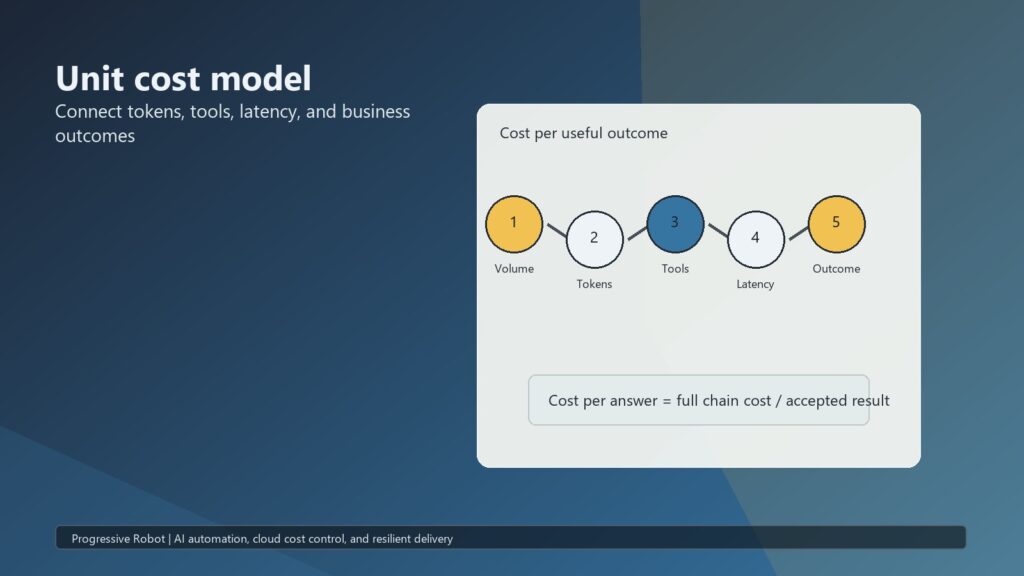
Inference Economics becomes manageable when teams stop talking about AI spend as one number and start modelling the cost of specific work. A monthly invoice is too late and too coarse. Leaders need unit-cost views while products are being designed.
A basic Inference Economics cost model has six layers.
| Layer | Questions to answer |
|---|---|
| Request volume | How many calls happen per user, case, document, transaction, or workflow? |
| Input size | How many prompt, history, retrieved, tool-definition, and file tokens are sent? |
| Output size | How many response, reasoning, summary, image, audio, or structured tokens are generated? |
| Model choice | Which tasks use premium, mid-tier, small, open, or specialised models? |
| Platform modifiers | Are cache reads, batch discounts, flex tiers, regional premiums, or tool charges involved? |
| Business result | What useful outcome is created, and how often does the AI answer need human correction? |
This does not need to be perfect on day one. It does need to be explicit. A spreadsheet with conservative assumptions is better than a vague hope that cheaper models will absorb every new workflow.
For example, a document review tool might start with 20,000 files per month. Each file creates one extraction call, one validation call, and one summary call. If the extraction prompt includes repeated instructions, policy text, and examples, caching may reduce input cost. If the work is not urgent, batch processing may cut token pricing. If the summary can be short and structured, output limits may prevent cost creep. If only exceptions need a premium model, most files can run through a cheaper route.
The same approach works for customer support. Instead of asking, “What will our chatbot cost?” ask a sharper set of questions: how many conversations, how many turns, how much history, how much retrieval, how many escalations, what model for triage, what model for answer generation, what model for quality checks, and what cost per successfully resolved case?
Inference Economics should also include non-token costs. Retrieval-augmented generation may add embedding costs, vector database storage, search queries, document parsing, reranking, data transfer, and monitoring. Agentic systems may add web search charges, container runtime, code execution, browser actions, and external API fees. Cloud spend can move from the model provider into surrounding infrastructure.
Google Cloud’s AI and ML cost guidance recommends defining business goals and KPIs, using billing labels, monitoring resources continuously, starting with small models and datasets, and comparing cost-performance through experimentation. That maps well to Inference Economics because token spend only matters when it is connected to business value and operating behaviour.
The most useful metric is often a blended one:
| Metric | What it reveals |
|---|---|
| Cost per successful answer | Whether the AI interaction creates value |
| Cost per avoided manual minute | Whether automation is cheaper than staff effort |
| Cost per accepted code change | Whether development assistants are producing usable work |
| Cost per processed document | Whether AI extraction beats manual processing or rules-based systems |
| Cost per escalated exception | Whether AI is filtering work effectively |
| Cost per retained customer or resolved complaint | Whether service outcomes justify the spend |
Once Inference Economics unit costs exist, optimisation becomes less political. A team can choose a more expensive model when it materially improves outcomes. Another team can be asked to redesign a prompt when it sends 40,000 tokens to answer a simple internal policy question.
Inference Economics is strongest when it gives product, engineering, operations, and finance teams one shared language.
Route work to the smallest effective model
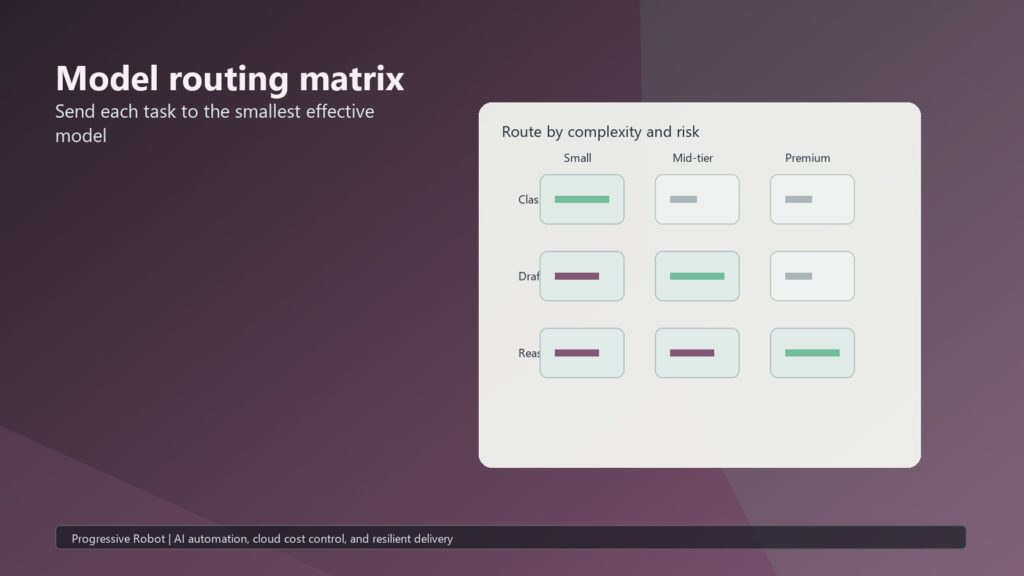
The simplest Inference Economics saving is often model routing. Not every task needs the most capable model. Some tasks need speed. Some need consistency. Some need reasoning. Some need extraction. Some need classification. Some need a premium model only when the cheaper route is uncertain. Inference Economics makes that routing decision explicit.
Provider pricing now makes this visible. OpenAI, Anthropic, Google, AWS, and other platforms all offer different models, service tiers, context windows, and pricing profiles. The pricing gap between a premium reasoning model and a lightweight model can be large. If every request goes to the same premium model, the architecture is probably wasting money.
A practical Inference Economics routing framework should classify work by risk and complexity.
| Work type | Likely routing pattern |
|---|---|
| Simple classification | Small or specialised model, deterministic output format |
| Entity extraction | Small model, schema validation, retry only on failure |
| Drafting routine content | Mid-tier model with output limits and templates |
| Complex reasoning | Premium model with explicit budget and evaluation |
| Sensitive decisions | Premium model plus human review and audit trail |
| High-volume background work | Batch or flexible processing tier |
| Repetitive long-context tasks | Prompt caching and smaller dynamic suffix |
This is not only a cost exercise. Smaller models can be faster, easier to control, and less verbose. They may also be better for narrow tasks when paired with strong prompts and validation. A premium model should be earned by the task, not selected by default because it performed well in a demo.
Inference Economics supports a tiered pattern. The first model handles triage or a cheap attempt. If confidence is high, the answer is accepted. If confidence is low, the task escalates to a stronger model or a human. This can be especially useful for support routing, compliance checks, document extraction, lead scoring, internal search, and content tagging.
There are caveats. Routing only works if quality is measured. A cheaper model that creates more errors, escalations, retries, or customer frustration may be more expensive overall. The right comparison is not price per token. It is total cost per acceptable outcome.
Inference Economics evaluation should therefore be part of the routing design. Keep a small labelled test set for common tasks. Compare models on accuracy, refusal behaviour, hallucination risk, formatting reliability, latency, token use, and escalation rate. Review the results regularly because model capability and pricing change quickly.
Some organisations should also consider open-weight or self-hosted models for stable, high-volume, lower-risk tasks. That decision needs care. Self-hosting can reduce marginal token costs in some scenarios, but it adds GPU capacity, scaling, monitoring, security, patching, model operations, and specialist skills. Inference Economics should include the full operating cost, not just the absence of a provider token bill.
The healthiest approach is model optionality. Design applications so models can be swapped, tested, and routed without rewriting the workflow. Keep prompts, evaluation sets, and provider integrations modular. Avoid binding a business process to one model name unless the commercial and technical reasons are clear.
That optionality is what turns falling token prices into durable savings instead of vendor drift.
Reduce token waste before negotiating discounts
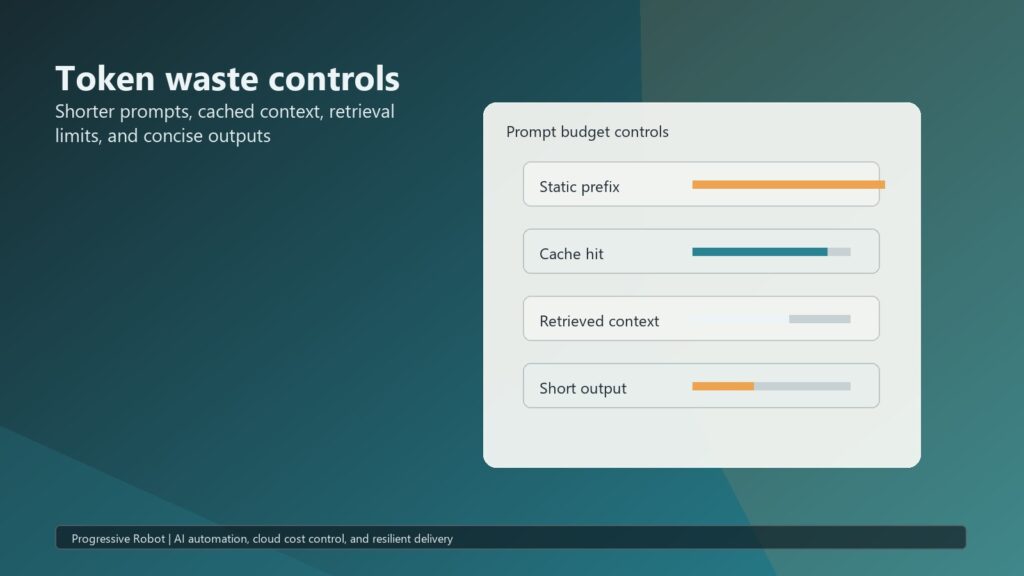
Negotiated discounts are useful, but Inference Economics usually finds savings first inside the request itself. The cheapest token is the one you do not send, and the second cheapest is the token you cache or batch.
Inference Economics prompt waste appears in predictable places. System prompts grow because every edge case gets appended. Conversation history is resent without summarisation. Retrieved documents include irrelevant chunks. Tool schemas are verbose. Output instructions ask for essays when a short JSON object would do. Agents keep intermediate reasoning and tool results in context longer than needed.
OpenAI’s cost optimisation guidance is blunt: reduce requests, minimise tokens, and select a smaller model where accuracy is maintained. Anthropic’s prompt caching guidance adds another lever: place stable, reusable content at the beginning of prompts and cache the parts that remain identical across requests. Cache reads can be charged at a much lower input-token rate than fresh processing, but cache strategy only works when the prefix is stable and cache hits are measured.
The practical controls are straightforward.
| Control | What to do | Cost effect |
|---|---|---|
| Prompt budgets | Set maximum input and output token limits by use case | Prevents silent prompt growth |
| Context pruning | Summarise or drop old conversation turns | Reduces repeated history cost |
| Retrieval discipline | Fetch fewer, better chunks with metadata filters | Lowers input tokens and improves accuracy |
| Output templates | Use concise structured responses where possible | Reduces output spend and parsing errors |
| Cache stable prefixes | Cache system prompts, examples, policies, and tool definitions | Cuts repeated input cost and latency |
| Prompt versioning | Track prompt changes and cache invalidation | Stops accidental cache misses |
| Retry limits | Cap retries and log why they happen | Prevents runaway loops |
Inference Economics should treat prompt engineering as cost engineering. A prompt that is 20% shorter, produces 30% shorter outputs, and improves cache hits may save more than a provider discount. It may also improve latency and reliability.
Retrieval is a special Inference Economics case. Teams often increase context because they are worried the model will miss something. More context can help, but it can also dilute the answer and increase cost. Better retrieval design usually beats simply sending more documents. Use filters, chunk quality, reranking, freshness rules, deduplication, and source-specific limits. Track answer quality beside token count.
Output control is just as important. Many business workflows do not need long prose. They need a decision, a summary, a confidence score, a cited answer, a next action, or a structured object that another system can use. Shorter outputs are not only cheaper; they are easier to audit and automate.
For agentic systems, token waste can hide inside the loop. Tool definitions are resent, intermediate steps are retained, and failed actions trigger more calls. Inference Economics requires an agent budget: maximum steps, maximum tool calls, maximum tokens, retry policy, escalation path, and a stop condition.
Before asking a provider for a bigger discount, make sure the request design is not leaking money.
Use batch and flexible tiers for work that can wait
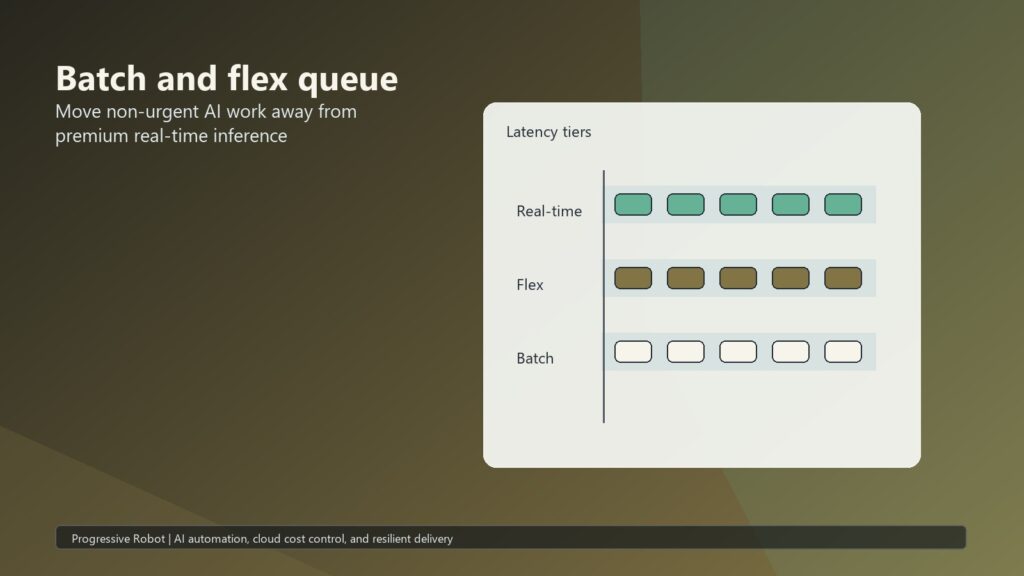
Real-time inference is not always necessary. A lot of enterprise AI work can wait minutes or hours: document classification, large-scale extraction, nightly enrichment, knowledge-base refreshes, model evaluations, compliance screening, product tagging, content migration, and backlog summarisation. Inference Economics should push that work toward batch or flexible processing when the provider supports it. Inference Economics also clarifies which work deserves premium latency.
This is one of the clearest commercial levers. OpenAI’s Batch API offers a 50% cost discount compared with synchronous APIs for eligible work, with higher separate rate limits and a 24-hour completion window. Anthropic’s Message Batches API also charges all usage at 50% of standard API prices and is designed for large volumes of asynchronous requests. Google Gemini paid usage lists Batch API access with a 50% cost reduction. Amazon Bedrock pricing says selected foundation models are available for batch inference at a lower price than on-demand inference.
The Inference Economics business question is simple: does the user need the answer immediately?
| Workload | Real-time need | Better pattern |
|---|---|---|
| Live customer chat | High | Synchronous low-latency route |
| Ticket summarisation after closure | Low | Batch job |
| Nightly CRM enrichment | Low | Batch or flexible tier |
| Real-time fraud support | High | Synchronous with strict model routing |
| Backlog document extraction | Low | Batch with validation and retry |
| Internal weekly reports | Low | Scheduled batch generation |
| Evaluation test runs | Low | Batch or flex processing |
Batch processing is not just cheaper. It also changes architecture. Requests need stable IDs, idempotent processing, retry logic, error handling, result storage, and monitoring. The output order may not match the input order, so systems should reconcile by custom ID rather than line number. Sensitive data policies may differ because asynchronous processing can involve temporary server-side storage of inputs and outputs.
Inference Economics should therefore classify AI workloads by latency tier. Real-time user-facing tasks deserve premium latency only when the user experience requires it. Internal tasks can often run in queues. Background jobs can use cheaper windows. Evaluations and migrations can be scheduled outside peak business hours.
Flexible processing tiers are another option. OpenAI describes flex processing as lower-cost access in exchange for slower response times and occasional resource unavailability, suited to non-production or lower-priority workloads. That is a useful match for experiments, data enrichment, and asynchronous workflows where delay is acceptable.
The cost saving can be substantial, but governance still matters. A batch job that processes the wrong dataset, duplicates every request, or generates unnecessarily long outputs can be expensive at any discount. Batch does not remove the need for token budgets, sampling, validation, and kill switches.
The mature pattern is a work queue with routing rules. Each request is tagged by use case, urgency, data sensitivity, model requirement, and budget. The platform decides whether it goes to real-time inference, batch inference, flex processing, or human review.
Inference Economics turns latency from a default into a priced decision.
Govern agent and tool-use costs before they multiply
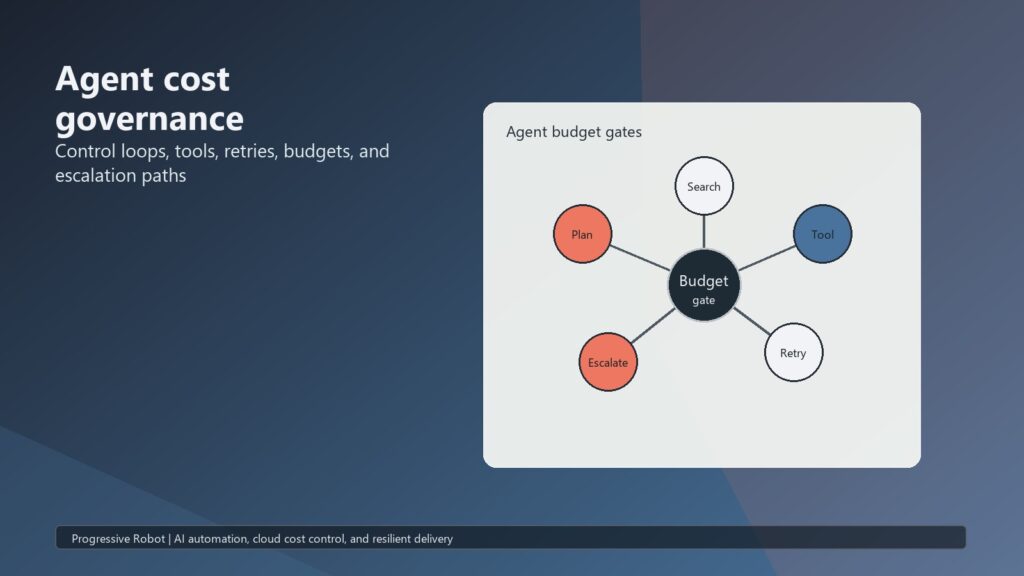
Agents make Inference Economics more urgent because one instruction can create many billable actions. A user may ask for a market brief, a code change, a supplier comparison, or a data cleanup. Behind the scenes, the agent may plan, search, call tools, inspect documents, write code, test results, retry failures, summarise findings, and generate a final answer. Inference Economics keeps that hidden chain accountable.
That is powerful. It is also how costs multiply.
Provider pricing pages increasingly show that tools have their own economics. Web search may be charged per search. Retrieved content may become input tokens. Tool definitions add tokens to requests. Code execution or container features may include runtime charges. Computer-use agents can add screenshot, tool, and session overhead. Even when a specific tool has no extra charge, the content it returns may increase input tokens in later steps.
Inference Economics for agents should therefore include controls at four levels.
| Control level | Required guardrail |
|---|---|
| User request | Budget, urgency, data class, and allowed tools |
| Agent plan | Maximum steps, expected tools, and stop condition |
| Tool execution | Per-tool limits, allowlists, audit logs, and rate limits |
| Final outcome | Success measure, human escalation, and cost attribution |
The most common Inference Economics mistake is giving agents open-ended goals without a cost boundary. “Research this account” can mean one search and a summary, or it can mean dozens of searches, page fetches, CRM checks, document reads, and drafting loops. The business outcome may be the same, but the cost profile is completely different.
Set budgets in the product design. A sales research agent might be allowed five searches, three page fetches, one CRM lookup, one premium-model synthesis, and a maximum output length. A coding agent might be allowed a bounded repository context, a test command, and a human approval before file edits. A finance agent might be allowed read-only tools unless a manager approves an action.
Autonomous AI agents can be valuable when they reduce manual work and improve consistency, but they need operational boundaries. Inference Economics is where those boundaries become measurable rather than theoretical.
Observability matters here too. Log every agent step with model, tokens, tool name, duration, outcome, error, and parent request. Show the full cost of the chain, not just the final answer. If an agent fails after 14 steps, the organisation still paid for those steps.
There is a governance benefit as well as a cost benefit. The same controls that limit spend also help with safety: tool allowlists, approvals, audit trails, escalation paths, and rate limits. Budget discipline and risk discipline often reinforce each other.
Inference Economics should be designed into agents before they become invisible background workers.
Put observability and chargeback around AI usage
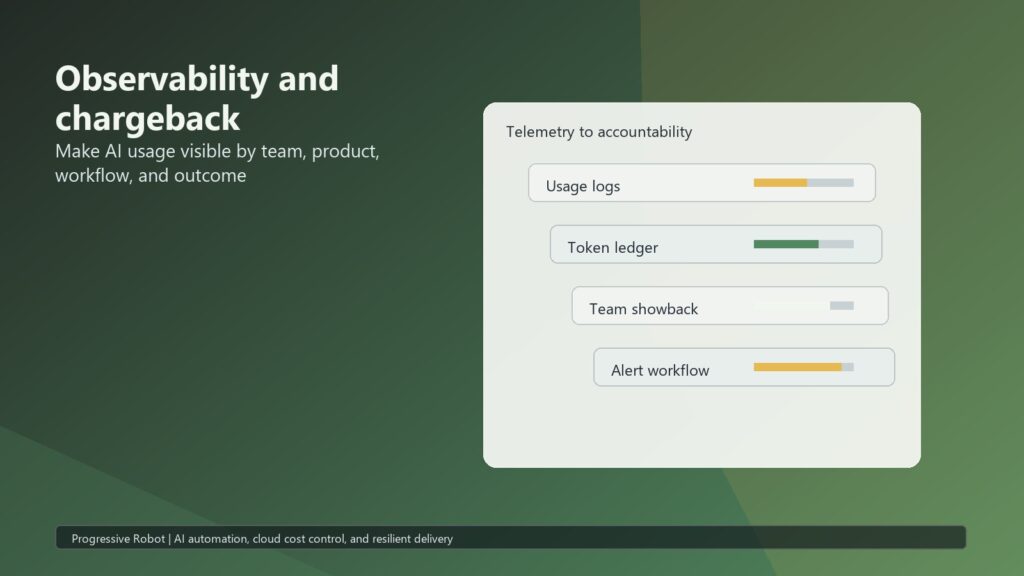
Inference Economics fails when AI spend is treated as a single shared bill. If every team uses the same API key, the same project, and the same provider account, finance can see the total but not the cause. Engineering can see activity but not value. Product teams can ask for more usage without seeing the cost of their design choices.
The fix is AI usage observability.
Every production AI request should carry Inference Economics metadata. At minimum, log the application, environment, team, user journey, customer segment, model, provider, input tokens, output tokens, cached tokens, retrieval calls, tool calls, latency, errors, and business outcome. For regulated or sensitive workloads, also log data classification, approval state, and human review status.
This does not require exposing confidential prompt content to dashboards. The cost layer can use counts, hashes, IDs, and classifications. The goal is to understand consumption patterns without turning cost monitoring into a privacy risk.
Useful Inference Economics dashboards include:
| Dashboard | What leaders can see |
|---|---|
| Spend by product and team | Who owns AI usage and budget |
| Cost per workflow outcome | Whether spend is creating useful value |
| Model mix | Where premium models are being used by default |
| Token distribution | Which prompts or outputs are unusually large |
| Cache hit rate | Whether caching strategy is working |
| Batch versus real-time share | Whether latency tiers are being used wisely |
| Agent step count | Which workflows are looping or retrying too much |
| Error and retry cost | How much failed work is being billed |
Google Cloud’s cost optimisation guidance recommends billing labels, dashboards, alerts, reports, and anomaly detection for AI and ML workloads. The same principle applies across providers. Inference Economics depends on tagging and attribution because AI spend can grow through small design choices made by many teams.
Chargeback or showback should be introduced carefully. The aim is not to punish teams for experimenting. The aim is to make consumption visible enough that good design wins. A pilot can have a sandbox budget. A production workflow should have an owner, a forecast, an alert threshold, and a review rhythm.
Workflow automation can help turn AI cost signals into action. A cost anomaly can create a review task. A cache hit rate drop can notify the platform team. A model-routing exception can open an approval workflow. A monthly usage report can go automatically to product owners with suggested improvements.
Inference Economics also needs procurement involvement. Vendor discounts, committed spend, reserved capacity, regional processing premiums, data retention requirements, and enterprise SLAs all affect the final cloud bill. Technical teams should not negotiate in isolation, and procurement should not negotiate without usage telemetry.
The best Inference Economics operating model is shared accountability: finance owns budget discipline, product owns value, engineering owns architecture, security owns risk controls, and operations owns reliability.
A 90-day plan for Inference Economics
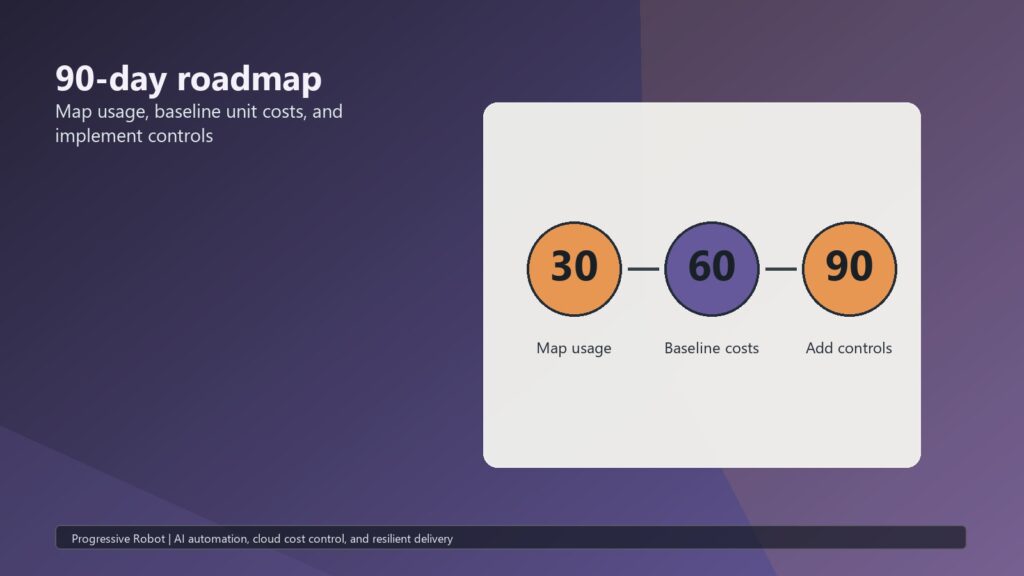
Inference Economics can feel abstract until it is turned into a short operating plan. A 90-day approach is enough to move from vague AI spend concern to practical control without freezing useful adoption.
Use the first 30 days to map usage. Identify every production and pilot AI workflow, provider account, API key, model, application owner, team, data source, and billing route. Pull token data where available. If logging is weak, start with provider exports, application logs, finance invoices, and interviews with product teams.
Use days 31 to 60 to create unit economics. Pick the highest-volume and highest-risk workflows. Calculate cost per answer, document, ticket, account, code change, or business outcome. Add model mix, prompt size, output size, retry rate, tool calls, cache hit rate, and latency requirement. Compare the current path with smaller models, shorter prompts, caching, batch processing, and route escalation.
Use days 61 to 90 to implement controls. Put budgets on pilots. Add metadata to production requests. Introduce model routing for two or three high-volume tasks. Move non-urgent work into batch. Add cache breakpoints for stable long prompts. Create alerts for cost spikes, unusual output length, retry loops, and cache misses. Start a monthly review with finance, engineering, security, product, and operations.
| Phase | Output | Practical actions |
|---|---|---|
| Days 1 to 30 | AI usage map | Catalogue providers, models, owners, keys, workflows, data classes, and invoices |
| Days 31 to 60 | Unit-cost baseline | Measure cost per workflow outcome, model mix, tokens, retries, tools, and latency tiers |
| Days 61 to 90 | Cost-control roadmap | Implement routing, caching, batch, budgets, alerts, and ownership reviews |
A practical roadmap should include these seven moves:
- Define the exact business outcome for each AI workflow.
- Add usage metadata to every production inference request.
- Build a unit-cost dashboard for the top five workflows by spend or risk.
- Route simple tasks to the smallest effective model and escalate only when needed.
- Reduce prompt and output waste before chasing provider discounts.
- Move non-urgent work to batch or flexible processing where suitable.
- Set agent budgets for tool calls, steps, retries, and human escalation.
The 90-day plan should not end with a static report. Inference Economics needs a monthly rhythm because models, prices, and usage patterns change quickly. A model that is expensive today may be cheap tomorrow. A cheap model may become risky if a workflow changes. A prompt that was efficient during pilot may become bloated after ten teams add requirements.
Review the cost model whenever a workflow moves from pilot to production, usage grows materially, a provider changes pricing, a new model is introduced, or an agent gains new tools.
The organisations that handle Inference Economics well will not be the ones that spend the least on AI. They will be the ones that know what each pound of AI spend is doing.
FAQ
What is Inference Economics?
Inference Economics is the practice of measuring and optimising the cost of running AI models in production. It connects token prices, model selection, prompt size, output length, caching, batch processing, tool use, latency, and business outcomes into one operating model.
Why can AI cloud spend rise when token prices are falling?
AI cloud spend can rise because usage grows faster than unit prices fall. More users, longer prompts, richer context, agent loops, retries, tool calls, and multimodal workloads can increase total consumption even when the cost per million tokens drops.
What should organisations measure first?
Start with cost per useful outcome. For example, measure cost per resolved support case, processed document, accepted code change, qualified sales account, or reviewed compliance item. Then break that cost into model, token, cache, batch, retrieval, tool, and infrastructure components.
Is the cheapest model always the best choice?
No. The cheapest model may create more errors, retries, escalations, or human review. Inference Economics compares total cost per acceptable outcome, not just price per token. Use the smallest effective model, but prove effectiveness with evaluation data.
How does prompt caching reduce AI costs?
Prompt caching reduces repeated input cost by reusing stable prompt prefixes such as system instructions, examples, documents, policies, and tool definitions. It works best when cached content is placed at the beginning of the prompt, remains identical across requests, and cache hit rates are monitored.
When should batch inference be used?
Use batch inference for work that does not need an immediate response, such as document extraction, offline classification, evaluations, knowledge-base refreshes, CRM enrichment, content migration, and scheduled reporting. Many providers offer lower prices for eligible batch processing.
How should agent costs be controlled?
Give agents explicit budgets: maximum steps, maximum tokens, allowed tools, retry limits, escalation rules, and stop conditions. Log each step with model, token, tool, duration, error, and result so the full cost of the agent chain is visible.
What is the first 30-day action for Inference Economics?
Map current AI usage. List providers, models, API keys, workflows, owners, data classes, costs, and business outcomes. Even an imperfect map gives finance, product, engineering, and operations a shared starting point.
More AI coverage: explore Progressive Robot's AI Models, Tools & Releases hub — hands-on reviews, setup guides and benchmarks in one place.










