
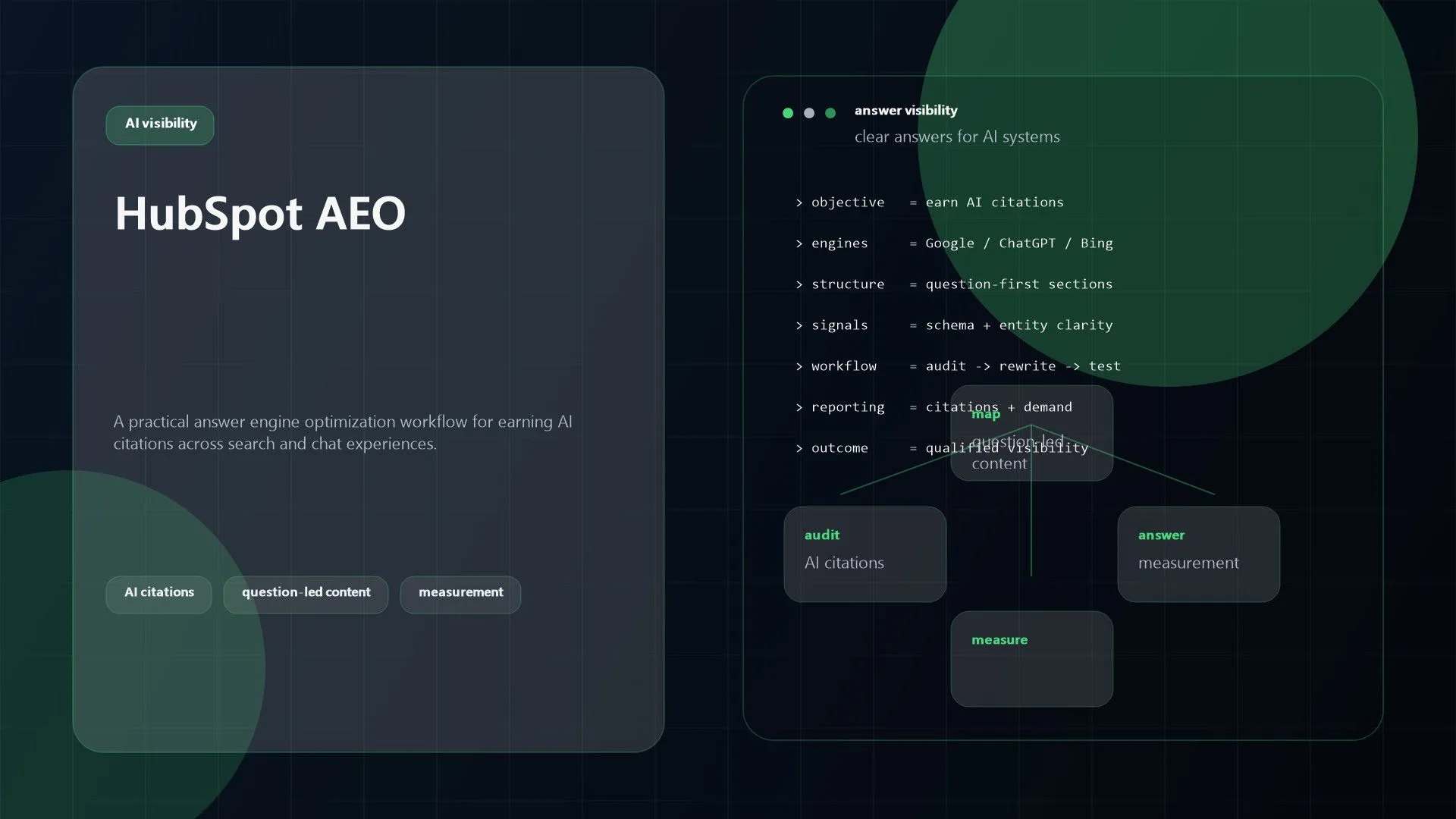
HubSpot AEO is HubSpot’s practical framing of answer engine optimisation: build content that AI systems can understand, trust, and cite when users ask real questions. Instead of optimising only for ten blue links, HubSpot AEO pushes teams to think about direct answers, entity clarity, structured formatting, and visibility inside AI Overviews, chat search, and conversational assistants.
That shift matters for teams already investing in Artificial Intelligence (AI) and Machine Learning (ML), AI strategy, workflow automation, and business process automation. If customers start getting answers without clicking, your brand still needs to be the source that gets quoted, remembered, and trusted.
This article draws on HubSpot’s What is Answer Engine Optimisation (AEO) and how does it change SEO?, Google’s Creating helpful, reliable, people-first content, and Google’s SEO Starter Guide. Those sources point to the same conclusion: strong HubSpot AEO is less about hacks and more about useful answers, clean structure, and durable authority signals.
| Topic | Practical answer |
|---|---|
| What HubSpot AEO is | A content strategy built to help AI systems cite your brand as a trusted answer source |
| What changes vs. SEO | The success metric shifts from only ranking and clicks to visibility, citations, and brand recall inside AI responses |
| Best content format | Clear question-led sections, direct answers up front, short paragraphs, and strong source support |
| Technical layer | Article, FAQ, and HowTo schema plus stronger entity signals and authorship clarity |
| Best first move | Audit the questions your audience already asks answer engines, then upgrade the pages that should win those citations |
HubSpot AEO at a glance
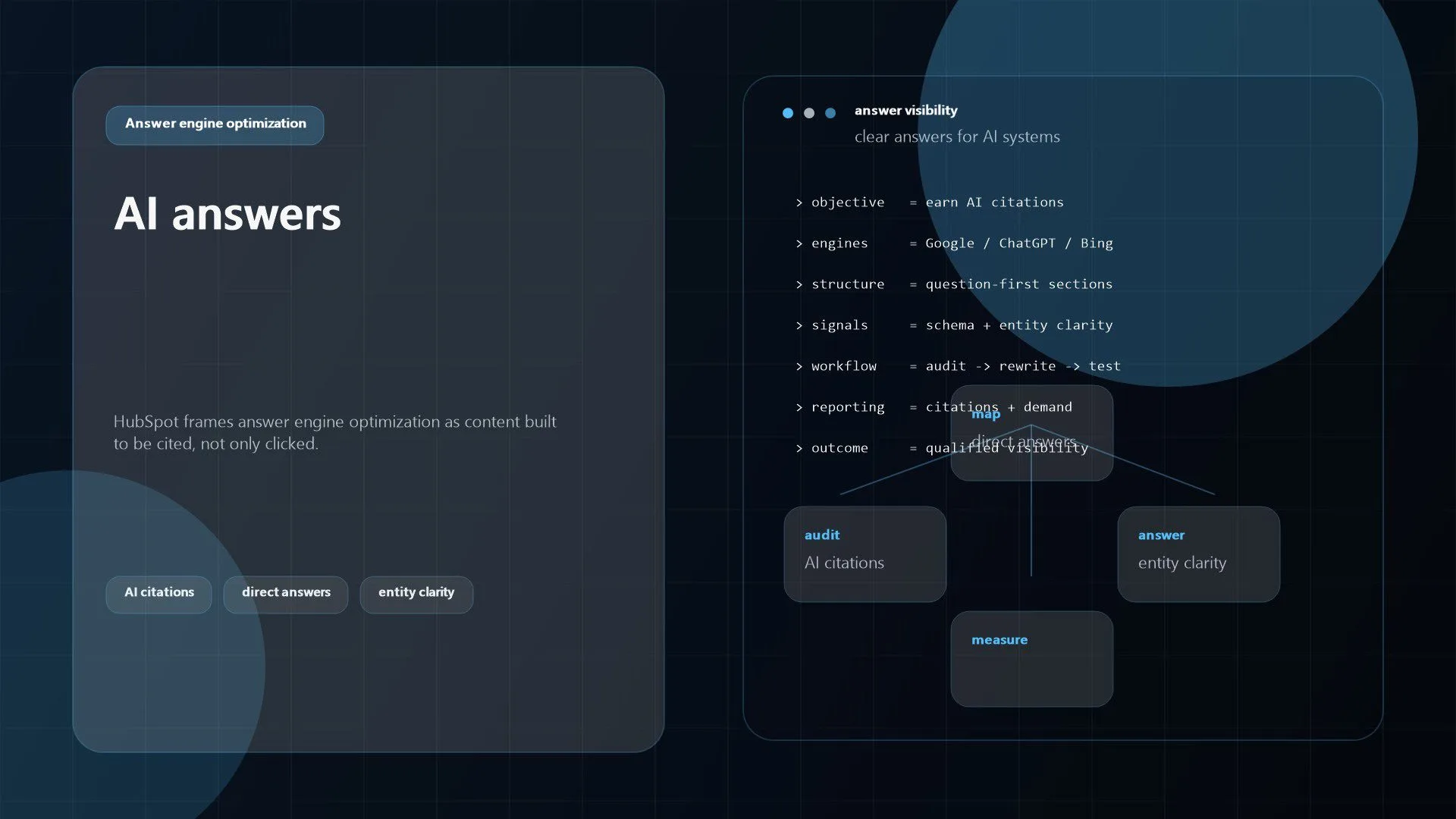
This approach starts from a simple idea: AI systems prefer pages that answer questions quickly and clearly. HubSpot’s own guidance describes AEO as optimising content so AI systems cite you as a source and feature your information in direct answers. That means the page has to do more than mention a keyword. It has to resolve intent fast.
In practice, HubSpot AEO keeps the strongest parts of classic SEO but changes the content goal. The target is not just a ranking position. The target is becoming the answer engine’s most usable source for a topic, question, or comparison. That is why concise introductions, clean headings, supporting evidence, and strong brand signals matter so much more.
The useful way to think about HubSpot AEO is as an operating layer on top of SEO. If your site architecture is weak, your internal linking is messy, or your content lacks depth, answer engines will not trust it either. But if your foundation is solid, this method helps you rework that content so machines can quote it and people can still act on it.
What HubSpot AEO means in practice
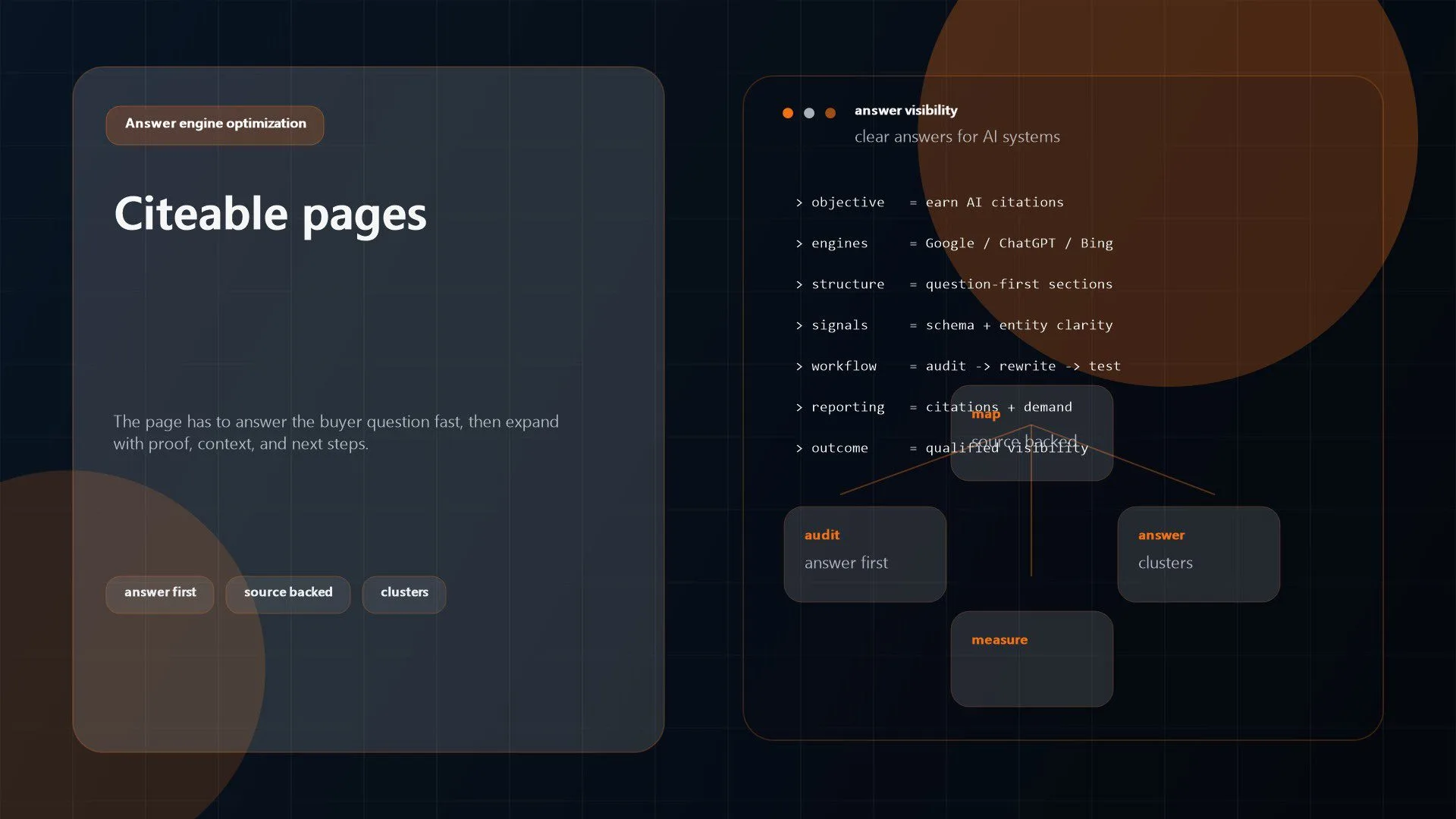
HubSpot AEO is not a separate publishing universe. It is a change in how you brief, structure, and measure content. HubSpot repeatedly emphasizes that AEO does not replace SEO. It adds a new requirement: pages have to be easy for AI systems to extract, summarize, and cite.
That changes how content should open. If someone asks, “What is answer engine optimisation?” the page should answer that in the first paragraph, not after three generic setup sections. The framework favours pages that make the answer obvious, then expand with context, examples, proof, and next actions.
It also changes how you think about entities. HubSpot’s guidance says entity clarity matters more than ever because AI systems need confidence about who you are, what you do, and how you relate to the topic. For B2B teams, that means clearer service pages, stronger author signals, better about-page context, and stronger links between articles and core offerings such as intelligent automation or workflow automation.
The most practical reading of the playbook is this: answer the question early, support the answer well, and make your brand easier to identify across the entire content cluster.
How HubSpot AEO changes classic SEO
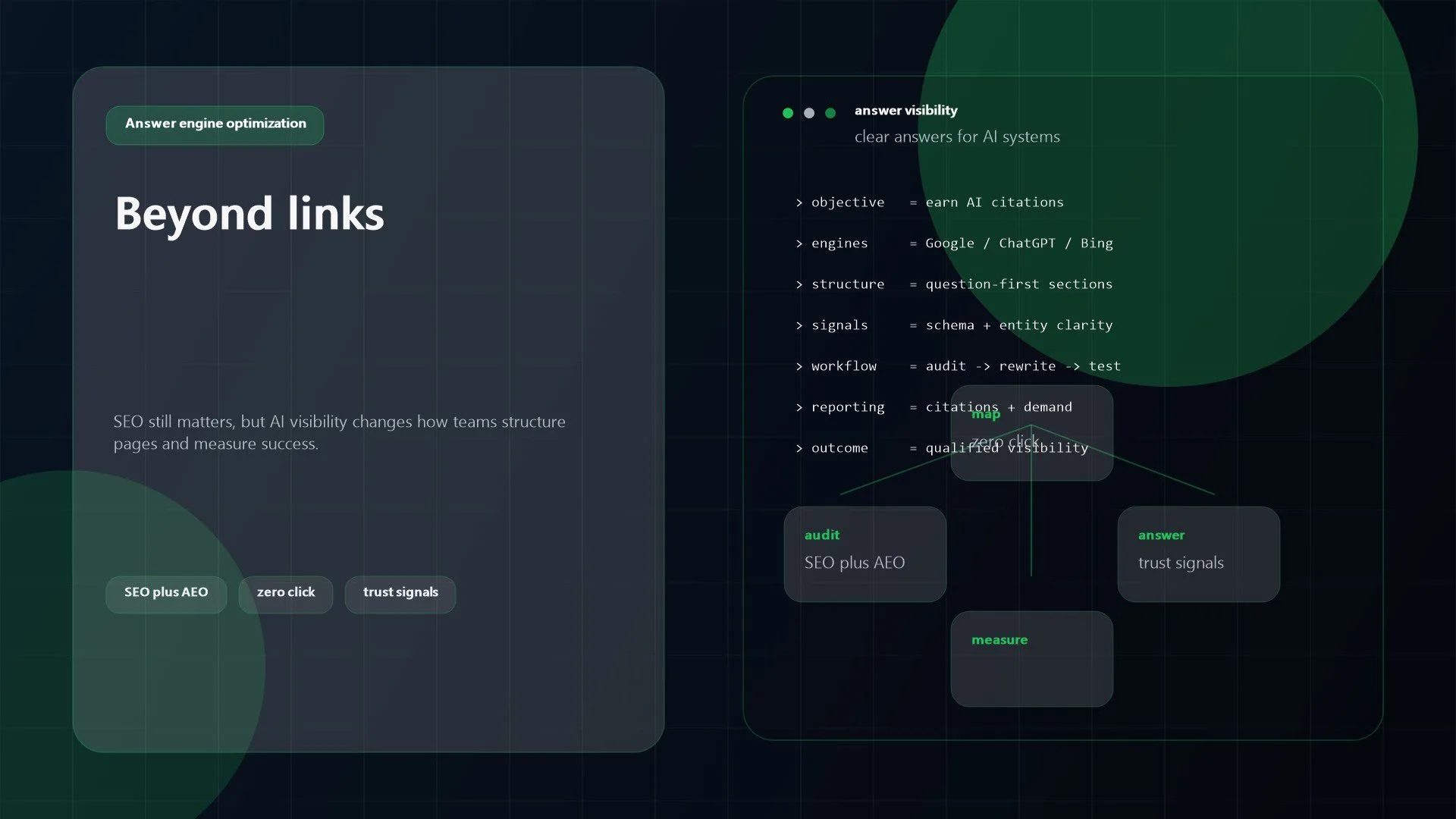
The biggest difference here is that visibility no longer depends only on a click. AI systems can quote your content, paraphrase your page, or surface your brand even when the user never visits immediately. That creates a zero-click reality, but it also creates a citation opportunity.
Classic SEO still cares about rankings, crawlability, internal links, and topic depth. This model keeps all of that, then adds a second lens:
- Your headings need to map to the exact questions users ask in conversational search.
- Your answers need to appear early enough for an AI system to extract them cleanly.
- Your content needs supporting facts, sources, and definitions that increase trust.
- Your page needs schema and entity signals that clarify what the content is about.
This is why the approach often rewards simpler writing. Short paragraphs, direct sentence structure, and scannable formatting help people, but they also help machines parse meaning. Google’s people-first guidance aligns with that same standard. Helpful content is complete, trustworthy, and written to solve a user’s problem, not merely to hit a search term.
The teams that usually benefit most from this framework are not the teams chasing novelty for its own sake. They are the teams willing to upgrade existing high-intent pages so each page does one job extremely well.
Which answer engines matter most for HubSpot AEO
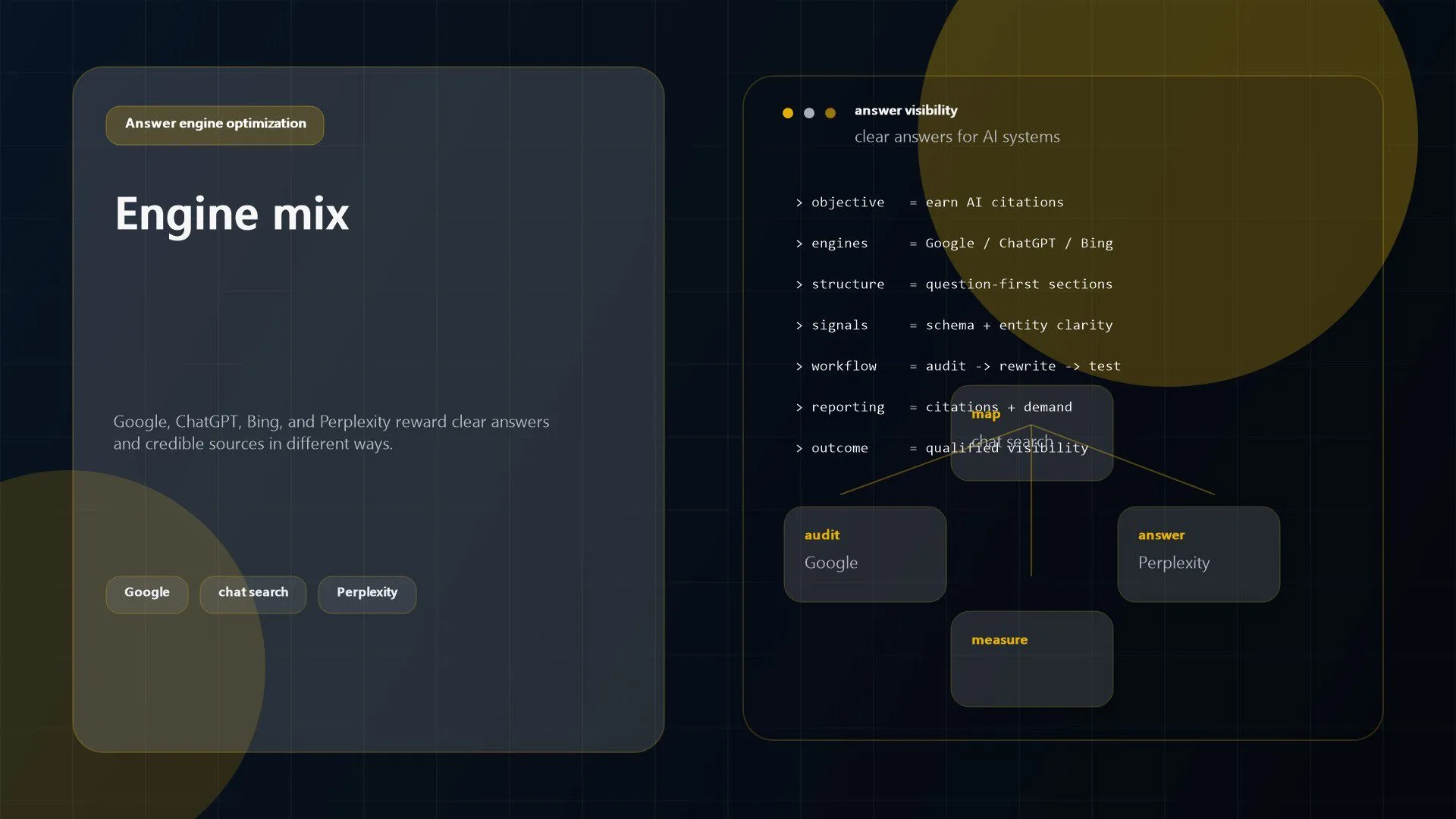
The strategy treats answer engines as a portfolio, not a single platform. HubSpot specifically calls out Google AI Overviews, ChatGPT Search, Bing Copilot, and Perplexity as important surfaces because each of them can synthesize information and cite sources differently.
Google AI Overviews usually reward content that already performs well in search and presents clean, extractable answers. ChatGPT Search tends to prefer credible sources with strong entity alignment and clearly attributed information. Bing Copilot often performs best when pages explain what a product or service does with direct language. Perplexity is especially comfortable citing content that already cites other authoritative sources.
That does not mean you need four separate content strategies. The method works best when one content architecture serves all of them. A question-led page with accurate definitions, clear examples, useful comparisons, and supporting citations has a better chance of showing up across multiple answer engines without forcing your team to maintain parallel editorial systems.
For most brands, the right priority order is simple. Start where your buyers are already asking questions. If your audience lives in Google, fix high-intent pages for AI Overviews first. If your buyers research in chat tools, make sure your best explainer pages are quotable, current, and source-backed.
How to build a HubSpot AEO workflow that actually ships
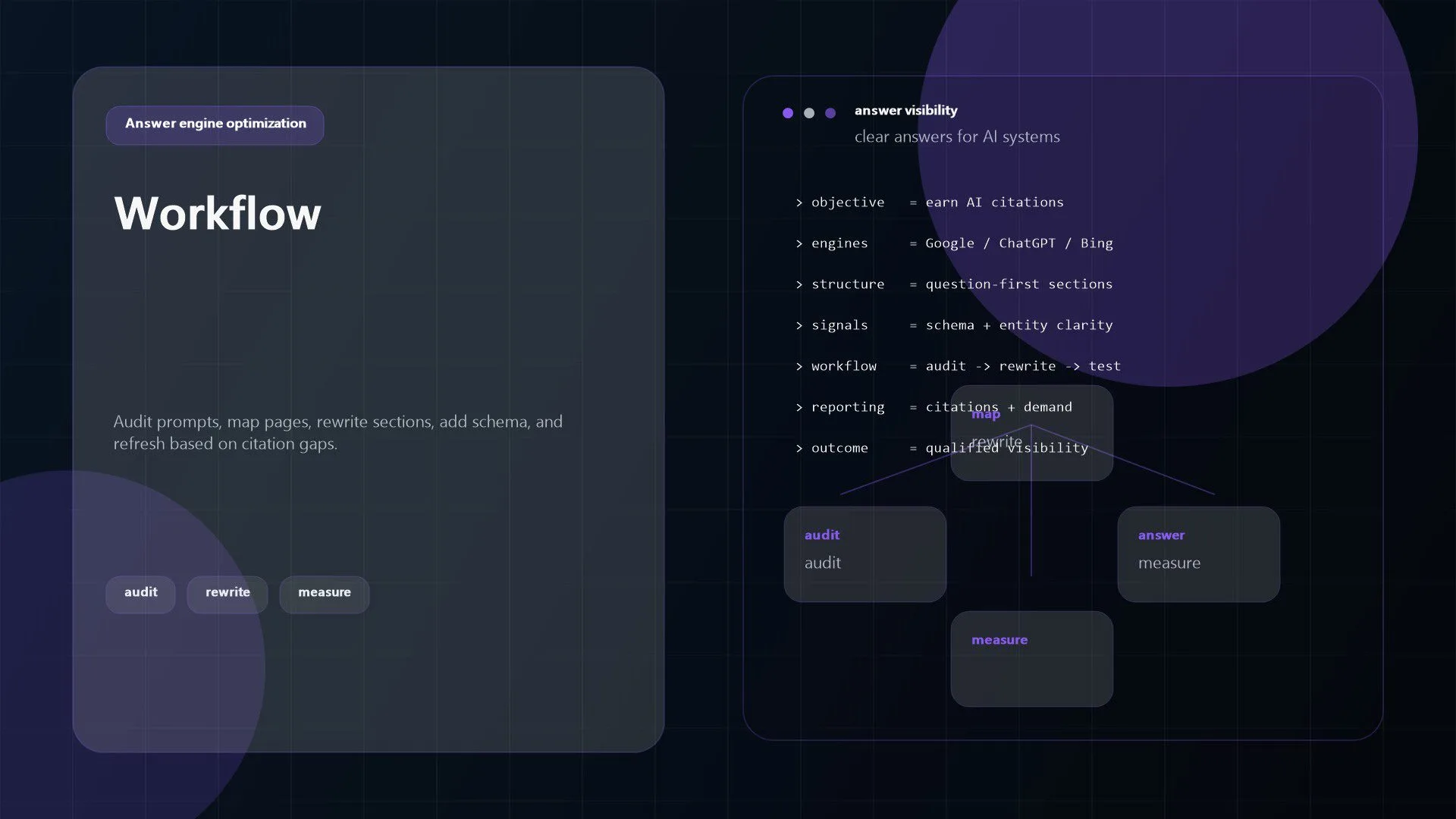
HubSpot AEO becomes useful only when it turns into a repeatable workflow. The fastest way to do that is to treat it as a sequence rather than a brainstorm.
1. Audit the prompts that matter
List the questions your buyers would ask in Google AI Overviews, ChatGPT Search, Bing Copilot, and Perplexity. Start with commercial and decision-stage questions first because those are the prompts most likely to turn into pipeline.
2. Map those prompts to existing content
Look at your current topic clusters and identify which pages already deserve to win citations. The work should usually begin with upgrading strong pages, not publishing twenty thin new ones.
3. Rewrite sections into direct answers
Use question-led H2s or H3s, place the clearest answer in the first lines of the section, and then expand with proof, examples, or tradeoffs. This is where content teams usually see the biggest lift because the page becomes both more readable and more citable.
4. Add the technical layer
Apply Article schema to long-form content and FAQ or HowTo schema where it fits naturally. Strengthen authorship, brand consistency, and internal linking so the page sits inside a trustworthy content ecosystem. If your team is already improving AI strategy or business process automation, this is the point where editorial work and technical governance should meet.
5. Measure, refresh, and scale
HubSpot’s own AEO Grader and AEO Tool positioning points in the right direction: audit visibility, track mentions and citations, benchmark competitors, then close the gaps. The program becomes sustainable only when the team can see where the brand appears, where it does not, and which pages deserve the next update.
How to measure HubSpot AEO without guessing
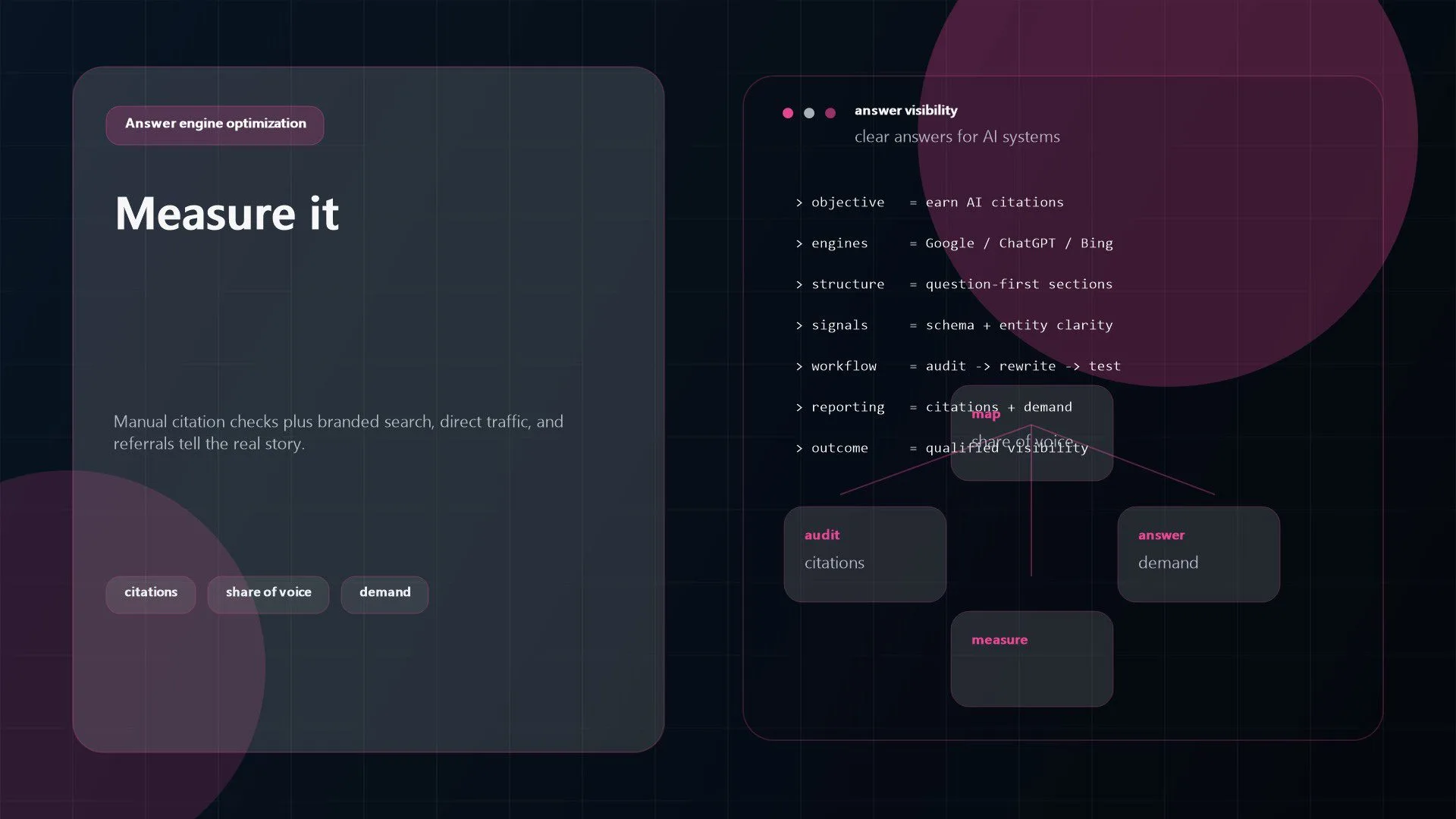
HubSpot AEO is harder to measure than keyword rankings, but it is not mysterious. The most reliable starting point is still manual testing. Build a monthly sheet of priority questions and record whether your brand appears, how often it appears, and whether it is the primary source or just a supporting mention.
After that, track the signals that usually move when HubSpot AEO is working:
- AI citation frequency across your target questions.
- Share of voice compared with direct competitors in answer engines.
- Branded search growth as more users remember your name from AI responses.
- Direct traffic quality, especially on pages optimised for answer-style discovery.
- Referral traffic from answer engines that expose clickable source links.
This is where many teams make the wrong call. They expect the program to behave like a normal ranking report. It does not. The stronger pattern is blended measurement: manual citation checks plus analytics signals that show whether AI visibility is turning into branded demand and qualified sessions.
If you want executive buy-in, keep the reporting concrete. Show the questions that matter, the sources currently winning them, the pages you updated, and the movement in citation share over time. That makes the work feel like an operational program instead of a fuzzy trend deck.
HubSpot AEO FAQ
What is HubSpot AEO?
HubSpot AEO is HubSpot’s practical approach to answer engine optimisation. The goal is to structure content so AI systems can understand it, trust it, and cite it when people ask questions in search or chat interfaces.
Does it replace SEO?
No. The framework depends on strong SEO fundamentals. Good rankings, crawlable pages, topic depth, and internal links still matter because answer engines often pull from content that already performs well organically.
Which content should you optimise first?
Start with existing pages that already target high-intent questions, rank reasonably well, and connect to business outcomes. Those pages usually give faster gains than brand-new low-authority pages.
What schema helps most?
Article schema helps long-form posts, FAQ schema helps question-and-answer sections, and HowTo schema helps process-driven content. The right schema depends on the page type, but the real goal is clarity, not markup for its own sake.
How long does it take to show results?
Meaningful results usually take weeks to months because answer engines need time to crawl, trust, and reuse your content. Stronger pages can earn earlier wins, especially when they already have authority and are updated into clearer answer-first formats.
HubSpot AEO matters because it gives content teams a realistic way to adapt without throwing out everything they already know about SEO. The playbook is straightforward: keep the foundation strong, make answers clearer, strengthen trust signals, and measure citations with the same discipline you use for rankings and conversions.
If your team wants to connect this playbook with a broader AI strategy, content operations, and production-grade workflow automation, contact Progressive Robot to turn AI visibility into a repeatable operating model.
More AI coverage: explore Progressive Robot's AI Models, Tools & Releases hub — hands-on reviews, setup guides and benchmarks in one place.