
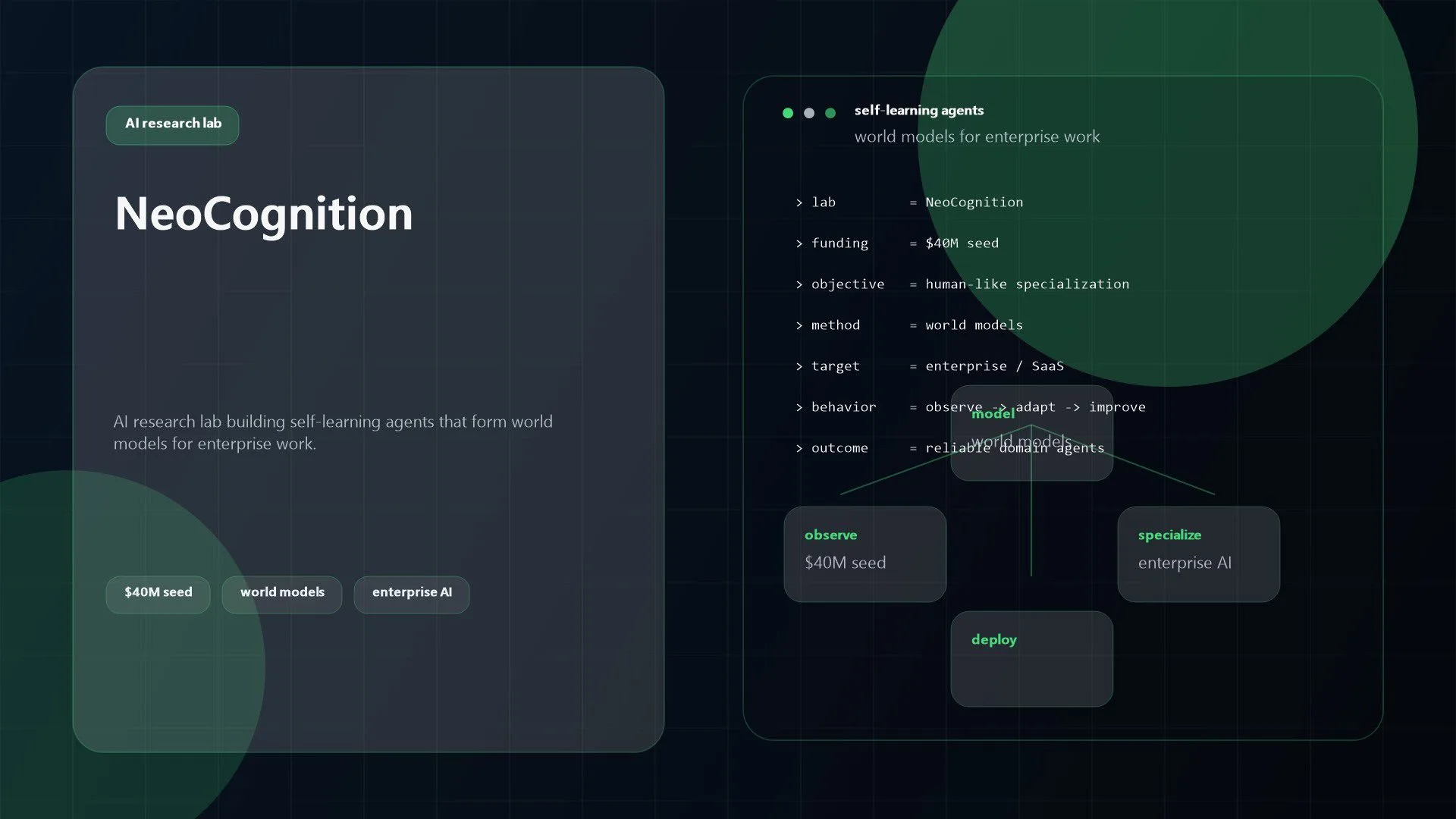
NeoCognition has stepped out of stealth with a $40 million seed round and a clear claim: current agents are too unreliable because they stay broad but never truly specialise. According to TechCrunch’s report on the funding, the startup says it wants to build self-learning agents that become experts in a domain the way humans do. That makes the company more than another startup raising money on generic agent excitement. It is trying to solve one of the biggest problems in AI execution: whether agents can learn a working model of a specific environment instead of guessing their way through tasks.
The timing matters. The lab arrives when enterprise buyers are interested in agents but still wary of handing them meaningful work. If an agent completes a task correctly only part of the time, then it is still a demo tool, not a dependable worker. The missing layer, in this view, is autonomous specialisation. For teams building AI strategy, workflow automation, business process automation, and intelligent automation, that claim is worth paying attention to because reliability is usually the line between pilot excitement and real deployment.
This article draws on TechCrunch’s funding report, Yu Su’s research page, and the company’s publicly described positioning through the story. Those sources point to the same core thesis: the lab wants agents that can build a world model for a profession or micro-environment, then keep learning until they become useful specialists rather than brittle generalists.
| Topic | What to know |
|---|---|
| Company | NeoCognition |
| Founder | Yu Su, Ohio State professor and AI agent researcher |
| Funding | $40 million seed |
| Co-leads | Cambium Capital and Walden Catalyst Ventures |
| Other backers | Vista Equity Partners plus angels including Lip-Bu Tan and Ion Stoica |
| Product thesis | Self-learning agents that specialise like humans |
| Commercial focus | Enterprises and established SaaS companies |
| Team size | Around 15 employees, most with PhDs |
What NeoCognition announced
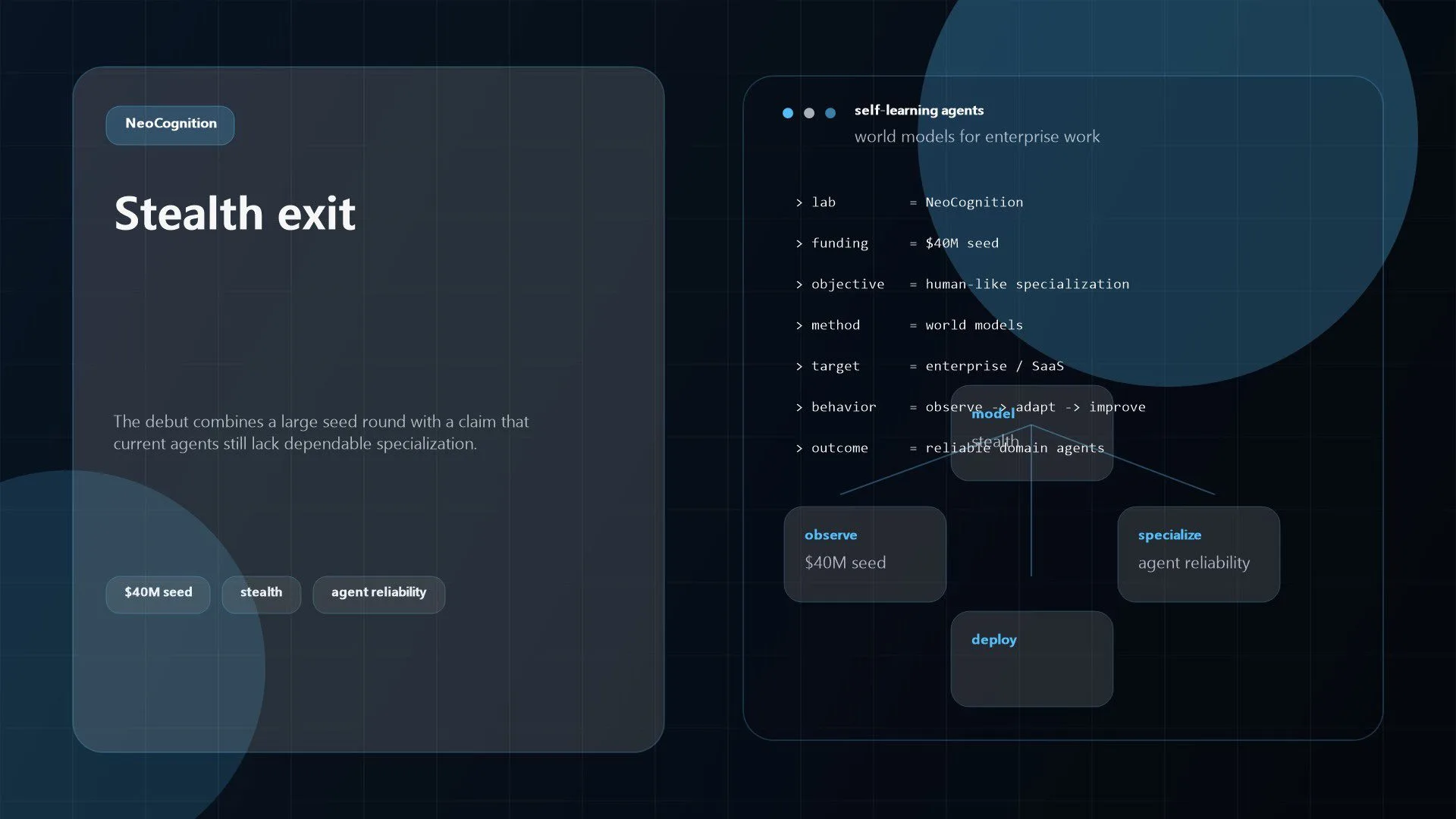
The headline fact is simple: NeoCognition has raised a $40 million seed round while emerging from stealth. That is a large seed by normal startup standards, but it is especially notable for a research-heavy AI lab still early in commercialization. TechCrunch reported that the round was co-led by Cambium Capital and Walden Catalyst Ventures, with participation from Vista Equity Partners and angels including Intel CEO Lip-Bu Tan and Databricks co-founder Ion Stoica.
That investor list tells you the company is being framed as more than a narrow lab spinout. It is being funded as a platform bet on the next layer of agent infrastructure. The pitch is not a single chatbot feature or a narrow copiloting tool. Instead, the company is presenting a broader architecture problem: how to make agents adapt to a profession, environment, and workflow until they become trustworthy enough for sustained enterprise use.
The founder story also matters. Yu Su did not come from a conventional startup background first and then move into AI research later. He came from the research side and only commercialized after deciding that model advances had made personalisation and agent specialisation more realistic. That research-first origin gives the startup a different profile from product-led agent startups that optimise the interface before they solve the learning problem.
Why NeoCognition says current agents are still unreliable
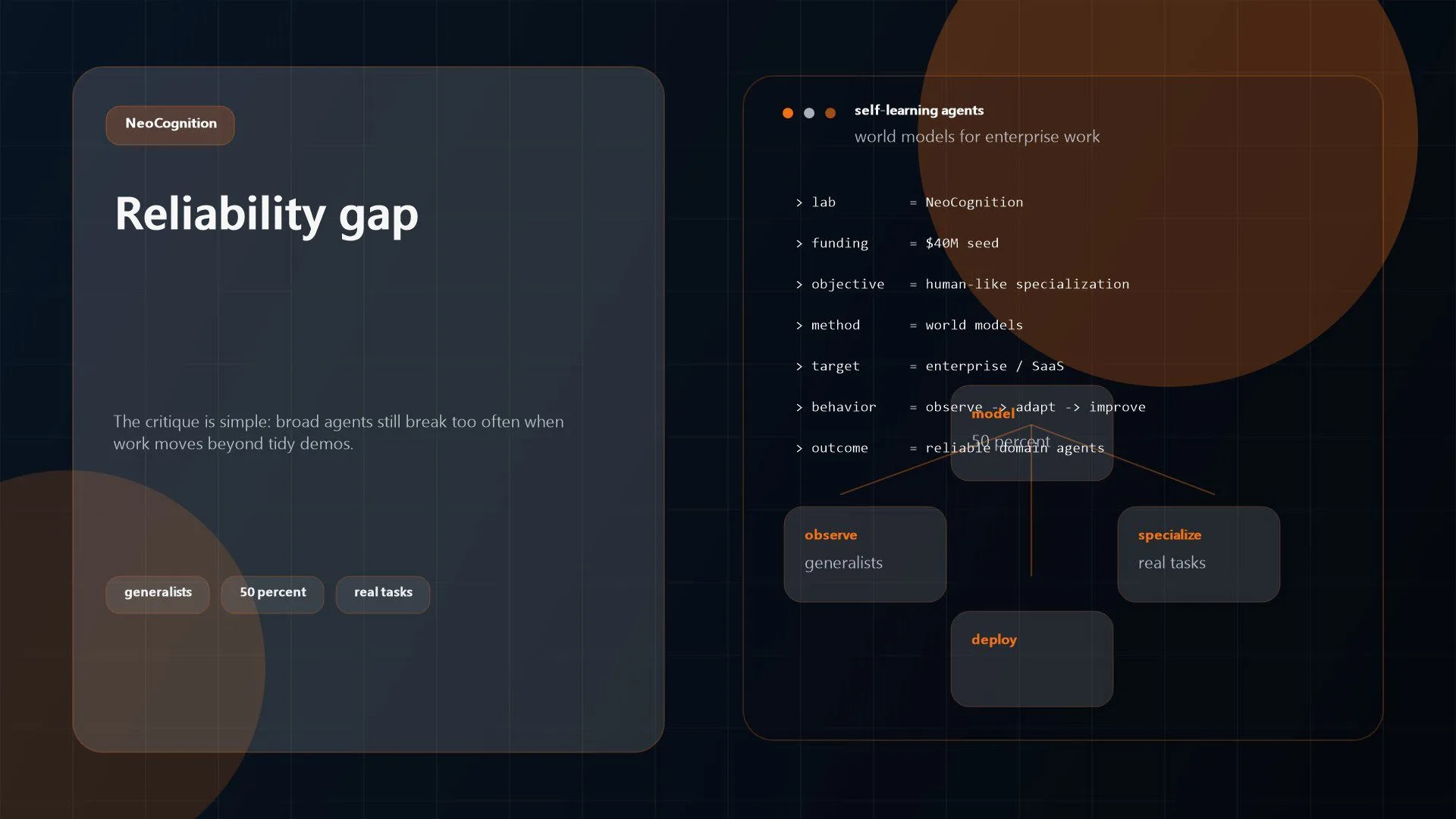
NeoCognition is entering the market with a critique of the current agent wave. Su told TechCrunch that today’s agents are generalists, which means users still take a leap of faith every time they assign a real task. He argued that consistency is the real bottleneck and said current agents across products such as Claude Code, OpenClaw, and Perplexity’s computer-use tools complete tasks as intended only around half the time.
That criticism is worth taking seriously because it maps to what many enterprises already experience. Agents can look impressive in bounded trials, yet break when a workflow changes, when the environment contains unfamiliar rules, or when a task requires contextual memory about how a business actually operates. The argument is that the market has spent too much time proving agents can attempt many tasks and not enough time proving they can become dependable at one domain.
For enterprise teams, that is the most practical part of the story. Reliability gaps create cost everywhere: higher review overhead, more exception handling, weak auditability, and poor user trust. If this approach can push agent consistency materially higher, then it is not just improving output quality. It is reducing the operational tax that currently makes many agent rollouts hard to justify.
How NeoCognition wants agents to learn like humans
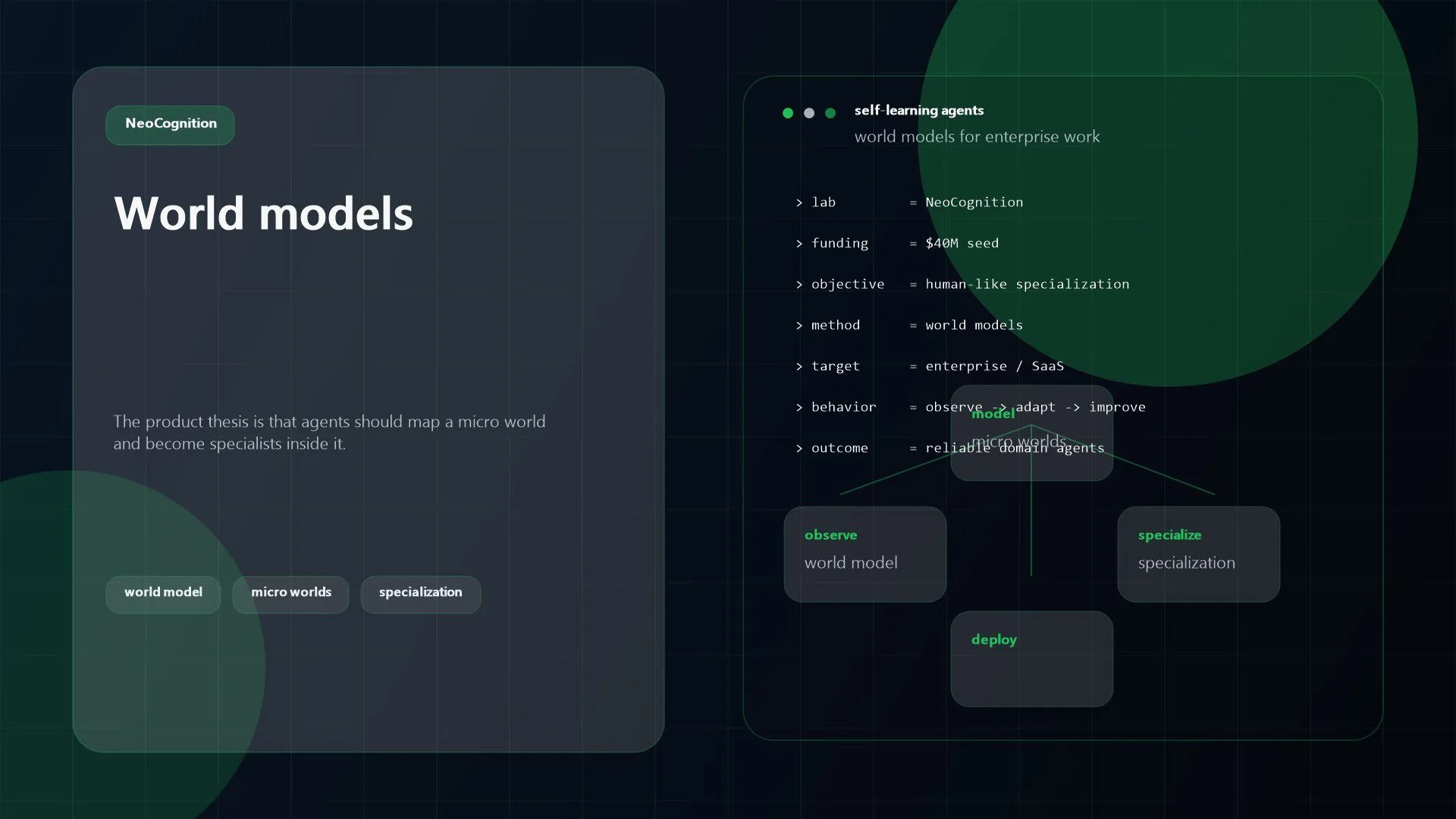
The core thesis is that human intelligence is powerful not only because it is broad, but because humans can specialise quickly when they enter a new environment. The lab wants agents to mimic that pattern. In Su’s framing, people keep learning by building a world model for a profession or environment. The same idea is meant to work autonomously for a given micro world.
That phrase matters. A world model is not just task history. It implies learning the rules, constraints, consequences, and recurring patterns that define how work actually gets done inside a specific setting. The company appears to believe that agents become useful when they can map a domain deeply enough to generalize within it rather than relying on one-shot prompting and static task recipes.
This is also where the lab separates itself from a lot of workflow automation pitches. Many agent vendors still depend on manual prompt engineering, fixed vertical tuning, or custom hand-built workflows. The goal here is a system that starts broad and then teaches itself to become an expert in a domain. If that works, the company could make specialisation faster, cheaper, and more portable than the current generation of vertical agent systems.
Why the $40M seed matters
The size of the seed round is strategically important because the problem is not lightweight. NeoCognition is trying to bridge research, infrastructure, enterprise go-to-market, and trust. That is expensive. A company working on self-learning agents needs room to hire researchers, run experiments, build product surfaces, and stay credible with enterprise customers that expect real performance instead of a lab demo.
The $40 million also gives the company a chance to avoid one of the classic traps in frontier-adjacent AI startups: being forced to commercialize too narrowly too early. It can keep investing in its core learning architecture while still building the enterprise hooks it needs for adoption. That balance matters because the most durable AI companies usually win at both layers. They solve a hard technical problem and package it in a way that enterprises can buy.
There is a signaling effect too. A seed round of this size tells the market that investors believe agent reliability is still an open category-defining opportunity. The startup is effectively being funded as a company that could shape how enterprises think about specialist agents, not just as another application startup chasing near-term usage metrics.
What NeoCognition plans to sell to enterprises
The startup is not positioning itself as a consumer assistant. TechCrunch reported that NeoCognition intends to sell primarily to enterprises, especially established SaaS companies. That is an important commercial clue. The company seems to view its technology as something customers can use either to build agent workers or to upgrade existing software products with more capable autonomous systems.
That enterprise and SaaS orientation makes sense. Established software companies already own workflows, permissions, customer context, and repeated task environments. If the lab can provide a self-learning layer that helps agents understand and master those environments, then it becomes a force multiplier for software vendors trying to add meaningful automation instead of shallow AI veneers.
This is where the story becomes especially relevant for buyers thinking about product modernisation. Enterprises do not just need agents that can answer questions. They need systems that can operate within the rules of finance, support, engineering, compliance, and internal operations. The bet is that the path to that level of usefulness is domain learning, not broader generality alone.
Why the NeoCognition investor mix matters
NeoCognition’s backers tell a story about where value may appear. Cambium Capital and Walden Catalyst Ventures fit the research-and-deep-tech side of the thesis, but Vista Equity Partners stands out because of its software portfolio and enterprise reach. Su explicitly noted that Vista’s involvement could give the company direct access to a large network of software companies looking to modernise products with AI.
That matters because enterprise agent adoption is rarely limited by model capability alone. Distribution, product integration, governance, and real customer workflows matter just as much. A company with this thesis still needs design partners and operating environments where its agents can learn, prove value, and become embedded. Vista can help create that path.
The angel list matters too. Lip-Bu Tan and Ion Stoica are not generic brand-name investors in this context. They are associated with deep technical judgment, infrastructure, and enterprise computing. Their presence suggests the startup is being taken seriously by people who understand both the systems layer and the commercial importance of reliable AI tools.
What risks and open questions remain for NeoCognition
The company is promising something important, but several questions still need answers. The first is measurement. It says today’s agents are too inconsistent, but outside the headline framing we still do not know exactly how improvement will be benchmarked across domains. If this becomes a serious enterprise platform, buyers will want hard evidence around task completion, error rates, supervision load, adaptation speed, and failure modes.
The second question is safety and control. A self-learning agent that specializes on the fly could be very powerful, but it also creates governance challenges. The lab will need to show how these agents are constrained, what they retain, how they are audited, and how customers can roll back or inspect what the system has learned. The stronger the specialisation claim, the more important those controls become.
The third question is commercialization speed. The company currently has roughly 15 employees, most with PhDs. That is a strong research signal, but enterprise buyers eventually need documentation, product support, security review readiness, integrations, and deployment discipline. It may have the technical foundation, but it still needs to prove it can cross the line from research lab to dependable enterprise vendor.
Those are not reasons to dismiss the startup. They are the normal questions any serious buyer should ask. If your team is evaluating self-learning agents, domain-specific automation, or next-generation AI product design, contact Progressive Robot to turn the agent idea into a governed delivery plan instead of another fragile pilot.
FAQ
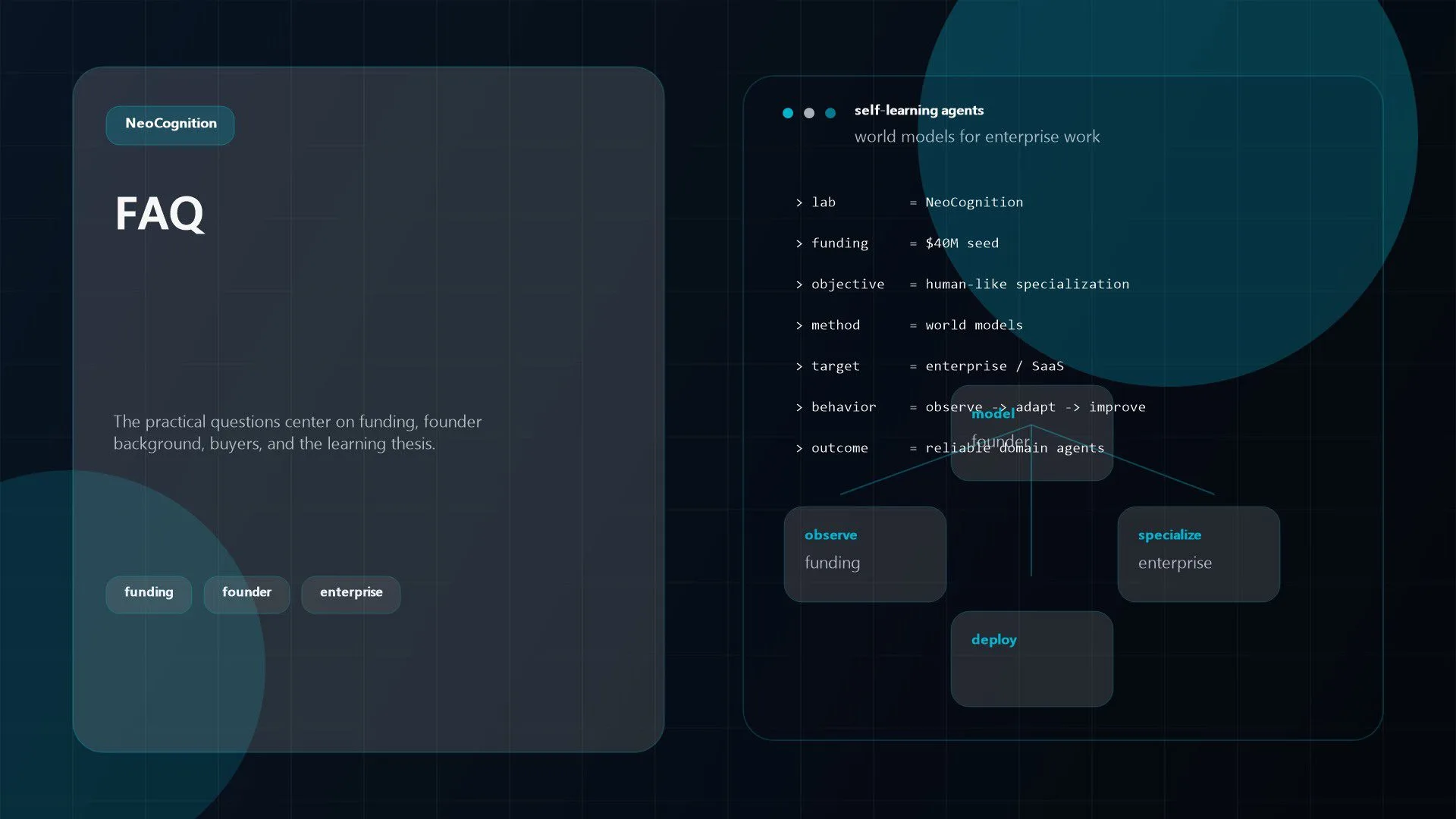
What is NeoCognition?
NeoCognition is a startup and research lab founded by Yu Su that is building self-learning AI agents intended to become experts in a domain the way humans do.
How much did NeoCognition raise?
It raised a $40 million seed round co-led by Cambium Capital and Walden Catalyst Ventures, with participation from Vista Equity Partners and notable angel investors.
Who founded NeoCognition?
It was founded by Yu Su, an Ohio State professor and AI agent researcher who spun out his work after seeing a chance to make agents more personalised and reliable.
What does NeoCognition mean by agents that learn like humans?
The idea is that strong agents need to build a world model for a profession or environment, then keep learning until they become useful specialists instead of brittle generalists.
Who does NeoCognition want to sell to?
It plans to sell mainly to enterprises and established SaaS companies that want to build agent workers or improve their existing products with more reliable AI systems.
Why does the NeoCognition Vista investment matter?
Vista Equity Partners gives the startup more than capital. It can also provide access to a large portfolio of software companies that may want to modernise products with enterprise-grade AI capabilities.
NeoCognition is interesting because it is attacking the problem that still blocks many agent deployments: specialisation. If the company can raise reliability by teaching agents to build usable world models inside real environments, it could matter far beyond this funding round.
More AI coverage: explore Progressive Robot's AI Models, Tools & Releases hub — hands-on reviews, setup guides and benchmarks in one place.