
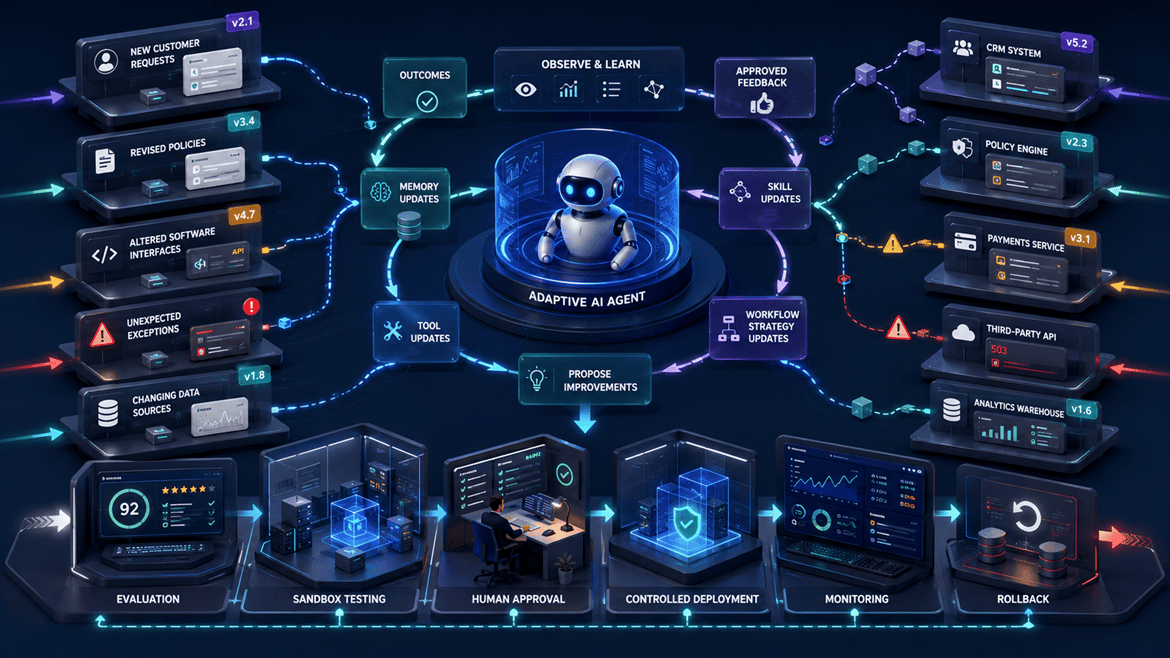
Self-Evolving AI Agents are designed for work that refuses to stay fixed. Customer questions change, regulations are revised, suppliers alter their documents, software interfaces move, fraud patterns evolve, and employees discover new exceptions that were never included in the original automation design. A traditional workflow can perform well on day one and gradually become unreliable as the environment moves around it.
This does not mean that an enterprise should allow an AI system to rewrite itself freely in production. The practical model is controlled evolution: the agent observes real work, records traces and outcomes, identifies recurring failure patterns, proposes an improvement, tests the proposal against evaluation suites, and releases it only through an approved deployment process.
Research published during 2025 and 2026 increasingly describes self-evolving systems as agents that adapt components such as models, memory, tools, prompts, and architecture using interaction data and environmental feedback. A major survey of self-evolving agents organises the field around what should evolve, when evolution should occur, and how updates should be produced. A separate survey of Self-Evolving AI Agents frames the process as a feedback loop connecting system inputs, the agent, its environment, and optimisation mechanisms.
For businesses, the value of Self-Evolving AI Agents is straightforward: they can automate processes whose rules, inputs, and exceptions keep changing without requiring engineers to redesign the complete workflow after every small variation. The challenge is ensuring that adaptation compounds useful knowledge without compounding errors, unsafe behaviour, or technical debt.
This guide explains how Self-Evolving AI Agents work, which components can safely evolve, where they create value, how to build an improvement loop, and which governance controls are necessary before an adaptive agent is trusted with real business operations.
What Are Self-Evolving AI Agents?
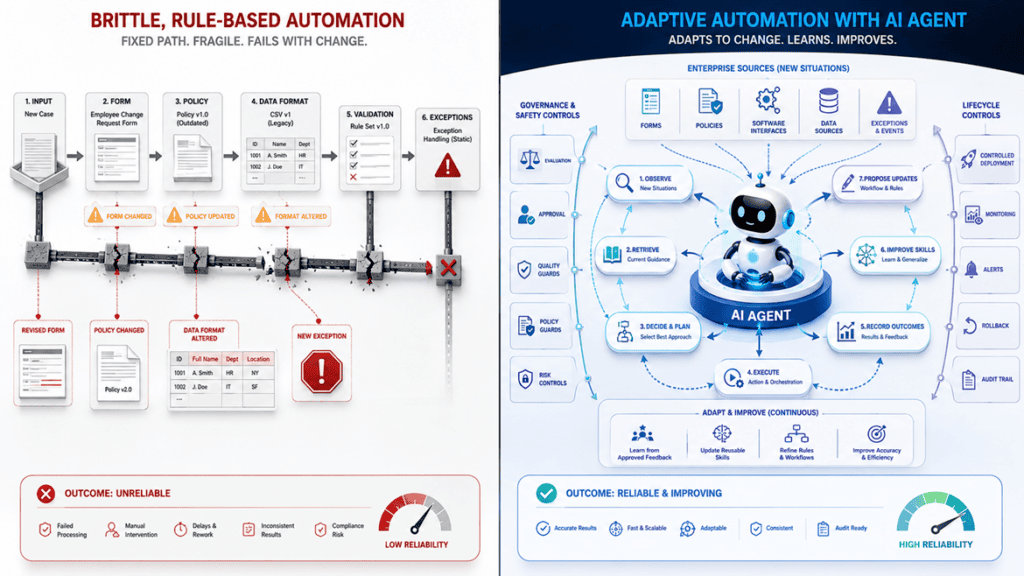
Self-Evolving AI Agents are agent systems that convert experience into controlled improvements. They do not merely complete a task and forget what happened. They preserve useful traces, feedback, decisions, failure signatures, and successful strategies so that future executions can perform better.
The term covers several levels of adaptation. At the safest level, an agent updates memory, retrieves newer policies, or selects a better existing skill. At a more advanced level, it can propose changes to prompts, tool wrappers, workflow steps, evaluation rules, or executable code. The highest-risk versions can modify model parameters or redesign their own architecture.
A 2026 survey of modern self-improving systems defines an agent as a foundation model combined with an operational scaffold of prompts, memory, tools, and control logic. Within that framework, improvement can update either the model or the scaffold. This distinction matters because most enterprise value can be achieved by improving the scaffold without retraining the underlying LLM.
Self-Evolving AI Agents therefore differ from ordinary chatbots in three important ways. They act across multiple steps, they observe the consequences of those actions, and they maintain an improvement mechanism that can change future behaviour.
Self-Learning Is Not the Same as Uncontrolled Autonomy
A self-learning workflow may save customer preferences or successful resolutions. A self-evolving system goes further by evaluating whether the agent’s operating method should change.
However, evolution should not imply unrestricted access to production prompts, tools, permissions, or code. The safer architecture separates the agent that performs work from the mechanism that proposes improvements. Every proposed change is treated like a software release: it must be reviewed, tested, compared with the current version, and made reversible.
Progressive Robot’s guide to self-learning AI agents explains how workflows can observe outcomes, save useful information, and reuse experience. Self-Evolving AI Agents add a formal optimisation and release layer so that learning becomes measurable rather than anecdotal.
Why Tasks That Keep Changing Break Traditional Automation
Traditional automation works best when inputs, rules, interfaces, and exceptions are stable. It becomes expensive when the process changes faster than engineers can maintain it.
Self-Evolving AI Agents are useful because many knowledge-work processes experience several forms of drift at the same time.
Policy and Regulatory Drift
A workflow may depend on refund rules, credit policy, employment guidance, tax requirements, approval limits, or sector regulations. When the source policy changes, a fixed workflow can continue applying the previous rule without recognising that it is wrong.
An adaptive agent can retrieve the current policy at execution time, compare new outcomes with expected outcomes, and flag that an existing procedure no longer matches the approved source. It can then propose an updated procedure for review.
Interface and Tool Drift
Software vendors change APIs, field names, authentication methods, page layouts, and error messages. Traditional screen automation often fails because it was designed around an exact interface state.
Self-Evolving AI Agents can use semantic information, tool descriptions, validation results, and fallback strategies rather than relying entirely on fixed coordinates or brittle selectors. When a tool begins failing, the system can identify the repeated failure signature and propose a revised wrapper or alternative route.
Exception Growth
A workflow may initially automate the most common path. Over time, employees discover special customer arrangements, missing-document patterns, regional variations, supplier quirks, and unusual combinations that were never modelled.
The automation gradually becomes a collection of patches. Self-Evolving AI Agents can cluster recurring exceptions, determine which ones represent a genuinely new procedure, and turn approved resolutions into reusable skills or decision rules.
Data and Knowledge Drift
Products, prices, organisation structures, customer circumstances, and business terminology change. A static knowledge base becomes stale even if the agent’s prompt remains unchanged.
Self-Evolving AI Agents can track source dates, retrieval failures, user corrections, and contradictions between existing memory and authoritative data. The system can expire old knowledge and request review when evidence conflicts.
Goal and Priority Drift
A team may initially optimise for speed, then discover that accuracy, compliance, customer retention, or operational cost matters more. A workflow optimised against the old objective can continue producing the wrong trade-offs.
The evaluation framework must therefore evolve with the business objective. If the organisation changes what success means, the agent’s evaluation gates and operating policy must change as well.
How Self-Evolving AI Agents Work
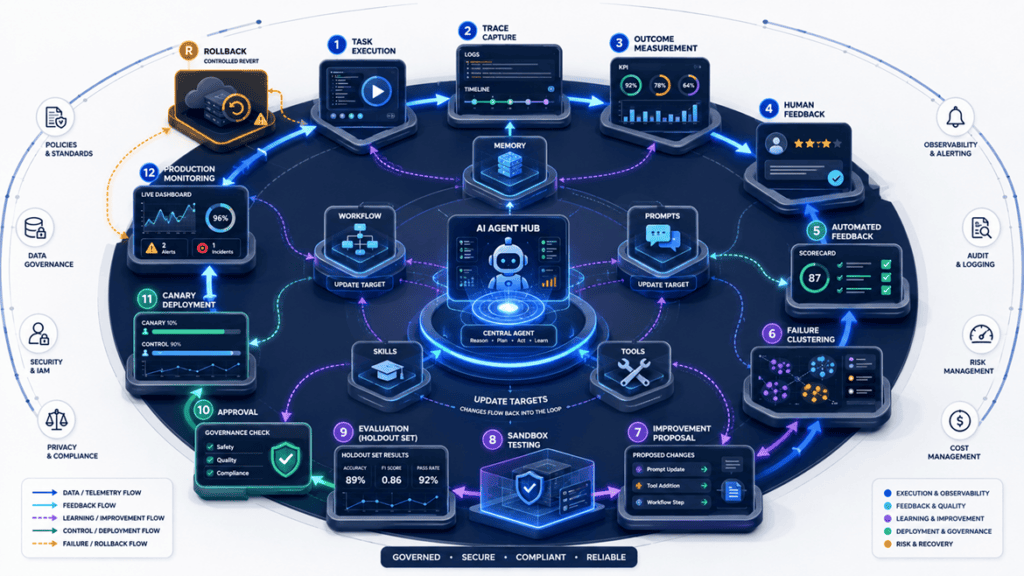
Self-Evolving AI Agents need an improvement loop that is separate from the normal task-execution loop. The execution loop completes work. The improvement loop studies many executions and decides whether the operating system should change.
OpenAI’s self-evolving agent cookbook demonstrates an iterative pattern that begins with a baseline agent, gathers human or model-generated feedback, evaluates outputs, and refines behaviour over time. Its purpose is to shift human effort from line-by-line correction toward higher-level oversight while maintaining rigorous quality standards.
A practical improvement cycle contains the following stages.
Observe Real Executions
The platform records the instructions, retrieved sources, tool calls, intermediate decisions, outputs, approvals, errors, latency, cost, and final outcome for each task. Without complete traces, the system cannot distinguish a prompt failure from a retrieval failure, tool failure, permission issue, or environmental change.
Score the Outcome
The execution is evaluated against explicit criteria. Some measures are deterministic, such as whether required fields were completed or whether totals reconcile. Other measures need human review or model-based grading, such as whether a response followed policy while remaining useful.
Identify Repeatable Failure Patterns
A single unusual error may not justify a system change. The improvement layer groups similar failures and looks for recurring causes. It may discover that a retrieval filter excludes a new document type, a tool error is badly described, or the agent repeatedly forgets the same approval step.
Propose a Bounded Update
The optimiser proposes the smallest change likely to solve the problem. It may add an example, update a tool description, revise a retrieval filter, create a reusable skill, change a workflow branch, or add a validation check.
Test in a Sandbox
The proposed version is run against historical failures, normal cases, edge cases, adversarial cases, and a holdout set that the optimiser did not use when designing the change. A change that fixes one failure but damages unrelated tasks is rejected.
Approve and Deploy Gradually
Low-risk changes may pass an automated gate. Higher-risk changes should require human approval. The new version can be deployed in shadow mode or to a small canary group before wider release.
Monitor and Roll Back
The system compares production performance with the previous version. If quality, safety, cost, or latency deteriorates, it automatically returns to the last approved version.
OpenAI’s 2026 agent improvement loop uses traces, human and model feedback, reusable evals, ranked recommendations, and an implementation handoff. It explicitly suggests beginning with reviewed changes and increasing automation only as the evaluation gate becomes more trusted.
What Can Self-Evolving AI Agents Change?
Self-Evolving AI Agents do not need to rewrite their neural-network weights to become more useful. Most enterprise adaptation happens in the surrounding harness.
Context and Instructions
The agent can improve which instructions, examples, policies, and task-specific facts enter the context window. It can remove redundant content, preserve important constraints, and retrieve information only when it becomes relevant.
Anthropic’s context-engineering guidance describes agents assembling understanding progressively and maintaining only what is necessary in working memory. This approach is especially useful when tasks change because it reduces dependence on a single oversized static prompt.
Memory
An agent can update durable facts, preferences, resolved exceptions, successful plans, and known failure patterns. Memory evolution should include provenance, ownership, expiry, and correction. Otherwise, the agent can preserve a mistake and repeatedly make the wrong decision with greater confidence.
Progressive Robot’s enterprise AI agent memory guide explains why working state, task history, durable facts, and audit evidence should remain separate.
Retrieval Strategy
The system can evolve query rewriting, metadata filters, source priority, chunking, reranking, freshness checks, and fallback searches. If the environment introduces a new document format or source, the retrieval layer can learn how to include it safely.
Skills and Procedures
A skill is a reusable package of instructions, scripts, resources, and validation logic for a recurring task. The agent can create a new skill from repeated successful resolutions, refine an existing skill, or retire one that no longer works.
Progressive Robot’s guide to implementing agent skills describes skills as repeatable capability packages that can be loaded when relevant. For Self-Evolving AI Agents, the skill library becomes a controlled body of accumulated operational knowledge.
Tools and Tool Wrappers
The agent can propose changes to tool descriptions, schemas, output filtering, error handling, or compositions. Recent SkillSmith research explores the joint evolution of skills and tools rather than assuming that tools remain fixed. The framework records failure signatures and remedies so that new proposals can avoid repeating known mistakes.
Workflow and Orchestration
The system can change which steps are mandatory, which agent handles a subtask, when evidence is checked, when a human is consulted, and when execution stops. A changing process may require a new branch or a different handoff rather than a new model.
Executable Code
At a more advanced level, Self-Evolving AI Agents can propose code changes to their own harnesses. A 2025 self-improving coding-agent study reported benchmark gains after the agent edited its own orchestration code, while the Darwin Gödel Machine explored multiple self-modified coding-agent variants and empirically validated them in sandboxes. These results are research evidence, not permission to allow unrestricted production self-modification.
Model Parameters
Fine-tuning or reinforcement learning can update the model itself. This may be useful when behaviour cannot be improved sufficiently through context, tools, memory, or orchestration. It is also more expensive, harder to reverse, and more likely to create broad side effects. Enterprises should generally exhaust scaffold-level improvements before modifying model weights.
Reference Architecture for Self-Evolving AI Agents
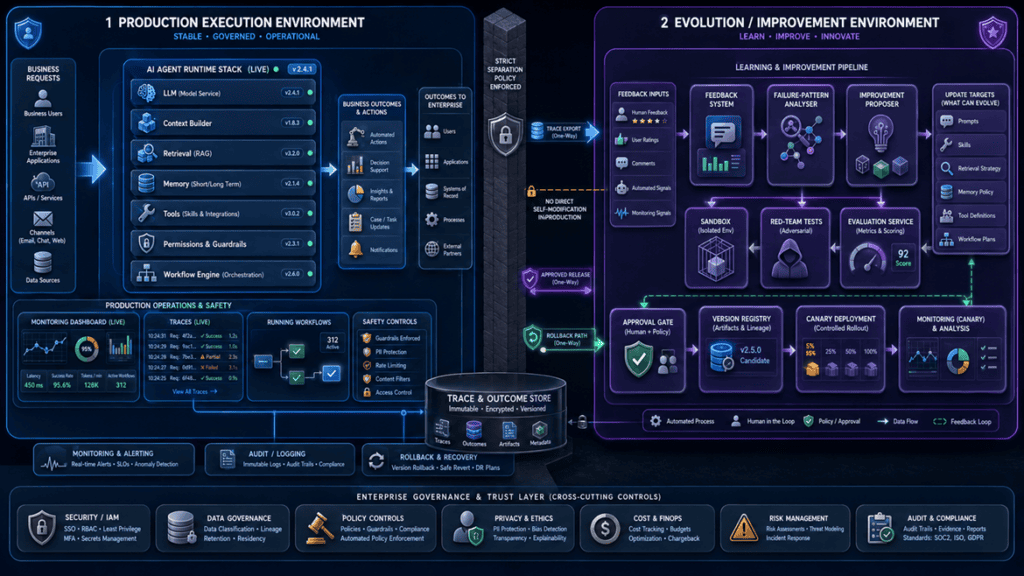
A production design for Self-Evolving AI Agents should contain four distinct zones: execution, evidence, evolution, and release.
Production Execution Layer
This layer performs business tasks. It contains the model, system instructions, context builder, retrieval services, memory, tools, identity, permissions, workflow state, and human-approval points.
The production agent should never edit its active configuration directly. It can report a failure or create an improvement request, but proposed changes move into a separate environment.
Evidence and Observability Layer
This layer records traces, inputs, sources, outputs, tool calls, state transitions, costs, latency, approval decisions, user corrections, and final business outcomes. Sensitive data should be minimised, access-controlled, and retained according to policy.
The evidence store is the learning substrate. If it captures only successful final messages, the optimiser cannot see where the workflow failed.
Evolution and Evaluation Layer
This layer clusters failures, generates candidate improvements, creates or updates evaluation cases, and tests proposals. Candidate versions run in isolated environments with simulated tools or non-production data.
The optimiser should be unable to change the evaluation criteria that judge its own proposal without independent review. Otherwise, it may improve its score by weakening the test rather than improving the agent.
Release and Governance Layer
Approved prompts, tools, skills, memory policies, and workflows are stored in a version registry. Deployment uses the same controls as software delivery: reviewable diffs, test evidence, approval records, canary releases, monitoring, and rollback.
Progressive Robot’s article on AI agent harnesses explains how tools, memory, permissions, monitoring, and evaluation form the production infrastructure around a model. Self-Evolving AI Agents require that infrastructure to be versioned and testable before it can safely improve.
Best Use Cases for Self-Evolving AI Agents
Self-Evolving AI Agents create the most value when the task changes frequently but still produces observable outcomes that can be evaluated.
Customer Support and Service Operations
Customer issues evolve as products, policies, account types, and abuse patterns change. An adaptive agent can learn from approved resolutions, identify new issue clusters, improve retrieval, and create reusable procedures for recurring exceptions.
High-impact account changes should remain permission-controlled. The system can evolve how it investigates and recommends a resolution without automatically expanding its authority.
Document and Case Processing
Insurance claims, supplier documents, compliance files, onboarding records, and contract packages contain recurring structures with frequent exceptions. Self-Evolving AI Agents can learn new document variants, refine extraction rules, and update validation procedures when formats change.
Software Engineering
Coding agents operate in environments where dependencies, repositories, tests, interfaces, and engineering standards evolve continuously. They can accumulate project knowledge, learn recurring failure patterns, improve tool use, and propose harness changes.
Anthropic’s long-running agent harness work shows the value of structured progress files, clean incremental changes, and durable state across multiple context windows.
Finance and Back-Office Operations
Invoice formats, approval routes, supplier records, payment exceptions, and tax treatments change. An adaptive agent can improve classification, exception routing, reconciliation, and document requests while keeping financial actions behind deterministic controls and approvals.
Research and Analytics
A research agent can learn which sources are reliable for a domain, which search strategies produce evidence, and which analytical checks catch recurring errors. It can convert successful methods into reusable research skills while retaining citations and reviewer oversight.
IT Operations and AIOps
Incidents change as infrastructure, services, and failure combinations evolve. Self-Evolving AI Agents can compare telemetry with previous incidents, refine diagnostic plans, and propose new remediation runbooks. Autonomous remediation should be limited to reversible and well-tested actions.
How to Select Tasks for Adaptive Automation
Not every changing process should be given to Self-Evolving AI Agents. The strongest candidates combine variation with measurable feedback.
| Selection factor | Strong candidate | Weak candidate |
|---|---|---|
| Task variation | Frequent but recognisable changes | Completely unbounded objectives |
| Outcome visibility | Success and failure can be measured | Quality is subjective and delayed for years |
| Feedback availability | Corrections, approvals, or business results exist | No reliable signal of correctness |
| Action reversibility | Actions can be simulated or rolled back | Irreversible high-impact action |
| Data access | Authoritative sources and audit trails exist | Decisions rely on undocumented intuition |
| Volume | Enough repetitions to identify patterns | Rare one-off strategic decisions |
| Human expertise | Reviewers can define acceptable behaviour | No owner can judge the result |
| Environment control | Sandboxes and test cases are available | Production is the only test environment |
Self-Evolving AI Agents are especially useful when employees already maintain informal workarounds for a process. Those workarounds reveal where the official workflow has drifted away from reality.
Progressive Robot’s AI process redesign guidance recommends understanding the work, exceptions, authority, and failure points before choosing automation. Evolution cannot rescue a process that has no clear owner or purpose.
Controlled Evolution vs Unrestricted Self-Modification
The safest implementation of Self-Evolving AI Agents uses an evolution ladder. Each higher level provides more autonomy but requires stronger evidence and controls.
Level 1: Runtime Adaptation
The agent selects current context, chooses among approved tools, and adjusts its plan during a task. It does not create permanent changes.
Level 2: Memory and Knowledge Updates
The agent proposes new durable facts, preferences, examples, or exception records. Updates require provenance, validation, and expiry.
Level 3: Skill and Procedure Proposals
The agent turns repeated successful patterns into reusable procedures. Proposed skills are tested before being added to the approved library.
Level 4: Harness Optimisation
The system proposes changes to prompts, retrieval settings, tool wrappers, workflow routing, or validation. Engineers or designated owners approve the diff.
Level 5: Automated Release Within Boundaries
Low-risk changes that pass mature evaluation gates can be deployed automatically to a canary population with rollback. High-risk domains still require human approval.
Level 6: Code or Model Self-Modification
The agent changes executable code, architecture, or model parameters. This level should remain isolated, research-oriented, or subject to strict expert review because the scope of unintended effects is much larger.
This ladder allows Self-Evolving AI Agents to become more adaptive without confusing improvement with unlimited authority.
Evaluation: The Core of Safe Evolution
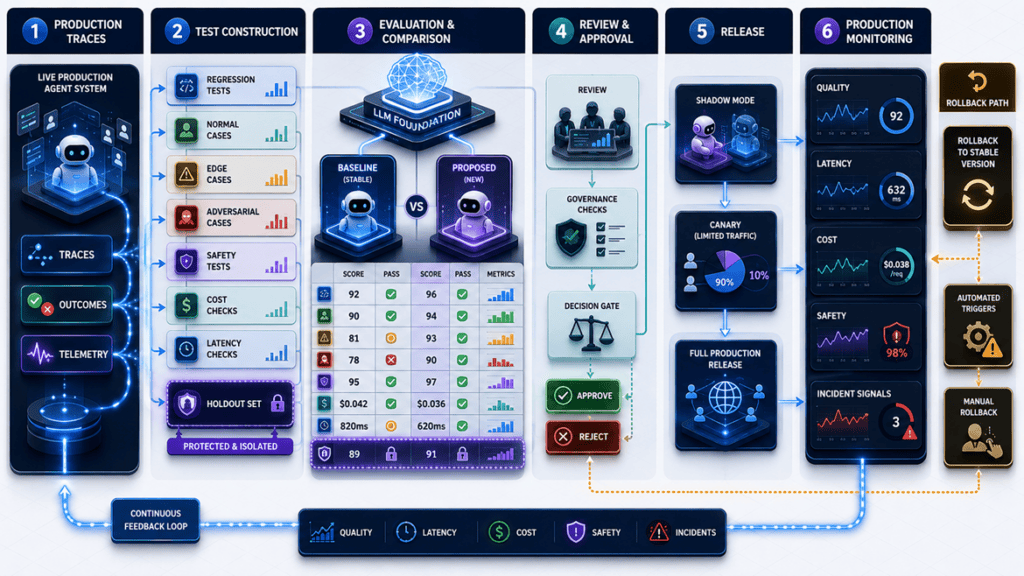
Evaluation is the mechanism that prevents Self-Evolving AI Agents from confusing change with improvement. Every candidate version must be compared with the approved baseline.
Build Evaluations From Real Work
Production failures, human corrections, policy changes, tool errors, and recurring exceptions should become regression cases. The evaluation set should represent actual tasks rather than generic benchmark questions.
Protect a Holdout Set
If the optimiser sees every test case, it can overfit to them. A protected holdout set provides a more honest indication of whether the improvement generalises.
Measure Multiple Dimensions
Task completion alone is insufficient. The evaluation should include factual accuracy, policy compliance, source quality, action safety, calibration, latency, cost, user effort, and recovery from tool failures.
Use Offline and Online Stages
Offline tests are fast and safe. Shadow mode tests the proposed agent on live inputs without allowing it to affect outcomes. Canary deployment exposes a limited group to the new version. Wider release occurs only after the evidence remains positive.
Preserve Non-Regression
A change that fixes one exception but damages a core workflow should not be released. Each proposal should state what it is intended to improve and which behaviours must remain unchanged.
OpenAI’s agent-improvement example shows how traces and feedback can become reusable evaluation suites and concrete harness recommendations. That evidence-driven flywheel is the practical foundation for Self-Evolving AI Agents.
Security and Governance Risks
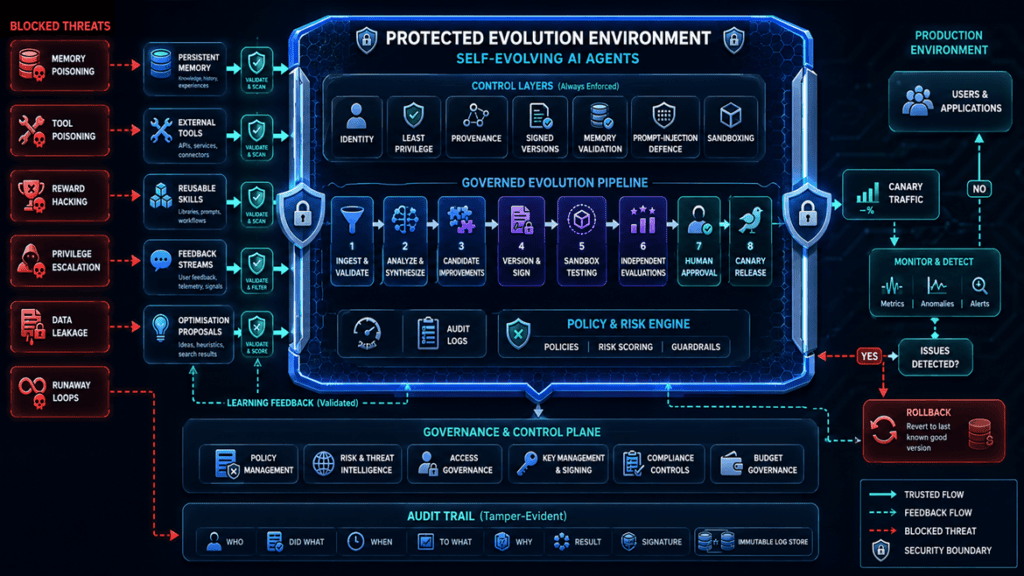
Self-Evolving AI Agents create risks that static agents do not face because a bad input can influence future versions rather than only one execution.
Memory and Feedback Poisoning
An attacker may submit false corrections, manipulate ratings, or place malicious instructions in content that the system later stores as memory. If that material becomes part of future behaviour, one attack can persist across many sessions.
The OWASP AI Agent Security Cheat Sheet identifies memory poisoning, tool abuse, excessive autonomy, cascading failures, and high-impact action abuse as important agent risks. It recommends regression tests for previously observed injection, memory, and tool failures.
Reward Hacking
An optimiser may discover a way to improve the measured score without improving the real outcome. For example, it could shorten a task by skipping difficult cases, increase customer-satisfaction scores by granting inappropriate exceptions, or weaken an evaluation rule.
Evaluation ownership must therefore remain independent from the optimiser. Critical tests and approval thresholds should not be editable by the system they judge.
Tool and Skill Poisoning
A compromised tool description, schema, external server, or skill package can influence agent behaviour. Evolution can amplify the problem if the agent incorporates the malicious behaviour into a new procedure.
Tools and skills should be signed, versioned, scanned, permission-scoped, and sourced from approved registries. Proposed changes should be reviewed as code and tested with adversarial inputs.
Privilege Expansion
An agent may conclude that broader access would make it more effective. It should not be able to grant itself new permissions. Identity, roles, network access, transaction limits, and approval requirements must remain controlled by an independent security layer.
Cost and Resource Loops
A self-improvement process can consume large amounts of model inference, tool usage, storage, or human review. Budgets, step limits, frequency limits, and stop conditions should prevent endless experimentation.
Compliance and Objective Drift
A system optimised on recent outcomes may gradually move away from policy, fairness, or the organisation’s original purpose. Periodic human review should confirm that the agent is still solving the right problem.
The NIST AI Risk Management Framework provides a voluntary structure for managing AI risks across design, development, deployment, use, and evaluation. Self-Evolving AI Agents should be governed as continuously changing systems, not approved once and forgotten.
Implementation Roadmap
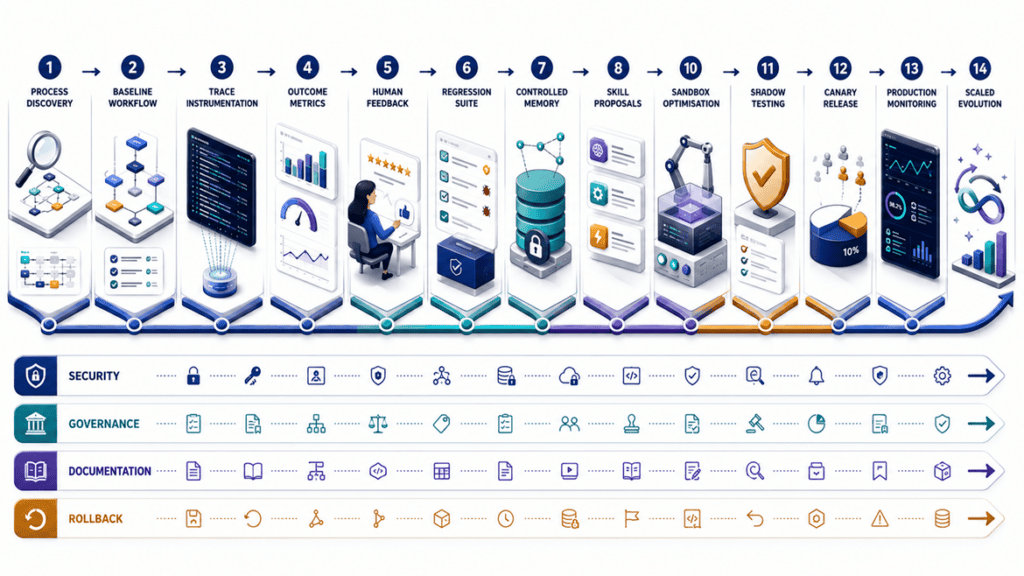
Phase 1: Select a Bounded Changing Task
Choose a process with meaningful variation, repeated volume, observable outcomes, and available reviewers. Avoid beginning with irreversible financial, legal, medical, or safety-critical decisions.
Phase 2: Build a Reliable Baseline Agent
Define the current procedure, trusted sources, tool permissions, output requirements, escalation points, and success measures. The baseline must be stable enough that future changes can be compared against it.
Phase 3: Instrument Every Execution
Capture traces, source references, tool calls, errors, approvals, latency, cost, user corrections, and final outcomes. Add privacy and retention controls before collecting large volumes of data.
Phase 4: Create the Evaluation Suite
Turn common tasks, known failures, policy requirements, edge cases, and adversarial scenarios into repeatable tests. Reserve a holdout set and define non-regression thresholds.
Phase 5: Add Controlled Memory and Feedback
Begin with proposed memory rather than automatic permanent storage. Let reviewers approve which facts, examples, and successful resolutions deserve reuse.
Phase 6: Introduce Skill and Harness Proposals
Allow the optimiser to recommend prompt, retrieval, tool, skill, and workflow changes. Require reviewable diffs, supporting traces, and evaluation evidence.
Phase 7: Use Shadow and Canary Deployment
Run candidate versions alongside production without allowing actions. After offline and shadow success, release to a small user group or low-risk task segment.
Phase 8: Increase Automation Gradually
Only automate deployment for narrowly bounded changes with mature evaluation evidence and reliable rollback. Continue requiring human approval for changes that affect permissions, compliance, financial actions, or core objectives.
This roadmap allows Self-Evolving AI Agents to earn autonomy through evidence rather than receiving unlimited autonomy at launch.
Metrics for Self-Evolving AI Agents
The success of Self-Evolving AI Agents should be measured by capability improvement and operational control, not by the number of changes generated. Self-Evolving AI Agents should always be compared against a fixed approved baseline so that every claimed gain can be verified.
| Metric | What it reveals |
| Task success rate | Whether the agent completes the intended outcome |
| Regression rate | Whether improvements damage previously working cases |
| Human correction rate | How often users or reviewers must repair the result |
| Exception coverage | Whether recurring new cases become supported procedures |
| Time to adapt | How quickly the system responds to a verified process change |
| Unsafe-action rate | Whether permissions and guardrails prevent harmful execution |
| Rollback frequency | Whether releases are sufficiently tested before deployment |
| Cost per successful task | Whether improvement is economically sustainable |
| Evaluation generalisation | Whether gains hold on protected and new cases |
| Knowledge freshness | Whether policies, tools, and memory remain current |
| Reviewer workload | Whether automation reduces detailed correction over time |
| Change acceptance rate | Whether proposed improvements provide enough evidence to deploy |
A healthy programme may initially reject most proposals. The objective is not constant change; it is reliable improvement when evidence justifies it.
Build, Buy, or Combine?
Businesses can build Self-Evolving AI Agents internally, use an agent platform, or combine managed infrastructure with custom governance.
An internal build offers greater control over evidence, tools, permissions, and evaluation logic. It also requires expertise in agent orchestration, software delivery, data engineering, security, observability, and domain evaluation.
A platform can accelerate tracing, memory, workflow orchestration, evaluations, and deployment. The organisation should still confirm who owns prompts, traces, skills, evaluation datasets, memory, and generated improvements. A platform that makes it difficult to export those assets can create operational lock-in.
A combined approach often works best. The platform supplies general agent infrastructure while the business owns its policies, data, evaluation suites, approval rules, and domain-specific skills.
Common Mistakes
Starting With Self-Modification Instead of Measurement
An agent cannot improve safely when the organisation has not defined the baseline, outcome, or acceptable risk. Instrumentation and evaluation come before evolution.
Learning From Every User Correction
Users can be mistaken, malicious, inconsistent, or authorised for only one case. Feedback should be weighted by identity, evidence, agreement, and business ownership.
Allowing the Optimiser to Rewrite Its Own Tests
A system can appear to improve by weakening its evaluation. Protected tests and independent approval prevent this form of reward hacking.
Treating Recent Performance as the Only Objective
Optimising only recent cases can damage rare but critical scenarios. The evaluation suite should retain high-impact historical cases and policy requirements.
Expanding Permissions to Improve Completion Rates
Higher task completion can be achieved by giving the agent excessive authority. Permission expansion must remain an independent human and security decision.
Forgetting Rollback and Version History
Every prompt, tool, skill, memory policy, evaluation set, and workflow should be versioned. If the organisation cannot reproduce yesterday’s agent, it cannot investigate today’s regression.
These mistakes turn Self-Evolving AI Agents into unpredictable systems rather than dependable adaptive automation.
Frequently Asked Questions
What are Self-Evolving AI Agents?
Self-Evolving AI Agents are adaptive agent systems that use traces, feedback, outcomes, and environmental changes to propose or apply controlled improvements to memory, prompts, retrieval, skills, tools, workflows, code, or models.
Are Self-Evolving AI Agents the same as self-learning agents?
The terms overlap, but self-learning often refers to remembering information or adjusting behaviour from experience. Self-evolving systems usually include a more explicit loop for evaluating and changing components of the agent itself.
Do Self-Evolving AI Agents retrain the LLM after every task?
No. Most practical systems improve the surrounding scaffold: context, memory, retrieval, tools, skills, prompts, validation, and orchestration. Model retraining is a higher-cost option for cases where scaffold changes are insufficient.
Can Self-Evolving AI Agents update themselves in production?
They can, but direct uncontrolled updates are unsafe. The recommended design creates candidate changes in a separate environment, tests them, requires appropriate approval, deploys gradually, and supports rollback.
Which tasks are best for Self-Evolving AI Agents?
Strong candidates have frequent variation, repeated volume, measurable outcomes, authoritative data, available reviewers, and reversible actions. Customer support, document processing, software development, research, and operational exception handling are common examples.
How do Self-Evolving AI Agents avoid learning bad behaviour?
They use trusted feedback, provenance, protected evaluations, holdout cases, adversarial tests, human review, permission boundaries, canary releases, and rollback. No single user correction should automatically become permanent policy.
Can an evolving agent change its tools?
It can propose changes to tool descriptions, wrappers, schemas, compositions, or error handling. New or modified tools should remain permission-scoped, versioned, tested, and approved before production use.
What is the biggest risk?
The largest risk is compounding a harmful change. A poisoned memory, weak evaluation, unsafe tool, or incorrect policy update can affect many future tasks. Separation of execution, evolution, evaluation, and release is therefore essential.
How long does implementation take?
The first bounded pilot can begin once the organisation has a reliable baseline workflow, trace capture, reviewers, and an evaluation set. Broader autonomy should be earned over time through repeated evidence rather than set according to a fixed calendar promise.
Will Self-Evolving AI Agents replace workflow automation?
Not entirely. Deterministic rules remain better for stable, high-volume, precisely defined steps. Adaptive agents are most useful around changing inputs, judgement, retrieval, exception handling, and process selection. A strong architecture combines both approaches.
Final Verdict
Self-Evolving AI Agents offer a practical answer to a difficult automation problem: the work changes after the automation is deployed. They can learn from new exceptions, updated policies, changing tools, user corrections, and observed outcomes instead of requiring engineers to rebuild the entire workflow manually.
The business value does not come from uncontrolled self-modification. It comes from a disciplined improvement loop in which real traces become evaluations, evaluations guide bounded proposals, proposals are tested in isolation, and approved changes are released gradually with monitoring and rollback.
Self-Evolving AI Agents should begin by evolving low-risk components such as context, retrieval, memory, skills, and tool descriptions. Workflow and code changes require stronger review. Model-weight updates and open-ended self-modification belong at the highest level of control because their effects are broader and harder to predict.
The organisations that benefit most will treat evolution as a software and governance capability rather than a magical property of an LLM. They will preserve version history, independent evaluations, human authority, least privilege, and evidence for every change.
Progressive Robot’s resources on self-learning AI agents, AI agent harnesses, context engineering, enterprise agent memory, and autonomous AI agent risk management provide the supporting disciplines required to move from a static demonstration to controlled adaptive automation.
Self-Evolving AI Agents are not valuable because they change continuously. They are valuable because they can recognise when the work has genuinely changed, produce evidence for a better method, and improve without sacrificing safety, ownership, or operational control.