

Data Engineering and Analytics as a Service gives businesses ongoing access to the people, processes, and technology required to turn fragmented operational data into reliable reporting, forecasting, and decision support. Instead of hiring every data engineer, analytics engineer, platform specialist, and business intelligence developer internally, an organisation can use a managed service that builds and operates the data foundation as a continuing business capability.
The model addresses a common problem. Companies often invest in dashboards before they have dependable pipelines, shared metric definitions, data-quality controls, or clear ownership. Reports then disagree, refreshes fail, analysts spend hours repairing spreadsheets, and leaders stop trusting the numbers. Data Engineering and Analytics as a Service is designed to solve the complete operating problem rather than deliver another isolated visualisation.
A capable service connects source systems, designs the target architecture, engineers batch and streaming pipelines, models business data, implements governance, builds analytics products, monitors reliability, and improves the platform as requirements change. The result should be a data system that remains useful after the first dashboard is launched.
This guide explains how Data Engineering and Analytics as a Service works, what it includes, how it differs from project consulting or staff augmentation, which architecture patterns are appropriate, how costs should be assessed, and how to select a provider that can deliver measurable business value.
What Data Engineering and Analytics as a Service Means
Data Engineering and Analytics as a Service is a managed delivery model in which an external multidisciplinary team takes responsibility for defined data-platform and analytics outcomes. The service may begin with discovery and architecture, but it continues through implementation, monitoring, incident response, optimisation, analytics delivery, and roadmap development.
Data Engineering Creates the Reliable Foundation
At its core, Data Engineering and Analytics as a Service replaces fragile manual movement with tested, monitored, and repeatable data flows.
Data engineering connects applications, databases, files, devices, and external platforms. Engineers build ingestion processes, transformation logic, storage layers, orchestration, testing, observability, and deployment automation.
A modern analytics pipeline generally collects data, stores it, processes it, and makes it available for analysis or visualisation. AWS describes these as common stages in an analytics architecture, while Azure documents layered ingestion, transformation, and consumption patterns for data-lake and lakehouse designs. AWS analytics architecture and Azure data-lake architecture provide official examples of these patterns.
Without this engineering layer, business intelligence remains dependent on manual exports, fragile scripts, and direct queries against operational systems.
Analytics Engineering Defines Business Meaning
Analytics engineering transforms technically clean data into reusable business models. It establishes dimensions, measures, relationships, time logic, naming standards, and tested transformations that analysts and dashboards can trust.
This is where terms such as revenue, active customer, gross margin, qualified lead, delivery performance, and churn receive controlled definitions. Data Engineering and Analytics as a Service should make those definitions visible, versioned, and owned rather than burying them inside individual reports.
Business Intelligence Turns Data Into Decisions
Effective Data Engineering and Analytics as a Service connects every dashboard to a trusted model and a clearly defined business decision.
The service also creates dashboards, scorecards, scheduled reports, alerts, and self-service datasets. These products should be organised around business decisions rather than around whichever columns happen to exist in a source system.
Progressive Robot’s Data Analytics service follows this outcome-led approach by connecting business questions, trusted data, governance controls, and operational decisions.
Platform Operations Keep the System Working
A data platform is not finished at go-live. Source schemas change, APIs expire, volumes grow, costs drift, dashboards require new logic, and data-quality incidents occur.
A genuine Data Engineering and Analytics as a Service engagement therefore includes monitoring, incident handling, pipeline recovery, performance tuning, cost management, access reviews, documentation, and continuous improvement.
Why Businesses Choose Data Engineering and Analytics as a Service
For organisations with fragmented systems and limited specialist capacity, Data Engineering and Analytics as a Service creates a structured route from data problems to measurable outcomes.
The Required Skills Are Broader Than One Role
A reliable analytics capability may require data architecture, cloud infrastructure, data engineering, analytics engineering, business intelligence, security, governance, DevOps, and domain analysis. One employee rarely covers all of these disciplines at production level.
Data Engineering and Analytics as a Service gives the business access to a blended team without requiring a full internal department from the beginning.
Demand Is Often Uneven
Data programmes rarely need the same skill mix every month. Architecture and migration may dominate early work, while operational support, dashboard development, optimisation, or predictive analytics may matter later.
A managed service can change the allocation of specialists without forcing the company to recruit permanent roles for every temporary phase.
Existing Teams Need Operational Relief
Many internal analysts spend most of their time repairing feeds, reconciling reports, and answering recurring data questions. This leaves little capacity for forecasting, experimentation, or decision support.
Data Engineering and Analytics as a Service can take responsibility for platform reliability while internal analysts focus on interpretation, stakeholder relationships, and business improvement.
Cloud Platforms Create Capability and Complexity
AWS, Azure, Google Cloud, Microsoft Fabric, Databricks, and other platforms provide powerful managed services. They also introduce choices around storage, compute, orchestration, networking, governance, identity, observability, and cost.
Google describes BigQuery as a fully managed serverless analytics warehouse with separate storage and compute layers, while Microsoft Fabric lakehouse architecture supports ingestion, transformation, storage, and analytics within a unified SaaS environment.
The service model helps organisations use these capabilities without turning every platform decision into a separate recruitment exercise.
What the Service Should Include
The scope of Data Engineering and Analytics as a Service should cover the complete data lifecycle rather than isolated dashboard production.

Strategy and Use-Case Prioritisation
The provider should begin by identifying which decisions, processes, and risks require better data. A useful roadmap prioritises business value, data readiness, delivery difficulty, and control requirements.
The output should not be a generic cloud diagram. It should identify the first data products, expected users, success measures, source systems, owners, and delivery sequence.
Source-System Assessment
The team examines databases, ERP, CRM, finance platforms, ecommerce systems, web analytics, support tools, spreadsheets, files, third-party APIs, and event streams.
The assessment should document ownership, extraction method, volume, latency, data sensitivity, known quality problems, retention, and change risk.
Architecture and Platform Design
Data Engineering and Analytics as a Service should select architecture according to workload rather than fashion. The target may be a warehouse, data lake, lakehouse, or a combination of these patterns.
AWS describes lakehouses as combining data-lake flexibility with warehouse analytics, while Azure Databricks describes a lakehouse as supporting BI, data engineering, and machine learning through shared scalable storage and processing. See AWS lakehouse storage guidance and Azure Databricks lakehouse documentation.
The design should cover environments, networking, identity, encryption, storage formats, compute, orchestration, cataloguing, lineage, disaster recovery, and cost controls.
Data Ingestion and Integration
The team builds reliable connectors for batch files, databases, SaaS applications, APIs, change-data capture, and real-time events.
Each pipeline needs defined ownership, retry behaviour, schema-change handling, freshness expectations, and reconciliation against the source. Reliable ingestion matters more than the number of available connectors.
Transformation and Data Modelling
Raw data is cleaned, standardised, joined, enriched, and shaped into reusable models. Transformation should be version-controlled, tested, documented, and promoted through environments using software-engineering practices.
Layered or medallion patterns can separate raw, validated, and business-ready data. Databricks and Microsoft both describe medallion architecture as a way to improve data quality progressively through multiple layers. See Databricks medallion architecture and Microsoft medallion architecture.
Data Quality and Observability
Quality controls make Data Engineering and Analytics as a Service dependable enough for finance, operations, customer analysis, and executive reporting.
A mature Data Engineering and Analytics as a Service solution monitors whether pipelines ran, whether data arrived on time, whether volumes changed unexpectedly, whether key fields are valid, and whether business totals reconcile.
Alerts should identify the affected data product, business impact, probable cause, and responsible owner. A green pipeline status is not enough when the records inside the pipeline are wrong.
Governance, Security, and Compliance
The service should establish classification, role-based access, row and column controls, encryption, retention, lineage, audit, and approval processes.
Governance must be practical. Analysts need to know which dataset is approved, what each measure means, who owns it, and whether they are authorised to use it for a particular purpose.
Semantic Models and Metrics
The provider creates reusable models for reporting and analysis. Important metrics receive definitions, grains, owners, calculation rules, permitted filters, and effective dates.
This prevents separate dashboards from producing different answers to the same question.
Dashboards and Decision Products
Dashboards should focus on a limited set of decisions and exceptions. Executive reporting may emphasise performance, risk, and trend. Operational reporting may emphasise queues, alerts, and required actions.
The service should measure whether a dashboard is used and whether it changes a decision. Usage without action can indicate attractive reporting with little operational value.
Advanced and Predictive Analytics
Once the foundation is dependable, the service can add forecasting, segmentation, anomaly detection, optimisation, and machine learning.
Predictive analytics uses historical data with statistical or machine-learning methods to estimate future outcomes. It becomes valuable only when the underlying data, evaluation, and operational workflow are controlled.
Managed Operations and Support
Operational ownership is central to Data Engineering and Analytics as a Service because data reliability must be sustained after the initial delivery.
The provider monitors pipelines, resolves incidents, tunes performance, manages costs, supports users, and plans improvements.
This continuing responsibility is what distinguishes Data Engineering and Analytics as a Service from a dashboard project that ends after acceptance.
Data Engineering and Analytics as a Service vs Other Models
Choosing Data Engineering and Analytics as a Service makes most sense when continuing ownership and operational reliability are as important as the initial build.
| Delivery model | Main responsibility | Best use | Primary limitation |
|---|---|---|---|
| One-time consulting project | Deliver a defined platform or report | Clear transformation with internal support afterward | Knowledge and operations may fall back to the client |
| Staff augmentation | Supply individual specialists | Strong internal leadership with temporary capacity gaps | Client retains coordination and outcome responsibility |
| Managed data service | Deliver and operate agreed data outcomes | Businesses needing a continuing multidisciplinary capability | Requires clear governance and service boundaries |
| Software platform only | Provide technical tools | Mature internal data teams | Tools do not provide operating ownership |
| Fully internal team | Own strategy, delivery, and operations | Large sustained demand and strong hiring capability | Higher fixed cost and slower skill expansion |
The most appropriate model depends on internal capability. Data Engineering and Analytics as a Service is strongest when the business needs continuing outcomes but does not want to build every engineering and operational function itself.
Recommended Data Architecture
The architecture behind Data Engineering and Analytics as a Service should remain scalable, governed, economical, and adaptable to future analytics and AI workloads.
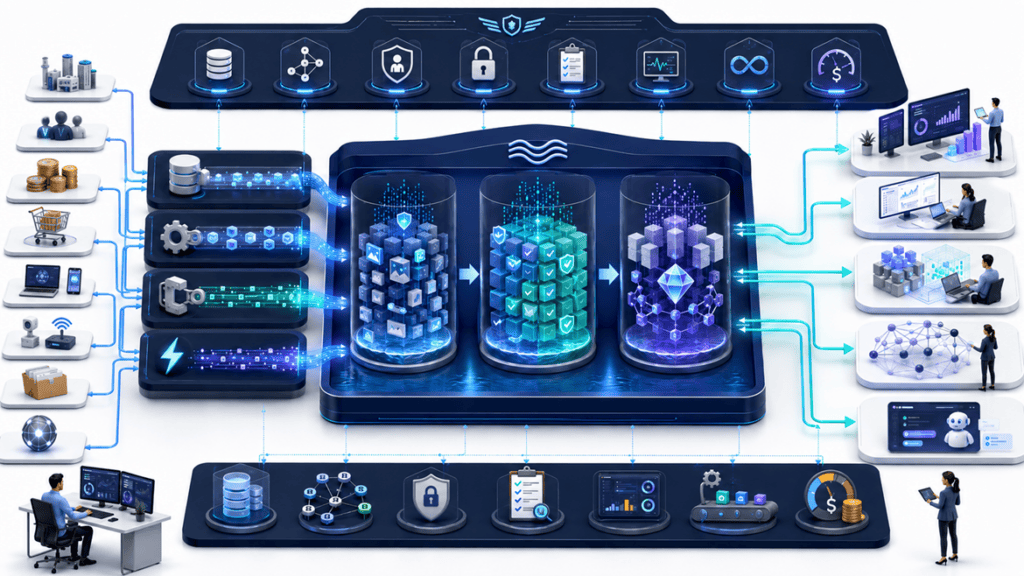
Warehouse-Centred Architecture
A cloud data warehouse is appropriate when most data is structured and the main workload is business intelligence, reporting, and SQL analysis.
The advantage is simplicity and strong query performance. The limitation is that unstructured data, machine learning, and very large raw-data retention may require additional services.
Data-Lake Architecture
A data lake stores large volumes of structured, semi-structured, and unstructured information. It can preserve source data economically and support multiple processing engines.
The platform needs strong cataloguing, quality, and access controls; otherwise, the lake becomes difficult to navigate and trust.
Lakehouse Architecture
A lakehouse combines flexible object storage with table management, governance, and query capabilities traditionally associated with warehouses.
This model can reduce separate data copies and support analytics, engineering, data science, and AI. Databricks states that a lakehouse can help eliminate silos that separate BI, data engineering, and machine learning.
Data-Mesh Operating Model
Data mesh distributes ownership to business domains while maintaining shared platform and governance standards. It can be useful in large organisations where one central team cannot understand every domain.
It should not be used as an excuse to duplicate tools and definitions. Domain autonomy needs common identity, quality, interoperability, and product standards.
Real-Time and Streaming Architecture
Streaming is appropriate when the business must react within seconds or minutes to operational events, fraud, equipment conditions, user behaviour, or logistics changes.
Real-time systems cost more to build and operate than scheduled pipelines. Data Engineering and Analytics as a Service should use streaming only where the decision window justifies the additional complexity.
Cloud Platform Options
A platform-neutral Data Engineering and Analytics as a Service provider should compare cloud options against the client’s existing estate and workload rather than applying one default stack.
Microsoft Azure and Fabric
Azure, Microsoft Fabric, and Azure Databricks provide managed services for ingestion, lakehouse storage, transformation, analytics, governance, and AI. Microsoft Fabric lakehouse scenarios use staged medallion layers and integrate ingestion, transformation, storage, and analytics, which can suit organisations already committed to Microsoft identity, Power BI, Azure, and Microsoft 365.
Progressive Robot’s Cloud Adoption service focuses on governed migration, security, resilience, and measurable value.
AWS, Google Cloud, and Databricks
AWS offers S3, Lake Formation, Glue, Redshift, Athena, streaming, and other purpose-built analytics services. Its data-lake guidance describes secure lake and lakehouse patterns with fine-grained governance.
Google BigQuery provides serverless storage and analytics with SQL, machine learning, notebooks, and AI-assisted engineering.
Databricks reference architectures support engineering, BI, streaming, machine learning, and AI across major cloud platforms.
Platform-Neutral Selection
Platform neutrality protects Data Engineering and Analytics as a Service from becoming a technology-resale exercise. The decision should compare current systems, skills, security, workload, integration, portability, commercial agreements, and long-term cost.
Data Governance and Security
Security and governance are operating requirements for Data Engineering and Analytics as a Service, not documents added after the platform has been built.

Identity, Classification, and Access
Developers, analysts, executives, service accounts, and external parties should receive only the permissions required for their role and purpose. Sensitive personal, financial, health, employee, customer, and commercial data needs clear handling, retention, and processing rules.
Lineage, Audit, and Secure Delivery
Users should be able to trace a metric through the semantic model, transformation logic, and source. Pipeline code and infrastructure should use version control, peer review, automated testing, secrets management, environment separation, and controlled deployment.
Data Engineering and Analytics as a Service should apply software-engineering discipline rather than making undocumented production changes.
Resilience and Recovery
Backups, replication, recovery procedures, and service objectives should reflect business impact. A monthly planning dashboard may tolerate different recovery targets from a fraud, logistics, or customer-service platform.
Data Quality and Trust
Reliable Data Engineering and Analytics as a Service depends on users being able to understand, verify, and challenge the information they receive.
Define and Test Quality
Each data product should define required completeness, accuracy, validity, uniqueness, consistency, and freshness. The service should reconcile key totals against authoritative sources to detect missing records, duplicate ingestion, incorrect joins, and transformation errors.
Expose Incidents and Control Definitions
When data is delayed or unreliable, dashboards should display the status rather than silently showing stale information. Important metric definitions should be reviewed, versioned, owned, and communicated so that separate reports do not interpret the same concept differently.
Analytics Products and Business Value
The purpose of Data Engineering and Analytics as a Service is to improve decisions and operations, not merely to increase the number of reports available.
Executive, Finance, and Customer Analytics
Leadership products can connect strategy, financial performance, customer outcomes, operational risk, and forecasts. Finance models can explain revenue, margin, cash, cost, and variance while retaining reconciliation and controlled definitions.
Customer analytics can combine CRM, marketing, product usage, support, and billing data while respecting consent and identity rules.
Operations, Forecasting, and AI Readiness
Operations products can analyse inventory, suppliers, production, logistics, maintenance, and service. Once the foundation is dependable, the service can support forecasting, anomaly detection, optimisation, and AI-ready data.
Progressive Robot’s AI in Data Analytics guide explains how these capabilities still depend on strong quality and governance.
Service Levels and Performance Measures
The service-level framework for Data Engineering and Analytics as a Service should combine platform performance with data reliability and business usefulness.
| Measure | What it shows |
| Pipeline success rate | Whether scheduled data movement completes reliably |
| Data freshness | Whether users receive data within the agreed decision window |
| Quality-test pass rate | Whether critical fields and rules remain valid |
| Incident resolution time | How quickly the provider restores dependable service |
| Reconciliation accuracy | Whether business totals match authoritative systems |
| Dashboard adoption | Whether intended users rely on the analytics product |
| Time to deliver a data product | How quickly the service responds to new priorities |
| Cloud cost per workload | Whether the platform operates economically |
| User correction rate | Where definitions or transformations remain unclear |
| Business outcome | Whether the service improves the target decision or process |
A service level should measure business reliability, not only technical availability. A pipeline can be online while delivering incomplete data.
Pricing and Commercial Models
Commercial terms for Data Engineering and Analytics as a Service should make provider responsibility, cloud consumption, platform licences, and change capacity easy to distinguish.
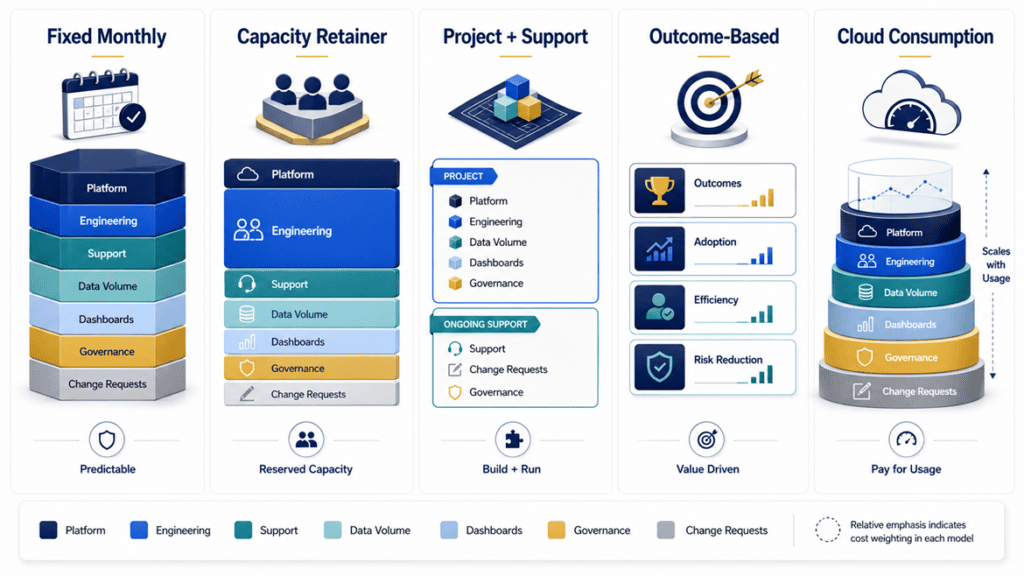
Fixed Service, Capacity, or Project Transition
A fixed monthly service provides predictable cost for stable scope. A capacity retainer provides a flexible blend of engineering and analytics skills. A project-plus-managed model funds the initial transformation separately before moving into steady-state support.
Outcomes and Consumption
Some fees may be connected to agreed migrations, report retirement, incident reduction, or data-product delivery.
Provider charges should remain separate from cloud compute, storage, data transfer, software licences, and third-party tools. Active cost management is essential because inefficient queries, duplicated data, uncontrolled retention, and oversized compute can increase consumption.
How to Calculate Total Cost
The financial case for Data Engineering and Analytics as a Service should compare the complete internal operating model with the complete managed-service cost.
The comparison should include internal salaries, recruitment, management, training, platform administration, support coverage, cloud consumption, licences, incident cost, project delay, and specialist contractors.
An internal team may provide better economics when demand is large and stable. A managed service may provide better economics when the skill mix changes, hiring is difficult, or the business needs extended operational coverage without building a large department.
The correct decision is based on total cost per dependable business outcome, not on the lowest engineering day rate.
Common Failure Modes
Most failures in Data Engineering and Analytics as a Service come from weak priorities, unclear ownership, poor data foundations, or an operating model that ends at go-live.
Tool-First Delivery
A platform selected before the organisation defines its decisions often becomes a technically impressive storage project with weak adoption. Dashboards built directly on source systems create duplicated logic and inconsistent metrics.
Excessive Initial Scope
Migrating every source at once can consume budget before users receive value. Delivering one useful end-to-end data product creates evidence and operational learning earlier.
Weak Governance or Operations
Policies that are not enforced through identity, permissions, quality, and ownership do not protect the platform. Pipelines also require monitoring and support after launch.
Provider Lock-In
The client should retain ownership of cloud accounts, repositories, data, infrastructure definitions, documentation, and credentials.
A good Data Engineering and Analytics as a Service provider makes the service valuable without making transition impossible.
Implementation Roadmap
A phased Data Engineering and Analytics as a Service roadmap reduces risk by delivering value before the organisation commits to every possible data source and use case.
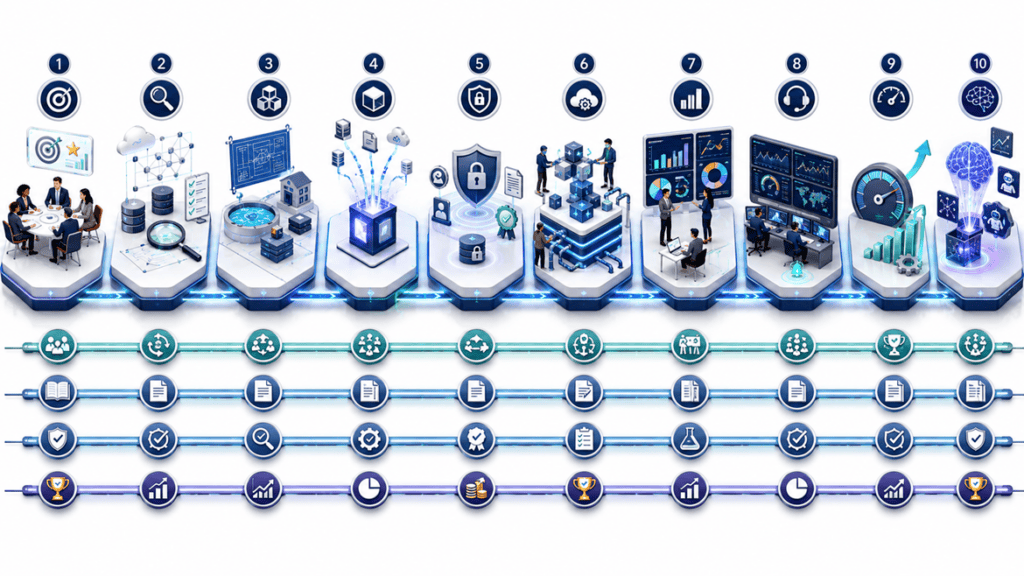
Phase 1: Define the Decision and Outcome
Choose one priority decision or process. Define current effort, data problems, intended users, target improvement, and unacceptable failure.
Phase 2: Assess Data and Platform Readiness
Review sources, ownership, quality, security, architecture, tools, skills, reporting, and operating constraints.
Phase 3: Design the Minimum Viable Architecture
Select the smallest architecture that can deliver the first outcome safely and expand later. Avoid building the final enterprise platform before learning from real use.
Phase 4: Deliver the First Trusted Data Product
Build ingestion, transformation, quality, semantic logic, reporting, and documentation for one end-to-end use case.
Phase 5: Establish Managed Operations
Introduce monitoring, support, service levels, incident processes, access review, cost management, and release governance.
Phase 6: Reuse Patterns Across Domains
Expand through standard connectors, transformation templates, quality rules, semantic conventions, and platform components.
Phase 7: Add Advanced Analytics
At this stage, Data Engineering and Analytics as a Service can extend the trusted platform into predictive, prescriptive, and AI-enabled use cases.
Introduce forecasting, machine learning, natural-language analytics, and AI-ready data only after the underlying products are dependable.
The roadmap keeps Data Engineering and Analytics as a Service connected to business value throughout the platform’s growth.
How to Select a Provider
Selecting a Data Engineering and Analytics as a Service provider requires evidence of technical depth, business understanding, operational maturity, and transparent ownership.
Business and Technical Capability
The provider should translate executive objectives into data products, definitions, controls, and measures.
Confirm access to architecture, engineering, analytics, security, DevOps, governance, and BI skills, and ask which named people will work on the service.
Delivery and Operating Evidence
Review sample architecture, pipeline patterns, testing, observability, infrastructure-as-code, semantic models, documentation, support coverage, incident handling, change prioritisation, and release cadence.
Ownership, Neutrality, and Pilot
The client should own accounts, data, code, infrastructure definitions, and documentation.
The provider should explain why its platform recommendation fits the workload and disclose portability trade-offs. A paid discovery or pilot can test Data Engineering and Analytics as a Service before wider responsibility is granted.
Frequently Asked Questions
The following questions address the commercial, technical, and governance issues that commonly arise when evaluating Data Engineering and Analytics as a Service.
What Is Data Engineering and Analytics as a Service?
Data Engineering and Analytics as a Service is a managed model in which an external team designs, builds, operates, and improves data pipelines, platforms, governance, semantic models, dashboards, and analytical products for agreed business outcomes.
Is It the Same as Data Analytics Consulting?
No. Consulting may provide advice or deliver a defined project. The as-a-service model usually includes continuing engineering, operations, support, optimisation, and roadmap delivery.
Does the Business Still Need Internal Data Staff?
Usually yes, but the internal team can be smaller and more focused. The organisation still needs business owners, data owners, decision-makers, and someone accountable for the provider relationship.
Which Cloud Platform Is Best?
There is no universal winner. Azure and Fabric may fit Microsoft-centred organisations, AWS may suit broad cloud-native estates, Google BigQuery may suit serverless analytics, and Databricks may suit shared engineering, analytics, and AI workloads.
The provider should select according to the existing estate, workload, skills, governance, and total cost.
How Quickly Can the First Dashboard Be Delivered?
A dashboard can be created quickly, but a trusted data product may require source access, quality analysis, definitions, pipelines, validation, and security.
A useful pilot should prioritise one bounded outcome rather than promise an entire enterprise platform immediately.
Can the Service Support Real-Time Analytics?
Yes, but real-time processing should be justified by the decision window. Scheduled or near-real-time pipelines are often less expensive and easier to operate.
How Is Data Security Protected?
Security should include identity, least privilege, encryption, private networking where required, managed secrets, classification, audit, lineage, environment separation, secure development, and incident response.
Will the Provider Own the Data Platform?
The client should normally retain ownership of cloud accounts, data, code, repositories, infrastructure definitions, and documentation. The provider operates the service under agreed permissions.
How Is Success Measured?
Success should combine technical measures such as freshness and quality with business outcomes such as reduced reporting effort, faster decisions, improved forecast accuracy, lower operational risk, or increased revenue.
Conclusion
Data Engineering and Analytics as a Service provides a practical route to a dependable data capability without requiring every specialist role to be hired internally.
The model works when the provider owns more than dashboard production. It must connect architecture, ingestion, transformation, modelling, quality, governance, security, analytics, platform operations, and continuous improvement around measurable business priorities.
A successful service begins with one decision, builds one trusted data product, establishes repeatable engineering and governance patterns, and expands only when the platform demonstrates value and reliability.
The right provider should leave the organisation with stronger data ownership, clearer definitions, better operational visibility, and an architecture that can support future analytics and AI.
Data Engineering and Analytics as a Service should reduce dependency on manual reporting without creating a new dependency on undocumented provider knowledge.
Progressive Robot helps organisations turn fragmented data into decision-grade intelligence through Data Analytics services, Data Management and Analytics, Cloud Adoption, and Cloud Computing services.
Businesses can contact Progressive Robot to discuss a managed data-engineering and analytics roadmap.