
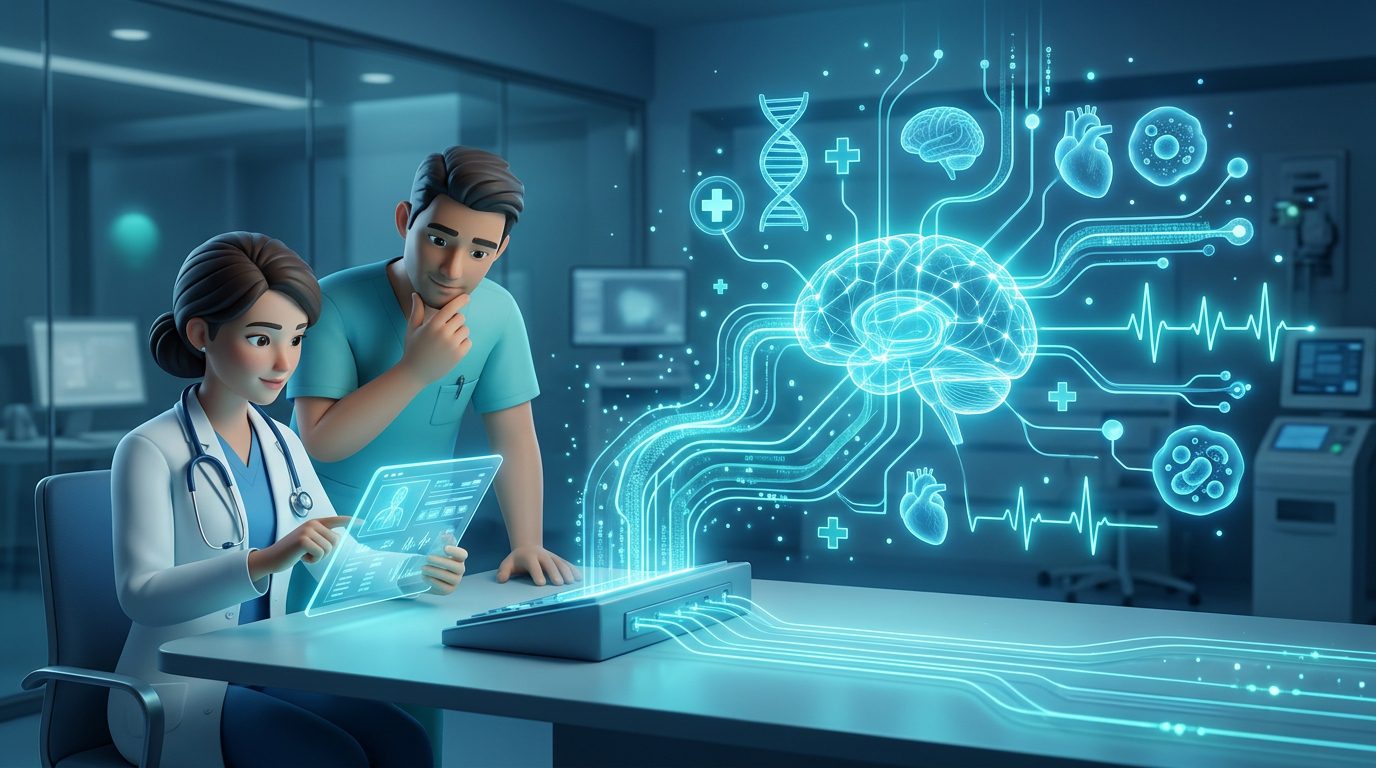
Microsoft medical AI is at the centre of Mustafa Suleyman’s ambition to develop what he calls “medical superintelligence.” Microsoft’s AI chief says the company’s diagnostic system has outperformed doctors on some challenging medical cases. The reported results suggest that AI could become a powerful aid for clinicians, but benchmark performance alone does not prove that a system is ready to diagnose patients independently.
Microsoft AI chief Mustafa Suleyman says the company’s diagnostic AI has delivered results that surpass doctors on some challenging medical cases. The claim is part of a wider ambition to develop what Suleyman calls “medical superintelligence”: AI systems capable of supporting healthcare work at an exceptionally high level.
The technology at the centre of the announcement is Microsoft’s Diagnostic Orchestrator, a system designed to approach difficult cases by coordinating AI agents that work through diagnostic reasoning. Microsoft says its performance in evaluations suggests that AI could become a powerful aid for clinicians—but the results should not be mistaken for proof that the system is ready to diagnose patients independently.
The distinction is important. Microsoft medical AI is being assessed through challenging test cases and simulated clinical scenarios. Its benchmark performance may indicate promise, but it does not establish how reliably it would work in hospitals, with incomplete patient information, time pressure and the consequences of real clinical decisions.
How Microsoft’s Diagnostic Orchestrator Works

Microsoft’s Diagnostic Orchestrator is designed to simulate aspects of a panel of medical experts. Rather than relying on a single response, the system uses multiple AI agents to examine a case and coordinate their reasoning.
The reported system is powered by OpenAI’s GPT-5 and is intended to work through demanding diagnostic questions. The orchestration approach attempts to make the process more structured: agents can consider different parts of a case, evaluate possible explanations and contribute to a combined assessment.
This is relevant because difficult diagnoses often require clinicians to weigh several competing possibilities. Symptoms may be ambiguous, test results may point in different directions, and a rare condition may resemble a more common one. A system that can systematically consider alternatives could help clinicians identify possibilities they might otherwise overlook.
Microsoft medical AI, however, should not be treated as a replacement for the clinical process. A diagnosis depends on more than reasoning over a written case. Doctors also examine patients, interpret evolving symptoms, order tests, consider medical history and communicate with people about their circumstances.
Microsoft medical AI is designed to examine difficult cases through coordinated reasoning rather than a single isolated response. The Diagnostic Orchestrator brings multiple AI agents into the process, making Microsoft medical AI relevant to cases where symptoms and test results may support several explanations. This approach does not make Microsoft medical AI infallible; it provides a method for organising diagnostic possibilities that clinicians still need to evaluate.
Microsoft Reports Strong Results on Complex Medical Cases

Microsoft says the Diagnostic Orchestrator achieved approximately 83% accuracy on complex medical cases. In the reported comparison, generalist doctors using reference materials achieved about 36%, while doctors without those references reached roughly 22%.
The company also reported results from emergency-department scenarios, where the AI system achieved about 80% accuracy compared with approximately 47% for physicians in the evaluation.
Those figures are striking, but they need context. They describe performance on particular test sets and scenarios, not a broad, independently established measure of how the system would perform across everyday medicine. The cases, evaluation design and comparison conditions affect what the numbers can tell us.
A high score on a difficult diagnostic benchmark can demonstrate that a model is capable of reasoning through the information presented to it. It cannot, by itself, show that the model will safely manage patients, recognise every urgent condition or make appropriate decisions when information is missing.
The reported results make Microsoft medical AI an important development to watch, but the next question is whether those gains persist under prospective clinical testing, where decisions can be evaluated against real patient outcomes.
The reported benchmark results have drawn attention to Microsoft medical AI because they suggest that an AI system can perform strongly on demanding diagnostic questions. However, Microsoft medical AI must be assessed in the context of the cases and conditions used for testing. A benchmark can measure performance on a defined task, while Microsoft medical AI in a real hospital would face incomplete records, changing symptoms and patient-specific factors.
Why Difficult Diagnoses Are a Key Test for AI

Hard cases are a meaningful test because they often involve uncertainty. A patient’s symptoms may not fit a textbook pattern, several conditions may explain the same findings, or a rare disease may be hidden among more familiar possibilities.
An AI system that performs well on these cases could potentially help clinicians broaden their differential diagnoses, organise evidence and identify questions that warrant further investigation. It may also be useful as a second-opinion tool when a clinician wants to check whether an alternative explanation has been considered.
But the ability to propose a plausible diagnosis is only one part of medicine. Clinical decisions also require assessing urgency, selecting appropriate tests, understanding treatment risks and taking the patient’s preferences into account.
Microsoft medical AI will therefore need to demonstrate more than benchmark accuracy. Researchers and healthcare providers will need to evaluate whether it improves decision-making, whether its recommendations are appropriately calibrated and whether clinicians can understand when its conclusions are uncertain.
Microsoft’s Medical Superintelligence Goal

Suleyman’s “medical superintelligence” ambition extends beyond answering diagnostic questions. Microsoft’s broader vision includes AI that could assist with treatment planning, care coordination and interactions between patients and healthcare professionals.
Such systems could eventually help clinicians manage information-intensive work, summarise evidence and consider options for complicated cases. They might also support patients in understanding medical information or preparing for conversations with their care teams.
The ambition is substantial, and the term “superintelligence” should be understood as a goal rather than an established capability. Healthcare involves complex biological systems, individual differences and decisions with serious consequences. Even a powerful model may be unreliable when asked to operate outside the conditions in which it has been evaluated.
For Microsoft medical AI to become useful in clinical settings, it will need careful validation, safeguards against harmful errors and clear rules about when a human professional must take responsibility.
Clinical Testing Is the Next Crucial Step
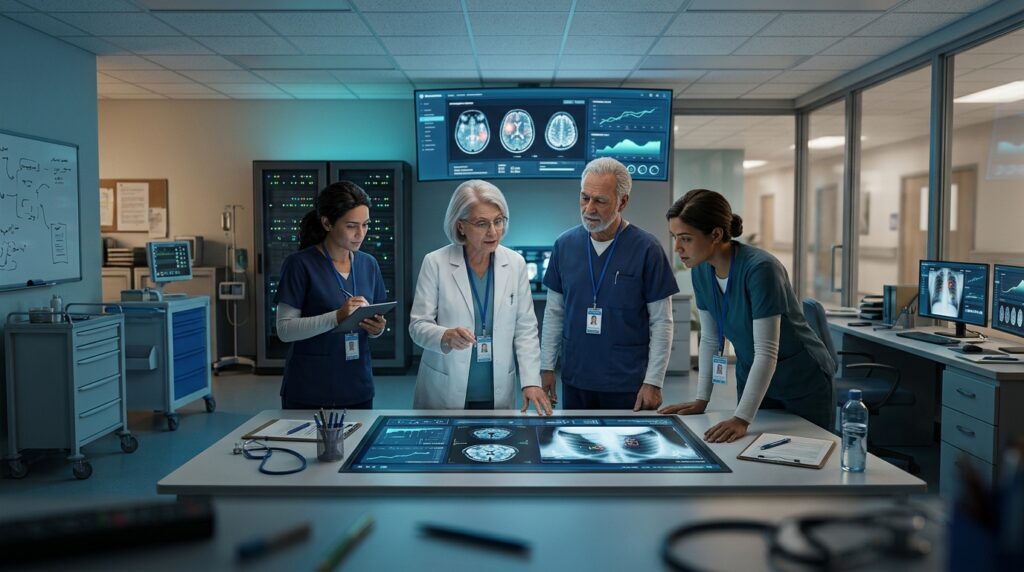
Microsoft plans to begin hospital testing with Beth Israel Deaconess Medical Center, according to the reported announcement. Clinical evaluation will be an important step in determining whether the system can support real medical work safely and consistently.
Testing in a hospital environment can reveal challenges that benchmark evaluations may not capture. Patient records can be incomplete, clinical workflows vary, and the information available at the time of a decision may differ from what is known later. Researchers will also need to examine whether AI recommendations change clinicians’ decisions and whether those changes improve outcomes.
The evaluation should consider both benefits and potential harms. A diagnostic assistant might help identify a missed condition, but it could also create false confidence, recommend unnecessary tests or distract a clinician with an incorrect suggestion.
Microsoft medical AI will need to be judged against clinically meaningful standards, including accuracy across different patient groups, reliability under uncertainty, privacy protections and the effect on the workload of healthcare professionals.
Until such evidence is available, the system’s reported benchmark results should be treated as promising research findings—not as a reason for patients to rely on AI instead of qualified medical care.
Hospital evaluation will help establish whether Microsoft medical AI can translate benchmark performance into meaningful clinical support. Researchers need to determine when Microsoft medical AI makes useful suggestions, when it produces errors and how clinicians respond to its recommendations. This testing is essential before Microsoft medical AI can be considered dependable for patient care.
What Microsoft’s Claims Mean for Doctors and Patients

For doctors, advanced diagnostic AI could become a useful resource for reviewing complex cases, exploring alternative explanations and reducing some information-processing burdens. Its value will depend on how well it fits into clinical practice and whether it provides trustworthy, relevant assistance.
Businesses exploring responsible AI adoption can also review Progressive Robot’s AI and related IT services to understand how AI solutions can be assessed and integrated into wider technology strategies.
For patients, the announcement is not a reason to assume that an AI system can diagnose their condition more accurately than their own doctor. Benchmark comparisons do not establish that a tool is suitable for individual medical decisions, and the system’s limitations may not be obvious to someone using it.
The safest approach is to regard Microsoft medical AI as a technology under evaluation. Patients should continue to seek qualified medical advice, particularly for urgent or worsening symptoms, and clinicians should use AI outputs only within appropriate professional and institutional safeguards.
Microsoft’s claims point to a potentially important direction for healthcare technology: AI systems may become capable of helping with some difficult diagnostic tasks. Whether they can deliver reliable benefits in real-world care remains an open question that clinical testing must answer.
For now, Microsoft medical AI should be understood as a promising technology under evaluation, not a substitute for professional medical care. Doctors and patients need evidence about how Microsoft medical AI performs in real clinical settings, including its limitations and potential risks. Until that evidence is established, Microsoft medical AI should support careful research and assessment rather than independent medical decisions.
Learn more: The reported details of Microsoft’s Diagnostic Orchestrator and medical superintelligence plans
More AI coverage: explore Progressive Robot's AI Models, Tools & Releases hub — hands-on reviews, setup guides and benchmarks in one place.










