
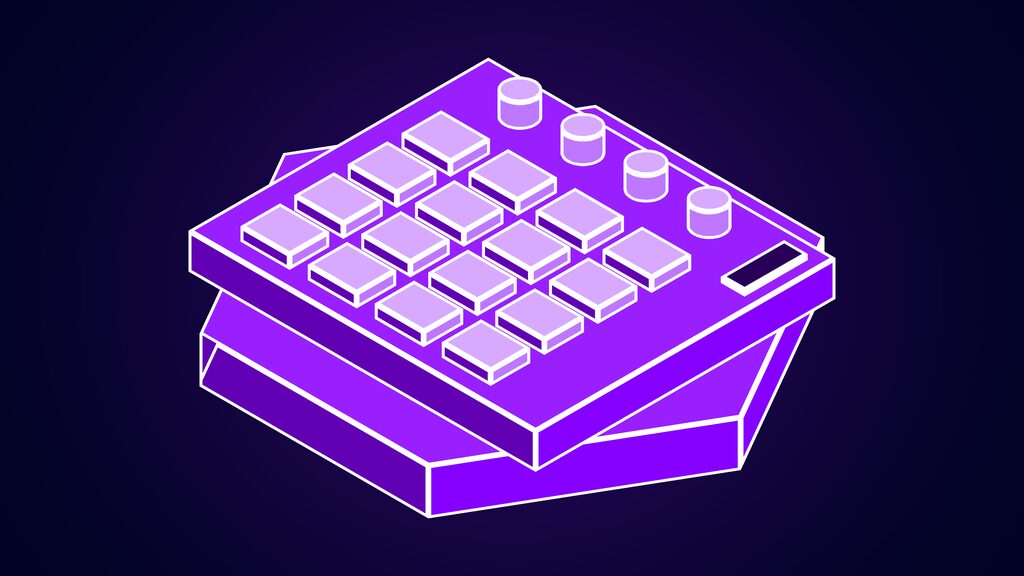
Engram sampler, the first instrument from Los Angeles start-up Thoughtful Things, does something most AI music products are built to avoid. It deliberately pushes small AI audio models until they break, then hands you the glitchy, half-formed sounds they produce as raw material to slice, loop and sequence. The company calls the process “model bending”, a nod to the circuit benders who rewire toys and cheap keyboards in search of strange new noises.
The Kickstarter campaign for the Engram sampler went live on 27 September 2026, with early pledges starting at $675. The Verge, which covered the launch the same day, summed up the pitch in one line: “This isn’t Suno in a box.” Founder Evan King describes the device as a “field recorder for latent space”, a tool for exploring the odd corners of what an audio model has learned rather than for producing a finished pop song at the press of a button.
That positioning matters at a time when AI music is mostly discussed in terms of lawsuits and licensing deals, as our report on Suno v6 and its licensed training data showed. Below, we explain what the Engram sampler actually does, how “hallucinated” audio is made, what is and is not known about the hardware, where its AI models came from, and whether the $675 pledge looks like good value.
Table of contents
- What the Engram Sampler Is, and What It Is Not
- How the Engram Sampler Turns AI Hallucinations Into Sound
- Model Bending: Circuit Bending for Neural Networks
- Engram Sampler Hardware, Controls and Workflow
- Tiny AI, Training Data and the Engram Sampler’s Models
- Engram Sampler vs Suno and Conventional Samplers
- Engram Sampler Price and Kickstarter Progress
- Who Should Back the Engram Sampler, and Who Should Wait
- Frequently Asked Questions About the Engram Sampler
- References
What the Engram Sampler Is, and What It Is Not
At first glance the Engram sampler looks like a fairly conventional piece of studio equipment. The differences are in where its sounds come from and how much of the music it leaves to you.
A sampler and groovebox first
A sampler records or loads short pieces of audio and lets you play them back from pads, chopped, pitched and rearranged. A groovebox adds a built-in sequencer, so you can build patterns and loops without a computer. Thoughtful Things describes the Engram sampler as both, and says it “combines a traditional sampler-groovebox workflow with hands-on sample generation using audio model bending”.
The company’s product render shows 16 pads in two rows of eight, eight labelled knobs, a small screen, a menu encoder and a block of function buttons, one of them marked “Gen”. Along the top edge sit sockets labelled USB, sync, MIDI, line-in and headphones. It is recognisably part of the same family as the compact grooveboxes that already sit on many producers’ desks.
“Not Suno in a box”
The Verge’s Terrence O’Brien was explicit that this “isn’t a ‘push-button, get-song’ device, aimed at creating something that sounds ready for top-40 radio”. Cloud services such as Suno take a text prompt and return a complete track, vocals included. The Engram sampler generates only “short bursts of audio”, according to its product page, and expects you to do the musical work: slicing, flipping and arranging those fragments like any other sample.
Thoughtful Things frames that as a creative choice. Its FAQ says the tiny AI engine is “expressive enough to add a dose of inspiration to your process, but you maintain creative control”. The product page closes its pitch with a line that sums up the attitude behind the Engram sampler: “These sounds do not exist. But you do.”
A research prototype, funded by backers
The Engram sampler is not a finished retail product yet. The Engram product page carries a clear warning: “This is a research prototype. Design may change.” The Kickstarter campaign funds a limited first run, so anyone pledging is backing a small company’s first instrument rather than buying one off the shelf. We look at what that means for risk further down.
How the Engram Sampler Turns AI Hallucinations Into Sound
“Hallucination” usually describes an AI failure. When a chatbot invents a court case or a witness, it can cost a professional real money, as a lawyer fined over AI-hallucinated witnesses found out. The Engram sampler turns that idea around. An audio model asked for something it cannot quite produce still outputs something, and that something can be musically interesting.
What an audio hallucination sounds like
The Verge describes a moment in the campaign video where King “uses his voice to ask for ‘piano,’ and Engram spits out something glitchy and vaguely piano-like”. That gap between the request and the result is the whole point. A large, well-trained model would try to return a convincing piano. A small model, pushed past its comfort zone, returns an impression of one, full of artefacts and textures no real piano makes.
Thoughtful Things titled one of its demo videos “Turning an audio hallucination into a beat”. Another, “This rare sampler is full of ghosts”, shows the Engram sampler prototype filtering recordings “through the latent space of audio models, uncovering sonic ghosts”. The language is poetic, but it describes a real technical process.
The embedded neural audio codec
The product page lists neural audio processing as a headline feature: you can “process and warp your own recordings with an embedded neural audio codec”. A neural codec is an AI model that compresses audio into a compact set of numbers and then rebuilds sound from them. Meta’s EnCodec, published in 2022, is a well-known example, built as an encoder and decoder around a “quantized latent space”.
That compact internal representation is what people mean by latent space. Once your recording lives there, you can nudge, stretch or scramble the numbers before turning them back into audio. The decoder then does its best to produce something plausible from values it was never trained on. Thoughtful Things has not named the codec inside the Engram sampler or said how large it is.
Sample generation and neural melding
The second route is generation from scratch. The Engram sampler can “create and glitch short bursts of audio to sample and manipulate”, with a spoken prompt through the on-board microphone as one way to steer it. A dedicated “Gen” button on the render suggests generation sits alongside recording as an everyday action rather than a hidden mode.
A third technique appears in a demo called “Melding my samples in latent space”. Its description says neural melding “swirls your samples together in latent space, then turns them back into audio”. Blending two sounds inside a model’s representation, rather than simply mixing their waveforms, is how you get hybrids that sound like neither source.
An unedited session, start to finish
The most useful demo is the unedited one, titled “Quick Engram sampler session. No edits, no talking.” Published in April, it runs for just under eight minutes. King’s description walks through the workflow: “I take a field recording, use the embedded neural audio codec to warp and stretch it into an ambient pad, then generate an abstract audio clip to slice and arrange into a four bar pattern.” It is a normal sampler session with two AI steps inserted into it.
| Feature | What goes in | What comes out | Described in |
|---|---|---|---|
| Neural audio processing | Your own recording, via line-in or the on-board mic | A warped, stretched or smeared version of it | Product page |
| Sample generation | A button press or a spoken prompt | A short burst of new, often glitchy audio | Product page, The Verge |
| Model bending | Changes to how the model itself behaves | Deliberately broken, uncanny output | Product page |
| Neural melding | Two or more samples | A hybrid formed inside latent space | Demo video, April 2026 |
Model Bending: Circuit Bending for Neural Networks
Model bending is the central idea behind the Engram sampler, and the name is borrowed on purpose from a much older, hands-on music tradition. The difference is that the things being bent are neural networks, not circuit boards.
Where circuit bending came from
Circuit bending is the practice of modifying the circuits in electronic devices, “such as children’s toys and digital synthesizers”, to change their sound, usually by opening them up and adding switches and potentiometers. It rewards curiosity over engineering precision. You connect two points on a board and listen to what happens. Many results are useless; a few become signature sounds.
Bending a network instead of a circuit
Thoughtful Things calls its approach “audio model bending – like circuit bending, but for neural networks”. The Engram sampler exposes “unique, tweakable features for glitchy neural audio processing”, which the company says push “tiny audio models beyond their limits”. The Verge adds that the device lets you “tweak and even break its tiny AI models”.
The idea has academic roots. In 2020, researchers Terence Broad, Frederic Fol Leymarie and Mick Grierson described network bending: inserting “deterministic transformations” as extra layers inside a trained generative network and applying them while it produces output. Their work was on images, not audio, and Thoughtful Things has not said whether its own algorithms resemble it. The principle is the same, though: change what happens inside the model, not just what you feed into it.
Why small models break in interesting ways
A tiny model has less capacity to cover up its mistakes. When a large model meets an unfamiliar input, it usually falls back on something generic and polished. A small model, especially one being actively bent, is more likely to expose the seams: smeared transients, metallic tones, phrases that collapse halfway through. For an experimental producer using the Engram sampler, those seams are the product.
King has made a version of this argument before. In a 2025 post about Mishearings, a project that turned speech-recognition errors into poetry, he quoted Brian Eno: “So much modern art is the sound of things going out of control, of a medium pushing to its limits and breaking apart.” The Engram sampler reads like that philosophy turned into hardware.
| Factor | Circuit bending | Network bending (research) | Engram model bending |
|---|---|---|---|
| What is changed | Physical circuit connections | Layers inside a trained image model | Tiny audio models on the device |
| How you do it | Wires, switches and potentiometers | Transformations inserted while generating | Knobs and buttons on the hardware |
| Typical output | Glitched toy or synth sounds | Distorted, reshaped images | Uncanny audio to sample |
| Needs a soldering iron | Usually | No | No |
| Source | Long-running DIY practice | Broad, Fol Leymarie and Grierson, 2020 | Thoughtful Things, 2026 |
Engram Sampler Hardware, Controls and Workflow
Thoughtful Things has published a feature list and a product render, but not a full specification sheet. Here is what is confirmed about the Engram sampler and what is still missing.
Connections and controls
The confirmed feature list covers the essentials for a studio instrument: “MIDI input and output”, “CV sync/gate input and output”, a “stereo line-level input for sampling”, a headphone output and an “on-board microphone for lo-fi sampling and voice control”. It also promises “sample and pattern storage and recall”, so patterns built on the Engram sampler can be saved and brought back.
CV (control voltage) sync matters to modular synthesiser users, because it lets the Engram sampler lock its tempo to a Eurorack system without MIDI. The company tags its demo videos with #eurorack, which suggests that is an audience it has in mind. King’s own background fits: his personal site lists a cellular rhythm generator for Eurorack and a project adding Eurorack features to a tape recorder.
Everything runs offline
“No internet connection, app, or subscription service is required: everything runs on the Engram’s hardware,” the product page says. The Verge confirms that the Engram sampler “isn’t connected to the internet” and “runs a ‘tiny AI’ locally”. For a studio instrument that is a practical advantage as well as a philosophical one. There is no account to lose, no server to go offline, and no monthly fee that could change after you buy.
It also means the device’s abilities are fixed by its processor. Thoughtful Things has not said which chip powers the Engram sampler, how much memory it has or how long generation takes. Those details will decide how responsive it feels when you are building a pattern in real time or playing live.
What we still do not know
Several numbers a buyer would normally expect are missing from the public material, including the processor, storage capacity, screen resolution, dimensions, weight, power supply and model size. Kickstarter lists an estimated delivery date for each reward tier, but we were unable to load the campaign’s reward tiers directly, so we have not confirmed them. Check those dates on the campaign page before pledging for an Engram sampler.
| Item | Status | Detail |
|---|---|---|
| Pads | Shown in render | 16 pads in two rows of eight |
| Knobs and buttons | Shown in render | Eight knobs, a menu encoder and eight function buttons |
| MIDI | Confirmed | Input and output |
| CV | Confirmed | Sync and gate input and output |
| Audio in | Confirmed | Stereo line-level input and on-board microphone |
| Audio out | Partly confirmed | Headphone output listed |
| Internet, app, subscription | Confirmed | None required |
| Processor, memory, storage | Not disclosed | No figures published |
| Model size and architecture | Not disclosed | Described only as tiny, in-house models |
| Retail price | Not disclosed | The Verge estimates $850 to $900 |
Tiny AI, Training Data and the Engram Sampler's Models
Thoughtful Things spends a surprising amount of its public material explaining what kind of AI it uses, where the models came from and what they were trained on.
“Chatbots are big AI. Engram is tiny AI.”
The FAQ says the Engram sampler uses “a tiny AI engine that runs directly on the hardware”, comparable to the models behind “exercise tracking on smart watches, autocorrect on phones, and stem separation in DAWs”. Its summary is blunt: “Chatbots are big AI. Engram is tiny AI.” The company argues that tiny AI “doesn’t claim to be ‘superintelligent'” and is “designed for small tasks”.
The distinction is partly marketing, but it has substance. Small models that run on the device itself are a fast-moving area, from phone features to compact language models such as the one in our report on PrismML’s tiny on-device LLM. The Engram sampler applies the same trade-off to sound: less raw capability, in exchange for privacy, speed and independence from the cloud.
Trained on licensed audio, according to the company
Training data is the most contested question in AI music, and Thoughtful Things addresses it directly on Kickstarter. “We’ve trained our audio models on open datasets that only contain audio licensed for commercial use (CC-BY or similar),” the campaign says. “We have not trained and will never train our models on non-commercial, pirated, or otherwise stolen data.”
CC-BY is a Creative Commons licence that allows commercial reuse as long as the creator is credited. The FAQ adds that the commercial Engram sampler “ships with our own in-house models, trained from scratch exclusively on data that permits commercial use and derivative works”. The company has not named the datasets, so the claim cannot yet be checked independently.
The MusicGen origin story
Thoughtful Things is open about how the project began. “Engram grew out of a hobby project using Meta AI’s MusicGen models, which were released for research purposes only,” its FAQ says. MusicGen, published by Meta researchers in 2023, comes in 300M, 1.5B and 3.3B parameter sizes. Its model card says the weights are released under CC-BY-NC 4.0, a licence that rules out commercial use.
That is why the company stresses that the shipping Engram sampler uses different models. MusicGen itself was trained on 20,000 hours of licensed music from Meta’s own sound collection, Shutterstock and Pond5, so the non-commercial restriction was a licence condition rather than a sign of scraped data. Thoughtful Things also notes that it is “not affiliated with or endorsed by Meta Platforms”.
The environmental claim, in context
The FAQ argues that tiny AI is “small enough for us to train on computers like gaming PCs – no massive data centers required”. It links to a peer-reviewed paper in Communications of the ACM, “Is TinyML Sustainable?“, to support its claim that the carbon impact of training small models is minimal.
The paper is more nuanced than a one-line summary. Its life-cycle analysis finds that tiny machine-learning systems can offset their own emissions by making other activities more efficient, but it also warns that “when globally scaled, the carbon footprint of TinyML systems is not negligible”. A single instrument trained on a gaming PC is still a very different scale from the data centres behind cloud AI, whose hardware waste we covered in our report on AI data centre e-waste.
Open firmware and pluggable models
The Verge reports that Thoughtful Things “plans to open up Engram’s firmware so that others can tweak it or load their own custom models”. The product page lists “pluggable audio models – create, share, and plug-in new audio models to experiment with, just like old-school ROMplers”. ROMplers were instruments that played back sounds stored in read-only memory, often expandable with plug-in sound cards, so the comparison points to a library of models you can swap in and out.
If that happens, the Engram sampler could become a small platform for experimental audio models rather than a single instrument. It also raises questions the company has not yet answered: which model formats will be supported, how custom models will be trained, and what licence any shared models will carry.
Engram Sampler vs Suno and Conventional Samplers
The Engram sampler sits between two familiar categories of music technology, and it is easiest to understand by comparing it with both.
The cloud song generators
Suno generates complete songs in the cloud from text prompts, and it sits at the centre of the music industry’s legal fight over AI. On 25 September, The Verge reported that Sony and Universal Music Group had filed a new lawsuit against Suno accusing it of “model laundering”. The labels argue that its v6 model was trained on the outputs of earlier models built on recordings they say were used without permission. Sony and UMG, The Verge noted, “are notable holdouts who did not sign a licensing agreement with Suno”.
Against that backdrop, the Engram sampler’s pitch of local models trained on commercially licensed open data is deliberate. It does not claim to replace musicians or to write hits. It claims to be a new kind of sound source that a musician then shapes. Questions about where AI music training data comes from are not new, as our report on The Atlantic’s AI music database investigation showed.
Conventional samplers and grooveboxes
On the other side are the hardware samplers producers already use. They record, chop and sequence audio, and there is no AI inside. The Engram sampler keeps that workflow, including pads, patterns, MIDI and sync, and adds generation and model bending on top. For someone who already owns a sampler, the question is whether those extra sound sources justify a second box at this price.
| Factor | Engram sampler | Cloud song generator | Conventional sampler |
|---|---|---|---|
| Where the AI runs | On the device, offline | Company servers | No AI |
| What you give it | Recordings, voice prompts, knob moves | Text prompts and lyrics | Recordings and sample packs |
| What you get | Short, often glitchy samples | Complete songs with vocals | Your own sounds, rearranged |
| Who arranges the music | You | Mostly the model | You |
| Account or subscription | None required | Account needed; free and paid plans | None |
| Training-data position | Commercially licensed open datasets, per the company | Deals with some labels, lawsuits from others | Not applicable |
| Best suited to | Experimental sound design | Fast finished tracks | Any genre |
Engram Sampler Price and Kickstarter Progress
The price and the funding numbers are the two things most backers will want to understand before committing money to the Engram sampler.
What $675 buys, and the retail maths
Early backers can pledge from $675 for an Engram sampler from a limited run. Thoughtful Things has not announced a retail price. The Verge estimated that it is “likely to be between $850 and $900, as the $675 pledge is listed as a 30 percent discount”.
The arithmetic is worth checking. If $675 is exactly 30% off, the full price would be about $964, because $675 divided by 0.7 is $964.29. At $850 the saving would be $175, or about 21%; at $900 it would be $225, or 25%. The discount may be rounded or measured differently, so treat every retail figure for the Engram sampler as an estimate until the company publishes one.
The saving from backing early depends on a retail price nobody has confirmed yet.
Funding so far
The campaign set a funding goal of $10,600, according to a Let’s Data Science capture of the Kickstarter page on 27 September, which showed $6,300 from nine backers with 30 days remaining. Kickstarter’s own project statistics showed $7,650 from 11 backers on 28 September, which the campaign’s widget reports as 72% funded.
Those are small numbers, and they say something useful about the Engram sampler. At $675 a unit, the goal equals roughly 16 early-bird pledges. The remaining $2,950 would be covered by five more backers at that level. The average pledge so far works out at about $695, which suggests most backers are ordering a unit rather than making a token contribution.
After its first day, the campaign was close to its modest goal.
The risk of backing a first instrument
Kickstarter is not a shop. Backers fund a project and receive a reward if it succeeds, and hardware projects in particular often ship late. Thoughtful Things is a small company launching its first product, which it still calls a research prototype. The low funding goal cuts both ways: it is easy to reach, but a limited run leaves less room to absorb rising component costs or manufacturing problems.
There are reasons for confidence too. The Engram sampler prototype has been shown publicly in demo videos since at least March 2026, the founder has a research background in embedded generative models, and the core idea does not depend on a cloud service that could be switched off. Read the campaign’s risks section and delivery estimates before committing.
Who Should Back the Engram Sampler, and Who Should Wait
The Engram sampler is a specialised instrument, and its appeal depends heavily on how you already make music.
Experimental producers and sound designers
The Engram sampler is aimed squarely at people who already enjoy tape loops, granular textures, circuit-bent toys and field recordings. If you like finding sounds by accident, and the idea of a “sampler full of ghosts” appeals, you are the target market. The demo videos are the best test: if the textures excite you, the pitch will make sense.
Developers and researchers
The promise of open firmware and pluggable models makes the Engram sampler interesting beyond music. It could become a physical test bench for small generative audio models, in the way that open hardware synthesisers have become platforms for community firmware. That depends on the company publishing clear documentation for model formats and training. Until it does, treat the openness as a plan, not a feature.
Who should wait
If you want finished songs, a cloud generator will do more with less effort. If you need a dependable live instrument with published specifications, a mature sampler is the safer choice today. And if crowdfunding risk worries you, waiting for retail units and independent reviews of the Engram sampler costs you the early discount but removes most of the uncertainty.
What to watch next
Three things will decide how the Engram sampler is judged: whether the Kickstarter campaign funds and ships on time, whether Thoughtful Things names the datasets behind its “commercially licensed” models, and whether the open firmware arrives with enough documentation for others to build on it. A published specification and a firm retail price would answer most of the remaining questions.
Frequently Asked Questions About the Engram Sampler
These are the questions readers are most likely to have about the device, answered from the company’s own material and The Verge’s reporting.
What is the Engram sampler?
The Engram sampler is a hardware sampler and groovebox from Thoughtful Things that uses small, on-device AI audio models to warp recordings and generate short new sounds. You then slice, sequence and arrange those sounds like any other sample.
Does the Engram sampler need the internet?
No. Thoughtful Things says no internet connection, app or subscription is required, and that all processing runs on the device itself.
How much does the Engram sampler cost?
Kickstarter pledges start at $675 for a limited early run. No retail price has been announced; The Verge estimates $850 to $900.
What does “model bending” mean?
It is Thoughtful Things’ term for tweaking a neural network‘s internal behaviour to produce deliberately unusual output, by analogy with circuit bending, where electronic toys are rewired to make new sounds.
Was the Engram sampler trained on copyrighted music?
The company says its shipping models were trained from scratch on open datasets licensed for commercial use, such as CC-BY material, and never on pirated or non-commercial data. It has not named the datasets.
Who makes the Engram sampler?
Thoughtful Things LLC, based in Los Angeles and founded by Evan King. According to the company’s about page, his PhD research at UT Austin focused on embedded generative models and earned multiple best paper awards.
References
Engram is a sampler that turns broken AI hallucinations into music (The Verge)
Engram: Generative audio sampler and groovebox (Kickstarter)
Engram generative audio sampler (Thoughtful Things)
Sony and UMG’s latest lawsuit against Suno accuses the company of model laundering (The Verge)
MusicGen large model card (Meta AI on Hugging Face)
Simple and Controllable Music Generation (arXiv)
High Fidelity Neural Audio Compression (arXiv)
Network Bending: Expressive Manipulation of Deep Generative Models (arXiv)
More AI coverage: explore Progressive Robot's AI Models, Tools & Releases hub — hands-on reviews, setup guides and benchmarks in one place.










