
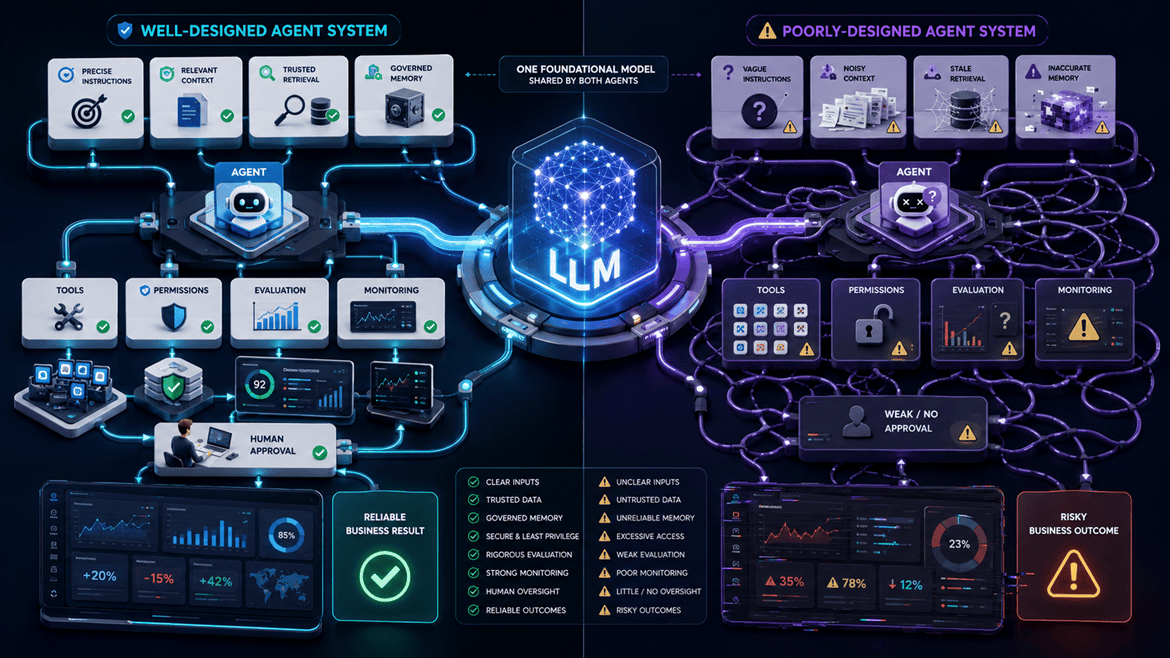
Why AI Agents Give Inconsistent Results becomes much easier to understand when an AI agent is treated as a complete software system rather than a language model behind a chat window. Two agents can use the same LLM, receive the same visible request, and still produce different answers, tool calls, decisions, and business outcomes.
The model may be identical, but the agents may not share the same instructions, retrieved evidence, memory, tools, permissions, workflow, runtime state, or evaluation rules. One agent might retrieve the latest approved policy and use a narrowly defined tool. Another might retrieve an outdated document, choose an overlapping tool, or lose an important instruction during a long execution.
That is the central reason Why AI Agents Give Inconsistent Results. The LLM provides general language and reasoning capability. The surrounding agent architecture decides what the model sees, what it can do, what it remembers, when it must stop, and how success is judged.
OpenAI’s practical guide to building agents describes production agents as systems that combine models, instructions, tools, orchestration, and guardrails. Anthropic’s guide to building effective agents similarly distinguishes simple workflows from agents that dynamically direct their own tool use and adapt across multiple steps. These descriptions make clear that an agent’s behaviour comes from the full system, not the model alone.
This article explains Why AI Agents Give Inconsistent Results even when two systems use the same LLM. It examines prompts, context engineering, retrieval, tool design, memory, orchestration, permissions, runtime state, model configuration, evaluations, and long-running task management. It also provides a practical framework for diagnosing inconsistent behaviour and improving reliability without eliminating useful flexibility.
Why AI Agents Give Inconsistent Results: The Quick Explanation
Why AI Agents Give Inconsistent Results should first be examined at the input layer. The visible user message is rarely the complete input to an agent. Before the model responds, the application may add system instructions, developer policies, examples, user metadata, conversation history, retrieved documents, memory, tool definitions, safety rules, and output requirements.
After the first response, the agent may call a tool. The tool result then becomes new context for the next model call. If two agents choose different tools or receive different results, their execution paths begin to diverge. A small difference at the first step can become a completely different outcome several steps later.
This is Why AI Agents Give Inconsistent Results despite sharing a model name. “Same LLM” does not mean same context, same actions, same environment, or same decision policy.
| Agent component | Agent A | Agent B | Likely consequence |
|---|---|---|---|
| Instructions | Clear objective and boundaries | Vague or conflicting rules | Different interpretation |
| Retrieved context | Current and authoritative | Stale or loosely related | Different factual basis |
| Tools | Distinct and well described | Overlapping and ambiguous | Different tool choice |
| Memory | Curated and time-aware | Raw history or inaccurate summary | Different continuity |
| Permissions | Least privilege and approvals | Excessive or insufficient access | Different ability to act |
| Orchestration | Defined stages and stopping rules | Open-ended loop | Different reliability |
| Runtime state | Same controlled environment | Changing data and services | Different observations |
| Evaluation | Repeated trials and trace review | A few successful demonstrations | Different production quality |
The LLM Is Only One Layer of an AI Agent
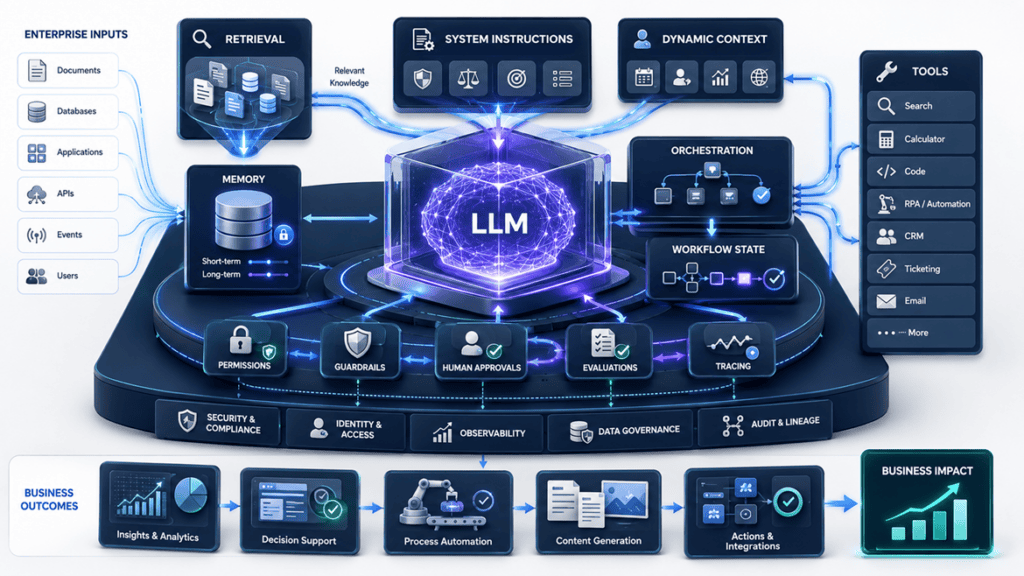
An LLM can interpret text, reason over supplied information, and generate a response. An agent wraps that capability in a loop that can plan, call tools, inspect results, update state, delegate work, and continue until an exit condition is reached.
OpenAI’s agent guidance describes single-agent systems that use tools and instructions in a loop, as well as multi-agent systems that use managers or handoffs. Anthropic’s guidance also explains that agents operate across multiple turns, use environmental feedback, and adapt their actions as work progresses.
This loop helps explain Why AI Agents Give Inconsistent Results. The first model call may differ because the hidden prompts differ. The second may differ because one agent searches a database while another searches a document index. By the fifth call, the agents may be reasoning over almost entirely different contexts.
A useful analogy is the same highly skilled employee working in two organisations. One organisation provides clear procedures, accurate records, suitable software, defined authority, and effective review. The other provides conflicting instructions, outdated files, ambiguous tools, and no agreed definition of completion. The employee has not changed, but the working environment has.
Progressive Robot’s guide to AI agent harnesses describes the harness as the layer that routes tasks, context, permissions, memory, tools, retries, and model calls. Harness design is therefore one of the clearest explanations for Why AI Agents Give Inconsistent Results.
System Instructions Create Different Operating Policies
Why AI Agents Give Inconsistent Results is often first visible in the system instructions. System instructions define an agent’s role, priorities, constraints, style, and decision policy. They are usually hidden from the end user, but they can have more influence than the visible request.
A support agent may be instructed to protect customer funds and require confirmation before any financial action. Another may be instructed to minimise handling time and resolve issues without additional questions whenever possible. Both agents can receive the same refund request and reach different actions because their priorities differ.
Instructions can also define which sources are authoritative, when a tool is mandatory, how uncertainty should be expressed, which actions require escalation, and which output format must be used. A detailed operating procedure can make the model appear more capable because the system has removed unnecessary ambiguity.
Conflicting instructions are another reason Why AI Agents Give Inconsistent Results. An agent told to “always act immediately” and “never act without complete evidence” must infer which rule has priority. Changing the order, hierarchy, or wording of those instructions can change the outcome.
AWS recommends agent standard operating procedures as a way to provide consistent process guidance while retaining the reasoning flexibility of an LLM. The lesson is not that every decision should be hard-coded. It is that critical workflows need explicit evidence requirements, decision boundaries, and escalation rules.
Context Engineering Changes What the Model Can See
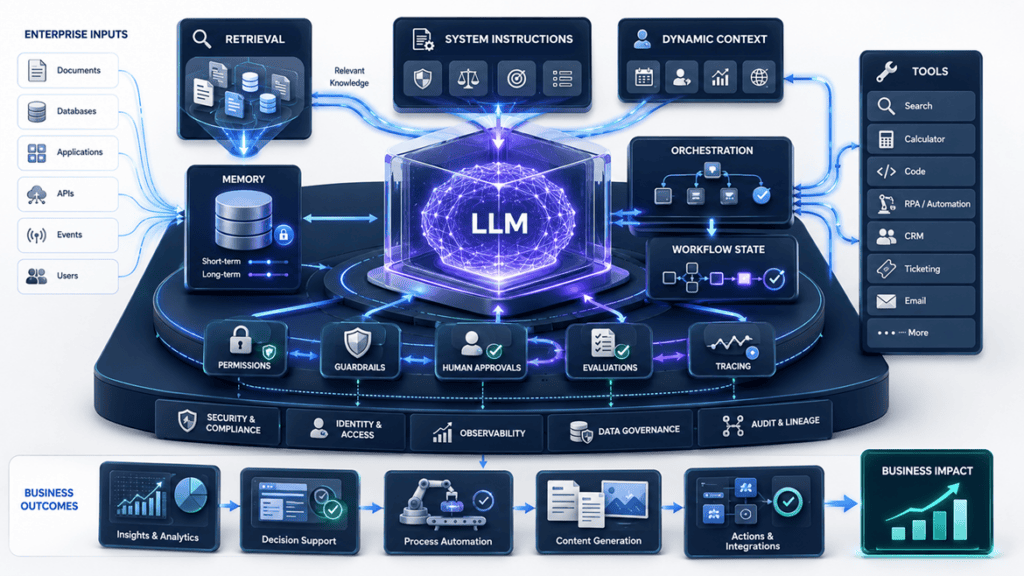
Context engineering is the practice of selecting, organising, and maintaining the information supplied to the model at each step. It includes system instructions, user messages, conversation history, retrieved documents, memory, tool schemas, tool results, and current workflow state.
Anthropic’s context-engineering guidance describes context engineering as the work of curating the optimal set of tokens for inference. This framing matters because context is finite and dynamic. An agent does not benefit from every available piece of information equally.
Poor context engineering is a major reason Why AI Agents Give Inconsistent Results. One agent may receive a compact package containing the current policy, the relevant account record, and a concise tool response. Another may receive several years of chat history, duplicated documents, stale policies, and an enormous API payload.
The second agent has more information, but not necessarily better information.
More Context Can Produce Worse Decisions
Large context windows encourage teams to include everything. Yet irrelevant and conflicting material competes with the details that matter.
Consider a contract-analysis agent. It may need the current agreement, approved amendments, governing law, and a specific policy. Adding unrelated contracts, superseded versions, and long email chains can bury the decisive clause.
The same principle applies to tool output. Returning twenty fields that the agent does not need increases context use and gives the model more opportunities to focus on the wrong detail. Compact, structured results usually support more reliable decisions.
Progressive Robot’s context-engineering guide explains that prompts, memory, retrieval, tools, and conversation history must be managed together. That is an important part of understanding Why AI Agents Give Inconsistent Results.
Retrieval Gives the Same Model Different Evidence
Why AI Agents Give Inconsistent Results is also an evidence-retrieval problem. Retrieval-augmented generation allows an agent to search documents, databases, websites, or knowledge stores before responding. The retrieval layer decides which evidence the model receives.
Two agents may use different indexes, embedding models, keyword systems, chunk sizes, metadata filters, reranking methods, freshness rules, and access controls. Each choice can change which document is returned.
One agent may retrieve the latest approved refund policy for the customer’s country. Another may retrieve an older global article because it contains more matching words. Both models can reason correctly over the supplied evidence, yet only one answer is valid.
This is another reason Why AI Agents Give Inconsistent Results. The generation model cannot use authoritative evidence that the retrieval system failed to provide.
Anthropic’s contextual retrieval work shows how document context, hybrid retrieval, and reranking can improve the evidence supplied to a model. The broader lesson is that model quality cannot compensate reliably for a poor evidence pipeline.
Why AI Agents Give Inconsistent Results can often be reduced by improving evidence selection. Reliable retrieval should consider document authority, effective date, jurisdiction, approval status, user permissions, and the purpose of the decision. It should also expose citations or source identifiers so users and evaluators can verify the answer.
Tool Design Influences Which Actions the Agent Takes
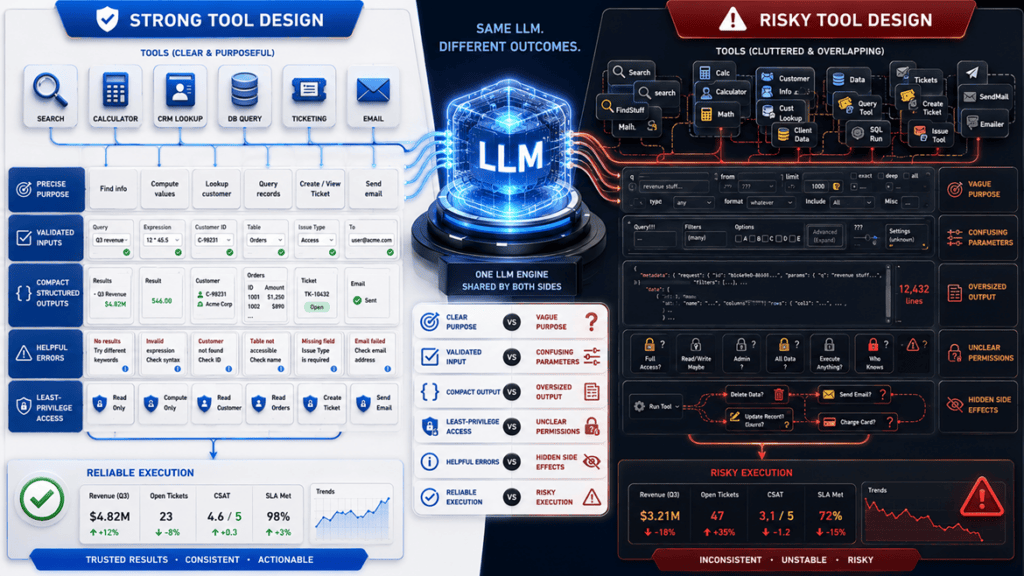
Why AI Agents Give Inconsistent Results can frequently be traced to tool design. Tools let an agent search, calculate, access business systems, write files, send messages, or execute actions. Their names, descriptions, parameters, examples, outputs, and errors all become part of the model’s decision environment.
A tool named check_refund_eligibility with a precise description is easier to use than several overlapping tools named lookup, query, find, and manage_payment. Ambiguous tool design forces the model to infer distinctions that should have been explicit.
OpenAI notes that overlapping tools can create performance problems even when the total tool count is not especially large. Anthropic’s tool-design guidance recommends clear names, useful descriptions, context-efficient outputs, and actionable errors.
Tool design therefore helps explain Why AI Agents Give Inconsistent Results. Two applications can call the same backend API but expose completely different interfaces to the model.
Tool Outputs Become Future Context
A tool result is not only a backend response. It becomes evidence in the next model call.
A concise structured result such as “eligible: true; refundable amount: £49; payment status: settled” creates a clear basis for action. A large unfiltered transaction object may contain the same facts but make them harder to identify.
Errors also influence the next decision. “Invalid request” provides little guidance. “The transaction ID must contain twelve digits and belong to the authenticated customer” gives the model a clear recovery path.
This is Why AI Agents Give Inconsistent Results after seemingly minor tool-wrapper changes. One wrapper guides the model toward a valid next action; another leaves it guessing.
Memory Gives Agents Different Histories
Why AI Agents Give Inconsistent Results over repeated sessions is closely connected to memory. An LLM does not automatically maintain durable memory across independent sessions. Agent systems add memory through saved preferences, conversation summaries, task artifacts, user profiles, or external stores.
One agent may remember that a customer has completed identity verification and prefers email communication. Another may begin without that information. A third may retrieve an inaccurate summary created during an earlier interaction.
These histories can make agents behave differently even when they later receive the same request. This is another explanation for Why AI Agents Give Inconsistent Results over time.
Memory Needs Provenance, Selection, and Expiry
Storing everything is not a reliable memory strategy. Unlimited memory creates noise, contradiction, privacy exposure, and unnecessary context use.
A mature system defines what can be remembered, why it remains useful, where it came from, who may access it, and when it should expire. Temporary task details should not be treated like permanent user facts. Policy decisions should include their source and effective date.
Progressive Robot’s enterprise AI agent memory guide explains how stale or poorly governed memory can preserve errors and outdated context. Memory quality is therefore central to Why AI Agents Give Inconsistent Results.
Orchestration Determines the Route Through the Task
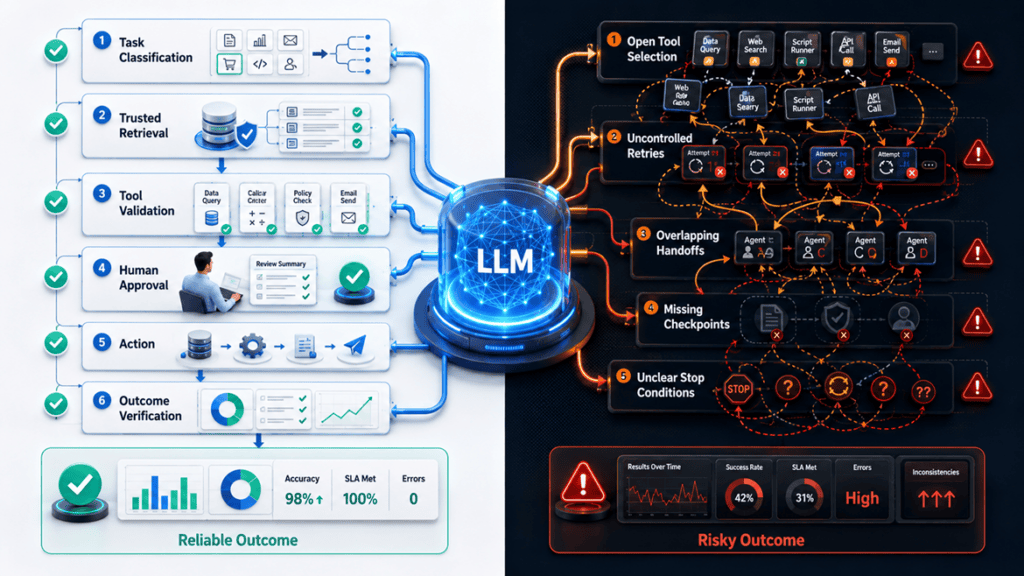
Why AI Agents Give Inconsistent Results across multi-step tasks is often determined by orchestration. Orchestration controls the sequence of model calls, retrieval, tools, checks, retries, approvals, handoffs, and stopping conditions.
One agent may classify a request, retrieve a policy, check the account, validate eligibility, request confirmation, and then act. Another may let the model choose every step dynamically. A third may delegate research and review to specialist agents.
All three can use the same LLM while following different paths.
OpenAI’s orchestration documentation covers manager-style coordination, where a central agent calls specialists as tools, and handoffs, where agents transfer control to one another. These patterns change context, authority, and failure modes at every stage.
Orchestration is therefore a major reason Why AI Agents Give Inconsistent Results. The difference may not come from the model’s reasoning quality; it may come from which workflow steps are mandatory and which are optional.
Retries and Stopping Rules Matter
An agent that retries a failed search may eventually find the correct document. Another may stop after the first failure. An agent with a large step budget may investigate thoroughly but also risk looping, increasing cost, or drifting away from the goal.
Stopping conditions should define when the objective is complete, when evidence is insufficient, when further action is unlikely to help, and when a human must intervene.
Without those boundaries, two otherwise similar agents can end at completely different points. This is Why AI Agents Give Inconsistent Results in long or ambiguous workflows.
Permissions and Guardrails Change the Visible Outcome
Why AI Agents Give Inconsistent Results can also reflect different permission boundaries. Two agents can reach the same internal conclusion but produce different outcomes because their permissions differ.
A read-only agent can recommend a refund. An agent with write access can process it. An agent without access to account history may ask repetitive questions. An agent with excessive permissions may take an action that should have required approval.
Permissions should follow least privilege. High-impact actions should use validation, confirmation, transaction limits, human approval, or rollback controls.
OpenAI’s agent-safety guidance emphasises guardrails, tool confirmations, structured variables, and limiting the influence of untrusted content. A secure agent may refuse or escalate where a less controlled system acts immediately.
Safety can therefore appear to be inconsistency. One agent may look less capable because it refuses an unsupported action, but that refusal can be the correct result.
Permissions and guardrails are an important reason Why AI Agents Give Inconsistent Results in finance, healthcare, customer support, cybersecurity, and other high-impact workflows.
Runtime State Means the Agents May Observe Different Worlds
Why AI Agents Give Inconsistent Results is sometimes explained by changing runtime state rather than model behaviour. Agents interact with systems that change. Databases are updated, inventory is purchased, appointments are booked, websites change, APIs fail, and files are modified.
Two identical agents launched seconds apart can receive different account balances, available slots, search results, repository states, or error messages. They are not necessarily reasoning differently; they may be responding to different evidence.
User identity, working directory, timezone, region, network access, sandbox configuration, and service availability can also influence execution.
Runtime state is therefore another reason Why AI Agents Give Inconsistent Results. A fair comparison must control the environment or record enough detail to reconstruct it.
Reliable traces should include timestamps, tool inputs, tool outputs, state versions, user identity, action identifiers, and errors. Without this information, teams may blame the model for differences caused by the external world.
“Same LLM” May Hide Different Model Configurations
Why AI Agents Give Inconsistent Results should also be investigated at the configuration level. Two products may advertise the same model family while using different snapshots, reasoning settings, context limits, sampling parameters, output schemas, or tool-choice modes.
One system may pin a specific model version. Another may use an alias that updates automatically. OpenAI’s model documentation distinguishes regularly updated aliases from snapshots that lock a specific version for more consistent behaviour. One system may also allocate a larger reasoning budget, optimise for speed and cost, or require strict structured output while another permits open-ended prose.
These differences can affect tool selection, depth, formatting, and reliability. They contribute to Why AI Agents Give Inconsistent Results even when the visible model label is the same.
Generative systems can also produce valid variation in wording and intermediate decisions. In a single response, the difference may be minor. In a multi-step loop, one different first action can change every later step.
The solution is not to demand identical prose. The goal is consistent evidence, policy compliance, decisions, and actions where those elements matter.
Long Tasks Amplify Small Differences
Why AI Agents Give Inconsistent Results becomes more pronounced as the task grows longer. A short assistant response may vary slightly in wording. A long-running agent may make dozens of decisions, use several tools, modify files, and update external state.
Every step creates another opportunity for paths to diverge. One different search query can return different documents. Different documents can produce a different plan. A different plan can create a different sequence of actions.
Long tasks also require context compaction, summarisation, or external state. One system may preserve a critical constraint while another loses it during compression. Some agents create progress files and structured checkpoints; others depend on conversation summaries.
Anthropic’s work on long-running agent harnesses highlights the value of structured artifacts, progress tracking, and effective context management across extended tasks.
Long-horizon execution is therefore a powerful explanation for Why AI Agents Give Inconsistent Results. Small early differences compound as the task continues.
Evaluations Determine Which Behaviour Gets Improved
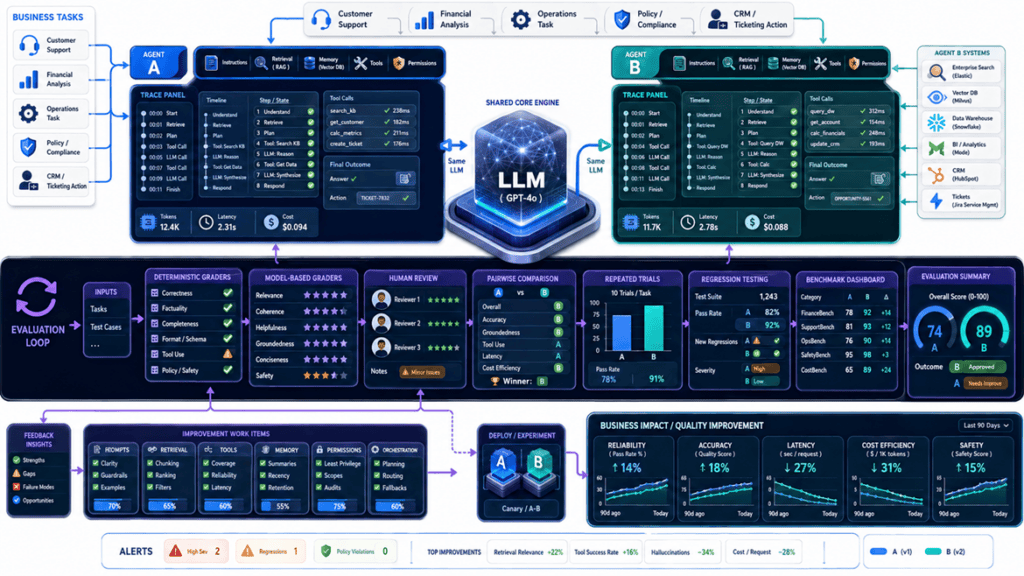
Why AI Agents Give Inconsistent Results cannot be understood without examining evaluation design. Teams improve what they measure. One product may optimise for factual accuracy and policy compliance. Another may optimise for task completion, user preference, speed, or cost.
Those evaluation priorities influence prompts, retrieval, tools, memory, orchestration, and guardrails. The same model can become two very different products because the surrounding systems are being optimised against different scorecards.
Anthropic’s guide to agent evaluations recommends examining repeated trials and complete trajectories, including tool calls, intermediate results, final outcomes, latency, and token use. AWS has likewise argued that evaluating only final answers makes root-cause analysis difficult.
Evaluation design is a major reason Why AI Agents Give Inconsistent Results in production. A few impressive demonstrations do not show how an agent behaves across normal, ambiguous, edge, and adversarial cases.
Progressive Robot’s LangSmith guide explains how traces can reveal prompt failures, retrieval problems, tool errors, and orchestration bugs. Observability turns inconsistency from a vague complaint into a diagnosable execution path.
A Practical Example: Two Refund Agents Using the Same LLM
Consider two support agents receiving the same message:
“I was charged for my annual subscription today, but I meant to cancel. Can you refund it?”
Agent A receives the current refund policy, the authenticated account record, and a tool named check_refund_eligibility. The tool returns a structured result showing that the payment settled today and falls within the approved refund window. The agent must explain the amount and request confirmation before taking financial action.
Agent B searches a general help centre, retrieves an outdated article, receives the customer’s full chat history, and has access to a vaguely named manage_payment tool. Its instructions prioritise rapid resolution but do not define refund limits or approval rules.
Agent A verifies the evidence, explains the decision, requests confirmation, and processes the refund. Agent B may refuse incorrectly, call the wrong operation, or ask unnecessary questions.
The model did not become more intelligent in Agent A. The system gave it a clearer and safer route. This example captures Why AI Agents Give Inconsistent Results: the decisive differences lie in instructions, retrieval, context, tools, permissions, and workflow design.
How to Diagnose Why AI Agents Give Inconsistent Results
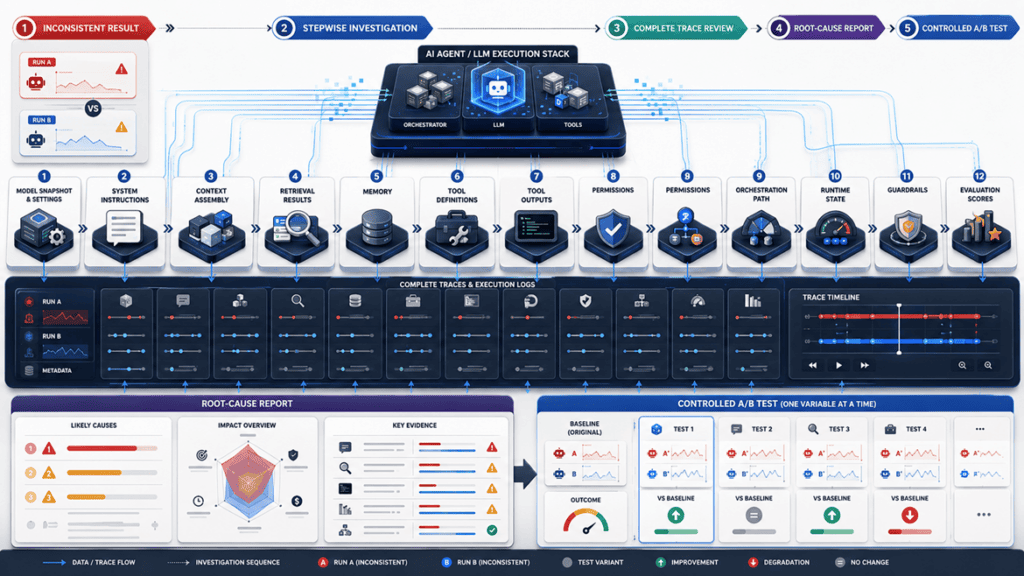
Diagnosing Why AI Agents Give Inconsistent Results requires comparing complete executions rather than reading only the final responses.
Confirm the Actual Model Configuration
Record the provider, endpoint, exact model snapshot, reasoning setting, sampling controls, token limits, response format, and tool-choice configuration. Do not rely on a marketing label.
Capture the Complete Initial Context
Compare system instructions, developer policies, examples, user input, retrieved records, memories, metadata, safety rules, and tool schemas in the exact order supplied to the model.
Compare Every Tool Call
Inspect tool choice, parameters, permissions, outputs, errors, retries, latency, and side effects. One early tool difference can explain the entire later trajectory.
Reproduce the Runtime Environment
Use the same user identity, source data, file versions, time assumptions, permissions, API responses, and sandbox configuration where possible.
Apply the Same Success Rubric
Evaluate factual accuracy, source authority, policy compliance, task completion, action safety, cost, latency, and user value. A smoother response may still be operationally wrong.
Change One Variable at a Time
Replace only the prompt, retrieval layer, memory policy, tool schema, or orchestration rule. Rerun the same evaluation set several times. Changing many variables simultaneously hides the cause.
This controlled process turns Why AI Agents Give Inconsistent Results from a broad observation into an engineering diagnosis.
How to Make AI Agent Results More Consistent
Improving consistency does not require forcing the same wording on every run. The aim is dependable decisions, evidence, and actions under equivalent conditions.
Define Clear Agent Procedures
Document the objective, required evidence, decision rules, permitted actions, escalation conditions, and completion criteria. Standard procedures reduce avoidable ambiguity while preserving reasoning flexibility.
Curate Context Deliberately
Supply current, relevant, and authorised information. Remove duplicated history, stale documents, and oversized tool responses. Preserve critical constraints during compaction.
Improve Retrieval Quality
Use metadata, authority, date, jurisdiction, permissions, hybrid search, and reranking where appropriate. Test whether the correct source is retrieved rather than whether the generated answer merely sounds plausible.
Design Tools for Agent Use
Give tools distinct names, precise descriptions, constrained inputs, compact structured outputs, and actionable errors. Separate read tools from consequential write tools.
Govern Memory
Store information only when it has a clear future purpose. Record provenance and effective dates. Add expiry, correction, deletion, and access controls.
Control Orchestration
Set step budgets, retry limits, timeouts, checkpoints, and stopping rules. Require confirmation or approval before high-impact actions.
Version the Full System
Version prompts, retrieval settings, memory rules, tool schemas, orchestration, model snapshots, and evaluation datasets. The model name alone is insufficient for reproducibility.
Run Repeated-Trial Evaluations
Test normal, ambiguous, edge, and adversarial cases several times. Measure pass rates, not one successful output. Inspect traces when performance changes.
These practices directly reduce the main reasons Why AI Agents Give Inconsistent Results while retaining the flexibility that makes agents useful.
When Different Results Are Acceptable
Variation is not always a failure. Creative writing, brainstorming, research planning, and conversational support may benefit from several valid approaches.
Specialised agents may also be intentionally different. A compliance agent should prioritise evidence, policy, and escalation. A marketing agent may prioritise creativity and audience response. A security agent may choose caution where a sales agent chooses engagement.
The important distinction is between controlled variation and unexplained inconsistency. Controlled variation stays within policy, uses appropriate evidence, and achieves the task. Unexplained inconsistency changes important facts, decisions, or actions without a valid reason.
Understanding Why AI Agents Give Inconsistent Results helps teams preserve useful diversity while constraining high-impact behaviour.
Common Myths About Inconsistent AI Agent Behaviour
A Better Answer Proves the Product Uses a Better Model
Not necessarily. The product may use better retrieval, tools, context, memory, orchestration, or evaluations.
Temperature Zero Makes an Agent Fully Deterministic
Lower sampling randomness can reduce variation, but it cannot freeze changing data, tool outputs, retrieval, model updates, or multi-step branching.
More Context Always Improves Accuracy
Irrelevant or conflicting context can hide the important evidence and reduce reliability.
More Tools Always Create a Better Agent
Overlapping tools increase selection difficulty, context use, operational complexity, and security exposure.
More Memory Always Improves Personalisation
Poor memory can preserve mistakes, stale policies, and sensitive information.
A Strong Model Can Overcome Weak Architecture
A model cannot reliably use evidence it never receives, call a tool it does not have, or enforce a control that was never implemented.
These myths obscure Why AI Agents Give Inconsistent Results by assigning every success or failure to the LLM rather than the complete agent system.
Frequently Asked Questions
Why AI Agents Give Inconsistent Results even when they use the same LLM?
They may receive different system instructions, context, retrieved evidence, memories, tools, permissions, runtime state, and orchestration. Multi-step execution amplifies those differences.
Can the same AI agent produce different results on repeated runs?
Yes. Generative variation, retrieval differences, changing external data, timing, tool failures, and branching decisions can alter the execution path.
Is prompt engineering the main solution?
Prompt engineering helps, but it is only one layer. Context selection, retrieval, memory, tools, permissions, orchestration, and evaluation are often equally important.
How should two AI agents be compared fairly?
Use the same task set, source data, permissions, runtime environment, and success rubric. Run multiple trials and compare complete traces as well as final answers.
Can an AI agent be made fully deterministic?
A tightly controlled workflow can reduce variation, but a flexible agent interacting with changing systems will not behave like a simple deterministic function. High-impact steps should use rules and validation.
Why does one AI product feel smarter than another using the same model?
The stronger product may provide better instructions, evidence, tools, memory, workflow control, and evaluations. Perceived intelligence often reflects total system quality.
Do multi-agent systems improve consistency?
Not automatically. They can improve specialisation and parallel work, but handoffs and coordination introduce additional failure points.
What should an agent platform log?
It should record configuration versions, retrieved sources, tool calls, parameters, outputs, errors, state transitions, approvals, outcomes, latency, and cost while respecting privacy and security requirements.
Are inconsistent results always harmful?
No. Variation is acceptable when several outputs are valid and no consequential fact, policy, or action changes. It becomes a problem when equivalent conditions produce conflicting or unsafe outcomes.
Final Verdict
Why AI Agents Give Inconsistent Results is ultimately a question about the complete system surrounding the language model.
The LLM provides general reasoning and language capability. Instructions determine priorities. Context and retrieval determine the evidence. Tools and permissions determine available actions. Memory determines continuity. Orchestration determines the route. Runtime state determines what the agent observes. Guardrails and evaluations determine which behaviour is permitted and improved.
Businesses should not select an agent product solely by the LLM named on its marketing page. They should ask which sources the system uses, how tools are designed, what the agent remembers, which actions it may take, where approvals are required, and how performance is evaluated across repeated trials.
Teams building agents should version the full system, capture execution traces, test realistic scenarios, and use deterministic controls around high-impact actions. These practices reduce the practical reasons Why AI Agents Give Inconsistent Results without removing the adaptability that makes agentic systems valuable.
Progressive Robot’s guides to AI agent harnesses, effective context engineering, enterprise AI agent memory, and LangSmith evaluation provide additional frameworks for moving from impressive demonstrations to controlled production systems.
Why AI Agents Give Inconsistent Results should therefore be treated as an architecture and operations question. The final lesson behind Why AI Agents Give Inconsistent Results is straightforward: when two agents share the same LLM but behave differently, compare the complete architecture, context, and execution path—not only the model label.