

Artificial intelligence is transforming transportation by helping governments, engineers, and road safety professionals make smarter decisions based on data. One of the latest breakthroughs in AI road safety is the ability to analyze pavement conditions and identify links between deteriorating road surfaces and vehicle crash risks. Instead of relying solely on manual inspections or historical accident reports, AI can process vast amounts of infrastructure and traffic data to identify hazardous road segments before accidents occur.
Road conditions have long been recognized as a significant factor influencing traffic safety. Cracks, potholes, uneven pavement, poor drainage, and surface wear can reduce vehicle stability, increase braking distances, and contribute to collisions. Traditionally, identifying these risks has required time-consuming inspections and reactive maintenance programs. However, advances in AI road safety now allow transportation agencies to detect pavement deterioration more efficiently and prioritize repairs based on predicted crash risks.
Modern AI systems can combine information from road sensors, high-resolution imagery, vehicle telemetry, weather conditions, traffic volumes, and historical accident records to build predictive models. These models identify patterns that may be difficult for human analysts to recognize, enabling authorities to focus maintenance resources where they can have the greatest impact on public safety.
The growing adoption of AI road safety also supports smarter infrastructure management. Rather than repairing roads according to fixed schedules, transportation departments can implement predictive maintenance strategies that reduce costs while improving road quality. By addressing deteriorating pavement before it becomes dangerous, agencies can enhance driver safety, reduce vehicle damage, and extend the lifespan of transportation infrastructure.
Beyond road maintenance, AI road safety contributes to broader smart city initiatives by integrating with intelligent transportation systems, connected vehicles, traffic monitoring platforms, and digital infrastructure. As artificial intelligence becomes more sophisticated, predictive analytics will play an increasingly important role in reducing accidents and improving mobility.
In this article, we’ll explore how AI road safety analyzes pavement conditions, why road surface quality affects crash risk, how researchers are using AI to improve transportation planning, and what this technology means for the future of safer roads.
Key Takeaways
- AI road safety helps identify dangerous pavement conditions before accidents occur.
- AI analyzes road quality, traffic data, weather, and crash history simultaneously.
- Predictive maintenance improves infrastructure while reducing repair costs.
- Transportation agencies can prioritize repairs using AI-generated risk assessments.
- Smart infrastructure supports safer roads and more efficient public investment.
- AI is becoming an essential tool for future transportation planning.
What Is AI Road Safety?

AI road safety refers to the use of artificial intelligence technologies to improve transportation safety by analyzing road conditions, traffic patterns, driver behavior, infrastructure performance, and environmental factors.
Instead of relying solely on manual inspections or reactive maintenance, AI continuously evaluates large datasets to identify risks before they result in accidents.
Modern AI road safety systems can assist with:
- Pavement condition monitoring.
- Crash risk prediction.
- Traffic flow analysis.
- Infrastructure inspections.
- Predictive maintenance.
- Hazard detection.
- Road asset management.
- Transportation planning.
These capabilities enable transportation agencies to make faster, data-driven decisions that improve public safety.
How AI Analyzes Pavement Conditions
One of the most valuable applications of AI road safety is pavement analysis.
Road surfaces naturally deteriorate over time because of heavy traffic, weather conditions, aging materials, and environmental stress. AI helps detect this deterioration much earlier than traditional inspection methods.
Modern AI systems gather information from multiple sources, including:
- High-resolution road images.
- Mobile mapping vehicles.
- Drones.
- Satellite imagery.
- Roadside sensors.
- Connected vehicles.
- Weather stations.
- Maintenance records.
Machine learning algorithms then evaluate pavement characteristics such as:
- Cracks.
- Surface roughness.
- Rutting.
- Potholes.
- Edge failures.
- Drainage issues.
- Surface wear.
- Structural deformation.
By recognizing subtle deterioration patterns, AI enables proactive maintenance before road conditions become hazardous.
Why Pavement Quality Affects Crash Risk
Road surface quality plays a major role in vehicle safety.
Damaged pavement can reduce tire grip, increase stopping distances, affect steering stability, and contribute to loss of vehicle control.
Poor pavement conditions become even more dangerous during:
- Heavy rain.
- Snow.
- Ice.
- Low visibility.
- High-speed traffic.
- Sharp curves.
- Busy intersections.
- Construction zones.
Using AI road safety, transportation agencies can identify these high-risk areas earlier and schedule repairs before accident rates increase.
This proactive approach helps improve safety while reducing long-term infrastructure costs.
Understanding the Research
Recent research demonstrates how AI road safety can establish meaningful relationships between pavement conditions and crash frequency.
Rather than examining road quality or accident history independently, AI models combine multiple datasets to identify hidden patterns that influence transportation safety.
Researchers typically analyze information such as:
- Pavement condition ratings.
- Historical collision data.
- Traffic density.
- Vehicle speeds.
- Road geometry.
- Weather conditions.
- Maintenance history.
- Geographic location.
Machine learning models then calculate the likelihood that deteriorating pavement contributes to future crash risks.
These insights help transportation agencies make evidence-based maintenance decisions instead of relying solely on scheduled inspections or subjective assessments.
AI Is Making Transportation More Predictive
Traditional road maintenance often focuses on repairing infrastructure after visible deterioration or increased accident reports.
By contrast, AI road safety supports predictive infrastructure management.
Instead of asking, “Which roads need repairs today?” transportation authorities can ask, “Which roads are most likely to become dangerous in the near future?”
This shift from reactive maintenance to predictive decision-making represents one of the most significant advantages of artificial intelligence in transportation.
AI Technologies Used in Road Safety
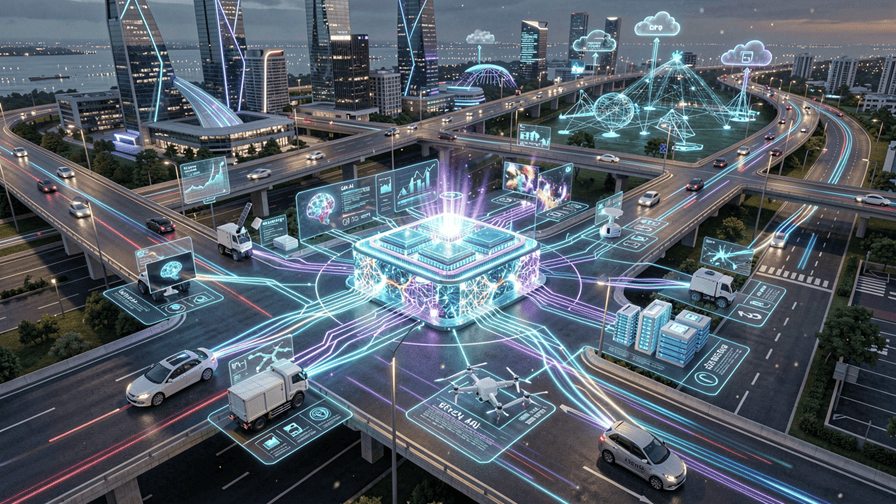
Modern AI road safety solutions combine several advanced technologies to evaluate road infrastructure, predict crash risks, and support transportation planning. Instead of relying on a single source of information, AI integrates multiple datasets to generate a comprehensive understanding of road conditions.
This data-driven approach enables transportation agencies to detect hazards earlier and make more informed maintenance decisions.
Machine Learning
Machine learning is the foundation of many AI road safety systems.
By analyzing historical accident records alongside pavement condition data, machine learning models identify relationships that would be difficult for humans to detect manually.
These models continuously improve as they receive additional information from new inspections, traffic patterns, and maintenance activities.
Computer Vision
Computer vision allows AI to inspect road surfaces automatically.
Using images captured by:
- Road inspection vehicles.
- Drones.
- Traffic cameras.
- Smartphones.
- Satellite imagery.
AI can detect:
- Cracks.
- Potholes.
- Surface wear.
- Lane deterioration.
- Edge damage.
- Road markings.
- Debris.
- Surface deformation.
Automated inspections reduce costs while improving inspection frequency.
Predictive Analytics
Predictive analytics transforms raw infrastructure data into actionable insights.
Instead of identifying only current pavement defects, AI road safety predicts where future problems are likely to develop based on historical trends and environmental conditions.
This enables agencies to prioritize maintenance before road quality declines significantly.
Geographic Information Systems (GIS)
Many AI road safety platforms integrate Geographic Information Systems (GIS) to visualize road conditions across large transportation networks.
GIS helps authorities:
- Map deteriorating roads.
- Monitor maintenance progress.
- Compare regional infrastructure.
- Identify accident hotspots.
- Plan repair schedules.
- Optimize maintenance budgets.
Interactive mapping makes complex transportation data easier to interpret.
Benefits for Transportation Agencies
The adoption of AI road safety offers numerous operational and financial advantages for transportation departments responsible for maintaining extensive road networks.
Improved Maintenance Planning
Rather than repairing roads according to fixed schedules, agencies can prioritize repairs based on AI-generated risk assessments.
This results in:
- Better resource allocation.
- Lower maintenance costs.
- Reduced emergency repairs.
- Longer pavement life.
- Improved public safety.
Faster Infrastructure Inspections
Traditional road inspections require significant time and labor.
AI-powered inspections can evaluate hundreds of kilometers of roadway far more efficiently while maintaining consistent assessment standards.
Better Budget Management
Infrastructure budgets are often limited.
By identifying roads with the highest predicted crash risk, AI road safety helps decision-makers invest maintenance funds where they will have the greatest impact.
Data-Driven Decision Making
Artificial intelligence replaces subjective infrastructure evaluations with measurable, evidence-based analysis.
Transportation agencies can justify repair priorities using objective AI-generated insights supported by large datasets.
Real-World Applications
The practical applications of AI road safety continue expanding as transportation systems become increasingly connected.
Highway Maintenance
State and national transportation agencies can monitor major highways continuously, identifying pavement deterioration before it creates serious safety hazards.
Urban Road Networks
Cities can use AI road safety to prioritize repairs in areas experiencing heavy traffic, frequent accidents, or rapidly deteriorating infrastructure.
Smart Cities
Smart city initiatives increasingly integrate AI with:
- Traffic management systems.
- Connected vehicles.
- Road sensors.
- Weather monitoring.
- Public transportation.
- Emergency response.
This creates a more responsive transportation ecosystem.
Fleet Management
Commercial fleet operators can use AI road safety insights to optimize routes, reduce vehicle wear, improve driver safety, and minimize accident risks.
Infrastructure Planning
Long-term infrastructure investments become more effective when planners understand which road characteristics contribute most significantly to crash risks.
AI helps prioritize future reconstruction projects based on predictive analysis rather than historical assumptions.
How AI Improves Public Safety
The greatest benefit of AI road safety is its potential to prevent accidents before they occur.
Instead of responding after crashes happen, transportation agencies can proactively identify hazardous road segments and address infrastructure issues earlier.
Potential public safety improvements include:
- Fewer traffic accidents.
- Reduced fatalities.
- Lower injury rates.
- Faster maintenance responses.
- Improved road quality.
- Better emergency planning.
- Safer driving conditions.
- Increased public confidence.
Predictive maintenance represents a significant shift toward proactive transportation safety.
AI Supports Smarter Infrastructure
Transportation infrastructure is becoming increasingly intelligent.
Road sensors, connected vehicles, drones, cloud computing, and advanced analytics now work together to generate real-time infrastructure insights.
Within this ecosystem, AI road safety acts as the analytical engine that transforms massive datasets into practical recommendations for engineers and policymakers.
As more connected infrastructure is deployed, AI will become an even more valuable tool for maintaining safe, efficient, and resilient transportation networks.
Challenges and Limitations of AI Road Safety

Although AI road safety has enormous potential to improve transportation safety and infrastructure management, it is not without challenges. Artificial intelligence depends on high-quality data, reliable infrastructure, and continuous monitoring to produce accurate predictions. If these requirements are not met, AI systems may generate incomplete assessments or inaccurate risk forecasts.
Transportation agencies should therefore view AI road safety as a decision-support tool that complements engineering expertise rather than replacing it.
Data Quality and Accuracy
The effectiveness of AI road safety depends largely on the quality of the data used to train and operate machine learning models.
Incomplete or outdated information can reduce prediction accuracy and lead to incorrect maintenance priorities.
Common data challenges include:
- Missing pavement inspection records.
- Inconsistent road condition ratings.
- Limited crash history.
- Poor image quality.
- Sensor failures.
- Weather-related data gaps.
- Inaccurate traffic measurements.
- Inconsistent reporting standards.
Maintaining accurate, up-to-date datasets is essential for reliable AI analysis.
Model Bias and Generalization
AI models learn from historical information.
If training datasets do not represent different road types, climates, traffic conditions, or geographic regions, AI road safety models may struggle to produce reliable predictions in unfamiliar environments.
For example, an AI system trained primarily on urban roads may perform differently when analyzing rural highways or mountainous terrain.
Regular model updates and diverse datasets help improve accuracy across various transportation networks.
Infrastructure Costs
Implementing AI road safety requires investment in both digital infrastructure and physical monitoring equipment.
Organizations may need to deploy:
- Road sensors.
- Inspection vehicles.
- Drones.
- High-resolution cameras.
- Cloud computing resources.
- Data storage systems.
- Network connectivity.
- AI software platforms.
While these investments can reduce long-term maintenance costs, they may present financial challenges for smaller transportation agencies.
Privacy and Data Governance
Some AI road safety systems use data collected from connected vehicles, mobile devices, or traffic monitoring systems.
Transportation authorities must ensure that data collection complies with privacy regulations and protects sensitive information.
Strong governance should include:
- Data anonymization.
- Secure storage.
- Access controls.
- Cybersecurity protections.
- Regulatory compliance.
- Clear data retention policies.
- Transparency.
- Ethical AI practices.
Responsible data management strengthens public trust while supporting effective AI deployment.
Human Expertise Remains Essential
Artificial intelligence can identify patterns and generate recommendations, but transportation engineering still requires professional judgment.
Road maintenance decisions often involve factors beyond what AI models can measure, including:
- Local construction priorities.
- Budget constraints.
- Emergency repairs.
- Community needs.
- Environmental regulations.
- Engineering assessments.
- Political considerations.
- Long-term infrastructure planning.
Combining AI road safety with experienced transportation professionals produces the most reliable outcomes.
Best Practices for Implementing AI Road Safety
Organizations seeking to adopt AI road safety should follow a structured implementation strategy that balances technology with operational expertise.
Begin with Pilot Projects
Rather than deploying AI across an entire transportation network immediately, agencies should start with smaller pilot programs to evaluate performance under real-world conditions.
Pilot projects provide valuable insights while reducing implementation risks.
Standardize Data Collection
Consistent pavement inspections, sensor calibration, and reporting methods improve the quality of AI predictions.
Standardized datasets also simplify long-term model training and validation.
Continuously Monitor AI Performance
Machine learning models require ongoing evaluation.
Transportation agencies should regularly review:
- Prediction accuracy.
- Maintenance outcomes.
- Crash reduction trends.
- Model performance.
- Data quality.
- Infrastructure changes.
Continuous improvement ensures that AI systems remain reliable over time.
Integrate Multiple Data Sources
Combining imagery, traffic information, weather data, pavement inspections, and maintenance history produces more comprehensive risk assessments than relying on a single dataset.
This multi-source approach strengthens AI road safety predictions.
Future Research Directions
Research into AI road safety continues advancing rapidly.
Future studies are expected to improve how AI evaluates infrastructure by incorporating richer datasets and more sophisticated predictive models.
Areas of ongoing research include:
- Autonomous road inspections.
- Real-time pavement monitoring.
- Connected vehicle analytics.
- Smart highway infrastructure.
- Edge AI processing.
- Digital twins for transportation.
- Climate impact modeling.
- Predictive infrastructure maintenance.
These innovations will help transportation agencies detect safety risks earlier while optimizing maintenance investments.
AI and the Evolution of Smart Transportation
As transportation systems become more connected, AI road safety will play an increasingly important role in supporting intelligent infrastructure.
Future road networks may combine AI with connected vehicles, smart traffic signals, roadside sensors, satellite imaging, and digital infrastructure to create transportation systems that continuously monitor, evaluate, and improve road safety in real time.
Rather than reacting to accidents after they occur, transportation agencies will increasingly rely on predictive intelligence to prevent them before they happen.
The Future of AI Road Safety
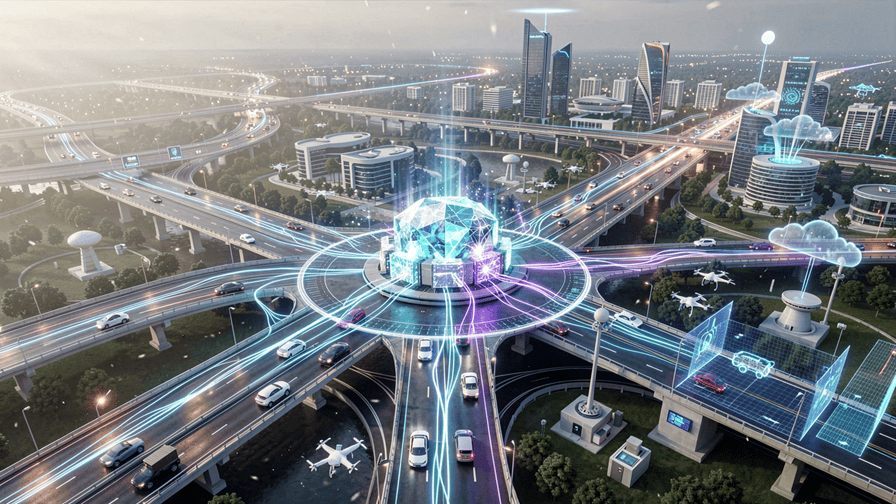
The future of AI road safety is closely tied to the evolution of smart transportation systems, connected infrastructure, and predictive analytics. As governments continue investing in digital infrastructure and intelligent transportation networks, artificial intelligence will play a much larger role in preventing accidents before they occur.
Instead of relying primarily on routine inspections or reactive repairs, future AI road safety platforms will continuously monitor road conditions using real-time data collected from connected vehicles, roadside sensors, drones, satellites, and IoT devices. These systems will automatically detect pavement deterioration, estimate crash risks, recommend maintenance priorities, and support engineers with data-driven decision-making.
Several developments are expected to shape the future of AI road safety:
- Real-time road condition monitoring.
- AI-powered predictive maintenance.
- Connected vehicle communication.
- Smart highway infrastructure.
- Digital twins for transportation networks.
- Autonomous infrastructure inspections.
- Edge AI for faster analysis.
- Integrated smart city transportation systems.
As these technologies mature, transportation agencies will be able to allocate resources more efficiently while significantly improving public safety.
Strategic Takeaways
The latest research linking pavement conditions to crash risk demonstrates how AI road safety is changing transportation management.
Key insights include:
- Artificial intelligence enables proactive road maintenance rather than reactive repairs.
- Pavement quality is an important factor influencing traffic safety.
- Machine learning can identify complex relationships between infrastructure conditions and accident risks.
- Predictive analytics improves maintenance planning and budget allocation.
- Smart infrastructure supports safer and more resilient transportation networks.
- Human expertise remains essential for interpreting AI recommendations and making engineering decisions.
Organizations that combine AI technologies with high-quality infrastructure data and experienced transportation professionals will be better positioned to improve road safety while reducing long-term maintenance costs.
Conclusion
Artificial intelligence is becoming an increasingly valuable tool for improving transportation safety and infrastructure management. The latest research connecting pavement conditions with crash risk highlights the growing potential of AI road safety to help transportation agencies identify dangerous road segments before accidents occur.
By analyzing pavement quality, traffic patterns, weather conditions, historical crash data, and infrastructure performance, AI road safety enables predictive maintenance strategies that improve road quality while optimizing public investment. Rather than waiting for roads to deteriorate or accident rates to rise, agencies can proactively address infrastructure issues based on AI-generated risk assessments.
Although challenges remain—including data quality, infrastructure investment, privacy, and model accuracy—the benefits of AI-driven transportation planning continue to grow. Advances in machine learning, computer vision, connected vehicles, and smart infrastructure are making predictive road safety more practical and reliable than ever before.
As transportation networks become increasingly connected, AI road safety will play a central role in reducing accidents, improving mobility, extending infrastructure lifespan, and supporting smarter cities. Organizations that embrace AI-powered transportation technologies today will be well positioned to build safer, more resilient road networks for the future.
Frequently Asked Questions (FAQs)
What is AI road safety?
AI road safety refers to the use of artificial intelligence to improve transportation safety by analyzing road conditions, traffic patterns, weather, infrastructure, and historical crash data to predict risks and support better decision-making.
How does AI detect dangerous pavement conditions?
AI uses technologies such as computer vision, machine learning, road sensors, drones, satellite imagery, and connected vehicles to identify cracks, potholes, surface wear, rutting, drainage issues, and other pavement defects that may increase crash risk.
Why is pavement condition important for road safety?
Damaged pavement can reduce tire traction, increase braking distances, affect vehicle stability, and contribute to accidents, particularly during adverse weather or high-speed driving conditions.
Who benefits from AI road safety?
Transportation agencies, highway authorities, city planners, civil engineers, infrastructure managers, fleet operators, insurance companies, and the general public all benefit from improved road maintenance and safer transportation networks.
Can AI replace transportation engineers?
No. AI road safety supports engineers by providing predictive insights and data analysis, but experienced professionals remain essential for infrastructure planning, engineering assessments, regulatory compliance, and maintenance decisions.
Build Smarter Transportation Solutions with AI
Artificial intelligence is transforming how organizations monitor infrastructure, predict maintenance needs, and improve public safety. Whether you’re planning AI-powered analytics, computer vision solutions, predictive maintenance systems, or smart infrastructure projects, our experts can help you design and deploy secure, scalable AI solutions tailored to your transportation goals.
More AI coverage: explore Progressive Robot's AI Models, Tools & Releases hub — hands-on reviews, setup guides and benchmarks in one place.










