
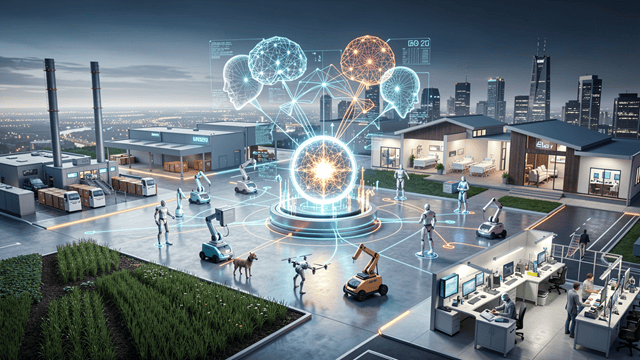
AI agents create virtual playgrounds that are transforming the way robots learn, adapt, and perform real-world tasks. Instead of relying solely on expensive physical testing environments, robotics companies are increasingly using AI-powered simulation platforms where robots can safely practice millions of interactions before ever touching the real world. These virtual environments generate vast amounts of high-quality training data, allowing robots to learn faster, make fewer mistakes, and continuously improve through artificial intelligence.
The rapid advancement of robotics, autonomous systems, and generative AI has created an enormous demand for training data. Traditional methods of collecting real-world data are often slow, costly, and difficult to scale. Every physical experiment requires hardware, human supervision, maintenance, and time. Virtual playgrounds solve this challenge by providing AI agents with realistic digital environments where they can generate unlimited synthetic data while learning from trial and error.
Major technology companies, robotics startups, and research institutions are investing heavily in simulation-based learning because it enables robots to master complex skills long before they enter factories, hospitals, warehouses, or homes. As embodied AI continues to evolve, virtual playgrounds are becoming one of the most valuable tools for developing safer, smarter, and more capable robots.
In this article, we’ll explore how AI agents create virtual playgrounds, why synthetic training data is essential for modern robotics, the technologies powering these digital environments, and how they are shaping the future of artificial intelligence.
Key Takeaways
Before diving deeper, here are the most important insights about how AI agents create virtual playgrounds:
- AI-powered simulations allow robots to learn without the risks associated with physical testing.
- Virtual playgrounds generate massive amounts of synthetic training data for machine learning models.
- Reinforcement learning enables robots to improve through continuous experimentation.
- Digital twins accurately replicate real-world environments for realistic training.
- Simulation significantly reduces development costs while accelerating robot deployment.
- Companies developing embodied AI increasingly rely on virtual environments before real-world testing.
Why AI Agents Create Virtual Playgrounds
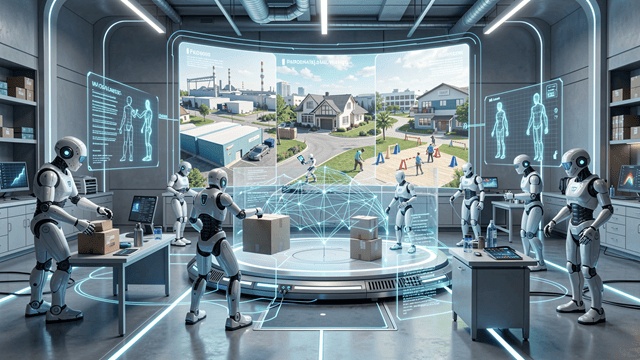
Robots learn differently from humans.
While people can often understand new tasks after watching a demonstration or reading instructions, robots require enormous quantities of structured training data before they can reliably perform even relatively simple activities.
Consider a warehouse robot learning to pick up boxes.
To become reliable, it must understand:
- Object recognition
- Depth perception
- Grasping techniques
- Collision avoidance
- Navigation
- Balance
- Motion planning
- Environmental changes
Collecting this information entirely in the physical world would require thousands—or even millions—of successful and unsuccessful attempts.
Physical experimentation presents several challenges:
- Hardware wear and tear
- High operational costs
- Safety concerns
- Limited scalability
- Human supervision
- Slow iteration cycles
Virtual playgrounds eliminate many of these barriers.
Instead of learning in expensive physical environments, robots can practice inside highly realistic digital simulations where mistakes carry no physical consequences.
What Are Virtual Playgrounds in Artificial Intelligence?
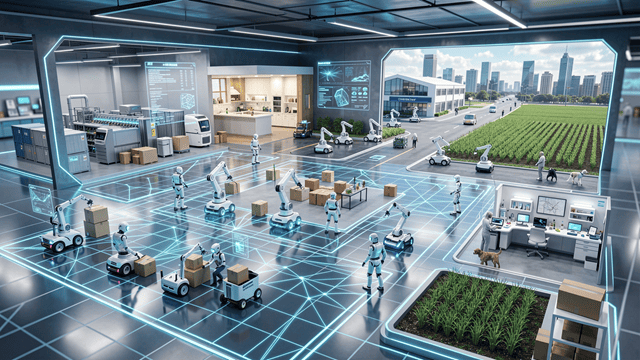
Virtual playgrounds are computer-generated simulation environments where AI agents and robots interact with realistic digital worlds.
These environments recreate physical laws, environmental conditions, lighting, object behavior, human interactions, and sensor inputs with remarkable accuracy.
Within these simulations, robots can:
- Walk
- Navigate buildings
- Pick up objects
- Operate machinery
- Open doors
- Stack inventory
- Avoid obstacles
- Collaborate with humans
- Respond to emergencies
Every interaction generates valuable training data.
Unlike traditional datasets, these environments continuously produce fresh examples that improve machine learning performance over time.
This makes virtual playgrounds one of the most scalable sources of AI training data available today.
Why Synthetic Training Data Is Becoming Essential
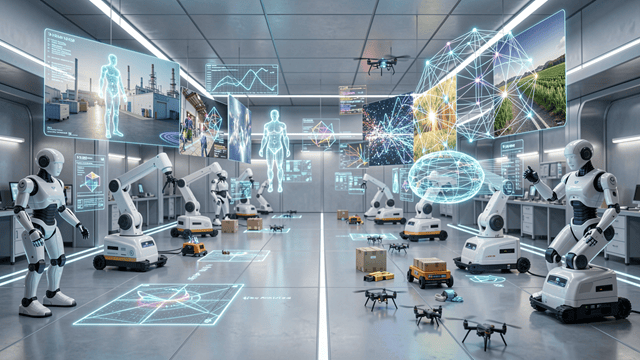
One of the primary reasons AI agents create virtual playgrounds is the growing need for synthetic training data.
Synthetic data refers to information generated artificially rather than collected directly from the real world.
For robotics, this offers several important advantages.
Unlimited Data Generation
Physical robots may perform only a few hundred experiments each day.
Inside a simulation, AI agents can complete millions of experiments within the same timeframe.
This dramatically accelerates learning.
Lower Development Costs
Building physical testing facilities is expensive.
Simulation environments reduce costs by allowing engineers to identify problems before manufacturing or deploying hardware.
Safer Learning
Many robotics applications involve dangerous environments such as:
- Construction sites
- Factories
- Nuclear facilities
- Disaster zones
- Offshore platforms
- Space exploration
Virtual playgrounds allow robots to learn safely without exposing people or equipment to unnecessary risk.
Faster Machine Learning
Machine learning models improve when exposed to diverse scenarios.
Simulation platforms can instantly create:
- Different weather conditions
- Changing lighting
- Unexpected obstacles
- Equipment failures
- Human interactions
- Rare edge cases
These variations help robots become more adaptable in unpredictable real-world environments.
The Role of AI Agents in Robot Learning
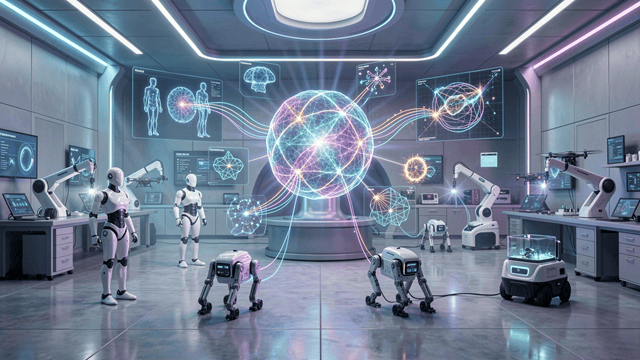
AI agents act as intelligent decision-makers within virtual environments.
Rather than following fixed instructions, they continuously observe their surroundings, make decisions, evaluate outcomes, and improve their behavior.
This learning process often relies on reinforcement learning, where an AI agent receives rewards for successful actions and penalties for poor decisions.
For example:
A warehouse robot receives positive rewards for correctly placing inventory.
It receives negative rewards if it drops products, collides with obstacles, or chooses inefficient routes.
Over millions of simulated interactions, the AI gradually develops increasingly effective strategies.
Because AI agents create virtual playgrounds that support continuous experimentation, robots can learn complex behaviors much faster than through physical testing alone.
Reinforcement Learning Powers Continuous Improvement
Reinforcement learning has become one of the most important techniques used within virtual playgrounds.
Instead of memorizing predefined instructions, robots learn through experience.
The process typically follows four steps:
- Observe the environment.
- Select an action.
- Receive feedback.
- Improve future decisions.
Repeating this cycle millions of times enables robots to develop sophisticated behaviors that would be impossible to program manually.
This approach is particularly valuable for:
- Autonomous navigation
- Robotic manipulation
- Industrial automation
- Autonomous vehicles
- Medical robotics
- Household assistants
How Simulations Accelerate Robotics Innovation
One of the greatest advantages of simulation is speed.
Developers can test thousands of software updates overnight without interrupting physical operations.
Entire fleets of virtual robots can train simultaneously, each exploring different solutions to the same problem.
This parallel experimentation dramatically shortens development cycles while improving model accuracy.
As a result, robotics companies can deploy safer and more reliable systems much sooner than would otherwise be possible.
How AI Agents Create Virtual Playgrounds Using Digital Twins
One of the most significant technologies enabling AI agents create virtual playgrounds is the digital twin. A digital twin is a highly detailed virtual replica of a physical object, machine, facility, or entire environment. Unlike a simple 3D model, a digital twin continuously mirrors real-world conditions by incorporating physics, sensor data, environmental variables, and operational behavior.
For robotics developers, digital twins provide an ideal environment for training AI systems before they are deployed in the real world. Engineers can accurately simulate factories, warehouses, hospitals, offices, retail stores, farms, or even entire cities, allowing robots to practice complex tasks without interrupting day-to-day operations.
As AI models improve, updates can be tested in the digital twin first. Once performance reaches acceptable levels, those improvements can be transferred to physical robots, significantly reducing deployment risks.
The Technologies Powering Virtual Robot Training
Creating realistic virtual playgrounds requires the integration of several advanced technologies. Rather than relying on a single AI model, these environments combine computer vision, physics simulation, machine learning, robotics software, and high-performance computing.
Together, these technologies enable AI agents to interact with digital worlds that closely resemble real-life environments.
Physics Engines
Physics engines simulate how objects move and interact according to the laws of physics.
They calculate:
- Gravity
- Friction
- Momentum
- Collisions
- Material properties
- Force interactions
- Balance
- Deformation
Without accurate physics simulation, robots would learn unrealistic behaviors that fail when transferred into physical environments.
For example, a robot trained to lift a lightweight virtual box must also understand how heavier boxes behave under different conditions.
Modern physics engines allow AI agents to experience these variations naturally.
Computer Vision Simulation
Robots perceive the world using cameras and sensors rather than human eyes.
Virtual playgrounds therefore simulate realistic visual inputs, including:
- Shadows
- Reflections
- Lighting changes
- Motion blur
- Camera noise
- Lens distortion
- Depth sensing
- Object occlusion
This synthetic visual data trains computer vision models to recognize objects under diverse real-world conditions.
Sensor Simulation
Today’s robots depend on numerous sensors to understand their surroundings.
Virtual environments accurately reproduce information generated by:
- LiDAR
- RGB cameras
- Depth cameras
- Radar
- GPS
- Inertial Measurement Units (IMUs)
- Force sensors
- Tactile sensors
By exposing robots to realistic sensor outputs, developers can identify perception problems long before physical deployment.
High-Performance Computing
Training millions of virtual interactions requires enormous computational resources.
Cloud computing and Graphics Processing Units (GPUs) enable thousands of AI agents to train simultaneously.
This parallel processing dramatically accelerates learning while reducing development costs.
Many organizations also use distributed computing clusters to run large-scale simulations continuously.
Domain Randomization Makes Robots More Adaptable
One of the biggest challenges in robotics is ensuring that skills learned in simulation transfer successfully into the physical world.
This challenge is commonly known as the Sim-to-Real Gap.
To reduce this gap, developers use a technique called domain randomization.
Rather than keeping every simulation identical, AI agents experience constant variation during training.
Examples include:
- Different lighting conditions
- Changing weather
- Floor textures
- Furniture layouts
- Object colors
- Camera positions
- Sensor noise
- Human movement
- Equipment failures
These randomized environments prevent robots from memorizing specific scenarios.
Instead, they learn general principles that apply across many different situations.
This significantly improves real-world reliability.
Sim-to-Real Transfer: Moving From Virtual to Physical Robots
Generating synthetic data alone is not enough.
Ultimately, robots must perform successfully outside the simulation.
Sim-to-real transfer refers to the process of applying behaviors learned in virtual playgrounds to physical robots operating in real environments.
Successful transfer depends on several factors.
Accurate Environmental Modelling
The virtual world should closely match real-world conditions, including dimensions, materials, lighting, and object behavior.
Realistic Sensor Inputs
Sensor simulation must accurately represent the cameras, LiDAR systems, depth sensors, and other hardware installed on physical robots.
Continuous Calibration
Developers compare simulated performance with real-world observations and refine the virtual environment accordingly.
This feedback loop gradually improves simulation accuracy.
Hybrid Training
Many robotics companies combine synthetic data with real-world observations.
Simulation provides broad experience, while physical testing validates performance under actual operating conditions.
Together, these approaches produce more reliable AI systems.
Why AI Agents Create Virtual Playgrounds Instead of Collecting Only Real Data
Although real-world data remains essential, relying on physical training alone presents several limitations.
Virtual playgrounds solve many of these challenges.
Unlimited Scale
A single simulation platform can generate millions of unique scenarios every day.
Collecting equivalent real-world data could take years.
Rare Events Become Easy to Study
Some situations occur very infrequently in real life.
Examples include:
- Emergency evacuations
- Equipment failures
- Falling objects
- Extreme weather
- Traffic accidents
- Hazardous material spills
Waiting for these events to occur naturally is impractical.
Simulation allows AI agents to practice them repeatedly.
Faster Iteration
Engineers can modify environments within minutes.
Instead of rebuilding physical test facilities, they simply adjust digital parameters.
This greatly accelerates product development.
Reduced Hardware Damage
Robots inevitably make mistakes while learning.
Virtual environments eliminate repair costs associated with crashes, collisions, and failed experiments.
Industries Benefiting From Virtual Robot Training
The fact that AI agents create virtual playgrounds is reshaping numerous industries beyond robotics research.
Manufacturing
Industrial robots practice assembly tasks, quality inspection, and predictive maintenance before deployment on production lines.
Healthcare
Medical robots train for surgical assistance, rehabilitation support, hospital logistics, and patient interaction inside realistic simulations.
Warehousing and Logistics
Autonomous mobile robots optimize inventory movement, package handling, and route planning within simulated fulfillment centers.
Agriculture
Agricultural robots learn crop monitoring, harvesting, weed detection, and autonomous navigation across virtual farms.
Autonomous Vehicles
Self-driving cars rely extensively on simulated environments to experience billions of driving scenarios that would be impossible to recreate safely on public roads.
Space Exploration
Robotic systems designed for lunar and planetary missions practice navigation, equipment handling, and terrain analysis inside digital replicas of extraterrestrial environments.
Embodied AI: The Next Evolution of Robot Intelligence
Embodied AI combines artificial intelligence with physical interaction.
Rather than existing only as software, embodied AI systems learn by interacting with environments through sensors and actuators.
Virtual playgrounds provide the perfect training ground for embodied AI because they allow robots to experience movement, manipulation, perception, and decision-making simultaneously.
As embodied AI advances, robots will become increasingly capable of adapting to unfamiliar situations without requiring explicit programming for every possible scenario.
Benefits of Virtual Playgrounds for AI and Robotics
As AI agents create virtual playgrounds, robotics companies are discovering that simulation-based learning offers advantages that extend far beyond reducing development costs. These digital environments enable faster innovation, improve robot reliability, and allow organizations to scale AI training in ways that would be impossible using physical testing alone.
From industrial automation to autonomous vehicles, virtual playgrounds are becoming an essential component of modern AI development strategies.
Accelerated Robot Learning
One of the greatest benefits of virtual playgrounds is the speed at which robots can acquire new skills.
Traditional robot training depends on physical hardware, which introduces limitations such as battery life, maintenance schedules, hardware failures, and human supervision. Every real-world experiment consumes valuable time and resources.
Simulation removes many of these barriers.
Thousands of virtual robots can train simultaneously, each exploring different solutions to the same problem. AI agents continuously evaluate successful and unsuccessful actions, allowing machine learning models to improve at an unprecedented pace.
Tasks that might require months of physical experimentation can often be completed within days using large-scale simulation environments.
Improved Safety During Training
Safety remains one of the biggest challenges in robotics.
Many robots operate in environments where mistakes could damage expensive equipment or place people at risk.
Examples include:
- Manufacturing facilities
- Hospitals
- Construction sites
- Mining operations
- Airports
- Warehouses
- Energy infrastructure
- Disaster response zones
By allowing AI agents create virtual playgrounds, developers can expose robots to dangerous situations without risking human safety or damaging physical equipment.
Robots can repeatedly practice emergency procedures, hazardous operations, and rare failure scenarios until they achieve consistent performance.
Lower Development Costs
Building and maintaining physical testing environments requires significant investment.
Organizations must purchase robots, sensors, replacement parts, testing facilities, and specialized equipment while also employing engineers to supervise experiments.
Virtual playgrounds dramatically reduce these expenses.
Once a simulation platform has been developed, it can generate millions of training scenarios with minimal additional cost.
This allows startups and established enterprises alike to accelerate innovation while making more efficient use of research budgets.
Better Generalization
One common challenge in robotics is overfitting.
A robot trained under highly controlled conditions may perform exceptionally well during testing but struggle when faced with unfamiliar environments.
Virtual playgrounds solve this problem by introducing continuous variation during training.
AI agents encounter:
- Different room layouts
- Changing weather conditions
- Variable lighting
- Moving obstacles
- Unexpected equipment failures
- Diverse object shapes
- Random human behavior
- Sensor inaccuracies
This diversity encourages robots to develop flexible decision-making rather than memorizing individual scenarios.
As a result, robots become more capable of adapting to unpredictable real-world conditions.
Continuous Improvement Through Synthetic Data
Unlike traditional datasets, simulation environments never stop generating new information.
Each interaction produces additional examples that can be used to improve machine learning models.
Developers can instantly create new scenarios by modifying:
- Environmental conditions
- Object properties
- Mission objectives
- Robot configurations
- Sensor settings
- Physical constraints
This continuous stream of synthetic training data enables AI systems to improve long after their initial deployment.
Real-World Applications of Virtual Playgrounds
The fact that AI agents create virtual playgrounds is transforming industries across the global economy.
Rather than remaining confined to research laboratories, simulation-based AI training is now being adopted at commercial scale.
Smart Manufacturing
Manufacturers use virtual factories to train robotic arms responsible for:
- Product assembly
- Welding
- Painting
- Packaging
- Material handling
- Quality inspection
Before software updates are deployed on production lines, they are validated inside digital simulations to reduce downtime and improve operational efficiency.
Healthcare Robotics
Healthcare providers are exploring simulation environments to train robots that assist with:
- Surgical procedures
- Hospital logistics
- Medication delivery
- Rehabilitation support
- Patient monitoring
Virtual training allows developers to evaluate robot behavior under numerous clinical scenarios without affecting patient safety.
Warehouse Automation
Modern fulfillment centers increasingly depend on autonomous mobile robots.
Simulation enables these robots to optimize:
- Route planning
- Shelf navigation
- Inventory handling
- Collision avoidance
- Fleet coordination
- Energy efficiency
As e-commerce continues to grow, virtual playgrounds help logistics companies deploy increasingly intelligent warehouse automation systems.
Autonomous Vehicles
Self-driving vehicles rely heavily on synthetic data.
AI agents continuously simulate:
- Urban traffic
- Rural roads
- Highway driving
- Adverse weather
- Pedestrian behavior
- Construction zones
- Emergency vehicles
- Unexpected obstacles
These simulations expose autonomous driving systems to situations that would be difficult, expensive, or dangerous to recreate physically.
Agriculture
Agricultural robots use virtual environments to learn:
- Crop monitoring
- Precision spraying
- Harvesting
- Soil analysis
- Autonomous navigation
- Weed detection
Simulation improves efficiency while reducing the costs associated with field testing.
Leading Companies Advancing Virtual Robot Training
As demand for intelligent robotics grows, several organizations are investing heavily in simulation technologies.
Some of the most influential companies include:
NVIDIA
NVIDIA develops advanced simulation platforms that combine high-fidelity graphics, physics simulation, and AI training. These environments support robotics research, autonomous vehicles, and industrial automation while enabling developers to create realistic digital twins.
Google DeepMind
Google DeepMind continues advancing reinforcement learning techniques that enable AI agents to solve increasingly complex tasks within simulated environments before applying those skills in real-world settings.
Boston Dynamics
Boston Dynamics combines physical robotics with extensive simulation to improve locomotion, balance, manipulation, and navigation for its advanced robotic systems.
Tesla
Tesla uses large-scale simulation to validate autonomous driving software by exposing AI systems to countless virtual driving scenarios that complement real-world data collection.
Figure AI and Other Robotics Startups
New robotics companies are increasingly adopting simulation-first development strategies, recognizing that virtual playgrounds significantly accelerate product development while improving reliability.
Challenges Facing Virtual Robot Training
Although AI agents create virtual playgrounds with remarkable realism, simulation is not a perfect replacement for physical testing.
Several important challenges remain.
The Sim-to-Real Gap
Even highly realistic simulations cannot perfectly reproduce every aspect of the physical world.
Small differences in lighting, materials, sensor performance, or environmental conditions may affect robot behavior after deployment.
Developers must continuously refine simulations to reduce these discrepancies.
Computational Costs
Large-scale simulations require substantial computing resources.
Training thousands of AI agents simultaneously often depends on expensive GPU clusters and cloud infrastructure.
As AI models become more sophisticated, computational requirements continue to increase.
Accurate Physics Remains Difficult
Real-world environments involve countless variables that are difficult to model perfectly.
Examples include:
- Flexible materials
- Liquid behavior
- Human unpredictability
- Environmental wear
- Sensor degradation
- Mechanical imperfections
Improving physics simulation remains an active area of robotics research.
Data Quality
Synthetic data is valuable only when simulations accurately represent reality.
Poorly designed virtual environments may produce biased or unrealistic training data that limits real-world performance.
Developers therefore invest considerable effort validating simulation accuracy against physical observations.
Ethical Considerations
As virtual playgrounds become increasingly sophisticated, organizations must also consider ethical issues surrounding AI development.
Important considerations include:
- Transparency regarding synthetic data usage.
- Fairness in AI decision-making.
- Security of simulation platforms.
- Responsible deployment of autonomous robots.
- Human oversight during critical operations.
- Protection against malicious use of AI-generated behaviors.
Addressing these issues will help ensure that simulation technologies continue supporting safe and trustworthy AI innovation.
The Future of AI Agents Creating Virtual Playgrounds
The pace of innovation in robotics is accelerating rapidly, and AI agents create virtual playgrounds that are becoming increasingly intelligent, realistic, and autonomous. What began as simple simulation software has evolved into sophisticated AI ecosystems capable of generating dynamic environments, realistic human behavior, and complex real-world scenarios with minimal human intervention.
As generative AI, robotics foundation models, cloud computing, and high-performance graphics continue to advance, virtual playgrounds will become even more valuable for training the next generation of autonomous machines.
Rather than simply reacting to pre-programmed environments, future AI agents will build, modify, and optimize their own virtual worlds based on the learning needs of each robot. This adaptive approach will dramatically reduce development time while producing robots that can generalize their skills across diverse environments.
The Rise of Embodied AI
One of the most exciting developments in robotics is the emergence of embodied AI.
Traditional artificial intelligence primarily processes digital information, such as text, images, or speech. Embodied AI extends these capabilities into the physical world, enabling machines to perceive, move, manipulate objects, and interact naturally with people and their surroundings.
Virtual playgrounds are essential for embodied AI because they provide safe environments where robots can repeatedly practice complex behaviors before operating in real-world settings.
Examples of embodied AI applications include:
- Household assistant robots
- Warehouse automation systems
- Industrial manufacturing robots
- Autonomous delivery robots
- Agricultural machinery
- Healthcare assistants
- Search-and-rescue robots
- Humanoid robots
As embodied AI continues to evolve, simulation-based learning will become an indispensable component of robot development.
Foundation Models Are Changing Robot Intelligence
Just as large language models transformed natural language processing, robotics is entering an era of foundation models.
These large-scale AI models are trained using vast amounts of multimodal data, allowing robots to perform many different tasks instead of being programmed for only one specific activity.
When AI agents create virtual playgrounds, foundation models gain access to millions of simulated experiences that would be impossible to collect entirely from the physical world.
These experiences help robots develop capabilities such as:
- Understanding natural language instructions
- Recognizing unfamiliar objects
- Adapting to new environments
- Learning new manipulation skills
- Collaborating safely with humans
- Solving unfamiliar problems
Rather than retraining robots from scratch for every new task, foundation models enable continuous learning across multiple environments and industries.
Generative AI Is Transforming Simulation
Generative AI is also revolutionizing the way virtual playgrounds are created.
Instead of manually designing every room, building, object, and scenario, developers increasingly use generative AI to automatically produce realistic environments tailored to specific training objectives.
For example, generative AI can instantly create:
- Warehouses with different layouts
- Offices containing unique furniture arrangements
- Hospitals with varying patient scenarios
- Manufacturing facilities with different equipment
- Construction sites featuring dynamic obstacles
- Residential homes with changing floor plans
This automation dramatically expands the diversity of training environments while reducing development effort.
As a result, AI agents create virtual playgrounds that become richer, more realistic, and better suited for large-scale robot learning.
Cloud Robotics Will Expand Simulation at Scale
Cloud computing is expected to play an even greater role in robot training over the coming years.
Rather than relying on local computing resources, organizations increasingly perform simulation within cloud infrastructure capable of supporting thousands of concurrent AI agents.
Cloud robotics enables several important advantages:
Global Collaboration
Engineering teams across multiple countries can access the same virtual environments, accelerating research and product development.
Continuous Learning
Robots deployed in the field can upload operational data to the cloud, where simulations generate additional training scenarios before distributing updated AI models.
Faster Model Updates
Cloud-based simulations enable organizations to validate software improvements before deploying them across large robot fleets.
Scalable Computing
High-performance cloud infrastructure allows millions of simulations to run simultaneously, dramatically reducing development timelines.
Human-Robot Collaboration Will Improve
Future robots will work more closely alongside people than ever before.
Virtual playgrounds allow AI agents to practice interactions involving:
- Factory workers
- Warehouse staff
- Healthcare professionals
- Customers
- Drivers
- Students
- Elderly individuals
- Emergency responders
Training these interactions safely within simulation helps developers improve communication, navigation, and collaboration before physical deployment.
This will become increasingly important as collaborative robots (cobots) become more common across manufacturing, healthcare, logistics, and retail.
Business Benefits of Simulation-Based AI Training
Organizations adopting simulation-first development strategies gain several competitive advantages.
Faster Product Development
Simulation shortens engineering cycles by allowing continuous testing without waiting for physical prototypes.
Lower Research Costs
Virtual experimentation reduces hardware expenses while enabling broader exploration of design alternatives.
Improved Product Reliability
Robots trained across millions of simulated scenarios generally perform more consistently when deployed in real environments.
Reduced Operational Risk
Potential problems can be identified before products reach customers, reducing maintenance costs and improving user safety.
Competitive Innovation
Businesses capable of generating high-quality synthetic training data can develop AI systems more rapidly than organizations relying solely on physical experimentation.
Challenges That Will Shape the Future
Although progress has been remarkable, several challenges remain before virtual playgrounds can fully replace physical testing.
Future research will continue focusing on:
- Narrowing the sim-to-real gap.
- Improving physics accuracy.
- Creating more realistic human behavior models.
- Reducing computational requirements.
- Enhancing simulation scalability.
- Improving multimodal AI reasoning.
- Strengthening AI safety mechanisms.
- Developing standardized benchmarking frameworks.
Addressing these challenges will make simulation-based robotics even more effective over the next decade.
Strategic Takeaways for Technology Leaders
For technology executives, robotics companies, and AI researchers, one conclusion is becoming increasingly clear: AI agents create virtual playgrounds that are rapidly becoming a strategic necessity rather than an experimental technology.
Organizations investing in AI should consider the following priorities:
Invest in Digital Twin Technology
High-fidelity digital twins enable realistic simulation while reducing deployment risks.
Build High-Quality Synthetic Data Pipelines
Reliable synthetic data improves AI model performance while reducing dependence on expensive real-world data collection.
Strengthen Cloud Infrastructure
Scalable cloud platforms allow thousands of AI agents to train simultaneously, accelerating innovation.
Prioritize Responsible AI Governance
Simulation environments should incorporate security, transparency, privacy, and ethical AI practices throughout the development lifecycle.
Prepare for Embodied AI
Businesses adopting embodied AI early will be better positioned to capitalize on the next generation of intelligent automation.
Final Thoughts
The fact that AI agents create virtual playgrounds marks one of the most important advances in modern robotics. By combining artificial intelligence, simulation, synthetic data, digital twins, reinforcement learning, and cloud computing, these environments enable robots to learn more efficiently, safely, and economically than ever before.
As robotics continues expanding into manufacturing, healthcare, logistics, agriculture, transportation, retail, and smart cities, virtual playgrounds will become an essential foundation for innovation. Organizations that embrace simulation-first AI development today are likely to lead the next generation of intelligent automation, while those that delay adoption may struggle to keep pace in an increasingly competitive AI landscape.
Ultimately, virtual playgrounds are not merely training tools—they represent the future of how intelligent machines learn, adapt, and collaborate with the world around them.
Frequently Asked Questions (FAQs)
What does it mean when AI agents create virtual playgrounds?
It means AI-powered systems generate realistic digital environments where robots can safely practice tasks, learn through simulation, and produce synthetic training data before operating in the physical world.
Why are virtual playgrounds important for robot training?
Virtual playgrounds reduce development costs, improve safety, accelerate machine learning, and allow robots to experience millions of training scenarios that would be impractical to recreate physically.
What is synthetic training data?
Synthetic training data is artificially generated information created through simulations instead of being collected directly from real-world environments. It helps train AI models efficiently while reducing the cost and complexity of data collection.
How do digital twins support robot learning?
Digital twins replicate physical environments with high accuracy, enabling robots to practice tasks under realistic conditions before deployment.
Which industries benefit most from virtual playgrounds?
Manufacturing, healthcare, logistics, agriculture, autonomous vehicles, aerospace, defense, retail, and smart city development are among the industries benefiting most from simulation-based robot training.
More AI coverage: explore Progressive Robot's AI Models, Tools & Releases hub — hands-on reviews, setup guides and benchmarks in one place.










