
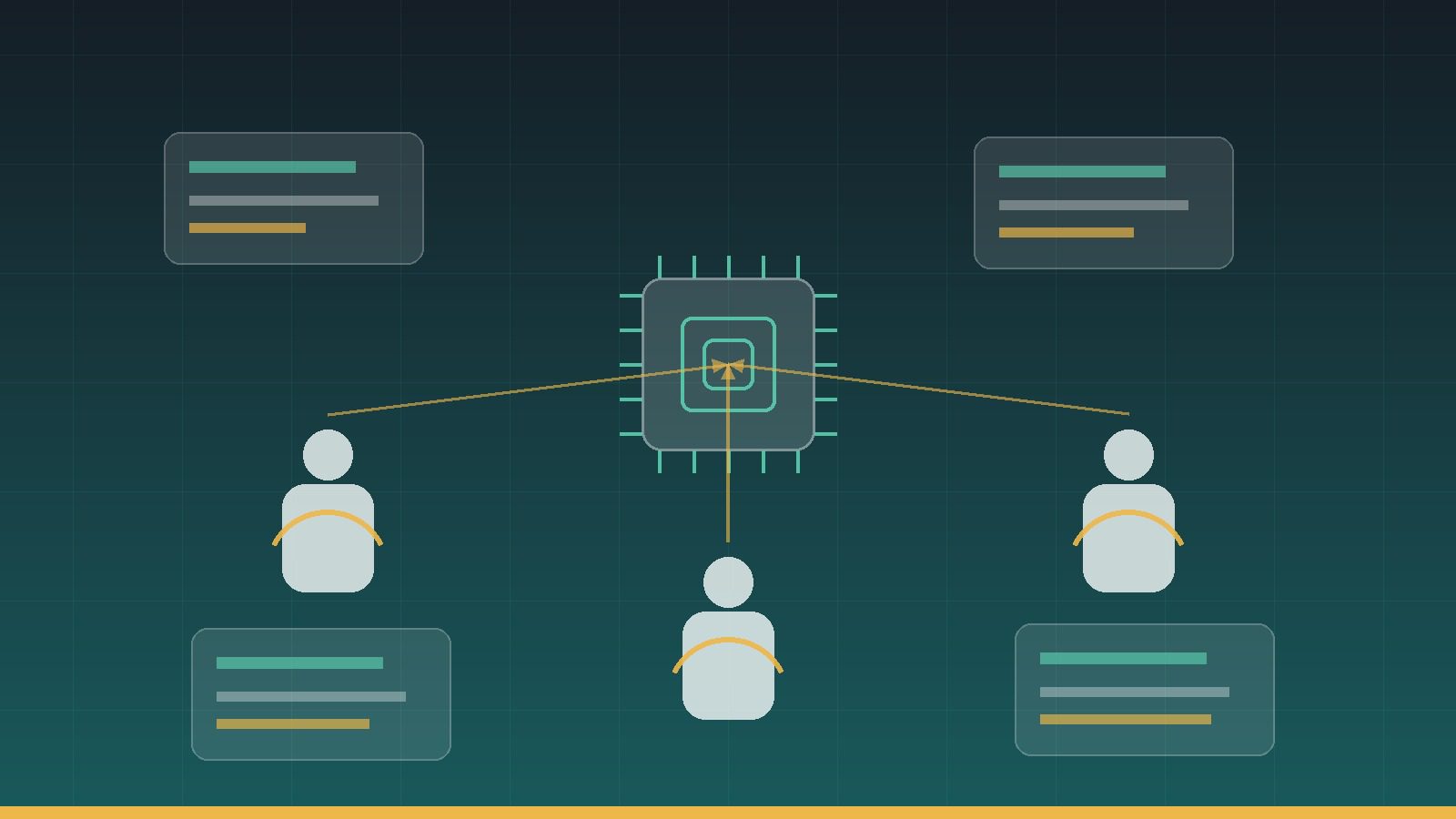
An AI-Native Organization is not a company that gives everyone a chatbot and calls the work transformed. It is a business that redesigns how work moves, how decisions are made, how data is captured, how humans review risk, and how AI systems are allowed to assist or act.
That distinction matters in 2026 because many organisations are still trying to automate broken manual processes. They add AI to inboxes, spreadsheets, approval chains, support queues, sales handoffs, finance exceptions, and project updates without first asking whether the workflow itself still makes sense. The result can look modern on the surface while preserving the same delays, unclear ownership, duplicated effort, and rework underneath.
If you want the short version, an AI-Native Organization starts with workflow redesign instead of tool rollout. It asks what the business outcome should be, what work should disappear, what should become rule-based, where AI should assist, where an agent may act, and where human judgement must remain visible.
This is the practical difference between useful transformation and expensive automation theatre. AI can draft, classify, summarise, search, route, recommend, trigger, and monitor. But if the underlying process is poorly owned, badly measured, weakly governed, or dependent on tribal knowledge, AI may only make the weakness travel faster.
This article draws on Michael Hammer’s classic Harvard Business Review argument, Reengineering Work: Don’t Automate, Obliterate, RAND’s research on why AI projects fail, Gartner’s warning that over 40% of agentic AI projects may be cancelled by the end of 2027, the NIST AI Risk Management Framework, and BCG’s research on moving from potential to profit with GenAI.
AI-Native Organization at a glance

An AI-Native Organization can be summed up in a few clear points.
- It redesigns workflows before automating them.
- It treats AI as part of the operating model, not just another application.
- It separates rules, workflow automation, AI assistance, agentic action, and human judgement.
- It captures better data at the point work happens.
- It defines decision rights before AI systems are allowed to act.
- It measures business outcomes, quality, risk, cost, and adoption, not only hours saved.
- It builds repeatable redesign habits instead of one-off AI pilots.
| Question | Automation-first organisation | AI-Native Organization |
|---|---|---|
| Starting point | Where can we add AI? | What work should change? |
| Success metric | Tasks automated or prompts used | Better outcomes across the full workflow |
| Main risk | Faster rework | Redesign gaps found before scale |
| Data approach | Use whatever data exists | Redesign data capture around decisions |
| Human role | Reviewer after the fact | Accountable designer, supervisor, and exception owner |
| Scaling model | More tools and pilots | Repeatable workflow redesign cycles |
The goal is not to make every process autonomous. The goal is to redesign work so that automation, AI, and people each have a useful place.
Why an AI-Native Organization matters in 2026

The AI-Native Organization matters because generative AI has moved from experimentation into operating-model pressure. Leaders are no longer asking only whether AI can produce a useful answer. They are asking whether AI can change cycle times, customer experience, cost-to-serve, compliance evidence, employee capacity, and management visibility.
That is a different question.
Traditional workflow automation usually works best when the process is already clear. It routes a form, sends a notification, updates a record, applies a rule, or moves a task to the next queue. AI can handle more ambiguous work, but that does not remove the need for process clarity. It raises the stakes.
RAND’s research is useful here because it points to ordinary reasons AI projects fail: teams misunderstand the business problem, optimise the wrong metric, lack suitable data, underinvest in infrastructure, chase technology, or build systems that do not fit the workflow and context. Those are operating-model failures as much as technology failures.
Gartner’s agentic AI warning makes the same point from another angle. Agentic systems are attractive because they can act across tools and workflows, but projects become fragile when costs rise, value is unclear, or risk controls are inadequate. That is exactly what happens when companies automate before they redesign.
An AI-Native Organization treats AI adoption as a business design problem. It does not ask staff to keep the old process alive while AI works around it. It redesigns the process so AI can reduce friction without hiding accountability.
9 critical workflow redesigns for an AI-Native Organization
1. Start with the business outcome, not the AI tool
The first redesign is strategic discipline.
An AI-Native Organization does not begin with a model, vendor, prompt library, or agent platform. It begins with an outcome that matters enough to change how work happens. Reduce invoice exception cycle time. Improve first-contact resolution. Shorten onboarding. Increase quote accuracy. Reduce security alert fatigue. Improve renewal follow-up. Cut time spent collecting compliance evidence.
The outcome should be specific enough to guide tradeoffs. “Use AI in finance” is too broad. “Reduce supplier invoice exceptions by 30% without increasing approval risk” is useful. “Improve sales productivity” is vague. “Move qualified inbound leads to a named owner within five minutes, with complete context and clear next action” gives the team something to design.
Once the outcome is clear, the team can decide whether the answer is AI, rules, integration, better forms, fewer approvals, a knowledge base, a human role change, or a mix of all of those.
That is the first habit of an AI-Native Organization: technology choices follow workflow intent.
2. Map the real workflow before automating the official one
Most organisations have two workflows. There is the official version in a process document, and there is the real version that staff use to get work done. The real version includes inbox shortcuts, private spreadsheets, old templates, personal judgement calls, missing fields, informal escalation paths, and exception handling that never appears on a chart.
An AI-Native Organization maps the real workflow before automation decisions are made.
Start with the trigger. What starts the work? A customer email, a form, an invoice, a sales enquiry, a support ticket, a security alert, a meeting note, a stock issue, or a regulatory request? Then follow the work until completion. Capture every system, handoff, decision, approval, delay, re-entry point, and exception.
The map does not need to be beautiful. It needs to be honest. AI succeeds or fails in the details that polite process diagrams leave out.
Once the real workflow is visible, the business can remove steps before it automates them. Duplicate approvals can be merged. Missing fields can be captured earlier. Low-value checks can become rules. Rework loops can be replaced with clearer intake. Exceptions can get owners.
The redesign rule is simple: do not teach AI to preserve unnecessary work.
3. Redesign intake so AI gets better inputs
Many AI projects fail at the front door. The organisation expects AI to classify, route, summarise, or decide using messy inputs that were never designed for that purpose.
An AI-Native Organization treats intake as a design surface. That means forms, email capture, ticket categories, CRM fields, meeting notes, voice transcripts, uploaded documents, and customer self-service flows all matter. The quality of AI output depends heavily on the quality and structure of what enters the workflow.
For example, a support assistant may need product version, account type, urgency, prior contact history, screenshots, known-error codes, and customer sentiment. A finance exception workflow may need purchase order status, supplier ID, approval threshold, payment terms, dispute reason, and attachment quality. A sales qualification flow may need source, company size, budget signal, use case, timeline, region, and owner.
If those inputs are missing, AI can still produce something, but the business will pay for it in review time and rework.
Good intake redesign usually includes:
- Required fields where they genuinely improve downstream decisions.
- Structured options for common categories.
- Free-text fields only where nuance matters.
- Validation at the point of capture.
- Clear ownership of reference data.
- Automatic enrichment from trusted systems.
- A way to flag incomplete or low-confidence cases.
An AI-Native Organization does not blame the model for weak inputs until it has redesigned the front door.
4. Separate rules, automation, AI assistance, agents, and humans
The fourth redesign is role clarity.
Not every step needs AI. Some steps should be simple rules. Some should be workflow automation. Some should use AI assistance. Some may be suitable for autonomous AI agents under strict limits. Some should stay human because judgement, empathy, accountability, negotiation, or regulation matters.
An AI-Native Organization makes those choices explicit.
| Work type | Best fit | Example |
|---|---|---|
| Stable rule | Rule-based automation | Route invoices under an approved threshold |
| System handoff | Workflow automation | Create a task when a form is submitted |
| Language-heavy review | AI assistance | Summarise a customer complaint and suggest a category |
| Pattern recognition | AI model | Flag unusual claims, invoices, or security alerts |
| Low-risk multi-step action | Bounded agent | Collect missing information and update a case record |
| High-accountability decision | Human with AI support | Approve a large refund, contract change, or sensitive response |
This separation prevents two common mistakes. The first is using AI where a deterministic rule would be cheaper and safer. The second is pretending that a high-risk decision can be delegated just because an AI system can generate a confident recommendation.
The AI-Native Organization is not human-only or AI-only. It is deliberate about who or what should own each type of work.
5. Build workflow data foundations, not abstract data lakes
Data strategy becomes more useful when it is tied to workflow redesign.
An AI-Native Organization does not only ask, “Do we have data?” It asks, “Do we capture the data needed to make this workflow better?” Those are very different questions. A company may have years of reports and still lack the fields, labels, outcomes, timestamps, override reasons, and context AI needs to support decisions reliably.
Workflow data foundations are practical. They connect source systems, define trusted records, clean high-value reference data, standardise categories, and capture outcome quality. They also log when humans override AI recommendations and why.
This matters because the best learning often comes from the redesigned workflow itself. When staff correct a classification, approve an exception, reject a recommendation, or escalate a case, that feedback can improve the system if the process captures it cleanly.
NIST’s AI Risk Management Framework is helpful here because it frames AI risk as something to govern, map, measure, and manage. That requires evidence. A workflow that cannot show what happened, which data was used, who reviewed it, and why a decision changed will struggle to be trusted.
The useful data question is not “Can we train a model?” It is “Can we run this workflow with enough context, evidence, and feedback to improve it safely?”
6. Define decision rights before AI systems act
AI raises an old management question in a sharper form: who is allowed to decide?
An AI-Native Organization defines decision rights before AI systems are allowed to act. That includes who can approve, reject, refund, escalate, discount, publish, notify, change a record, close a case, or override a recommendation.
If decision rights are unclear for people, they will be unsafe for AI.
Use a simple decision-rights table during redesign:
| Decision | AI role | Human role | Control |
|---|---|---|---|
| Categorise request | Act when confidence is high | Review low-confidence cases | Threshold and sample audit |
| Draft response | Recommend | Approve sensitive messages | Template and tone controls |
| Approve low-value refund | Act within limit | Review above limit | Threshold, logging, fraud checks |
| Change contract terms | Assist only | Decide and approve | Commercial and legal approval |
| Escalate risk event | Act immediately | Investigate and close | Incident log and owner queue |
This is not bureaucracy for its own sake. It is what makes speed acceptable. Staff trust AI more when they know where authority begins and ends.
The AI-Native Organization turns decision rights into system design, not hallway folklore.
7. Replace manual handoffs with event-driven work and review queues
Manual handoffs are where many workflows quietly lose time. A person sends an email, another person waits, a manager checks a spreadsheet, a team asks for missing context, and the work returns to the start.
An AI-Native Organization redesigns handoffs around events and queues. When a trigger happens, the system creates the right record, enriches it with context, applies rules, asks AI to classify or summarise where useful, routes it to the correct owner, and places exceptions in visible review queues.
The point is not to remove people. The point is to stop using people as glue between systems.
Review queues are especially important. They turn uncertainty into managed work. Instead of hiding low-confidence AI output in someone’s inbox, the workflow can surface it with context, priority, owner, due date, and escalation path.
This is where the AI Process Redesign discipline becomes practical. The business needs to decide what should happen automatically, what should be reviewed, what should be escalated, and what should pause the workflow.
An AI-Native Organization does not make every handoff invisible. It makes every important handoff observable.
8. Measure the full workflow, not the AI task
Task-level time savings can be misleading. AI may reduce drafting time while increasing checking time. It may classify tickets quickly but send more cases to the wrong queue. It may summarise meetings well but create no change in follow-through. It may automate a finance step while increasing exceptions.
An AI-Native Organization measures the full workflow.
Useful metrics include:
- Cycle time from trigger to completion.
- First-time-right rate.
- Exception rate and exception age.
- Human review time.
- Customer or employee satisfaction.
- Cost per completed case.
- Rework and error rate.
- AI confidence and override rate.
- Escalation quality.
- Incidents, near misses, and control breaches.
This is how leaders avoid mistaking activity for value. A workflow is better when the business outcome improves, quality holds or rises, risk remains controlled, and users actually adopt the new way of working.
BCG’s GenAI research points to the same lesson: value comes when organisations move beyond experiments and connect AI to productivity, growth, upskilling, partnerships, and responsible deployment. Measurement has to reflect that wider operating model.
The AI-Native Organization asks a blunt question after every pilot: did the work improve, or did the AI only make one step look faster?
9. Create a repeatable 90-day workflow redesign rhythm
The final redesign is cadence.
An AI-Native Organization does not wait for a huge transformation programme before making progress. It chooses one valuable workflow, redesigns it, pilots the new operating model, and captures lessons that can be reused.
Days 1 to 15 should focus on selection. Choose a workflow with visible pain, measurable value, enough volume, and manageable risk. Good candidates include support triage, sales qualification, invoice exceptions, onboarding, renewal management, internal knowledge search, compliance evidence collection, service scheduling, and security alert triage.
Days 16 to 30 should focus on mapping. Document the real workflow, systems, data, decisions, handoffs, approvals, exceptions, owners, and current performance.
Days 31 to 45 should focus on redesign. Remove unnecessary steps, clarify ownership, define decision rights, standardise intake, improve data capture, and decide which parts should be human, rule-based, automated, AI-assisted, or agentic.
Days 46 to 60 should focus on build. Configure the workflow, integrations, AI prompts or models, access controls, review queues, dashboards, logging, and training materials.
Days 61 to 75 should focus on pilot. Run real cases with real users inside safe boundaries. Measure the whole workflow, not only the AI output.
Days 76 to 90 should focus on governance and scale. Decide whether to kill, fix, or scale. Document lessons, update controls, confirm ownership, and choose the next workflow.
For SMEs that need senior technology judgement without hiring a full-time CIO, the vCIO advantage can help connect strategy, workflow redesign, security, data, vendors, and adoption into one practical plan.
The AI-Native Organization becomes real when this rhythm repeats.
Workflow candidates for an AI-Native Organization
Not every workflow is a good first candidate. The best starting points have visible pain, measurable outcomes, enough repeated volume, and a risk profile that can be governed.
| Workflow | AI-native redesign opportunity | First metric to watch |
|---|---|---|
| Customer support triage | Classify, summarise, route, and escalate with better intake | First-contact resolution |
| Sales qualification | Enrich leads, score fit, draft next action, assign owner | Speed to qualified follow-up |
| Invoice exceptions | Match records, detect missing data, route approvals | Exception cycle time |
| Employee onboarding | Personalise tasks, collect documents, answer FAQs | Time to productive start |
| Compliance evidence | Collect, classify, and track evidence requests | Evidence completion rate |
| Knowledge search | Answer from approved sources and flag gaps | Search success rate |
| Service scheduling | Match availability, skills, location, and priority | Schedule accuracy |
| Security alert triage | Summarise alerts, correlate context, escalate risk | Mean time to triage |
The best first workflow is rarely the flashiest one. It is the one where the business can see whether the redesigned process actually works.
Common mistakes that stop an AI-Native Organization from forming
The first mistake is treating AI access as transformation. Tool access can help individuals, but an AI-Native Organization needs redesigned workflows, data, controls, and measurement.
The second mistake is automating before simplifying. If the process has unnecessary approvals, unclear ownership, and poor intake, AI may accelerate the wrong shape of work.
The third mistake is using AI where rules are enough. Deterministic steps should often be rules or workflow automation because they are cheaper, clearer, and easier to govern.
The fourth mistake is ignoring exception work. Real value often depends on how the workflow handles messy cases, not only happy-path tasks.
The fifth mistake is measuring prompts instead of outcomes. Usage does not prove value. The business needs to measure speed, quality, risk, cost, satisfaction, and adoption.
The sixth mistake is leaving staff outside the redesign. People who do the work know where the process breaks. Without them, the new workflow may look efficient to leaders and irritating to users.
The seventh mistake is giving agents authority without control. Agentic work needs thresholds, logging, permissions, review queues, rollback, and named owners.
The final mistake is trying to redesign the whole company at once. Start with one workflow. Learn quickly. Build the muscle. Then repeat.
AI-Native Organization FAQ
What is an AI-Native Organization?
An AI-Native Organization is a business that redesigns workflows, data, decision rights, controls, and roles around practical AI capability. It does not simply add AI tools to old manual processes. It changes how work happens so AI, automation, and people each contribute where they fit best.
How is an AI-Native Organization different from a company using AI tools?
A company using AI tools may still run the same manual workflows with extra software on top. An AI-Native Organization changes the operating model: intake, routing, decisions, handoffs, review, data capture, measurement, and governance are redesigned around better outcomes.
Does every workflow need autonomous AI agents?
No. Many workflows need rules, integrations, better forms, dashboards, or AI assistance rather than autonomous action. Agents should be used where multi-step action creates value and where authority, limits, monitoring, and rollback are clearly defined.
Which workflow should a business redesign first?
Start with a workflow that has clear value, repeated volume, visible friction, measurable outcomes, and manageable risk. Support triage, invoice exceptions, sales qualification, onboarding, renewal management, internal knowledge search, and compliance evidence collection are common starting points.
How do you measure progress toward becoming AI-native?
Measure full workflow performance: cycle time, first-time-right rate, exception volume, review time, cost per completed case, customer or employee satisfaction, quality, incidents, adoption, and AI override rate. Do not rely only on hours saved or tool usage.
Can an SME become an AI-Native Organization without a large transformation programme?
Yes. Start with one important workflow, one owner, one outcome, and a 90-day redesign cycle. The aim is to build a repeatable operating habit, not to launch a large programme before learning what works.
What is the biggest risk when building an AI-Native Organization?
The biggest risk is using AI to preserve broken manual processes. If ownership, data, controls, and workflow design are weak, AI can increase speed without improving the outcome. Redesign comes first.
Final thoughts
An AI-Native Organization is built through redesign, not decoration. It does not win by attaching AI to every old workflow. It wins by deciding what work should change now that AI can help with language, judgement support, classification, routing, monitoring, and bounded action.
The practical path is simple, even if the work takes discipline: choose an important workflow, map the real process, remove unnecessary friction, improve intake and data, define decision rights, decide where humans and AI belong, pilot under production constraints, and measure the whole outcome.
That is how businesses move beyond automating broken manual processes. The AI-Native Organization is not the one with the most AI tools. It is the one that redesigns work well enough for AI to create measurable, trusted value.










