
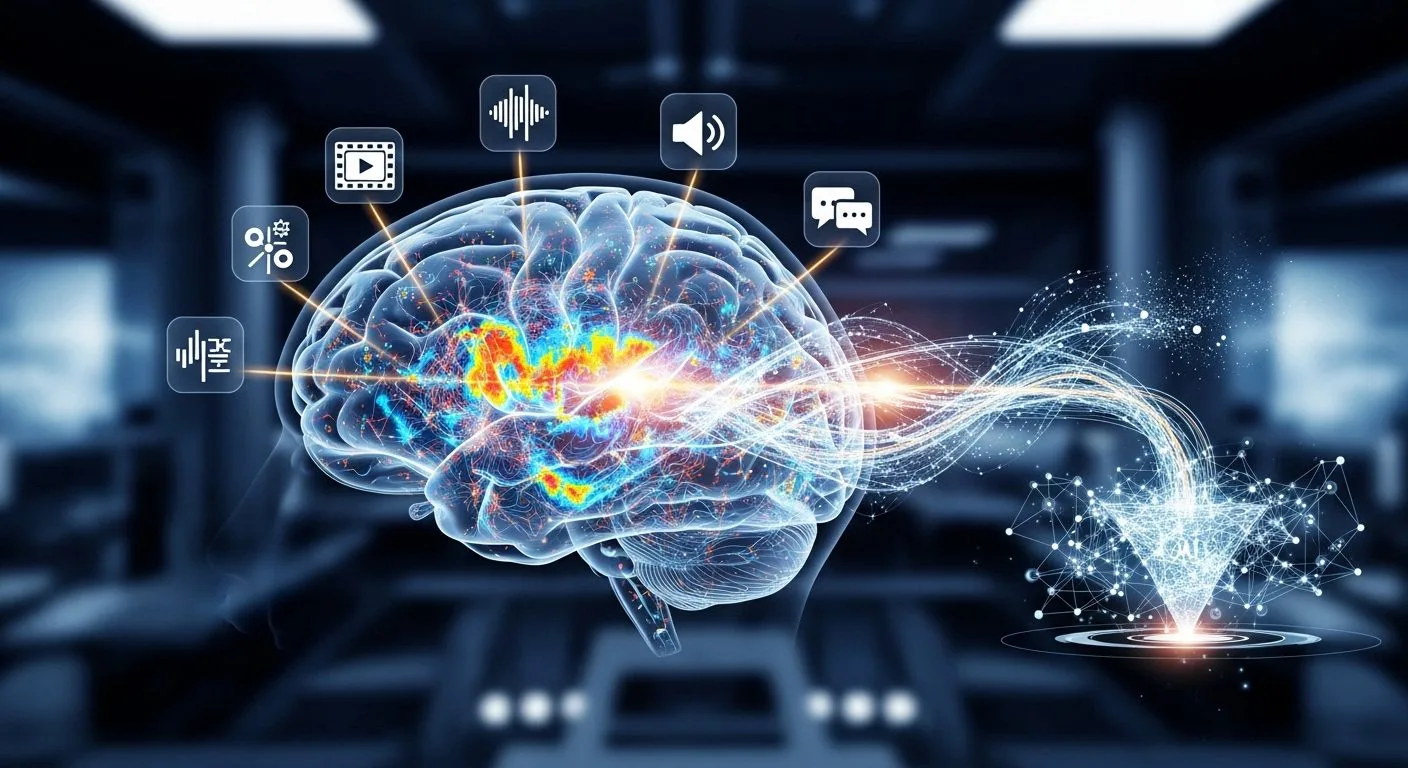
TRIBE v2 model is Meta’s new predictive foundation model designed to estimate how the human brain responds to complex sights, sounds, and language. In Meta’s own words, it is a predictive foundation model trained to understand how the human brain processes complex stimuli.
If you want the short version, Meta says TRIBE v2 acts like a digital twin of human neural activity. In the official TRIBE v2 announcement, the company says the model can predict high-resolution fMRI responses to almost any sight or sound, offers a 70x resolution increase versus similar models, and can help neuroscientists test theories without running human-subject experiments for every question. The accompanying paper abstract and Hugging Face model card make the technical picture clearer: TRIBE v2 is a tri-modal brain encoding model built around video, audio, and language inputs.
That matters because this is not a typical AI product launch. TRIBE v2 model sits at the intersection of neuroscience, multimodal foundation models, and clinical research acceleration. If Meta’s claims hold up in wider research use, the model could help scientists simulate brain responses faster, compare theories more cheaply, and explore neurological questions at a scale that would otherwise be difficult and expensive.
This guide uses Meta’s official TRIBE v2 announcement, Meta’s paper page for A foundation model of vision, audition, and language for in-silico neuroscience, and the public TRIBE v2 model card on Hugging Face as the main references. TRIBE v2 model in practical terms is this: a research system that tries to predict whole-brain activity from rich media inputs instead of building one narrow brain-encoding model for each separate task.
TRIBE v2 model at a glance

TRIBE v2 model is a tri-modal predictive foundation model for brain activity built to estimate human fMRI responses to video, audio, and language.
- Meta says TRIBE v2 can predict high-resolution brain responses to new stimuli, tasks, subjects, and languages.
- The paper abstract describes a unified dataset of more than 1,000 hours of fMRI across 720 subjects.
- The blog post says the training data includes more than 700 healthy volunteers exposed to images, videos, podcasts, and text.
- The Hugging Face model card says TRIBE v2 combines LLaMA 3.2 for text, V-JEPA2 for video, and Wav2Vec-BERT for audio in one Transformer-based architecture.
- Meta says the model outperforms traditional linear encoding approaches by several-fold on prediction accuracy.
- The public release includes model weights, code, a paper, and an interactive demo.
- The released weights are under a CC BY-NC license, which makes the project research-friendly but not a blanket commercial release.
TRIBE v2 model at a high level is a multimodal brain simulator for in-silico neuroscience research.
Why TRIBE v2 model matters

TRIBE v2 model matters because neuroscience has long been fragmented across highly specialised experiments and narrow predictive models. Researchers often build one model for one dataset, one sensory modality, or one experimental paradigm, which makes it hard to form a more unified picture of how the brain processes real-world experiences.
Meta’s framing is that TRIBE v2 can change that by offering one foundation model that works across vision, audition, and language. If that generalization is robust, it means researchers can move more quickly from raw stimulus to predicted brain activity, test hypotheses in simulation, and reuse the same model across multiple classes of experiments.
That also matters beyond neuroscience. Foundation models become more important when they can represent complex systems in a reusable way instead of solving only one narrow benchmark. If you want broader context on how advanced AI systems move from isolated tasks into reusable infrastructure, Progressive Robot’s guide to workflow automation is a useful companion read.
7 critical facts about the TRIBE v2 model

1. TRIBE v2 model is built for three modalities, not one
The first fact to understand is that TRIBE v2 model is explicitly tri-modal. The paper describes it as a foundation model of vision, audition, and language for in-silico neuroscience. That matters because brain-encoding research has often been split between separate models for separate domains.
TRIBE v2 instead tries to learn a shared predictive system across videos, sounds, and text. In practical terms, that makes it far closer to a foundation-model approach than a narrow neuroscience benchmark model.
2. TRIBE v2 model is trained on unusually large fMRI data for this kind of work
Meta’s announcement says the model builds on earlier work trained on low-resolution fMRI recordings of four individuals and expands to a much larger dataset collected from more than 700 healthy volunteers. The paper abstract gives a more specific research summary: over 1,000 hours of fMRI across 720 subjects.
That scale is important because it gives TRIBE v2 model a much broader basis for learning how different brains respond to rich stimuli under both naturalistic and experimental conditions.
3. TRIBE v2 model predicts brain activity from rich real-world stimuli
This is not only a text model or a lab-only image model. Meta says the training data includes images, podcasts, videos, and text. The Hugging Face model card also shows direct prediction workflows for video, audio, and text inputs.
That makes TRIBE v2 model more relevant to real human cognition, because the brain does not operate in neat benchmark silos. It processes mixed streams of language, visuals, sound, and temporal context all the time.
4. TRIBE v2 model uses a modern multimodal stack under the hood
The model card says TRIBE v2 combines LLaMA 3.2 as its text feature extractor, V-JEPA2 for video, and Wav2Vec-BERT for audio. Those representations are then mapped through a unified Transformer architecture onto the cortical surface.
That detail matters because TRIBE v2 model is not claiming to solve brain prediction from scratch with one monolithic network. It assembles strong modality-specific backbones and then learns a shared brain-response mapping layer on top.
5. TRIBE v2 model makes strong zero-shot and resolution claims
Meta says TRIBE v2 reliably predicts high-resolution fMRI brain activity and supports zero-shot predictions for new subjects, languages, and tasks. The blog also says the system delivers a 70x resolution increase compared with similar models.
Those are ambitious claims, but they are also what make TRIBE v2 model interesting. If the model can generalize without retraining for every new subject or experiment, it becomes much more useful as a reusable scientific tool instead of a custom lab artifact.
6. TRIBE v2 model is designed for in-silico experimentation, not mind reading
One of the most important points in the paper is that TRIBE v2 enables in-silico experimentation. Meta says it can recover results from seminal visual and neuro-linguistic paradigms and reveal interpretable latent features tied to multisensory integration.
That means TRIBE v2 model should be understood as a hypothesis-testing system for researchers, not a consumer technology that reads private thoughts. It predicts likely neural responses to known stimuli using learned population-level structure.
7. TRIBE v2 model is publicly released for research, but with boundaries
Meta has released the paper, codebase, model weights, and demo, which is a serious open research gesture. At the same time, the Hugging Face page lists the license as CC BY-NC 4.0, and the project documentation notes gated access to LLaMA 3.2 components for some training workflows.
So the right interpretation is that TRIBE v2 model is available for broad research exploration, but it is not a no-strings commercial foundation model release.
TRIBE v2 model in simple terms

TRIBE v2 model in plain English is a brain-response simulator trained on lots of fMRI data plus lots of real media.
You give it a video, an audio clip, or a piece of text, and it predicts how an average human brain is likely to respond across the cortical surface. According to the model card, those predictions live on the fsaverage5 cortical mesh at roughly 20,000 vertices.
That does not mean TRIBE v2 model understands consciousness or individual thoughts. It means the system is trying to model broad patterns of neural activity well enough to support neuroscience research and faster theory testing.
FAQs
TRIBE v2 model raises a few obvious questions.
What is TRIBE v2 model?
TRIBE v2 model is Meta’s tri-modal foundation model for predicting human fMRI responses to video, audio, and language stimuli.
What data was TRIBE v2 model trained on?
Meta says the system uses a large unified dataset built from more than 1,000 hours of fMRI across 720 subjects, with stimuli including images, videos, podcasts, and text.
Can TRIBE v2 model read minds?
No. TRIBE v2 model predicts likely brain responses to known inputs. That is very different from decoding arbitrary private thoughts from a person’s brain.
Is TRIBE v2 model open source?
The project is publicly released with code, weights, and a demo, but the weights are under a CC BY-NC license. That makes it open for research use, not a fully unrestricted commercial release.
Why does TRIBE v2 model matter so much?
TRIBE v2 model matters because it suggests brain-encoding research can move toward reusable multimodal foundation models instead of remaining fragmented across many tiny task-specific systems.
Final thoughts on the TRIBE v2 model
TRIBE v2 model looks important because it pushes neuroscience research toward the same foundation-model logic that has already reshaped language, vision, and multimodal AI.
If Meta’s claims continue to hold under wider academic use, the bigger story is not just better prediction accuracy. It is the possibility of faster in-silico neuroscience, more scalable theory testing, and a more unified way to study how the brain processes complex stimuli. That is a meaningful step for both neuroscience and AI research.
More AI coverage: explore Progressive Robot's AI Models, Tools & Releases hub — hands-on reviews, setup guides and benchmarks in one place.