
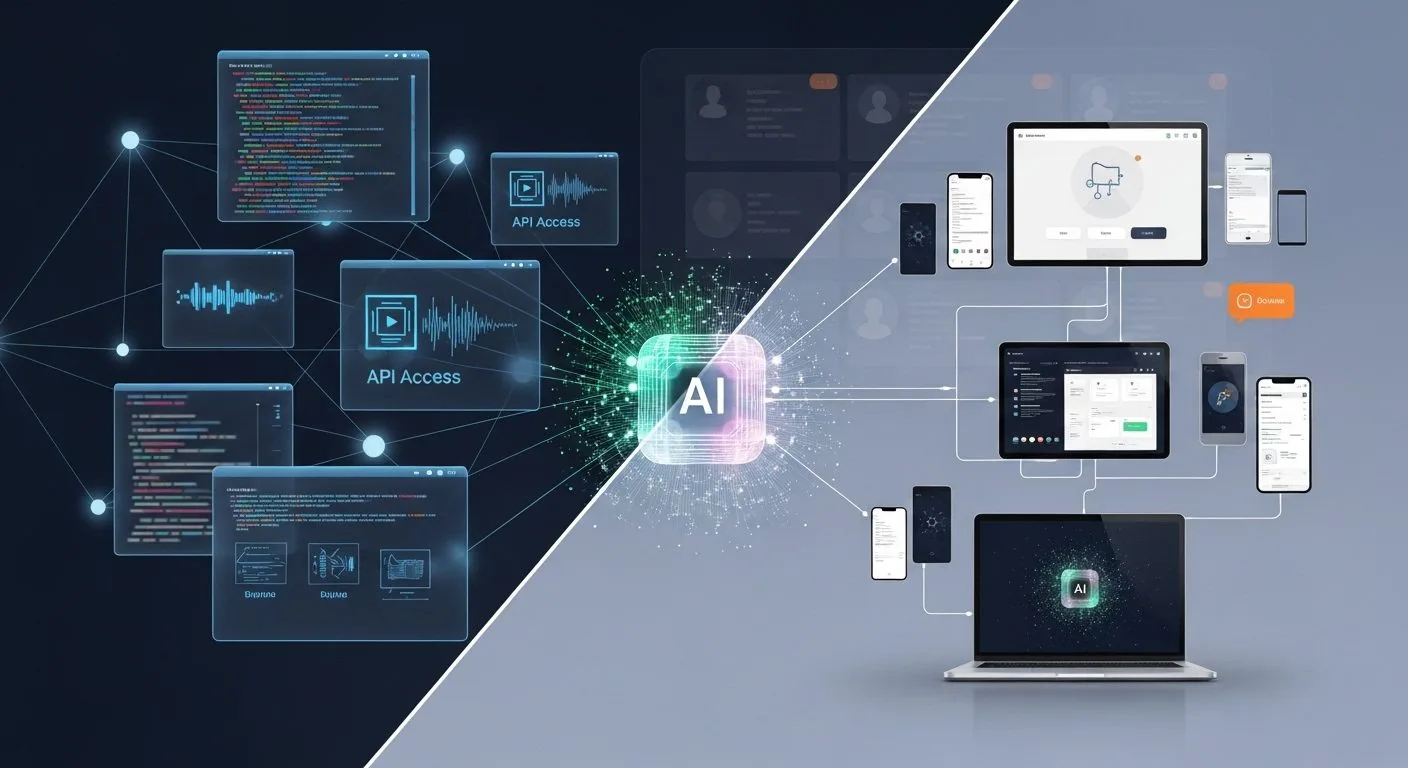
Meta open-source identity looks weaker after the arrival of Muse Spark, a new product-first model that is clearly competitive but not meaningfully open to developers at launch.
If you want the short version, AI News argues that Muse Spark puts Meta back in the frontier conversation while undercutting the open-builder reputation that made Llama so widely adopted. That framing largely holds up against Meta’s own materials. In its official Introducing Muse Spark post, Meta says the model is available in Meta AI and the Meta AI app, with a private API preview for select users. That is a very different access model from the official Llama 4 announcement, where Meta said openness drives innovation and made Llama 4 Scout and Llama 4 Maverick downloadable on llama.com and Hugging Face.
That difference is why the story matters. Meta may now have a more credible answer to rival frontier labs on capability, but it is no longer offering the same immediate developer access that helped define its public AI identity.
This guide uses AI News’ April 2026 report on Muse Spark and Meta’s open-source identity, Meta’s official Muse Spark launch post, and Meta’s official Llama 4 announcement as the main references. Meta open-source identity in practical terms is this: the company may have rebuilt its model stack successfully, but it is asking the developer community to trust future openness instead of offering present-day access.
Meta open-source identity at a glance

- Muse Spark is the first Muse-family model from Meta Superintelligence Labs.
- Meta says Muse Spark is a natively multimodal reasoning model with tool use, visual chain of thought, and multi-agent orchestration.
- Meta is shipping Muse Spark through Meta AI and a private API preview, not as a public weight release.
- Meta’s Llama 4 Scout and Maverick launch was framed very differently, with public downloads and explicit language about openness helping developers.
- AI News argues Meta now has a competitive AI model, but the open-source identity that powered Llama’s momentum is weaker.
- Meta still has unmatched consumer distribution through its own apps, which may matter more to the business than community goodwill.
- Meta says larger Muse models are coming, but future openness is still a promise, not what shipped now.
Why Meta open-source identity matters

Meta open-source identity matters because model influence is not only about benchmark position. It is also about who gets to build on top of the model, how fast an ecosystem forms around it, and whether developers believe the vendor is serious about sharing meaningful access.
That was always the real advantage behind Llama. Even when critics pointed out that Llama was more accurately open-weight than fully open-source in the strict OSI sense, Meta still benefited from being seen as the big lab willing to let developers download, fine-tune, host, and adapt major models themselves.
Muse Spark changes that perception. If you want a business-side example of why deployment inside everyday software can matter more than raw model rankings, Progressive Robot’s guide to workflow automation is useful context. Meta now looks more interested in direct product distribution and controlled access than in letting the broader ecosystem run with its newest flagship model.
7 critical facts behind the Meta open-source identity shift

1. Muse Spark is competitive enough to make the shift matter
The first important point is that this is not a defensive or obviously second-tier release. In its official launch post, Meta says Muse Spark offers competitive performance across multimodal perception, reasoning, health, and agentic tasks. The company says its Contemplating mode, which runs multiple reasoning agents in parallel, reaches 58% on Humanity’s Last Exam and 38% on FrontierScience Research.
That does not automatically make Muse Spark the best model in the world. It does mean Meta is no longer asking people to care about a weaker model in exchange for openness. The tradeoff now is sharper: better competitiveness, less direct access.
2. Meta rebuilt its stack and clearly wants credit for the recovery
Meta’s Muse Spark launch post says the company rebuilt its pretraining stack over the last nine months, changing architecture, optimisation, and data curation. According to Meta, the new recipe can reach the same capability level with over an order of magnitude less compute than Llama 4 Maverick.
That is a serious claim, and it helps explain why Meta feels comfortable changing the distribution model. If the company believes it has a more efficient and more scalable path forward, it has a stronger reason to keep the highest-value models inside its own products or behind controlled access.
3. Muse Spark is product-first and access-controlled at launch
This is the clearest sign that Meta open-source identity has weakened. Meta says Muse Spark is available today through meta.ai and the Meta AI app, while API access is limited to a private preview for select users. That is not a developer-first release pattern. It is a product rollout pattern.
For developers, the practical difference is enormous. A public weight release lets teams test, fine-tune, self-host, benchmark independently, and build tooling around the model immediately. A private preview means Meta decides who gets in, when, and on what terms.
4. The contrast with Llama 4 is impossible to ignore
Meta’s official Llama 4 post used much more open language. The company said openly available leading models are important so everyone can build the future of personalised experiences. It said openness drives innovation and is good for developers, good for Meta, and good for the world. It also made Llama 4 Scout and Maverick downloadable on llama.com and Hugging Face from day one.
That is why Meta open-source identity became such a large part of Meta’s AI brand in the first place. The company did not just talk about openness. It paired the message with real downloads, partner distribution, and a developer ecosystem that could move without waiting for Meta’s approval.
5. The identity was never purely open-source, but it was clearly more open than this
This point needs precision. Llama’s earlier releases were widely described as open-source, but the more accurate label was open-weight. Meta used custom licenses and did not fully match the strict definition of open-source software. Even so, the practical experience for developers was much closer to open building than what Muse Spark offers.
So the real story is not that Meta moved from perfect openness to total secrecy overnight. The story is that Meta open-source identity was always partly cultural and ecosystem-based, and Muse Spark weakens that culture because the newest important model is not being shared in the same usable way.
6. Meta may now care more about distribution than developer symbolism
AI News makes a strong point here: Meta has a distribution machine its rivals would love to have. Muse Spark is rolling into Meta AI, and Meta is positioning the model for use across Facebook, Instagram, WhatsApp, Messenger, and AI glasses. If the company can reach billions of users inside its own products, it may see less strategic need to win every argument about developer openness.
From a business perspective, that logic is understandable. From a community perspective, it still marks a shift. Meta open-source identity mattered because developers felt they were part of the story, not just downstream users of Meta’s product choices.
7. Future openness is still framed in the future tense
The final fact is the simplest one. The present release is proprietary. AI News reports that Meta’s leadership says bigger models are in development with plans to open-source future versions. That may still happen, and if it does, Meta can recover some of the trust it is spending now.
But future versions do not change what Muse Spark is today. Right now, Meta open-source identity is being tested against a release that asks the developer community to wait while Meta keeps the most strategically important new model close.
Meta open-source identity in simple terms

Meta open-source identity in plain English used to mean that even if Meta was self-interested, developers still got something concrete: weights they could download and use.
Muse Spark changes that deal. Meta still gets the reputational benefit of a stronger model and the commercial benefit of huge in-house distribution, while developers get a promise that more open access may come later.
That is why the reaction is mixed. The model itself looks more serious. The access model looks less generous.
FAQ
Meta open-source identity raises a few obvious questions.
Is Muse Spark open source?
No. Based on Meta’s official launch post, Muse Spark is available through Meta AI and the Meta AI app, with a private API preview for select users rather than a public download.
Is Llama still open?
Llama 4 Scout and Llama 4 Maverick are still available for download, and Meta continues to use language about openness around the Llama ecosystem. The issue is that Meta’s newest strategically important model is not being released that way.
Was Llama ever truly open source?
Not in the strictest technical sense. Llama was better described as open-weight because Meta used its own license terms. But in practical developer terms, it was much more open than a private API preview.
Why does this shift matter if Meta already has billions of users?
Because product reach and developer ecosystem power are not the same thing. Meta can win on distribution and still lose some of the trust, experimentation, and third-party momentum that came from letting developers build directly on its latest models.
Could Meta regain that identity later?
Yes, if it actually releases future Muse-family weights in a developer-usable form. But that would need to happen in practice, not just in roadmap language.
Final thoughts on Meta open-source identity
Meta open-source identity does not look weaker because the company suddenly forgot how to build good AI. It looks weaker because Muse Spark is competitive enough to matter and closed enough to change expectations.
That is the real tension in the story. Meta may have repaired its frontier credibility faster than many expected, but it is doing so through a model that looks more like a controlled product asset than a community-building release. If that becomes the norm, Meta will still be a major AI force. It will just sound a lot less like the company that made openness a core part of its AI narrative.
More AI coverage: explore Progressive Robot's AI Models, Tools & Releases hub — hands-on reviews, setup guides and benchmarks in one place.










