
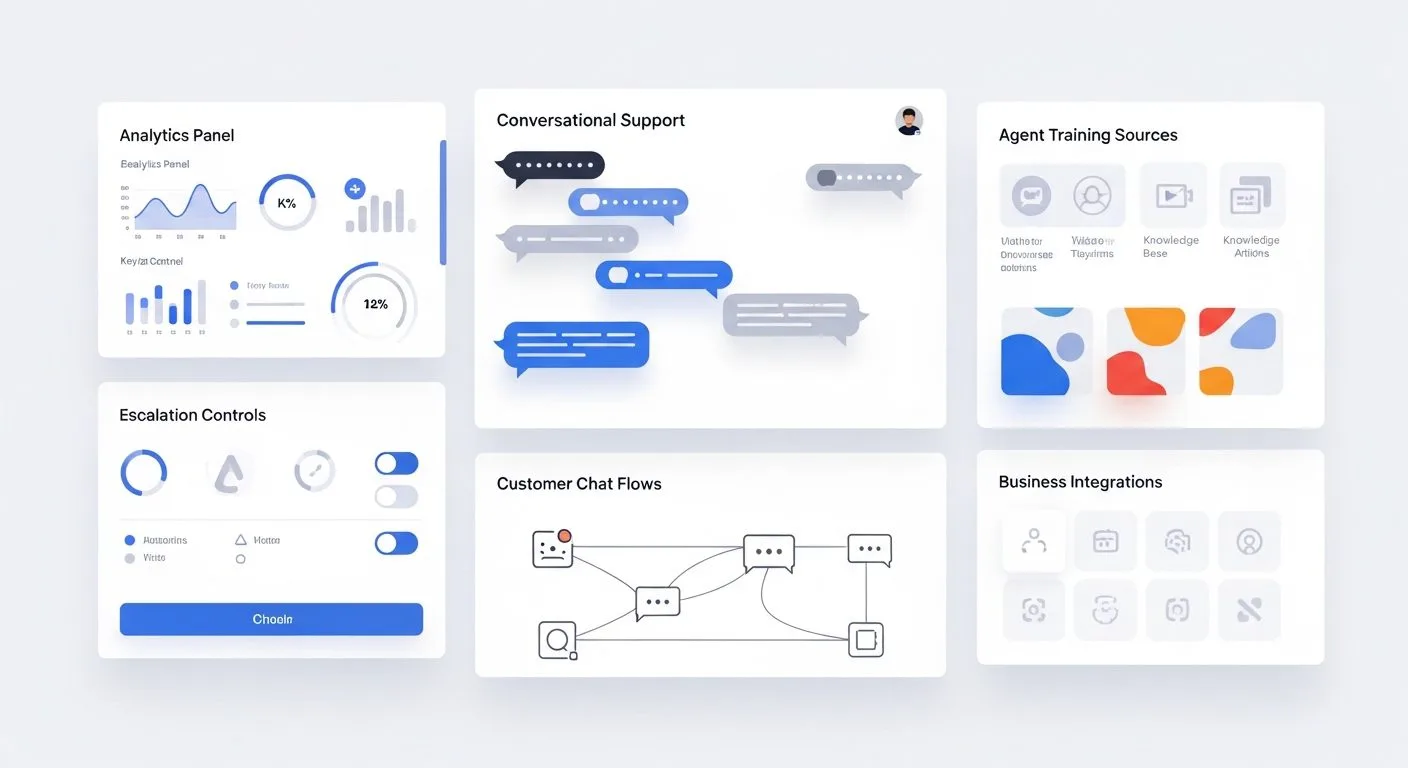
What is Chatbase? Chatbase is a platform for building, deploying, and improving AI support agents that handle customer questions, take actions, escalate when needed, and integrate with the systems businesses already use.
If you want the short answer to what is Chatbase, it is not just a website chatbot builder. Official product pages position Chatbase as a complete platform for AI customer support agents, with training on business data, integrations across support and commerce tools, analytics, security controls, omnichannel deployment, and developer APIs.
This guide uses the official Chatbase homepage, pricing page, user guides, security page, and developer API documentation as the main references.
What is Chatbase at a glance
What is Chatbase at a glance? It is an AI support-agent platform built to help businesses automate customer service while keeping humans, workflows, and security in the loop.
- Chatbase officially describes itself as the complete platform for AI support agents.
- The homepage says businesses can train an agent on company data, configure actions, deploy it to customers, refine performance, route harder issues to humans, and review analytics.
- Chatbase highlights training from documents, websites, and databases to produce more relevant responses.
- The product supports actions and workflow automation inside connected systems, including tasks such as updating subscriptions or changing customer details.
- Official materials emphasise omnichannel support across website chat, WhatsApp, Slack, email, and other integrations.
- Chatbase also provides analytics, smart escalation, API access, security controls, and enterprise guardrails.
- Public-facing pages say more than 10,000 businesses trust Chatbase and position it as a customer support platform rather than a general-purpose AI experiment.
Why understanding what is Chatbase matters
If you want a useful answer to what is Chatbase, it helps to distinguish it from the broader flood of AI chatbot tools. Many chatbot products still focus mainly on answering FAQs. Chatbase is trying to move beyond that by combining conversational support, business actions, escalation paths, reporting, and deployment across customer channels.
That matters because real support work is not only about generating text. It includes retrieving customer data, taking approved actions, handing off edge cases, staying on-brand, and helping a business understand what customers are asking. Chatbase is more relevant when you need that larger support workflow, not just a chat bubble on a landing page.
If you are thinking about how AI support fits into broader workflow automation, Chatbase is useful because it connects customer conversations to actions and operational systems instead of stopping at answers.
What is Chatbase in simple terms

What is Chatbase in plain English? It is a customer support AI platform that helps you build an agent, train it on your business information, connect it to your tools, and let it resolve or route customer issues.
The simplest way to think about it is this:
- Your company gives the agent knowledge from documents, websites, databases, or connected systems.
- Chatbase lets the agent chat with customers, trigger actions, escalate when needed, and report what is happening.
That means what is Chatbase is not just “AI chat for your website.” It is a broader support-operations layer built around AI agents.
7 powerful facts behind what is Chatbase

1. Chatbase is positioned specifically for AI customer support
The first thing to understand about what is Chatbase is that the official site is very specific about the category. It does not pitch itself as a general consumer chatbot or a broad AI playground. It calls itself the complete platform for AI support agents.
That matters because the product is designed around customer-facing resolution, support workflows, and business outcomes rather than open-ended casual chat.
2. Chatbase agents are trained on business data and connected systems
Another core part of what is Chatbase is the training model. The official guides describe agents as trainable on documents, websites, or databases, while the homepage emphasizes syncing with real-time data from CRMs, order systems, helpdesk platforms, and similar tools.
This is important because support quality usually depends on business context. Chatbase is trying to make the agent useful by grounding it in actual company knowledge and live operational data.
3. Chatbase is built to do more than answer questions
The homepage makes clear that Chatbase is not only about replying to support queries. It also supports actions and omnichannel automation through integrations and configurable workflows.
Official examples include tasks such as updating a customer’s subscription or changing an address. That changes the answer to what is Chatbase. It is not only a response engine. It is also a platform for support actions.
4. Chatbase supports escalation, analytics, and ongoing optimisation
Support teams rarely want full automation without oversight. Chatbase reflects that reality.
The official product flow includes smart escalation to human agents, analytics and insights, refinement and optimisation, and reporting on performance. The feature pages also highlight advanced reporting and observability so teams can improve how the agent behaves over time.
This matters because what is Chatbase is partly a control and improvement layer, not only an AI frontend.
5. Chatbase is designed for omnichannel deployment
Another important part of what is Chatbase is channel coverage. Official materials say the platform works across multiple channels customers already use, including website chat, WhatsApp, Slack, and email. The docs also say Chatbase deploys across 15+ platforms, with examples such as WordPress, Shopify, Zendesk, and more.
That matters because many support teams do not want separate bots for separate surfaces. Chatbase is trying to act more like one support-agent platform that can be deployed across the customer journey.
6. Chatbase includes security, compliance, and enterprise safeguards
The security page gives a more serious answer to what is Chatbase for businesses handling sensitive data.
Chatbase says it is GDPR compliant and SOC 2 Type II compliant, encrypts data at rest and in transit, supports user roles, offers rate limiting, and allows domain allowlists for embed control. The homepage also says customer data stays yours and is not used to train models.
This is important because support agents frequently touch customer information, so security posture is part of the product itself, not an optional extra.
7. Chatbase has both no-code and developer paths, but advanced capability is tiered
The user guides emphasise simplicity and no-code deployment, including easy embedding and pre-built actions. At the same time, the developer docs show that Chatbase also supports programmatic use through a REST API for sending messages, managing agents, and retrieving conversations, leads, and analytics.
The pricing and API docs also make clear that not every capability is available on every tier. For example, API access appears on higher plans, and the docs note that API v2 is available starting from the Standard plan.
That means Chatbase is approachable for non-technical teams, but the full platform depth expands as you move up the plan ladder.
What is Chatbase good at

What is Chatbase best suited for? Based on the official product story, it is strongest when a business wants AI support that goes beyond FAQ retrieval.
Its clearest fits are:
- Training a support agent on company content and connected business systems.
- Handling common customer questions while routing harder cases to humans.
- Triggering support or account actions through integrated workflows.
- Deploying the same support experience across multiple channels.
- Tracking conversations, leads, and support performance through analytics.
- Giving support and operations teams a secure, managed path into AI automation.
If your main problem is customer-service scale rather than general AI experimentation, Chatbase is more relevant than a generic chatbot builder.
What is Chatbase pricing and access right now

What is Chatbase pricing and access right now? Chatbase offers a free entry point, several paid business tiers, enterprise plans, and add-ons for extra usage and branding control.
The public pricing page currently lists:
- Free: $0 per month with limited model access, 50 message credits per month, 1 member, 1 agent, and 400 KB per agent. Free-plan agents are deleted after 14 days of inactivity.
- Hobby: $32 per month billed annually, with 500 message credits, 5 enabled AI Actions per agent, 10 MB per agent, 2 members, integrations, basic analytics, and attachments.
- Standard: $120 per month billed annually, with 4,000 message credits, 8 enabled AI Actions per agent, 20 MB per agent, 3 members, voice, telephony, API access, personalisation, auto-retraining, and advanced integrations.
- Pro: $400 per month billed annually, with 15,000 message credits, 12 enabled AI Actions per agent, 40 MB per agent, 5 members, advanced analytics, source suggestions, and tickets as a source.
- Enterprise: custom pricing with higher limits, custom roles and permissions, SSO, white-labelling, audit logs, priority support, a success manager, and SLAs.
The pricing page also advertises add-ons for auto-recharge credits, extra agents, and removal of Chatbase branding.
This gives Chatbase a path from simple testing to enterprise-scale support automation, but it also means the most powerful features sit above the free entry tier.
What is Chatbase still limited by
What is Chatbase still limited by? Even from the official materials, a few limits are clear.
- The platform is purpose-built for support, so it is not the best fit if you want a totally general AI agent platform for unrelated workflows.
- Message credits, training size, enabled actions, seats, and advanced integrations are all gated by plan.
- API access and newer API capabilities are not available at the very bottom of the plan stack.
- The best results still depend on high-quality source content, clean system integrations, and clear escalation rules.
- Security and guardrails help, but businesses still need to design workflows carefully when customer data and account actions are involved.
That means the best way to think about Chatbase is as a serious AI support platform with strong operational features, not as a magic box that fixes support quality on its own.
Frequently asked questions
Is Chatbase just a website chatbot?
No. The official positioning is broader than that. Chatbase is built for AI customer support across channels, actions, escalation, analytics, security, and integrations.
Can Chatbase take actions inside business systems?
Yes. The homepage says agents can take actions and automate workflows through connected systems and integrations.
Does Chatbase support human handoff?
Yes. Smart escalation is one of the core product features, with support for routing complex issues to humans.
Is Chatbase secure enough for business use?
Chatbase says it is GDPR compliant and SOC 2 Type II compliant, encrypts data at rest and in transit, and offers controls such as user roles, rate limiting, and domain allowlists.
Does Chatbase have an API?
Yes. The developer docs describe a REST API for chatting with agents, managing them programmatically, and retrieving conversations, leads, and analytics data.
Final thoughts
If you came here asking what is Chatbase, the most useful answer is that it is an AI support-agent platform built to help businesses automate customer conversations without losing operational control.
That is what makes Chatbase stand out. It combines training, actions, escalation, reporting, channels, APIs, and security in a way that is clearly focused on support teams rather than generic chatbot novelty.
Whether Chatbase is the right choice depends on how much of your customer-support workflow you want to automate and how much depth you need in integrations, analytics, and governance. But if you want a grounded answer to what is Chatbase in 2026, it is best understood as a managed platform for customer-facing AI support agents, not just a simple bot widget.
More AI coverage: explore Progressive Robot's AI Models, Tools & Releases hub — hands-on reviews, setup guides and benchmarks in one place.










