
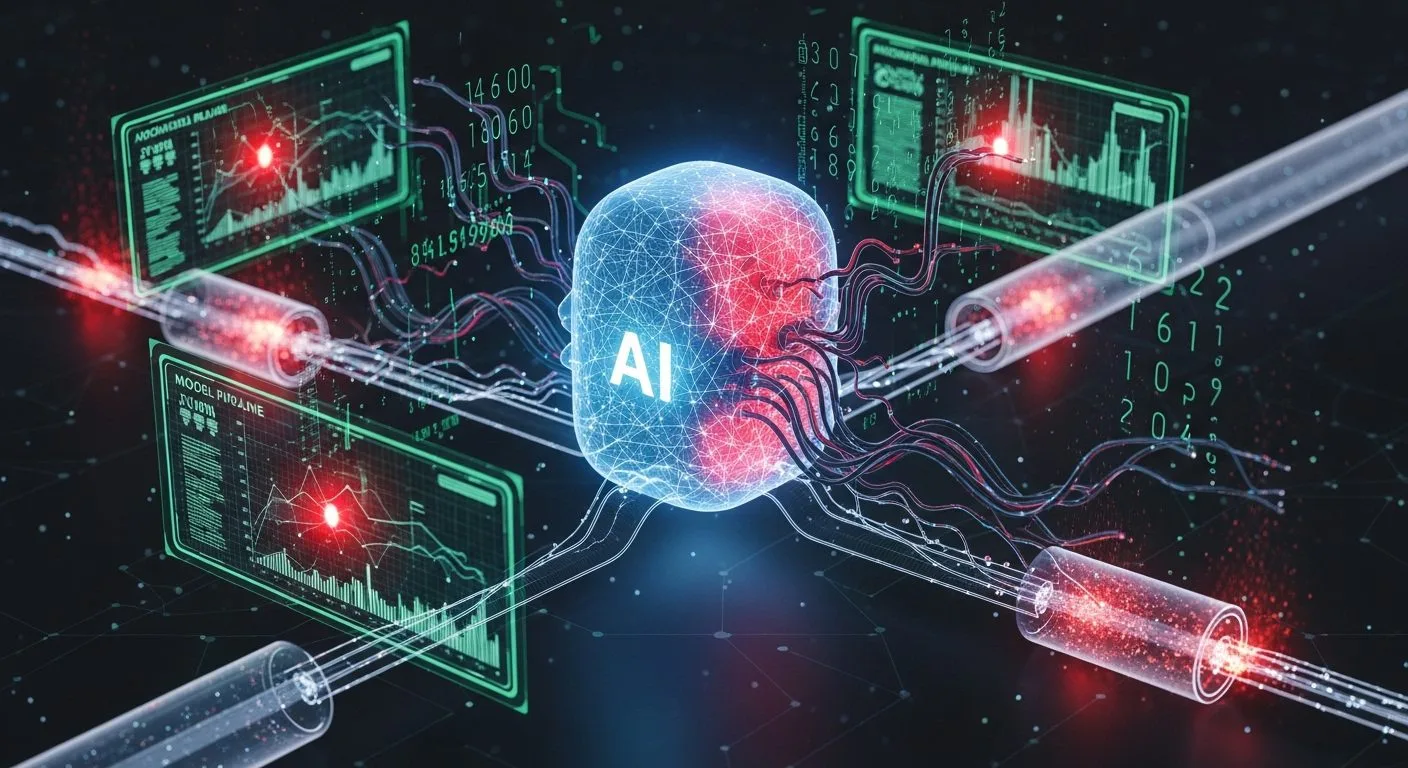
What is Poisoned AI? Poisoned AI is a plain-English way to describe AI systems whose behaviour has been manipulated through corrupted training data, backdoored models, tainted datasets, or compromised learning pipelines.
If you want a practical answer to what is Poisoned AI, the key point is simple: it refers to AI that has learned from bad or malicious inputs in a way that makes the model less trustworthy, less accurate, or actively dangerous. In formal security language, this is usually discussed through concepts like data poisoning, backdoor attacks, clean-label attacks, model tampering, and broader adversarial machine learning risks.
This guide uses IBM’s official data poisoning explainer, OWASP’s GenAI Security work, Microsoft’s AI Red Team guidance, and the NIST AI Risk Management Framework as the main references.
What is Poisoned AI? A security problem where attackers or unsafe pipelines quietly distort what an AI system learns, how it behaves, or when it fails.
What is Poisoned AI at a glance
What is Poisoned AI at a glance? It is AI that has been compromised through poisoned data, hidden triggers, or other manipulation in the model lifecycle.
- IBM defines data poisoning as a cyberattack in which threat actors manipulate or corrupt the training data used to develop AI and machine learning models.
- Poisoned AI can result from label flipping, fabricated data injection, backdoor attacks, or clean-label attacks.
- Some attacks are targeted, meaning they try to force a specific failure. Others are non-targeted and aim to degrade overall model reliability.
- Poisoned AI can affect machine learning systems, large language models, security tools, autonomous systems, and other AI-based products.
- Poisoned AI is not the same as prompt injection, which attacks a model at inference time rather than during training or system preparation.
- Defenses usually involve data validation, anomaly detection, access controls, adversarial testing, and governance across the full AI pipeline.
Why understanding what is Poisoned AI matters
If you want a better answer to what is Poisoned AI, it helps to understand why the concept matters right now. Organisations are building AI systems with third-party datasets, open-source models, external connectors, retrieval pipelines, and shared repositories. That creates more opportunities for attackers, low-quality data, or unsafe supply-chain dependencies to influence model behaviour before anyone notices.
That matters because poisoned AI is not just a lab problem. It can degrade business decisions, security detection, recommendation quality, compliance reporting, fraud detection, and other high-impact workflows. If you are already thinking about broader cyber hygiene and infrastructure hardening, Progressive Robot’s guide on how to secure your business network is relevant supporting context.
What is Poisoned AI in simple terms

What is Poisoned AI in plain English? It is AI that has been taught the wrong thing on purpose or through unsafe data handling.
Imagine training an AI system on information that looks normal but has been quietly altered. Maybe labels were swapped. Maybe fake records were inserted. Maybe a hidden trigger was embedded so the model behaves normally until a specific input appears. The result is a model that can still look useful on the surface while failing in ways that benefit an attacker.
What is Poisoned AI for a non-technical reader? A smart system that has been tampered with before or during learning, so its answers or decisions can no longer be trusted fully.
What is Poisoned AI in the current threat landscape

What is Poisoned AI in the modern security landscape? It is part of a wider problem that sits across data integrity, AI supply chain security, and adversarial machine learning.
What is Poisoned AI through data poisoning?
The clearest answer to what is Poisoned AI starts with data poisoning. IBM says data poisoning happens when threat actors manipulate or corrupt the training data used to build AI and ML models. Because model quality depends heavily on data integrity, even small corruptions can alter behaviour in subtle or dramatic ways.
This matters because many AI systems are trained on large, complex, distributed datasets collected from multiple sources. The more distant the source chain becomes, the harder it can be to verify everything that shaped the model.
What is Poisoned AI through targeted and non-targeted attacks?
IBM also separates poisoning into targeted and non-targeted attacks. Targeted attacks push the model toward a specific manipulated outcome, while non-targeted attacks aim to weaken overall robustness and accuracy.
That distinction matters because poisoned AI is not always obvious. Sometimes the attacker wants broad degradation. Sometimes the attacker wants one precise failure mode that only appears under certain conditions.
What is Poisoned AI through backdoors and stealthy changes?
Another important part of what is Poisoned AI is the backdoor problem. IBM describes backdoor attacks as subtle manipulations that leave the model appearing normal under most conditions, but cause malicious behaviour when a trigger is encountered. Clean-label attacks are even harder to spot because the poisoned samples can still appear correctly labelled to ordinary review processes.
This is one reason poisoned AI is such a serious risk. The model may pass many normal checks while still containing hidden failure paths.
What is Poisoned AI compared with prompt injection?
What is Poisoned AI is often confused with prompt injection, but they are not the same threat. IBM notes that data poisoning manipulates training data and long-term model behaviour, while prompt injection tries to exploit a generative AI system at inference time by feeding it malicious instructions.
That difference is important for defenders. Poisoned AI is more about what the system has already learned or absorbed. Prompt injection is more about what the attacker is trying to make the system do right now.
What is Poisoned AI in supply-chain terms?
What is Poisoned AI also needs to be understood as a supply-chain problem. Open datasets, open models, shared repositories, external model weights, and third-party fine-tuning assets all create opportunities for corruption or hidden manipulation.
OWASP’s GenAI Security project exists because organisations need practical ways to identify and mitigate these kinds of risks across the lifecycle of generative AI systems, agentic systems, and AI-driven applications. Poisoned AI fits squarely inside that broader governance problem.
What damage can poisoned AI cause?

What is Poisoned AI in terms of business impact? It is a model integrity problem that can create real operational and security failures.
The main risks include:
- Misclassification and degraded model performance
- Biased or skewed decision-making
- Hidden backdoors that activate under specific conditions
- Security monitoring failures if defensive models are poisoned
- Loss of trust in AI outputs, automation, and recommendations
- Compliance, safety, or reputational damage when corrupted outputs affect real users
IBM explicitly notes that poisoned data can lead to misclassification, security vulnerabilities, and backdoor threats. In high-stakes sectors such as healthcare, autonomous systems, or cybersecurity, those failures can become serious safety and business risks very quickly.
How organisations reduce poisoned AI risk

What is Poisoned AI from a defensive point of view? A manageable risk, but only if organisations treat AI pipelines like security-critical systems.
According to IBM, key mitigations include data validation and sanitization, adversarial training, continuous monitoring, anomaly detection, and strict access controls around training datasets and repositories. Microsoft AI Red Team guidance reinforces the need for threat modelling, structured testing, and security review of AI systems before and after deployment. NIST’s AI RMF supports the broader governance side by encouraging organisations to build trustworthiness and risk management into AI design, development, use, and evaluation.
In practical terms, that means poisoned AI risk is reduced when teams:
- Validate and sanitize training data before use
- Restrict who can modify datasets, models, and repositories
- Monitor deployed behaviour for anomalies and drift
- Test for hidden triggers, brittle behaviour, and adversarial weaknesses
- Review third-party models and external data sources carefully
- Govern AI systems with clear ownership, auditing, and risk processes
What is Poisoned AI still confused with
What is Poisoned AI still confused with? Usually bad outputs in general.
That is a mistake. Not every wrong answer from an AI system means the system is poisoned. Hallucinations, stale information, prompt injection, weak prompting, poor retrieval, and ordinary model limitations can all create bad results without any poisoning attack.
The reason the distinction matters is that poisoned AI implies a data integrity or model integrity problem, not just an output quality problem.
Frequently asked questions
What is Poisoned AI in FAQ form? These short answers cover the most practical questions.
Is poisoned AI an official single technical term everywhere?
No. The exact phrase is often used informally. More formal discussions usually talk about data poisoning, backdoor attacks, adversarial ML, or model supply-chain compromise.
Can large language models be affected by poisoned AI risks?
Yes. Large language models can be affected through poisoned training data, compromised fine-tuning inputs, backdoored model assets, or other integrity failures in the model pipeline.
Is poisoned AI the same as prompt injection?
No. Prompt injection attacks a system during use, while poisoned AI usually refers to compromised learning data or model behaviour that was shaped earlier in the lifecycle.
What is the biggest practical defence against poisoned AI?
There is no single defence. The strongest approach combines data validation, access control, continuous monitoring, adversarial testing, and clear AI governance.
Final thoughts
If you came here asking what is Poisoned AI, the most useful answer is that it is AI whose learning or behaviour has been corrupted through poisoned data, hidden triggers, or unsafe model pipelines.
What is Poisoned AI today? It is one of the clearest examples of why AI security cannot stop at the user interface. The real risk often starts much earlier, in the data, model, and supply chain behind the system.
What is Poisoned AI at its core? A trust problem in the intelligence layer itself.
More AI coverage: explore Progressive Robot's AI Models, Tools & Releases hub — hands-on reviews, setup guides and benchmarks in one place.