
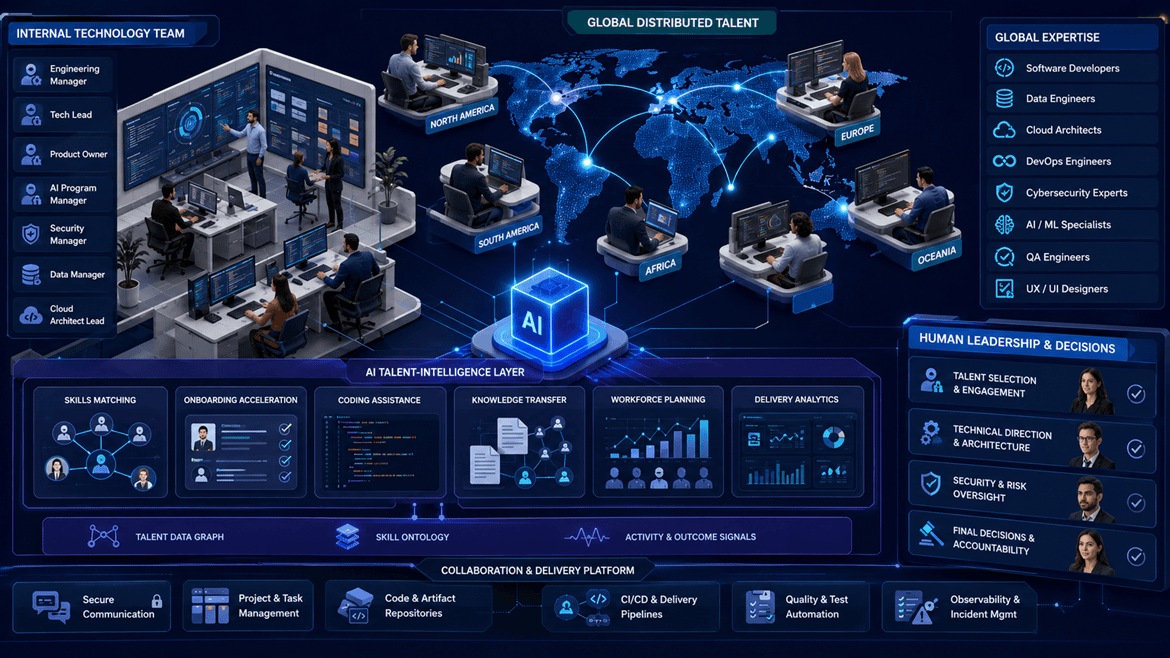
IT Staff Augmentation Strategies are changing because artificial intelligence is affecting both sides of the talent equation. It is changing how companies identify people, assess skills, onboard specialists, manage delivery, and measure performance. At the same time, it is changing the work augmented professionals are expected to perform. Organisations no longer need only developers, cloud engineers, security specialists, or data professionals. They increasingly need people who can use AI safely inside real delivery environments.
This shift does not eliminate the need for external specialists. It changes the reason businesses use them. Staff augmentation was traditionally used to fill a vacancy, meet a deadline, or add technical capacity. Modern IT Staff Augmentation Strategies increasingly use external talent to introduce new capabilities, redesign workflows, transfer AI knowledge, and help internal teams adopt tools that are evolving faster than normal recruitment cycles.
The Zones article that inspired this topic argues that staff augmentation can help organisations integrate specialist AI expertise while building capability inside existing teams. That is an important starting point, but the transformation goes further. AI is also changing workforce planning, candidate matching, technical assessment, developer productivity, governance, commercial models, and the balance between human specialists and digital agents. Zones’ discussion of AI and staff augmentation reflects this broader movement toward flexible access to AI expertise.
This guide explains how AI is reshaping IT Staff Augmentation Strategies, where it creates measurable value, which risks need to be controlled, and how organisations can redesign their operating model without treating AI as either a replacement for people or a shortcut around delivery discipline.
IT Staff Augmentation Strategies: The Quick Answer
AI is reshaping IT Staff Augmentation Strategies in four connected ways. First, recruiting teams can use AI to search wider talent pools, interpret skills, assist screening, and reduce administrative work. Second, augmented professionals use AI coding, analytics, automation, and knowledge tools to deliver more work with the same team size. Third, businesses are shifting from buying individual roles toward assembling blended human-and-agent capability around outcomes. Fourth, leaders need stronger governance because AI changes how code, data, intellectual property, and performance are managed.
| Area | Traditional staff augmentation | AI-enabled staff augmentation |
|---|---|---|
| Talent search | CV keywords and recruiter networks | Skills intelligence, semantic search, and assisted matching |
| Candidate assessment | Interviews and manual tests | Structured assessments supported by AI and human review |
| Team design | Role-by-role capacity | Human specialists combined with AI tools and agents |
| Onboarding | Documents, meetings, and shadowing | Searchable knowledge, AI assistants, and guided learning |
| Delivery | Hours, tasks, and velocity | Outcomes, quality, automation leverage, and risk controls |
| Knowledge transfer | End-of-project documentation | Continuous documentation and reusable AI-supported workflows |
| Governance | Contract, access, and supervision | Controls for models, prompts, data, generated code, and agents |
| Commercial model | Hourly or daily rates | Capacity, specialist pods, managed outcomes, or blended pricing |
The strongest IT Staff Augmentation Strategies do not use AI only to cut the number of people involved. They use it to increase the value of each specialist, shorten time to capability, improve knowledge transfer, and make flexible teams easier to govern.
Why AI Is Changing IT Staff Augmentation Strategies
The pressure comes from both demand and supply. The World Economic Forum’s Future of Jobs Report 2025 found that 86% of surveyed employers expected AI and information-processing technologies to transform their business by 2030. Two-thirds planned to hire people with specific AI skills, while skills gaps remained the leading barrier to transformation.
Those findings help explain why IT Staff Augmentation Strategies are becoming more important. Permanent recruitment is often too slow for a capability that the organisation needs immediately, particularly when the relevant tools, models, and platforms are changing every few months. A business may need an AI engineer for a pilot, an MLOps specialist for production deployment, a data engineer for retrieval pipelines, or a security expert for model and agent governance. The requirement may be urgent but not permanent in its original form.
Microsoft’s Work Trend Index has also described a move toward human-agent teams and organisations that redesign work around AI rather than simply adding isolated tools. Its 2025 research analysed 31,000 workers across 31 countries and reported that 81% of leaders expected agents to be moderately or extensively integrated into their AI strategy within 12 to 18 months. Microsoft’s 2026 research continued the emphasis on rearchitecting work and treating organisations as learning systems.
For IT Staff Augmentation Strategies, this means the unit of capacity is changing. Companies are not only adding a Java developer, cloud architect, or business analyst. They are adding professionals who can design, supervise, verify, and improve AI-enabled work.
AI-Driven Talent Discovery in IT Staff Augmentation Strategies
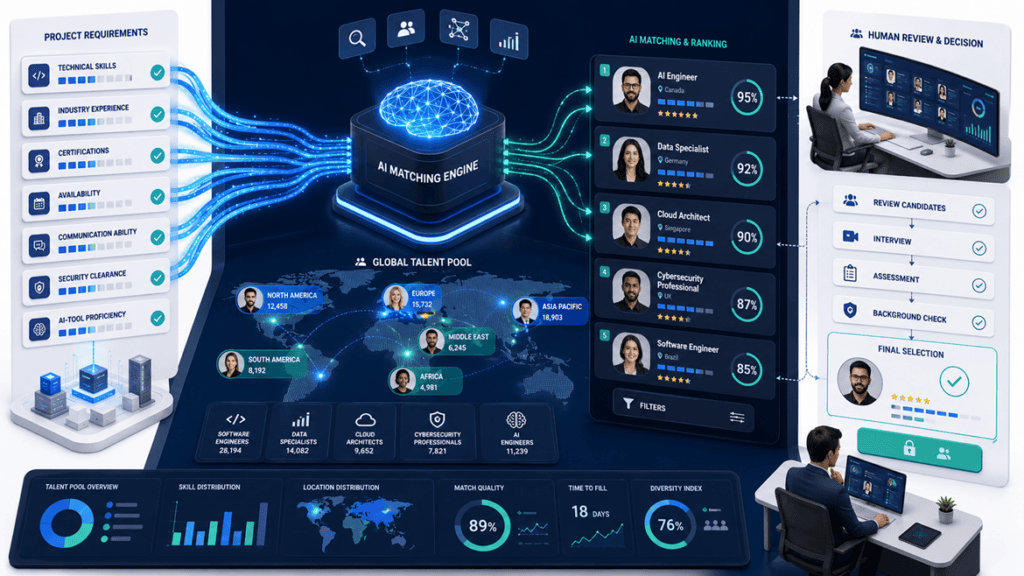
Traditional recruiting relies heavily on job titles, CV keywords, recruiter memory, and a relatively narrow network. AI-assisted search can interpret related skills, identify adjacent experience, generate search criteria, summarise profiles, and help recruiters compare a candidate’s evidence with the work required.
LinkedIn’s 2025 Future of Recruiting report said talent-acquisition professionals already using generative AI reported an average 20% reduction in workload. LinkedIn has also argued that skills-first hiring helps employers focus on capability rather than relying only on degrees or previous job titles.
This changes IT Staff Augmentation Strategies because companies can define the requirement in terms of tasks and capability rather than a familiar role label. A team may not need a generic “AI developer.” It may need someone who can evaluate retrieval quality, implement model observability, secure agent tools, or integrate an approved model into an existing Microsoft, AWS, or Google Cloud environment.
AI-assisted matching should not become an automated rejection system. Historical hiring data may reproduce bias, profile information may be incomplete, and a model may overvalue superficial keyword similarity. Human reviewers should confirm the evidence, challenge the ranking, and document why a person was selected.
The practical advantage is speed and coverage. Recruiters can search a wider market and spend more time validating high-potential candidates. The risk is false precision. Modern IT Staff Augmentation Strategies should treat AI recommendations as decision support, not as proof that a candidate is suitable.
Skills-Based Hiring in IT Staff Augmentation Strategies
A fixed job description can become outdated before a project starts. AI platforms, coding tools, data stacks, security controls, and cloud services evolve quickly. A role defined around one product may fail to capture the underlying capability the organisation needs.
Skills-based IT Staff Augmentation Strategies begin with work decomposition. Leaders define the outcomes, tasks, technical environment, domain knowledge, collaboration needs, and risk level. Recruiters then search for evidence that a professional can perform that work.
LinkedIn has estimated that 70% of the skills needed for the average job in 2015 will be different by 2030. The World Economic Forum reported that employers expect 39% of key job skills to change by 2030. These projections support a more dynamic approach to workforce design.
The change is particularly important for AI work. A candidate may know a specific framework but lack evaluation, security, data-governance, or production-operations experience. Another candidate may not match the preferred title but may have built comparable systems in another industry.
Better IT Staff Augmentation Strategies use a capability matrix that separates essential skills from trainable skills. It may include software-engineering fundamentals, cloud architecture, data quality, model evaluation, responsible AI, communication, domain knowledge, and the ability to review AI-generated output critically.
This approach also improves internal capability building. The augmented specialist can be selected not only for delivery but also for mentoring, documentation, pair work, and reusable standards. The business gains a capability rather than simply renting additional hands.
AI-Assisted Screening in IT Staff Augmentation Strategies
AI can help recruiters generate structured interview questions, summarise evidence, compare assessments, and identify areas that require deeper investigation. It can also support realistic coding, architecture, data, cloud, or security exercises.
However, AI-generated assessments create new integrity problems. Candidates may use coding assistants during take-home work, automated detectors may produce unreliable conclusions, and interviewers may mistake polished output for understanding. IT Staff Augmentation Strategies therefore need to assess how a person works with AI, not pretend AI tools do not exist.
A modern technical assessment can allow approved AI tools while requiring the candidate to explain decisions, validate generated output, identify security or maintainability problems, and respond when the tool gives a poor answer. This reveals judgement, foundations, and responsible use more effectively than a memory test.
The assessment should mirror the engagement. A cloud specialist can review a flawed architecture. A developer can extend and test a small codebase. An AI engineer can design an evaluation plan. A security professional can threat-model a tool-using agent.
AI should support consistency in scoring, but human experts should retain responsibility for interpreting the evidence. The strongest IT Staff Augmentation Strategies combine structured rubrics with expert discussion, references, and a bounded paid pilot where appropriate.
How IT Staff Augmentation Strategies Change the Skills Businesses Need
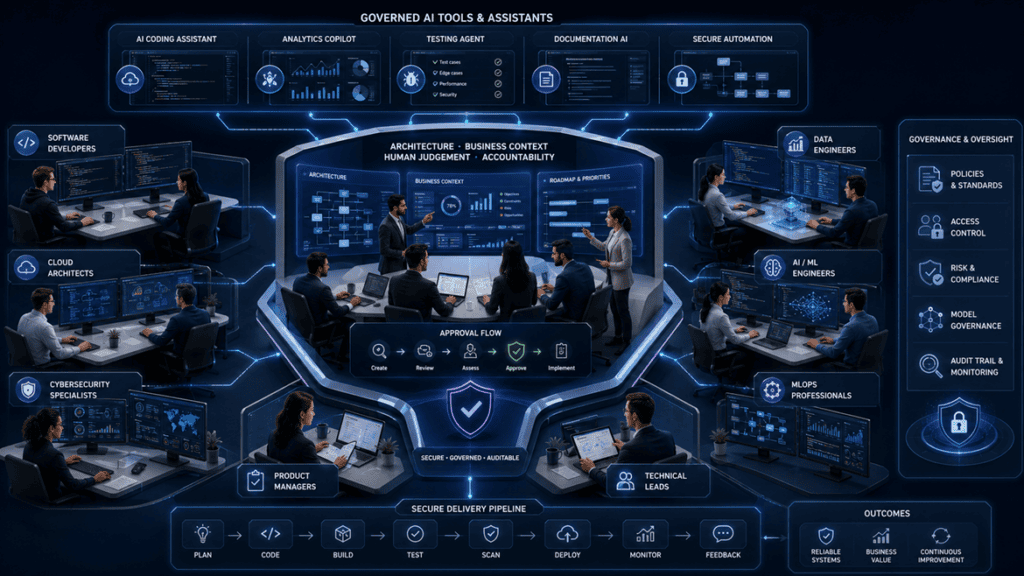
AI adoption creates demand for new specialist combinations. Companies may need machine-learning engineers, data engineers, AI product managers, model evaluators, MLOps engineers, context engineers, automation architects, and AI security professionals. They also need conventional developers, analysts, and infrastructure specialists who can work effectively with AI-enabled tools.
The World Economic Forum lists AI and machine-learning specialists, big-data specialists, and software developers among fast-growing roles. At the same time, its report emphasises analytical thinking, resilience, leadership, and collaboration alongside technical skills.
This affects IT Staff Augmentation Strategies because the highest-value profile is often hybrid. A senior developer who understands the company’s domain and can supervise coding agents may create more value than an isolated model specialist. A data engineer who can build governed retrieval and evaluation pipelines may be more useful than someone focused only on model experimentation.
The hiring question should therefore be: what combination of human expertise and AI leverage will deliver the outcome safely? That question produces a different team from simply asking how many developers are needed.
From Individual Contractors to AI-Enabled Delivery Pods
Traditional augmentation often adds one individual to an existing team. That remains useful when internal leadership is strong and the gap is clearly defined. AI-intensive work, however, often crosses architecture, data, security, product, and operations boundaries.
IT Staff Augmentation Strategies are therefore moving toward small cross-functional pods. A pod might include a senior engineer, data specialist, AI engineer, quality or evaluation specialist, and fractional security or architecture support. The members use AI tools, but they also provide the human controls those tools require.
The pod model reduces coordination gaps. It gives the client one accountable capability unit rather than several disconnected specialists. It can also improve knowledge transfer because the pod produces shared documentation, reusable patterns, and operating controls.
This does not mean every engagement should become managed services. Staff augmentation still differs because the client normally owns priorities, product decisions, and day-to-day direction. Progressive Robot’s comparison of staff augmentation and managed services explains that the right model depends on desired control, management capacity, cost structure, and outcome ownership.
Effective IT Staff Augmentation Strategies choose between individuals, pods, and managed outcomes deliberately rather than treating every external engagement as interchangeable.
IT Staff Augmentation Strategies for Human-Agent Teams
AI agents can perform bounded tasks such as generating test cases, drafting documentation, summarising incidents, searching code, preparing migration scripts, or monitoring repetitive workflows. This introduces a new workforce-planning question: which work should be performed by internal employees, augmented specialists, automation, or a combination?
Microsoft’s Work Trend Index describes the emerging “agent boss” as a person who builds, delegates to, and manages agents. Its research also describes human-agent teams as a defining feature of AI-oriented organisations.
For IT Staff Augmentation Strategies, this means capacity should be planned around tasks and accountability rather than headcount alone. An augmented engineer may supervise several coding or testing agents, but that does not make the engineer optional. It changes the work toward specification, review, architecture, integration, security, and ownership.
Organisations should identify tasks that are deterministic, reversible, and easy to verify. Those are stronger candidates for automation. Ambiguous decisions, high-impact changes, and work requiring organisational context should retain meaningful human involvement.
The right question is not “How many people can AI replace?” It is “What operating model produces the best combination of speed, quality, learning, and control?” Modern IT Staff Augmentation Strategies use AI to raise the capability ceiling of the team while keeping responsibility visible.
AI-Assisted Delivery in IT Staff Augmentation Strategies
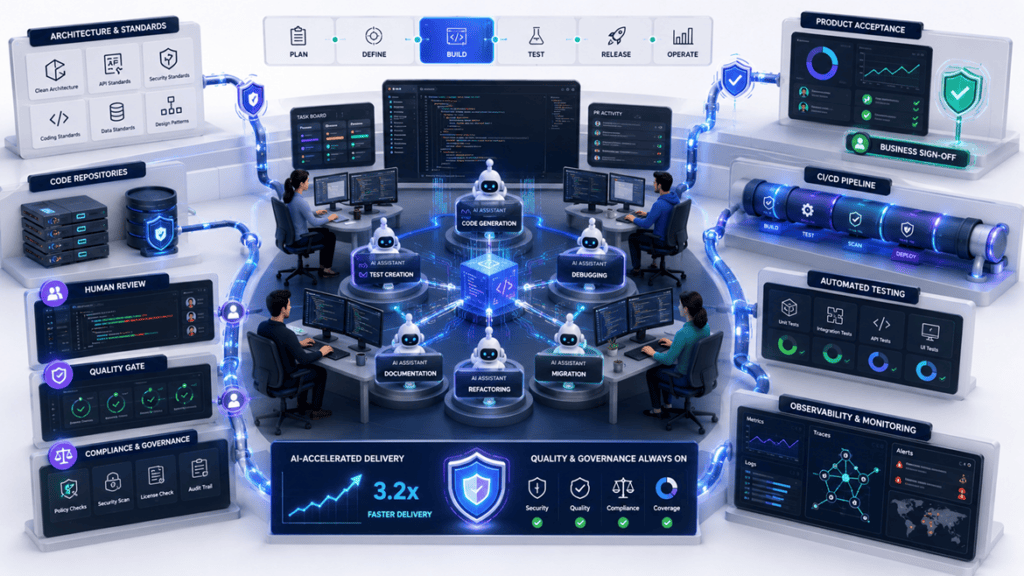
AI coding tools can reduce time spent on boilerplate, tests, documentation, search, and routine refactoring. GitHub has reported experiments in which developers using Copilot completed a coding task up to 55% faster. DORA’s 2025 research found widespread AI use and perceived productivity benefits, while also warning that individual gains do not automatically translate into better software-delivery performance.
This distinction is critical for IT Staff Augmentation Strategies. A supplier should not promise that five AI-enabled developers are automatically equivalent to ten conventional developers. Productivity depends on task type, repository quality, test automation, architecture, developer expertise, security, review, and the amount of rework generated.
AI can help an experienced specialist move faster because the specialist can validate suggestions and direct the tool effectively. It can also help a new team member understand a codebase, but generated explanations may be incomplete or wrong. Strong onboarding and review remain necessary.
Contracts and performance reviews should focus on accepted outcomes, quality, lead time, reliability, security, and maintainability. Measuring only lines of code, story points, or prompt activity rewards volume rather than value.
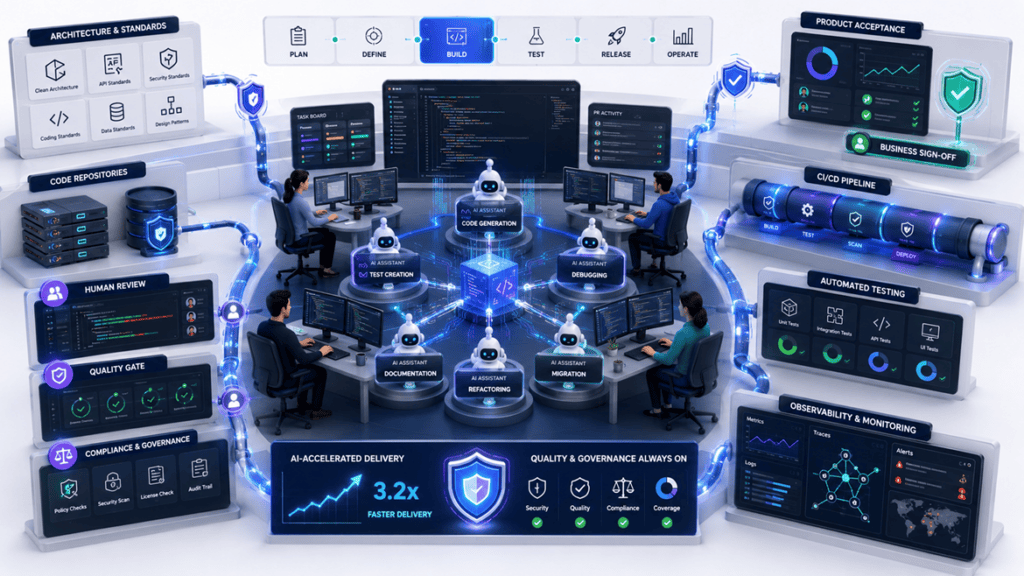
Good IT Staff Augmentation Strategies make AI use transparent. Teams agree which tools are approved, what data may be shared, how generated code is reviewed, and which evidence demonstrates that productivity has improved without weakening quality.
Faster Onboarding and Knowledge Transfer
External specialists lose time when documentation is fragmented and key knowledge exists only in meetings or individual memory. AI search and knowledge assistants can reduce that delay by helping new team members navigate architecture records, repositories, policies, service catalogues, tickets, and past decisions.
This can make IT Staff Augmentation Strategies more efficient, but only when the underlying information is trustworthy. An AI assistant cannot repair missing ownership, outdated documents, or contradictory procedures by itself. It may simply present the wrong information more fluently.
The organisation should curate approved sources, expose dates and ownership, and require links back to original evidence. Access should be based on the specialist’s role and contract. Sensitive customer data, credentials, security incidents, and proprietary code require stricter controls.
AI can also improve knowledge transfer at the end of an engagement. It can help generate runbooks, architecture summaries, code explanations, test documentation, and change histories. Human experts should review those artifacts before acceptance.
The goal is continuous transfer rather than a rushed handover in the final week. IT Staff Augmentation Strategies should require augmented professionals to leave behind reusable knowledge, standards, and operating assets throughout the engagement.
Workforce Planning Becomes Predictive and Dynamic
AI can analyse project pipelines, skill inventories, delivery history, vacancy trends, supplier performance, and upcoming technology changes. This can help leaders forecast where capability gaps are likely to appear.
Instead of waiting for a project to become blocked, IT Staff Augmentation Strategies can use scenario planning. Leaders can model the impact of a product launch, migration, acquisition, security programme, or AI initiative on required roles and capacity.
The output should remain a planning aid rather than an automated hiring order. Historical data may reflect outdated team structures or underinvestment. Forecasts can also miss strategic changes that have no precedent in the data.
A useful workforce model separates enduring capability from temporary demand. Enduring capability may justify permanent hiring and internal development. Temporary demand, specialist migration work, or short-lived platform expertise may justify augmentation. Some roles require a hybrid plan: an external specialist starts the work while training an internal owner.
The most effective IT Staff Augmentation Strategies connect workforce planning with architecture and product roadmaps. Talent decisions then follow the actual future operating model rather than last year’s organisational chart.
AI Changes Commercial and Pricing Models
Hourly and daily rates remain common because clients control the backlog and augmented professionals work inside existing teams. AI complicates this model when a specialist can produce more value in less time.
IT Staff Augmentation Strategies are beginning to use several commercial structures: time and materials for uncertain work, capacity retainers for flexible access, pod pricing for a stable multidisciplinary unit, milestone fees for bounded deliverables, and outcome-linked incentives where measurement is credible.
Outcome pricing can align incentives, but it requires careful definitions. A supplier should not be rewarded for short-term speed if the result creates security problems or technical debt. Contracts should define acceptance, quality, documentation, support, security, and change control.
AI tool costs also need clarity. The agreement should state whether model usage, coding assistants, evaluation tools, cloud environments, and specialised platforms are included in the rate or billed separately.
Modern IT Staff Augmentation Strategies should avoid measuring value by hours alone, but they should also avoid pretending that every software outcome can be priced perfectly in advance. The commercial model should reflect uncertainty, client control, and the provider’s level of responsibility.
Security and Privacy in IT Staff Augmentation Strategies
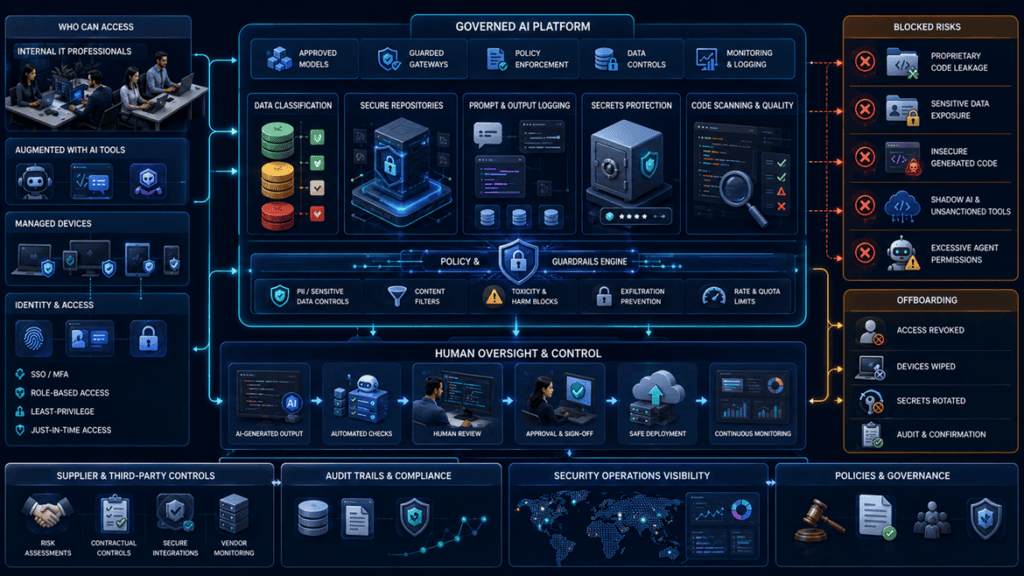
AI introduces risks beyond ordinary contractor access. A coding assistant may transmit source context to a provider. A prompt may contain customer information. Generated code may include insecure patterns, incorrect licences, or dependencies that have not been approved. An agent may have authority to call tools and modify systems.
The OWASP Secure Coding with AI guidance recommends reviewing what context coding assistants send to providers and applying approval controls for sensitive codebases. NIST’s AI Risk Management Framework provides a broader structure for governing AI risk across design, deployment, use, and monitoring.
Security must therefore be built into IT Staff Augmentation Strategies. Contracts should define approved tools, data locations, retention, model-training terms, intellectual-property ownership, subcontractors, breach notification, and the return or deletion of data at the end of the engagement.
Technical controls should include managed identities, multifactor authentication, least privilege, protected repositories, secret management, code review, dependency scanning, logging, environment separation, and prompt-injection protections for agentic systems.
Offboarding is especially important. Access to code, cloud accounts, knowledge systems, model endpoints, and AI memories should be removed promptly. The provider should return documentation and confirm deletion obligations.
AI does not make remote or augmented work inherently insecure. Weak governance makes it insecure. Mature IT Staff Augmentation Strategies apply the same or stronger controls to external professionals and the AI systems they use.
Bias and Fairness in AI-Assisted Hiring
AI-assisted recruiting can widen a search, but it can also reproduce patterns from historical data or favour candidates whose profiles resemble previous hires. Automated summaries may omit important evidence, and ranking systems may give a false impression of objectivity.
IT Staff Augmentation Strategies should use job-relevant criteria, structured rubrics, diverse review, accessibility, and an appeal or correction process. Sensitive characteristics should not be used to make employment decisions unless a valid legal basis exists.
Leaders should ask vendors what data powers their matching system, how recommendations are evaluated, which factors influence rankings, and how candidates can correct inaccurate information. Human reviewers should be trained to question AI outputs rather than simply approve them.
The NIST AI Risk Management Framework emphasises governance, measurement, transparency, and ongoing monitoring rather than one-time approval. That approach is suitable for talent systems because labour markets, models, and job requirements continue to change.
Responsible IT Staff Augmentation Strategies use AI to find overlooked capability, not to create an opaque barrier between people and opportunity.
New Roles in AI-Enabled Augmented Teams
AI creates technical roles, but it also creates governance and operating roles. Organisations may need AI product owners, agent supervisors, model-risk specialists, evaluation engineers, AI security professionals, data stewards, knowledge managers, and change leaders.
Microsoft’s workforce research has highlighted emerging roles such as AI agent specialists, AI trainers, and AI workforce managers.
These roles matter because tools do not manage themselves. Someone must define objectives, curate knowledge, review failures, monitor cost, approve permissions, and decide when the AI should defer to a person.
IT Staff Augmentation Strategies can use fractional or temporary experts to establish these capabilities before the organisation commits to a permanent structure. An external AI governance lead might design standards and train internal owners. An evaluation engineer might create the initial test framework. A data specialist might prepare governed knowledge sources.
The engagement should include a transition plan from the beginning. The business must know which roles should remain external, which should transfer internally, and which can be reduced after the capability becomes stable.
Choosing a Partner for AI-Enabled IT Staff Augmentation Strategies
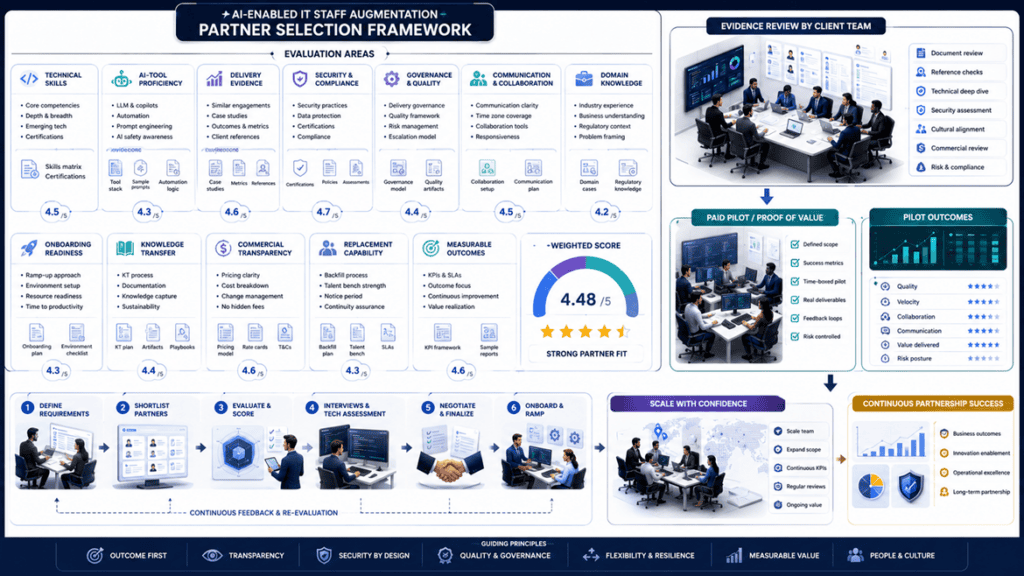
A provider should be able to explain how AI changes its own delivery model. Vague claims about faster coding or intelligent recruiting are not enough.
Ask how candidates are sourced and assessed, which AI tools are approved, how generated work is reviewed, how client data is protected, and which delivery metrics are used. Review the named people who will join the engagement rather than relying only on company-level capability statements.
The provider should demonstrate expertise in the client’s actual environment. An AI specialist working with healthcare data, regulated finance, industrial systems, or public-sector infrastructure needs more than generic model knowledge.
Strong IT Staff Augmentation Strategies also test the provider’s knowledge-transfer approach. Ask what documentation, reusable code, runbooks, evaluation suites, training, and architecture assets the client will own.
Progressive Robot’s staff augmentation guide explains the model as a flexible way to add specialist capability while the client retains control. Its IT Outsourcing service extends this with defined governance, risk controls, and measurable performance where broader service ownership is required.
A short paid pilot can reveal more than a long sales process. Use a real but bounded task, agreed security controls, and a clear rubric for technical quality, communication, speed, documentation, and collaboration.
Implementation Roadmap for IT Staff Augmentation Strategies
Define the Business Outcome
Start with the result: faster migration, improved release quality, AI product delivery, reduced incidents, better data access, or stronger security. Avoid beginning with a fashionable role title.
Decompose the Work
Identify tasks, decisions, systems, data, dependencies, risks, and required human judgement. Mark which work can be assisted by AI, which can be automated, and which must remain under human control.
Map Internal and External Capability
Document existing skills, available leadership, workload, and knowledge gaps. Decide which capabilities should remain internal because they are strategic or high risk.
Define AI and Security Controls
Approve tools, model providers, data classes, repositories, logging, review, and agent permissions before the augmented team begins work.
Select the Engagement Model
Choose individuals when internal management is strong, a pod when the work crosses disciplines, or managed services when the provider should own defined outcomes and operations.
Run a Paid Pilot
Test the provider on a bounded task. Measure technical quality, collaboration, responsible AI use, documentation, and time to productive contribution.
Establish Shared Delivery Standards
Use common repositories, architecture rules, definitions of done, review procedures, incident processes, quality gates, and product goals.
Measure Outcomes and Transfer Capability
Track delivery and business results while requiring continuous documentation, mentoring, reusable assets, and internal ownership.
Review the Workforce Mix
Quarterly, decide whether to scale, change skills, automate more work, convert key people to permanent roles where appropriate, or transition responsibility internally.
This roadmap keeps IT Staff Augmentation Strategies connected to business value rather than allowing AI adoption to become an uncontrolled tooling experiment.
Metrics That Matter
IT Staff Augmentation Strategies need metrics that distinguish activity from value.
| Metric | What it reveals |
| Time to qualified shortlist | Whether AI-assisted sourcing improves speed |
| Interview-to-engagement rate | Whether matching produces relevant candidates |
| Time to productive contribution | Whether onboarding and knowledge access work |
| Accepted delivery lead time | Whether the team increases useful throughput |
| Escaped defect rate | Whether speed is damaging quality |
| Rework percentage | Whether AI-generated output is creating hidden cost |
| Security findings | Whether tools and delivery controls remain effective |
| Knowledge-transfer completion | Whether the client retains capability |
| Internal team productivity | Whether augmentation improves the wider team |
| Cost per accepted outcome | Whether the model creates economic value |
| Retention and continuity | Whether critical knowledge remains stable |
| AI tool adoption and exception rate | Whether tools help and where people override them |
Metrics should be interpreted together. Faster delivery with more production defects is not improvement. Lower cost with weak documentation may create future dependency.
The purpose of IT Staff Augmentation Strategies is not to maximise utilisation. It is to give the organisation the right capability at the right time while preserving control, quality, and learning.
Common Mistakes
The first mistake is using AI to accelerate a poorly defined hiring request. Faster search cannot compensate for unclear outcomes and unrealistic expectations.
The second is assuming AI proficiency replaces engineering fundamentals. Professionals must still understand architecture, security, testing, operations, and business context well enough to validate generated output.
The third is measuring individual productivity while ignoring system performance. DORA’s research shows why faster local work does not automatically improve delivery throughput or stability.
The fourth is allowing shadow AI. If specialists use unapproved tools with client code or data, the organisation may lose visibility over information handling and intellectual property.
The fifth is outsourcing strategic ownership. The provider can supply expertise and capacity, but the client still needs accountable product, architecture, security, and business owners.
The sixth is neglecting transition. IT Staff Augmentation Strategies become expensive dependencies when knowledge, accounts, repositories, workflows, and evaluation assets remain controlled by individuals or suppliers.
Frequently Asked Questions
How is AI changing IT staff augmentation?
AI is changing sourcing, skills matching, assessments, onboarding, software delivery, workforce planning, and performance measurement. It is also increasing demand for specialists who can build, govern, and supervise AI-enabled systems.
Will AI reduce the need for augmented developers?
AI may reduce effort for some repetitive tasks, but it also creates new demand for architecture, integration, evaluation, security, data, governance, and product expertise. Team composition is more likely to change than the need for capable people to disappear.
Which roles are most in demand for AI-enabled augmentation?
Common needs include AI and machine-learning engineers, data engineers, MLOps professionals, cloud architects, software developers with AI-tool experience, AI security specialists, evaluation engineers, product managers, and governance experts.
Can AI select candidates automatically?
It can assist search, matching, summarisation, and structured assessment. Final decisions should involve accountable people who validate job relevance, evidence, fairness, and context.
How should AI-enabled augmented teams be measured?
Measure accepted outcomes, quality, lead time, reliability, security, business impact, knowledge transfer, and total cost. Avoid relying only on hours, generated code, or story points.
Are AI-enabled augmented teams secure?
They can be secure when the organisation controls identities, devices, repositories, approved models, data access, generated-code review, logging, agent permissions, and offboarding. The risk comes from uncontrolled tools and weak governance rather than augmentation itself.
Is staff augmentation better than managed services for AI work?
Staff augmentation fits organisations that retain product and delivery management. Managed services fit work where the provider should own defined outcomes or operations. A hybrid arrangement can use augmentation for strategic collaboration and managed services for stable service components.
How can a business prevent dependency on external AI specialists?
Require documentation, pair work, internal owners, reusable evaluation suites, architecture records, runbooks, training, and a transition plan from the beginning of the engagement.
Should contracts charge by time or outcome?
Time-based pricing suits uncertain work under client direction. Outcome or milestone pricing suits bounded deliverables with clear acceptance. Pod or capacity pricing can support ongoing multidisciplinary demand. The model should reflect control and uncertainty honestly.
Final Verdict
AI is not making staff augmentation obsolete. It is turning it into a more strategic workforce capability.
Modern IT Staff Augmentation Strategies use AI to search for skills more intelligently, assess real capability, accelerate onboarding, increase specialist productivity, forecast talent gaps, and build blended human-agent teams. They also recognise that AI introduces additional obligations around data, security, generated code, permissions, fairness, and accountability.
The strongest strategy is not to replace external professionals with tools or to add AI specialists without redesigning the work. It is to define the business outcome, decide which tasks require human judgement, select people who can use AI responsibly, and establish a delivery system that verifies quality and transfers capability.
The model will continue to evolve. Individual specialists will remain useful, but more organisations will use cross-functional pods, fractional experts, AI agents, and outcome-linked delivery. Internal leaders will spend less time counting capacity and more time designing the right combination of people, tools, and controls.
Progressive Robot helps organisations create accountable IT Outsourcing and custom software development models, including flexible specialist teams, AI-assisted workflows, governance, and measurable delivery. Businesses can also review the guide to building distributed software teams or contact Progressive Robot to discuss an appropriate engagement structure.
The central lesson is clear: IT Staff Augmentation Strategies should use AI to increase access, capability, and learning while keeping human accountability visible. The organisations that get this balance right will scale expertise faster without sacrificing security, quality, or long-term control.