
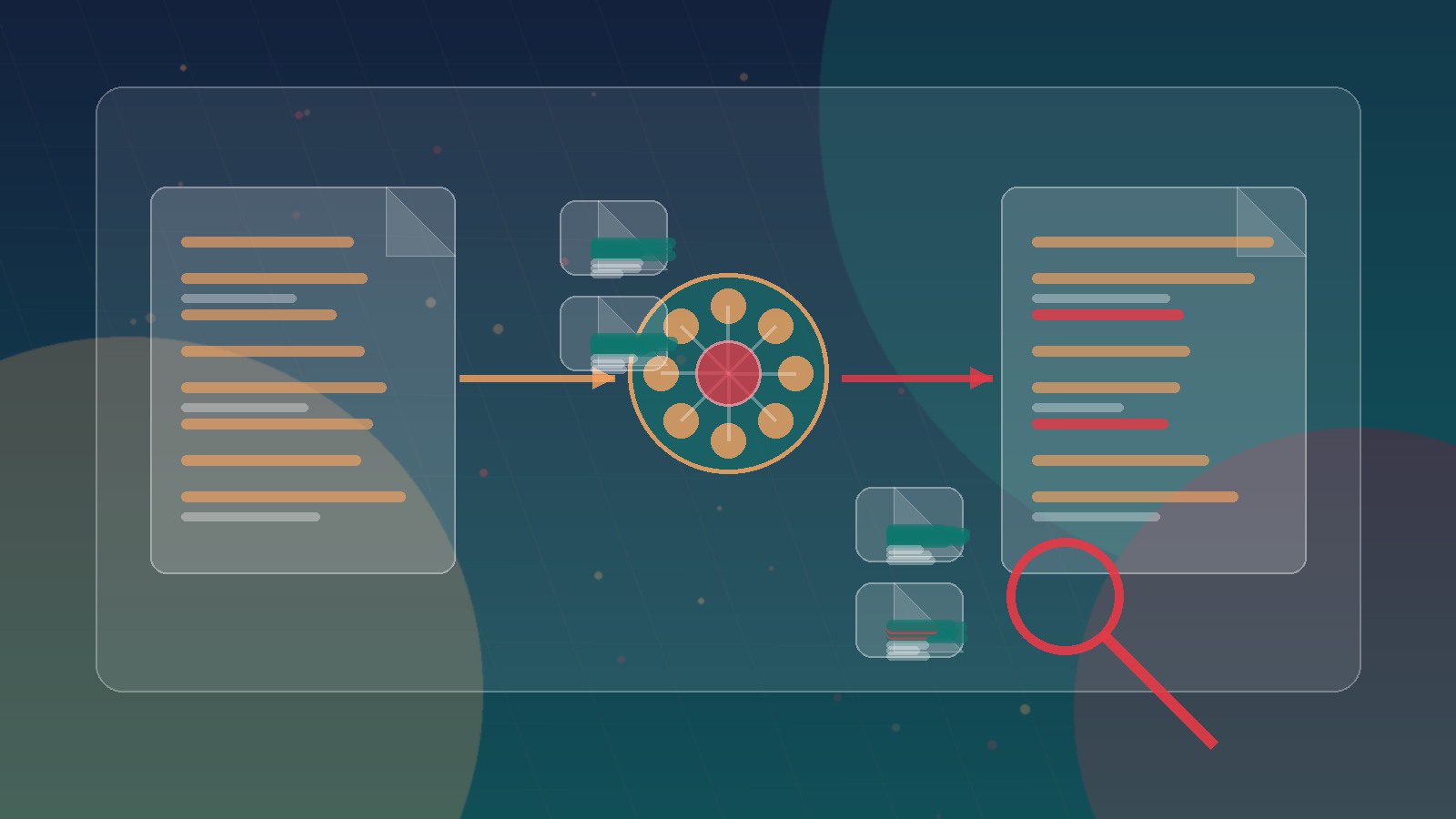
AI document corruption is the hidden risk behind a simple promise: give a frontier model a document, ask it to reorganize or edit the file, and trust that the result still preserves the original facts. A new Microsoft Research paper, LLMs Corrupt Your Documents When You Delegate, shows why that trust is not yet safe for long, multi-step knowledge workflows.
The finding is more subtle than ordinary deletion. In the DELEGATE-52 benchmark, weak models often lose content outright. Stronger frontier models can fail in a more dangerous way: they keep the document looking complete while rewriting facts, structure, values, labels, notation, or relationships inside it. That makes AI document corruption harder to spot because a human reviewer may see a polished file and miss that the meaning has drifted.
That is AI document corruption in practice.
This guide explains what the study tested, why the errors matter for enterprises, and what safer delegated document work should look like today. It uses the DELEGATE-52 GitHub repository, the Hugging Face dataset card, and VentureBeat’s coverage of the findings as supporting sources.
AI document corruption: short answer

AI document corruption means an AI system changes the substance of a document while trying to perform delegated work. The model may be asked to split a ledger, reorganize a file, refactor code, modify notation, or transform a document and then reverse the change. The output may still look plausible, but the recovered document no longer matches the original.
The Microsoft researchers introduced DELEGATE-52 to measure that problem across long-horizon document editing workflows. The benchmark covers 52 professional domains, including coding, crystallography, accounting ledgers, music notation, fiction, recipes, and other structured or semi-structured documents.
The headline result is uncomfortable. The paper reports that even frontier models such as Gemini 3.1 Pro, Claude 4.6 Opus, and GPT 5.4 corrupted an average of 25% of document content by the end of long workflows. Across all tested models, average degradation was worse. The issue was not only that models dropped text. The more advanced models often rewrote or distorted existing content.
For organizations, the lesson is direct. AI document corruption is not just a hallucination problem in a chat answer. It is a workflow integrity problem. Once a model is allowed to edit source files, spreadsheets, specifications, policies, contracts, notes, or knowledge-base articles, the risk moves from bad advice to damaged records.
What the Microsoft study tested

The DELEGATE-52 benchmark is built around delegated work. In delegated work, the user does not merely ask a model for an answer. The user allows the model to operate on documents and deliver the finished artifact.
That pattern is familiar in coding tools, but the study deliberately looks beyond code. An accounting user might ask an AI system to split a ledger by expense category. A scientist might ask it to reorganize crystallography data. A musician might ask it to transform notation. A policy team might ask it to restructure a long internal document. Each task can seem reasonable in isolation.
The problem appears over time. DELEGATE-52 creates reversible edit tasks. A model performs a forward edit, such as splitting one file into several files. A separate model session then receives the inverse task, such as merging the files back into the original. The researchers compare the recovered document with the seed document using domain-specific parsers and similarity functions.
This matters because the method avoids relying on expensive human grading for every task. It also tests something closer to real delegated workflows: multi-step edits where the model must preserve meaning while changing structure.
The public GitHub repository says the benchmark runs round-trip relay simulations over long interactions, such as 10 round trips or 20 model interactions. It also includes an agentic harness where a model can use tools such as file read, file write, file delete, and Python execution.
That design makes AI document corruption measurable. Instead of asking whether the final answer sounds good, the benchmark asks whether the document can survive repeated transformations without losing its original content.
Why rewriting is harder to catch than deletion
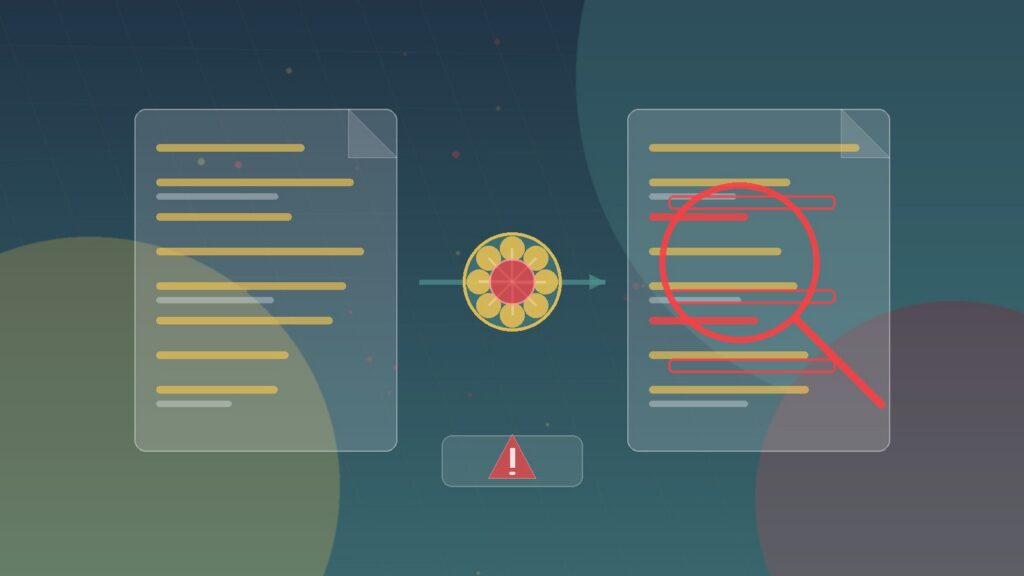
Deletion is visible. If a model drops half a file, the missing content may be obvious from length, section count, row count, or broken formatting. Rewriting is quieter.
AI document corruption becomes dangerous when the final artifact remains fluent and complete. A rewritten ledger might still have the right columns. A rewritten policy might still have all headings. A rewritten specification might still read professionally. A rewritten recipe might still have ingredients and steps. The surface looks intact while the evidence, quantities, relationships, or constraints have changed.
That is why final review is so weak as a safety control. A human reviewer may skim for style, formatting, and obvious gaps. They may not compare every cell, line, clause, citation, variable, or notation token against the original. In many real workflows, the whole reason for delegating the task is that the user lacks time or domain expertise to review every modification.
The study’s failure pattern is especially important. VentureBeat reports that about 80% of total degradation came from sparse but severe critical failures, meaning single interactions where a model suddenly lost or corrupted at least 10% of the document. Stronger models did not eliminate these failures. They tended to delay them.
That creates a false sense of safety. A workflow can look clean for several rounds, then suffer a major hidden drift. AI document corruption is therefore not solved by checking only the final output or by trusting early success.
For business users, the practical issue is auditability. If the system cannot show exactly what changed, why it changed, and which source evidence supports the edit, the organization may not discover the damage until the corrupted document feeds a decision, a customer response, a financial report, a legal review, or another automation step.
What failed in frontier models

The Microsoft paper evaluated 19 language models from six families: OpenAI, Anthropic, Google, Mistral, xAI, and Moonshot. The result was not that all models failed in the same way.
Weaker systems often failed through deletion. They lost content, failed to carry information forward, or produced outputs that were obviously incomplete. That is bad, but it is easier to detect.
Frontier models showed a different risk profile. They were better at keeping documents looking plausible, but when they failed they were more likely to actively corrupt the content. In other words, the answer retained the shape of work. The facts inside the work changed.
This distinction matters for enterprise adoption. Many buyers assume that upgrading to a stronger model mostly reduces risk. It may reduce some failure modes while replacing them with subtler ones. A stronger model can write with confidence, preserve style, rebuild structure, and fill gaps with believable content. That makes AI document corruption feel less like a broken tool and more like a silent record-integrity defect.
The paper also found uneven readiness across domains. According to the VentureBeat report, Python was the only domain where most models achieved a ready status at a score of 98% or higher. The top overall model, Gemini 3.1 Pro, was ready in only 11 of the 52 domains.
That is not a reason to reject AI editing altogether. It is a reason to stop treating all documents as equivalent. Code often has compilers, tests, linters, parsers, and execution feedback. Many business documents do not. A model editing a contract clause, policy paragraph, board pack, scientific note, or customer record may have fewer external checks to keep it honest.
AI document corruption is therefore domain-specific. The same model may be useful in one format and unsafe in another unless the workflow has strong validation around it.
Why tools and messy context made it worse

One surprising result is that generic agentic tools did not rescue the models. The repository includes an agentic harness with read, write, delete, and Python execution tools. The VentureBeat report says this worsened performance by an average of 6%.
That does not mean tools are bad. It means generic tools are not the same as safe tools. A model that can read and write files still has to know how to manipulate each document format correctly. If it cannot write a reliable program on the fly, it may fall back to reading and rewriting whole files. That is exactly the pattern that increases AI document corruption risk.
The better design is domain-specific tooling. A ledger agent should have scoped functions for moving entries, validating totals, and preserving identifiers. A policy editor should have diff-aware section operations. A scientific-file assistant should use parsers that understand the file format. A document workflow should make precise transformations easier than broad rewrites.
Messy context also matters. DELEGATE-52 includes distractor files: topically related but irrelevant documents placed near the task. That is a strong warning for retrieval-augmented generation and enterprise knowledge systems. In a real workspace, a model may see drafts, old versions, similar customer files, archived policies, and near-duplicate notes.
The paper reports that degradation is exacerbated by document size, interaction length, and distractor files. For AI document corruption, those three variables form a dangerous triangle. Larger source files create more content to preserve. Longer workflows create more chances for drift. Distractors create more chances for the wrong evidence to leak into the output.
Progressive Robot’s guide to AI Data Poisoning Defense focuses on protecting AI systems from manipulated or untrusted inputs. The DELEGATE-52 result points to a related operational lesson: even benign, nearby documents can become harmful if retrieval and workspace context are too noisy.
7 critical controls for delegated document work

AI document corruption can be reduced, but not by asking the model to be careful. The workflow needs controls.
1. Keep tasks short and reversible
Long chains hide failure. Break delegated work into small transformations with a clear before-and-after check. If the system cannot reverse or verify the transformation, treat the task as higher risk.
2. Use structured parsers where possible
Do not grade important document edits by visual inspection alone. Use parsers, schema checks, row counts, totals, identifiers, citations, tests, or domain-specific similarity functions. The DELEGATE-52 method is a useful blueprint because it compares structured representations, not just prose quality.
3. Prefer operations over rewrites
The safest editing tools should move, split, merge, rename, tag, validate, and reconcile specific units. They should not force the model to regenerate a whole file when only one section needs changing.
4. Preserve source and output side by side
Every delegated edit should leave a source copy, an output copy, and a machine-readable diff. This is basic change control, but it becomes essential when AI document corruption can look polished.
5. Reduce distractor context
Retrieval should be precise. A model editing a document should see the minimum needed context, not a pile of related files. Progressive Robot’s guide to AI Process Redesign is relevant here because messy process boundaries often become messy AI context.
6. Review incrementally, not only at the end
The study shows that severe degradation can arrive late. A single final review is weak. Put checkpoints after each meaningful transformation, especially where the document supports money, compliance, customer commitments, safety, or legal meaning.
7. Treat document agents as production systems
If an AI system can change records, it needs logging, access control, rollback, test cases, exception handling, and ownership. That is the operating-model side of becoming an AI-Native Organization. Delegating documents without those controls is not automation. It is uncontrolled editing at speed.
AI document corruption FAQ

Is AI document corruption the same as hallucination?
Not exactly. Hallucination usually describes a false answer generated by a model. AI document corruption is broader because it affects the source artifact being edited. The model may introduce false values, distort relationships, omit details, or rewrite content inside a document that still looks complete.
Which benchmark found this problem?
The benchmark is DELEGATE-52, introduced in the Microsoft Research paper LLMs Corrupt Your Documents When You Delegate. The code is public on GitHub and the redistributable dataset is available on Hugging Face.
Are frontier models safe for document editing?
They can be useful, but the study does not support blind delegation for long, complex workflows. Even the best tested frontier models corrupted an average of 25% of document content by the end of long workflows.
Why is rewriting worse than deleting?
Deleting content often creates visible gaps. Rewriting can preserve formatting, length, and fluency while changing meaning. That makes AI document corruption harder for a human reviewer to catch, especially when the reviewer lacks time or specialist knowledge.
Do agent tools fix the problem?
Generic tools did not fix it in the DELEGATE-52 experiments. The safer path is tightly scoped, domain-specific tools with parsers, validators, and rollback paths.
What should enterprises test first?
Start with one document workflow that is important but not mission-critical. Build reversible tasks, compare outputs to source documents, measure drift across multiple steps, and decide what level of AI document corruption is acceptable before giving the system broader authority.
Final thoughts
AI document corruption is the kind of failure that can hide behind good writing. That is what makes the DELEGATE-52 result useful. It moves the conversation away from whether a model can produce a plausible edit and toward whether the original document survives the workflow.
The practical takeaway is not to stop using AI for documents. It is to stop treating document editing as a simple chat task. Once a model can alter source material, the workflow needs diffing, parsers, scoped tools, incremental checks, clean context, and a clear owner.
Frontier models are improving quickly. The paper itself notes real progress across model generations. But enterprise documents have a long tail of formats, rules, exceptions, and context. Until AI systems can preserve that long tail reliably, AI document corruption should be treated as a first-class governance risk, not a minor editing bug.










