
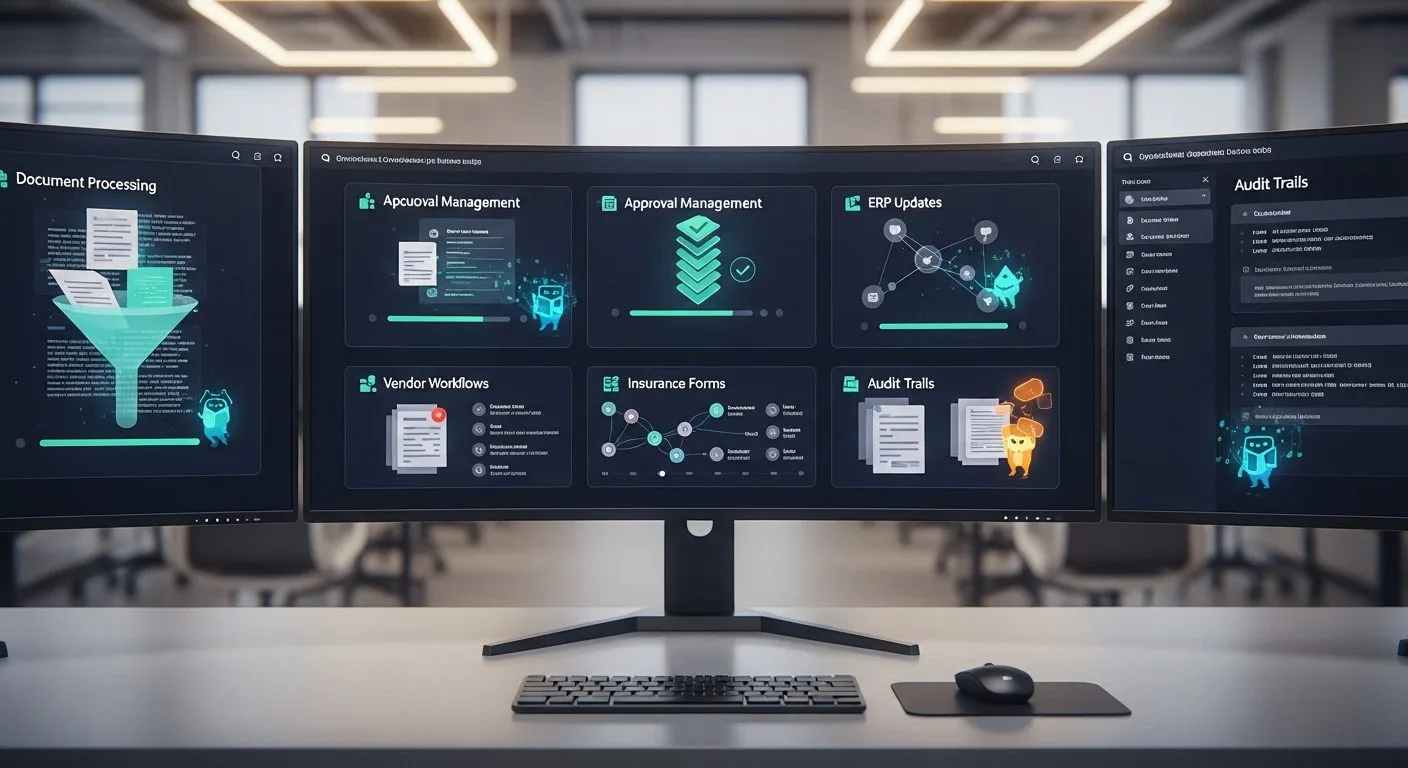
What is Komo? Komo is an AI operations platform that positions itself as agentic AI for centralised operations.
If you want a practical answer, the key point is simple: it is not a general chatbot, writing tool, or AI search engine. Komo is built around enterprise operations automation. Its product story focuses on AI agents that read documents, work across systems of record, communicate with external parties, update operational systems, and close tasks end-to-end with human oversight and auditability.
What is Komo for enterprise teams dealing with operational drag? It is a platform meant to execute the work, not only describe it.
This guide uses Komo’s official homepage, security page, procurement page, and insurance page as the main references.
In short, it is a purpose-built AI platform for operational workflows in enterprise environments, especially where document-heavy, rules-heavy, and system-driven work slows teams down.
What is Komo at a glance
What is Komo at a glance? It is an enterprise AI operations platform designed to automate end-to-end work across operational systems.
- Komo describes itself as agentic AI for centralised operations.
- The homepage says Komo builds an operational intelligence layer that handles end-to-end workflows across systems of record, 24/7, autonomously.
- The platform says its agents read documents, communicate with external parties, update systems of record, and close tasks end-to-end.
- Komo emphasizes human oversight, approval gates, source attribution, and audit trails.
- Official solution pages currently focus on procurement and insurance operations.
- Komo highlights enterprise security claims such as no training on customer data, tenant isolation, zero-trust architecture, encryption, and auditability.
Why understanding what is Komo matters
If you want a better answer, it helps to understand why this category matters. Many organisations still run critical operational work through email chains, documents, portals, spreadsheets, ERP updates, manual follow-up, and repetitive exception handling. That work is expensive, slow, difficult to scale, and often dependent on institutional knowledge that leaves with staff turnover.
That matters because Komo is trying to solve a specific operational gap, not the broad “AI for everything” story. It is positioning itself around task execution inside real business processes. If you are thinking about how agent platforms fit into production environments, Progressive Robot’s guide to OpenClaw AI agent orchestration is useful supporting context.
What is Komo in that context? A bet that agentic AI can absorb operational overhead without forcing a rip-and-replace stack.
What is Komo in simple terms

What is Komo in plain English? It is a platform that tries to turn company workflows and SOPs into AI-driven operations.
Komo says it converts existing Standard Operating Procedures into Agent Operating Procedures so institutional knowledge can run automation. Instead of asking employees to manually move information between documents, email, ERPs, CRMs, portals, and databases, Komo aims to let AI agents execute those steps with approvals and exceptions surfaced to humans when needed.
What is Komo for operations leaders? A system meant to reduce manual processing while keeping governance, auditability, and human review in the loop.
Komo in the current product story

In its current product story, it is an AI platform focused on operational execution, not just insight or conversation.
What is Komo when viewed through its product pages? A governed AI execution layer for enterprise operations.
Komo for centralised operations
The homepage gives the clearest explanation of the product. Komo says it provides an operational intelligence layer that handles end-to-end workflows across systems of record, autonomously and around the clock.
This matters because the product is framed as an operations engine. The goal is not only to answer questions about work. The goal is to complete the work.
Komo for SOP-driven automation
Another important part of the product story is its SOP-based positioning. Komo says existing SOPs become the agent’s operating instructions.
That changes the framing of the platform. It is not being sold as a blank-slate AI assistant that you prompt casually. It is being sold as a system that follows structured operational playbooks defined by the organisation.
Komo for procurement workflows
Komo’s procurement page shows one of the most concrete explanations of the product in practice. The page says its agents can support sourcing, RFQ distribution, quote collection, supplier comparison, PO lifecycle management, invoice processing, three-way matching, vendor onboarding, and master data operations.
Komo also markets specific outcomes there, including 85% reduction in manual procurement workload, average annual procurement value captured of $3.5 million, less than two weeks from setup to production, and 10x procurement capacity without new headcount.
That makes the platform much easier to understand. It is a workflow execution platform for operational bottlenecks.
What is Komo in procurement terms? An agent layer over sourcing, POs, invoices, and vendor operations.
Komo for insurance operations
The insurance page gives another strong explanation of the product. It says Komo supports underwriting operations, claims operations, policy administration, and data operations across document-heavy insurance workflows.
The page highlights submission intake, data extraction, appetite validation, FNOL triage, coverage verification, claims routing, endorsement processing, renewal management, certificate issuance, document extraction, and direct writes into core systems. It also markets outcomes such as 90% straight-through processing on routine tasks, 10x throughput, and 99%+ extraction accuracy.
This shows that the platform is closely tied to verticalized operational automation, not only generic AI assistance.
Komo for governance and human oversight
The product also needs to be understood through its governance layer. The homepage says exceptions are escalated, decisions are surfaced for approval, and every action is logged with source attribution and audit trails.
That matters because enterprise operations teams usually do not want fully ungoverned autonomy. Komo is clearly trying to reduce resistance by emphasising approvals, traceability, and role-based control.
Komo for enterprise security
The security page adds another important layer to the product story. Komo says customer operational data is never used to train or improve its models. It also says it uses strict tenant isolation, complete audit trails, zero-trust architecture, end-to-end encryption, and regular third-party audits.
The site also highlights alignment with standards and frameworks including SOC 2, CCPA, ISO 27001, GDPR, and the EU AI Act. Whether a buyer accepts every marketing claim is a separate diligence question, but the product is clearly being positioned for enterprise security reviews.
What is Komo for security-conscious buyers? A vendor that clearly expects security review and compliance scrutiny to be part of the buying process.
What is Komo good at

What is Komo good at? Based on its own product story, Komo is strongest when the work is repetitive, document-heavy, rules-driven, and spread across multiple systems.
Its clearest use cases are:
- Procurement operations
- Insurance operations
- Document extraction and validation
- PO and invoice workflows
- Vendor onboarding and operational follow-up
- Claims, policy, and submission handling
- Human-in-the-loop workflow automation with audit trails
For enterprises evaluating agentic automation, it is a platform aimed at converting operational overhead into structured AI execution.
What is Komo pricing right now
What is Komo pricing right now? Based on the public pages available, Komo does not appear to publish open self-serve pricing.
The public site routes visitors toward Request a Demo flows rather than public plan tables. The pricing URL currently resolves to a sign-in flow rather than a visible pricing breakdown. That suggests Komo is operating as a sales-led enterprise platform rather than a product with transparent click-to-buy pricing.
In practical terms, pricing appears to be custom or demo-led, not publicly posted in a standard tier structure.
What is Komo still limited by

What is Komo still limited by? Even from the official site, a few practical constraints are clear.
- Public pricing is not visible, which makes lightweight evaluation harder.
- The current public messaging is strongly enterprise-oriented rather than small-business-friendly.
- The most detailed use cases are concentrated in procurement and insurance, so buyers in other domains would still need to validate fit.
- Like any operations AI platform, the real value depends on workflow design, integration quality, and exception handling, not just model capability.
- Enterprise claims around security, compliance, and ROI still require buyer-side due diligence before adoption.
That means the best way to think about Komo is as a serious operations platform candidate, not a plug-and-play tool for every team.
Frequently asked questions
What is Komo in FAQ form? These short answers cover the most practical questions.
Is Komo a chatbot or AI search engine?
No. The clearest answer is that it is an AI operations platform focused on executing workflows, not just answering questions.
Does Komo focus on specific industries?
Yes. Its public site currently emphasizes procurement and insurance workflows as major use cases.
Does Komo emphasise human oversight?
Yes. The official site repeatedly highlights approvals, escalations, audit trails, and human-in-the-loop controls.
Is Komo publicly priced?
Not in a standard self-serve way on the public pages reviewed here. The site appears to be demo-led and enterprise sales-oriented.
Final thoughts
If you came here asking what is Komo, the most useful answer is that it is an agentic AI platform built for operational execution inside enterprise workflows.
What is Komo today? It is part of the broader shift from AI that only assists to AI that actually completes operational work across systems, documents, approvals, and business rules. That is what makes it stand out.
What is Komo for enterprises under operational pressure? A structured way to turn SOPs into governed agent execution.
What is Komo at its core? A platform for organisations that want AI agents to run structured operational processes, not just generate text about them.
More AI coverage: explore Progressive Robot's AI Models, Tools & Releases hub — hands-on reviews, setup guides and benchmarks in one place.