
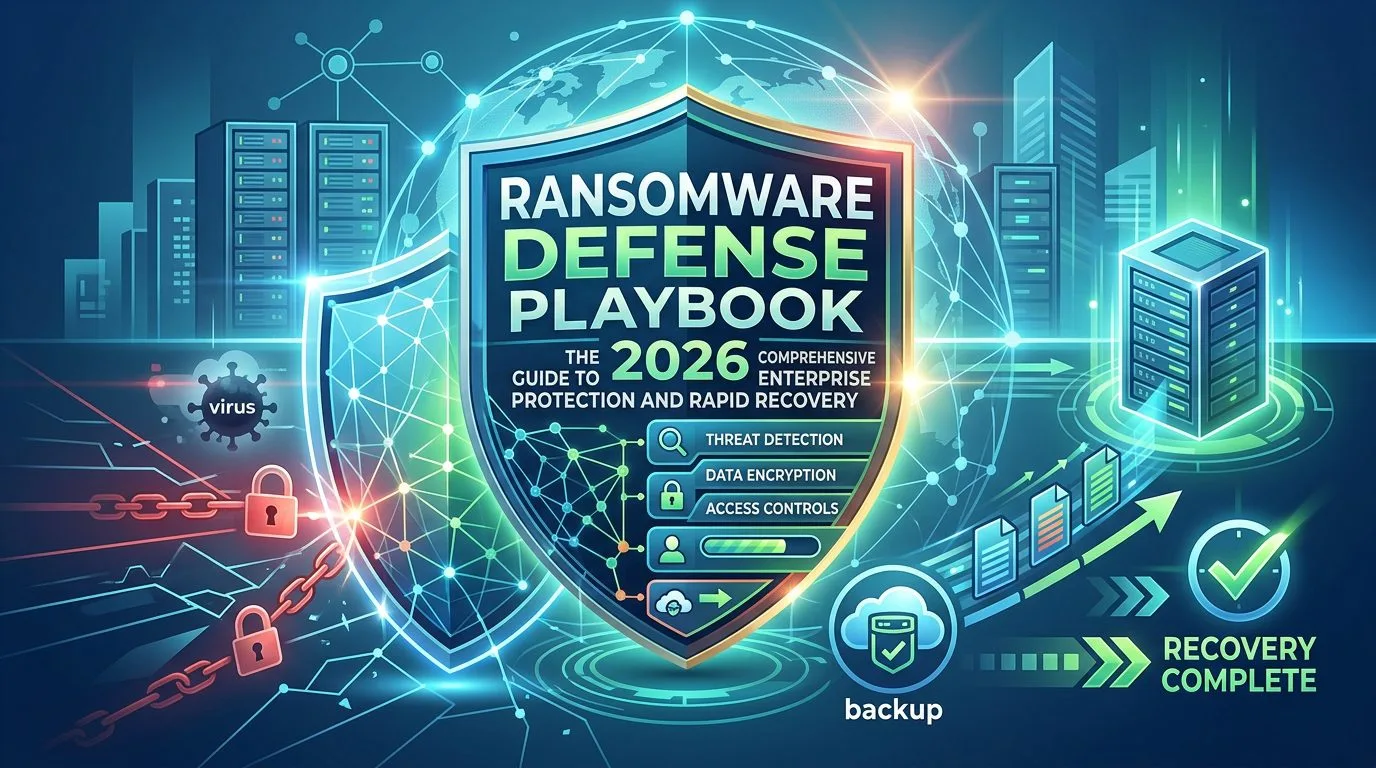
Ransomware attacks in 2026 have reached unprecedented levels, with the average cost now exceeding $2 million per incident. Your organisation needs more than just prevention tools—it requires a comprehensive ransomware defence playbook that combines proactive security measures, real-time detection capabilities, and proven recovery strategies. This ransomware defence playbook provides enterprise leaders with actionable frameworks to protect critical assets, minimise downtime, and maintain business continuity when threats materialize.
Implementing this ransomware defence playbook ensures your organisation has the tools, processes, and trained personnel necessary to prevent attacks, detect breaches quickly, and recover rapidly if prevention fails. A robust ransomware defence playbook transforms security from reactive firefighting into proactive risk management.
THE 2026 RANSOMWARE THREAT LANDSCAPE: WHY DEFENCE IS NON-NEGOTIABLE

The Escalating Threat
Ransomware has evolved from opportunistic malware into sophisticated, targeted cyber warfare. In 2026, organisations face the following challenges:
- 156% increase in ransomware attacks since 2023
- $2 million+ average cost per successful attack (including downtime, recovery, and extortion payments)
- 48-hour median time to initial encryption after breach detection
- 73% of enterprises targeted at least once in the past year
- Double-extortion tactics now standard: data theft plus encryption
Ransomware Attack Vectors in 2026
Understanding how attackers penetrate your defenses is critical for building effective ransomware defence playbook countermeasures. The most common attack vectors include:
1. Phishing and Social Engineering (48%) – Targeted spear-phishing campaigns with AI-generated content
2. Vulnerability Exploitation (31%) – Unpatched systems, especially remote access tools
3. Credential Theft (27%) – Stolen credentials from data breaches reused across platforms
4. Supply Chain Compromise (19%) – Third-party vendor vulnerabilities as entry points
5. Remote Desktop Protocol (RDP) Attacks (16%) – Weak RDP configurations and exposed services
THE THREE-PILLAR DEFENCE STRATEGY: PREVENTION, DETECTION, RECOVERY

Pillar 1: Prevention – Stop Attacks Before They Start
Prevention is your first and best line of defence. Implement these foundational security measures immediately as part of your ransomware defence playbook:
Zero Trust Architecture Implementation
Zero Trust eliminates the concept of a trusted internal network, requiring verification for every access request regardless of location. This cornerstone of any effective ransomware defence playbook requires:
- Identity-First Security: Multi-factor authentication (MFA) mandatory for all users
- Micro-Segmentation: Network divided into smallest possible zones to limit lateral movement
- Least Privilege Access: Users receive only necessary permissions for their role
- Continuous Verification: Real-time risk assessment of every access attempt
Email and Web Security Hardening
Since 48% of attacks begin with phishing, your email security must be military-grade – a critical component of any ransomware defence playbook:
- AI-Powered Phishing Detection: Machine learning models trained on current threat patterns
- URL Rewriting: All links pass through secure gateway before user access
- Attachment Sandboxing: Automatic detonation of suspicious files in isolated environments
- User Awareness Training: Quarterly simulated phishing exercises with immediate feedback
Patch Management and Vulnerability Reduction
Unpatched vulnerabilities remain the number one exploitation vector. Implement automated patching workflows as essential elements of your ransomware defence playbook:
- Automated Scanning: Continuous vulnerability assessment across all assets
- Critical Patch SLAs: 48-hour maximum deployment window for critical patches
- Patch Testing: Validation environment before enterprise-wide deployment
- Exception Management: Documented risk acceptance process with executive approval required
Backup Security and Air-Gapping
Your backups are your final defence. Protect them as critically as production systems – this is non-negotiable in any ransomware defence playbook:
- Immutable Backups: Write-once-read-many (WORM) storage preventing ransomware modification
- Air-Gapped Copies: Physical or logical isolation from production networks
- Backup Encryption: End-to-end encryption with separate key management
- Regular Recovery Testing: Monthly restore drills to verify backup integrity
Pillar 2: Detection – Identify Attacks in Real-Time
Even the best defenses can fail. Your detection capabilities must identify and contain threats before widespread encryption occurs – this is where your ransomware defence playbook proves its worth.
Endpoint Detection and Response (EDR)
Modern EDR solutions provide visibility into endpoint behaviour, identifying ransomware indicators before encryption begins:
- Behavioral Analysis: Machine learning detecting anomalous file operations
- *Process Tree Monitoring: Tracking parent-child process relationships for suspicious patterns
- File Access Correlation: Identifying mass file access consistent with encryption activity
- Automated Containmen: Instant endpoint isolation upon threat detection
Network Traffic Analysis
Ransomware communication and lateral movement create detectable network signatures:
- Encrypted Traffic Inspection: SSL/TLS decryption for threat analysis
- DNS Query Monitoring: Detection of command-and-control domain lookups
- Lateral Movement Detection: Unusual internal connection patterns flagging spread attempts
- Data Exfiltration Alerts: Large outbound transfers triggering immediate investigation
User and Entity Behaviour Analytics (UEBA)
Anomalous user behaviour often indicates compromised accounts:
- Baseline Establishment: Machine learning creating normal behaviour profiles for each user
- Deviation Detection: Real-time alerts on unusual access patterns or data downloads
- Privileged Account Monitoring: Enhanced scrutiny of admin-level activity
- Time-Based Anomalies: Access outside normal working hours triggering investigation
Pillar 3: Recovery – Minimise Downtime When Prevention Fails
Despite best efforts, attacks may succeed. Your recovery capabilities determine business impact and total cost of incident – this is where a well-designed ransomware defence playbook becomes essential.
Incident Response Playbook Development
A documented, tested ransomware defence playbook is essential for coordinated response:
- Role Assignment: Clear RACI matrix defining who does what during an incident
- Communication Plan: Pre-approved templates for internal/external stakeholder updates
- Decision Framework: Escalation paths and decision trees for critical choices (e.g., paying ransom)
- Legal and Regulatory Compliance: Procedures for notification requirements and evidence preservation
Backup Restoration Strategy
Rapid recovery depends on reliable, accessible backups:
- Tiered Recovery Objectives: Different RTO/RPO targets by business system criticality
- Automated Restore Scripts: Pre-tested scripts reducing manual restoration time
- Parallel System Access: Ability to restore critical systems while investigation continues
- Cloud Failover Options: Ready-to-activate cloud environments for disaster recovery
Post-Incident Recovery and Learning
Every incident provides learning opportunities. Capture these insights systematically to improve your ransomware defence playbook:
- Root Cause Analysis: Detailed investigation of initial breach vector
- Timeline Reconstruction: Complete attack timeline from first access to containment
- Effectiveness Assessment: What worked, what failed in the response effort
- Improvement Plan: Documented action items for strengthening defenses
STEP-BY-STEP RANSOMWARE DEFENCE PLAYBOOK IMPLEMENTATION GUIDE

Phase 1: Immediate Actions (Weeks 1-2)
These critical steps should be completed immediately, regardless of current security posture. This initial phase establishes the foundation for your ransomware defence playbook:
Week 1: Assessment and Stabilization
Day 1-2: Asset Inventory and Critical System Identification
- Document all systems, applications, and data repositories
- Identify business-critical systems requiring priority protection
- Map data flows between systems to understand lateral movement risks
Day 3-4: Backup Audit and Hardening
- Verify all critical systems have current backups* Test backup restoration procedures for top 5 critical systems
- Implement immutable storage or air-gapped copies where missing
Day 5: MFA Deployment Verification
- Confirm multi-factor authentication enabled on all user accounts
- Identify any legacy systems preventing MFA implementation
- Develop exception handling process with compensating controls
Week 2: Security Baseline Implementation
Your ransomware defence playbook now moves into strategic hardening phase:
Day 6-8: Patch Management Review
- Conduct vulnerability scan across entire environment
- Prioritise and deploy critical patches (48-hour SLA)
- Establish automated patching schedule for ongoing maintenance
Day 9-10: Email Security Enhancement
- Enable advanced phishing protection features
- Configure URL rewriting for all email traffic
- Begin user awareness training program enrollment
Day 11-12: Network Segmentation Assessment
- Document current network segmentation level
- Identify high-value assets requiring additional isolation
- Plan micro-segmentation implementation roadmap
Phase 2: Strategic Hardening (Months 1-3)
Month 1: Zero Trust Foundation
- Deploy identity and access management platform with conditional access policies
- Implement network micro-segmentation for top-tier critical systems
- Establish continuous authentication verification workflows
- Begin least privilege access review across all user accounts
Month 2: Detection Capability Enhancement
- Deploy or upgrade EDR solution across all endpoints
- Configure behavioral analytics for ransomware indicators
- Implement network traffic analysis with encrypted inspection
- Establish SOC monitoring procedures for threat detection alerts
Month 3: Recovery Readiness Validation
- Conduct full-scale incident response tabletop exercise
- Test automated backup restoration for all critical systems
- Validate communication plan with all stakeholders
- Document lessons learned and update ransomware defence playbook accordingly
Phase 3: Continuous Improvement (Ongoing)
Quarterly Activities
- Simulated phishing campaigns with metrics tracking
- Vulnerability scan and patch compliance review
- Backup restore drill for randomly selected systems
- Incident response tabletop exercise with new scenarios
Annual Activities
- Comprehensive security architecture assessment
- Third-party penetration testing engagement
- Ransomware defence playbook full review and update
- Executive briefing on ransomware threat landscape changes
CRITICAL SUCCESS FACTORS AND COMMON PITFALLS

Success Factors That Make or Break Your Defence
- Executive Sponsorship: Without C-level commitment, security initiatives stall
- Budget Adequacy: Ransomware defence requires sustained investment in people, processes, and technology
- Cross-Functional Collaboration: Security teams must work closely with IT operations and business units
- Continuous Testing: Theories are useless without regular validation through exercises and drills
- Speed of Implementation: Threats don’t wait for perfect plans – start now and iterate your ransomware defence playbook
Common Pitfalls to Avoid
- Backup Complacency: Assuming backups exist without verifying they’re secure, current, and restorable
- False Confidence in Prevention: Over-reliance on perimeter defenses without detection or recovery planning
- Siloed Response Efforts: Security, IT operations, legal, and communications teams working independently
- Insufficient Testing: Never testing your ransomware defence playbook until an actual attack occurs
- Ignoring User Behaviour: Focusing only on technology while neglecting human factors in security
MEASURING SUCCESS: KEY PERFORMANCE INDICATORS AND METRICS

Track these metrics to validate your ransomware defence effectiveness and identify improvement areas:
Prevention Metrics
- Time-to-Patch (Critical): Target less than 48 hours from vulnerability disclosure
- MFA Coverage: Target 100% across all user accounts
- Phishing Click Rate: Target less than 5% in simulated campaigns
- Unpatched Critical Systems: Target 0 systems beyond SLA window
Detection Metrics
- Mean Time to Detect (MTTD): Target less than 2 hours from initial compromise
- Detection Coverage: Percentage of endpoints and networks with EDR/monitoring enabled
- False Positive Rate: Maintain less than 10% to prevent alert fatigue
- Lateral Movement Detections: Number detected before encryption begins
Recovery Metrics
- Mean Time to Recover (MTTR): Target less than 24 hours for critical systems
- Backup Success Rate: Percentage of restore tests completed successfully
- Recovery Point Objective Compliance: Percentage of incidents within RPO targets
- Cost Per Incident: Track total financial impact over time
REGULATORY COMPLIANCE AND LEGAL CONSIDERATIONS

Mandatory Reporting Requirements
Several jurisdictions now mandate ransomware incident reporting with strict timelines:
- United States (CISA): Report within 24 hours of discovery for critical infrastructure
- European Union (NIS2 Directive): Notify competent authorities within 24-72 hours depending on severity
- California (CCPA/CPRA): Consumer notification required within 45 days if personal data compromised
- Financial Services: Additional sector-specific reporting requirements apply
Your ransomware defence playbook must include compliance procedures for all applicable regulations.
Legal Considerations During Incident Response
- Do Not Admit Liability: All communications should be reviewed by legal counsel
- Preserve Evidence: Maintain chain of custody for potential law enforcement involvement
- Insurance Notification: Prompt notification to cyber insurance provider required per policy terms
- Regulatory Coordination: Proactive engagement with regulators can mitigate penalties
EXTERNAL REFERENCES AND RESOURCES

Authoritative Sources for Ransomware Intelligence
CISA Ransomware Guidance
Comprehensive federal guidance on prevention, detection, and response
Updated: March 2026 | Source: Cybersecurity & Infrastructure Security Agency (U.S. Government)
FBI Internet Crime Complaint Center (IC3) Annual Report
Latest statistics on ransomware trends and financial impact
Updated: February 2026 | Source: Federal Bureau of Investigation
National Institute of Standards and Technology (NIST) Cybersecurity Framework
Ransomware-specific implementation guidelines for enterprise security programs
Updated: January 2026 | Source: U.S. Department of Commerce
OWASP Top 10 Application Security Risks
Web application vulnerabilities that ransomware attackers exploit
Updated: November 2025 | Source: Open Web Application Security Project
Industry Research and Analysis
Mandiant Ransomware Report 2026
Detailed analysis of attack techniques and attacker motivations
Source: Google Cloud (Mandiant)
Secure Ransomware Trends Q1 2026
Quarterly threat intelligence on emerging ransomware variants
Source: F-Secure Corporation
Zero Trust Security: The 2026 CIO’s Survival Guide to Enterprise Protection
Comprehensive guide covering identity-first architecture and micro-segmentation strategies that form the foundation of ransomware prevention
Published: April 4, 2026 | Category: Cyber Security
AI-Powered Automation in Enterprise IT Solutions: The 2026 Complete Guide
Explore how AI-driven security automation enhances threat detection and response capabilities
Published: April 3, 2026 | Source: Artificial Intelligence
CONCLUSION: YOUR RANSOMWARE DEFENCE JOURNEY BEGINS NOW
Ransomware is not an “if” but a “when” question. The organisations that survive and thrive in 2026 are those that treat ransomware defence as a continuous journey rather than a one-time project. This ransomware defence playbook provides the framework, but your commitment to implementation determines success.
A comprehensive ransomware defence playbook transforms security from reactive firefighting into proactive risk management. Your future self will thank you for investing in a robust ransomware defence playbook today.
Immediate Next Steps
- Conduct an executive briefing on current ransomware threats and organizational risk exposure
- Perform gap analysis against this ransomware defence playbook’s recommendations
- Prioritise Phase 1 actions for immediate implementation (Weeks 1-2)
- Allocate budget for security tools, training, and incident response capabilities
- Establish cross-functional team responsible for ransomware defence program execution
The Cost of Inaction
The average ransomware attack costs $2 million or more in direct expenses alone. Add reputational damage, regulatory fines, customer churn, and executive time spent managing crisis, and the total cost escalates dramatically. Organisations that invest proactively in ransomware defence spend a fraction of this amount while achieving measurable risk reduction. A well-implemented ransomware defence playbook is your best insurance against catastrophic financial loss.
Progressive Robot’s Role in Your Defence Journey
At Progressive Robot, we understand that effective ransomware defence requires more than just technology – it demands strategic partnership with security experts who know your environment and can provide ongoing support. Our cybersecurity services include:
- Comprehensive security architecture assessment
- Zero Trust implementation guidance
- Incident response plan development
- Regular tabletop exercise facilitation
- 24/7 threat monitoring and detection services
- Custom ransomware defence playbook development tailored to your organisation
Contact us today at to discuss how we can help strengthen your ransomware defence capabilities. Your future self will thank you for the investment made today in a robust ransomware defence playbook.










