
The Data Center Challenge has moved from a facilities issue to a board-level IT delivery problem. UK organisations are trying to modernise applications, adopt AI, improve resilience, and control cloud spend at the same time that data centre power demand, electricity prices, grid capacity, and specialist skills shortages are tightening the room for manoeuvre.
For IT leaders, the Data Center Challenge is no longer just whether a server room, cloud region, or colocation site has enough compute. It is whether the delivery model can cope with energy volatility, power availability, cooling requirements, cyber resilience, supplier concentration, and the shrinking availability of people who understand infrastructure deeply enough to keep services reliable.
The UK government has now recognised data centres as Critical National Infrastructure, and its AI plans put compute, power, skills, and data access at the centre of future growth. That policy attention is useful, but it does not remove the pressure on individual organisations. The Data Center Challenge still lands in everyday decisions: where to place workloads, which legacy systems to retire, how to negotiate hosting contracts, what to automate, and how to train teams before knowledge gaps become outages.
This guide explains how high UK energy costs and skills shortages are reshaping IT delivery. It is written for CIOs, IT directors, operations leaders, infrastructure teams, and business owners who need a practical plan rather than a technology slogan.
Data Center Challenge at a glance
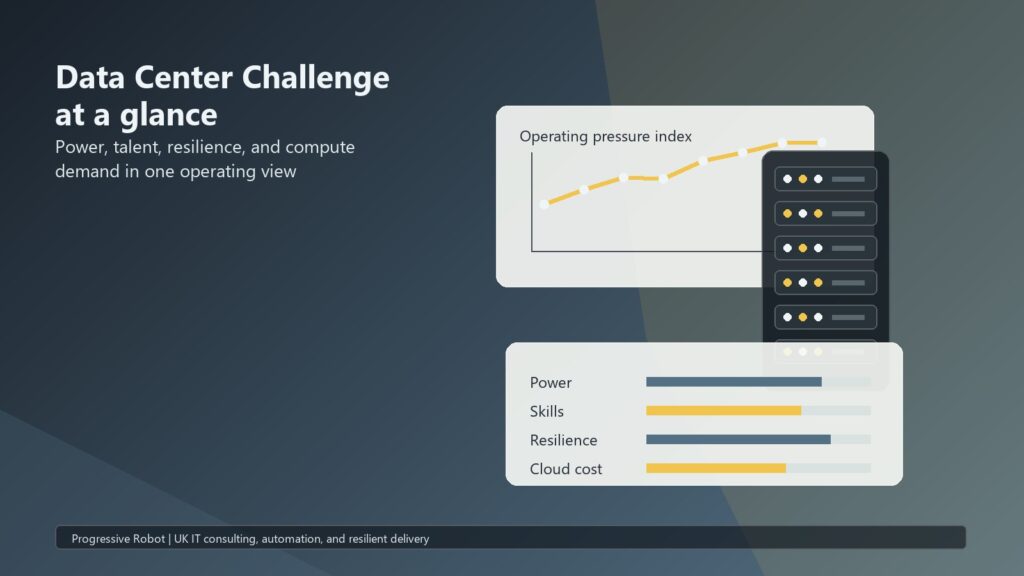
The Data Center Challenge starts with a simple dependency: every digital service needs somewhere to run. That may be a hyperscale cloud region, a colocation rack, an edge site, a managed hosting platform, a SaaS provider, or an on-premise room that everyone stopped calling strategic years ago. The delivery risk is that each option now depends on a tighter set of external conditions.
Power is more expensive and more strategically important. Specialist labour is harder to hire and retain. AI and data workloads are more compute hungry. Security and resilience expectations are higher because data centres now underpin public services, financial systems, supply chains, digital health, retail, manufacturing, and day-to-day office work.
The practical result is a change in the way IT delivery should be planned.
| Pressure | What it changes | IT delivery response |
|---|---|---|
| High electricity costs | Hosting and compute decisions affect operating margin | Track energy-sensitive workloads and compare location options |
| Grid connection limits | New capacity may not arrive when projects need it | Add power availability to programme risk registers |
| Skills shortages | Infrastructure, cyber, cloud, and data skills become bottlenecks | Use automation, managed services, and targeted upskilling |
| AI demand | More compute is needed for training, inference, data processing, and experimentation | Separate exploratory AI from production-grade platforms |
| Resilience expectations | Outages have wider business and public-service consequences | Test runbooks, suppliers, recovery targets, and failover routes |
| Supplier concentration | One platform choice can create operational and commercial lock-in | Maintain exit plans, portable data, and architecture standards |
The Data Center Challenge is therefore not solved by moving everything to cloud, moving everything out of cloud, or waiting for the market to settle. It needs a balanced delivery model. Some workloads belong in public cloud. Some belong in colocation. Some should be modernised, consolidated, or retired. Some should be managed by a specialist partner because the internal team does not have the time or skills depth to run them safely.
For decision makers, the Data Center Challenge is a forcing function: it asks whether infrastructure choices still match the organisation’s cost base, talent base, and tolerance for disruption.
The important shift is governance. Data centre decisions can no longer be treated as hidden plumbing. They need commercial, energy, architecture, security, and talent input before commitments are made.
Critical infrastructure changes board priorities
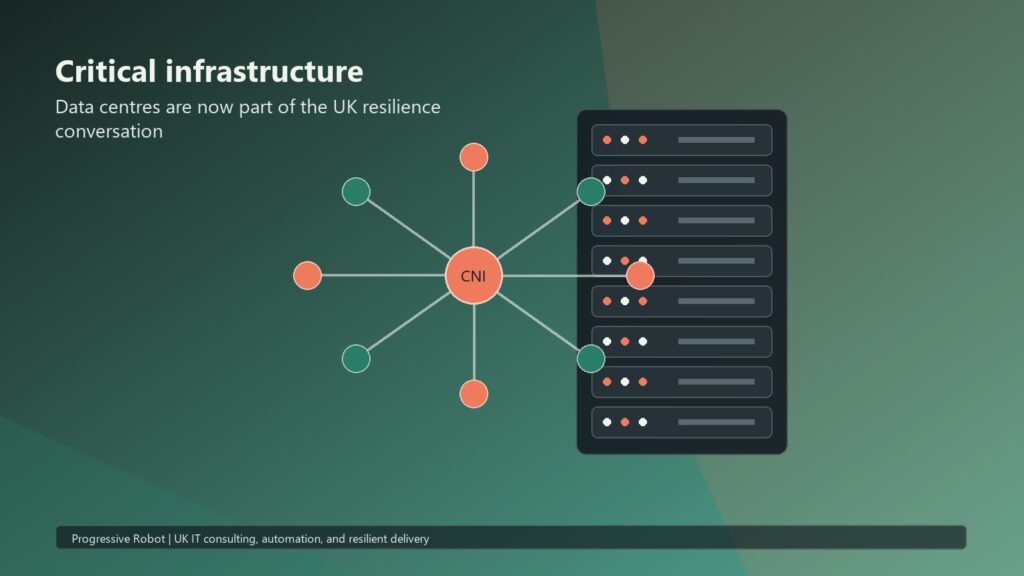
The UK government’s decision to classify data centres as Critical National Infrastructure is a signal that digital infrastructure is now part of national resilience. The designation covers physical data centres and the cloud operators that provide essential services. It also gives the sector closer coordination with government, security agencies, and emergency planning.
For boards and senior teams, this changes the tone of the Data Center Challenge. Data centres are not simply property assets or supplier line items. They are the physical layer behind patient records, payments, logistics, digital identity, school platforms, energy systems, software development, communications, and AI services. When that layer fails, the disruption travels quickly.
The CrowdStrike incident in 2024 showed how dependent organisations are on digital operating layers. UK government communications noted that 60% of GP practices were affected during that outage. That was not a classic data centre power failure, but it was a useful warning: modern IT incidents can cross organisational boundaries faster than traditional continuity plans expect.
The Data Center Challenge asks leaders to connect three questions that are often handled separately.
First, what services are genuinely critical to the organisation? Not every workload needs the same level of resilience. A marketing archive, a payroll platform, a customer portal, and an operational control system do not carry the same outage cost.
Second, where do those services run and who controls the recovery route? A cloud service may be highly resilient but still poorly governed if the organisation has weak identity controls, no backup plan, or no practical ability to switch suppliers. An on-premise system may feel controlled but be fragile if the only engineer who understands it is about to leave.
Third, what dependencies sit below the application? Power, cooling, network carriers, managed service providers, software vendors, identity platforms, monitoring tools, and security partners all form part of the service chain.
The board conversation should move from a generic question like “are we in the cloud?” to a sharper one: “Can our most important services continue, recover, and scale under the combined pressure of energy cost, capacity limits, supplier failure, and skills shortages?”
Viewed this way, the Data Center Challenge gives boards a practical reason to ask better questions about systems that used to sit below the strategy line.
That is the heart of the Data Center Challenge. It makes infrastructure visible again.
Energy costs are now an architecture constraint
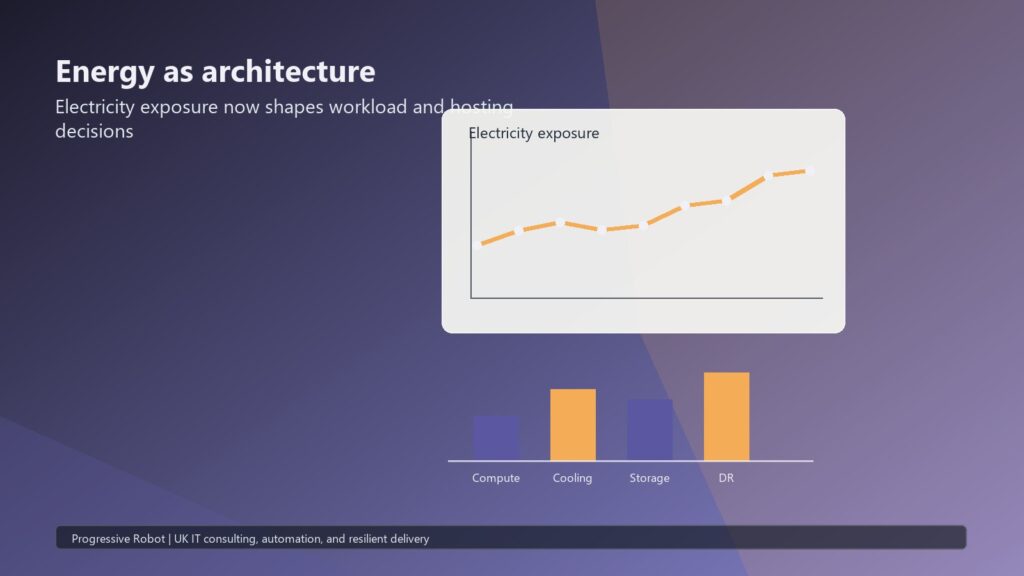
High UK energy costs reshape IT delivery because compute is not weightless. Every workload has a power, cooling, and carbon consequence somewhere in the supply chain. The bill may arrive through a cloud invoice, a colocation service charge, an internal facilities budget, or a managed service contract, but the energy dependency is still there.
The Department for Energy Security and Net Zero publishes non-domestic and international industrial energy price datasets because business energy costs are now a central economic issue. For data centre operators, electricity is a major operating cost. For customers, that cost can appear indirectly through hosting prices, reserved capacity charges, renewal negotiations, or minimum commitments.
The Data Center Challenge is not simply that electricity is expensive. It is that energy cost now influences architecture. A poorly optimised workload that runs continuously across oversized instances is not just a cloud hygiene problem. It is a recurring energy and margin problem. A legacy platform that requires inefficient hardware, old storage patterns, and manual operational work carries a delivery cost that may be hidden until budgets tighten.
IT teams should therefore treat energy as a design input.
| Architecture decision | Energy-cost question |
|---|---|
| Workload placement | Does this workload need to run in this location, at this tier, all the time? |
| Application modernisation | Can the workload scale down, sleep, cache, archive, or run in batches? |
| Data retention | Are we storing duplicate, stale, or low-value data in expensive tiers? |
| AI experimentation | Are pilots controlled, measured, and separated from production commitments? |
| Disaster recovery | Are recovery environments right-sized for the actual recovery target? |
| Hardware refresh | Can newer infrastructure reduce power draw and management overhead? |
This is where FinOps and infrastructure architecture start to overlap. Cost reports that only show monthly spend are useful, but they are not enough. Leaders need to know which systems create the biggest ongoing compute footprint, which teams control the choices, and which business outcomes justify the cost.
The Data Center Challenge also raises uncomfortable questions about procurement. Long contracts can offer price certainty, but they can also lock the organisation into a location, technology stack, or capacity profile that becomes awkward later. Short contracts give flexibility, but may expose the business to renewal pressure when market demand is rising.
There is no universal answer. The practical answer is to create an energy-aware workload register. Classify systems by business importance, usage pattern, data sensitivity, performance requirement, growth expectation, and exit complexity. Then decide whether each workload is in the right place.
A mature Data Center Challenge plan should make that register part of regular architecture governance, not a one-off spreadsheet created during budget pressure.
Energy-aware architecture does not mean slowing down digital delivery. It means removing waste before it becomes a permanent operating cost.
Grid access and power capacity affect delivery timelines
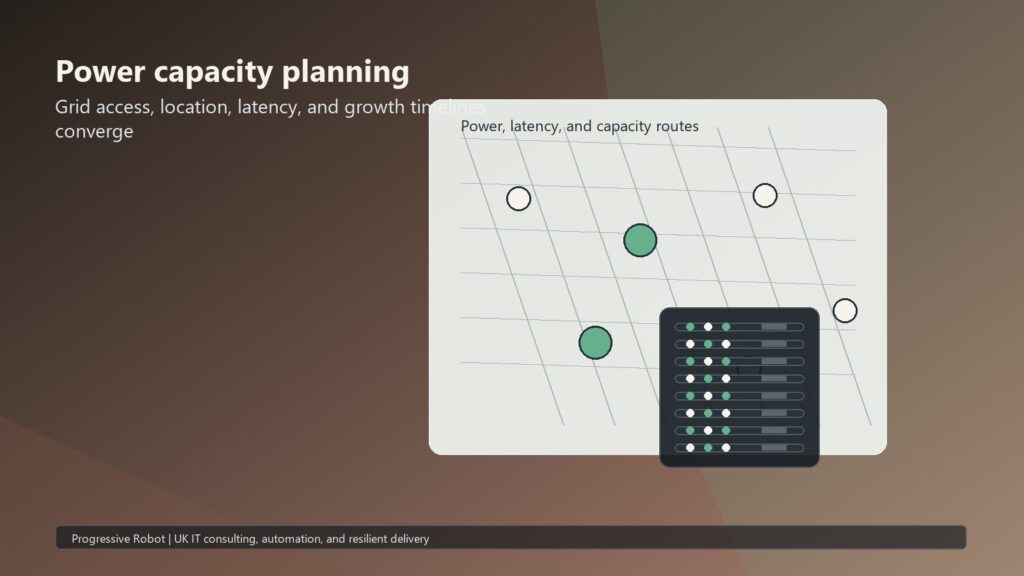
The Data Center Challenge becomes more concrete when a project needs capacity that the electricity network cannot provide quickly. Data centres require significant power, and AI infrastructure plans are making power access a competitive advantage. The UK government’s AI Growth Zones are explicitly designed to improve access to power and planning support for AI-enabled data centres.
The government’s AI Opportunities Action Plan also recommends accelerated AI data centre build-out, clean power provisioning, and long-term compute planning. Its response commits to AI Growth Zones, the first at Culham, with a proposed data centre beginning at 100MW and plans to scale to 500MW. Those figures show the scale of the power conversation.
For enterprise IT teams, grid connection reform may sound distant. It is not. The same power constraint that shapes hyperscale and colocation supply can affect the availability, price, location, and lead time of hosting options. If capacity is scarce in one region, suppliers may steer customers toward different sites or different commercial models.
The government’s electricity networks connections action plan exists because connection queues and delivery delays have become barriers to energy infrastructure and economic development. Data centre projects sit inside that wider queue for power, planning, and network reinforcement.
This changes project management. Major IT programmes should ask power and capacity questions earlier.
- Will the selected hosting location support expected growth for the next 3 to 5 years?
- Are there contractual guarantees for capacity expansion?
- What happens if the chosen site cannot deliver additional power when the business needs it?
- Does the disaster recovery plan assume capacity that has not been reserved?
- Are AI, analytics, and storage growth forecasts included in infrastructure planning?
- Is network latency being balanced against power availability and cost?
The Data Center Challenge is especially important for organisations that still operate private data rooms or campus infrastructure. An internal server room may feel cheaper than a migration project until cooling, electrical resilience, physical security, hardware refresh, and scarce engineering time are measured properly. Conversely, moving to a provider does not remove capacity risk; it transfers the need to manage it commercially.
Power availability should therefore appear in architecture decision records, supplier scorecards, and programme risk logs. A cloud-first or colocation-first strategy is incomplete if it ignores energy availability.
In practice, the Data Center Challenge means delivery teams need capacity evidence before promising new service dates.
The strongest delivery teams will treat capacity as a portfolio issue. They will avoid putting every future workload assumption into one site, one supplier, or one region without understanding the power and contract implications.
Skills shortages change the operating model
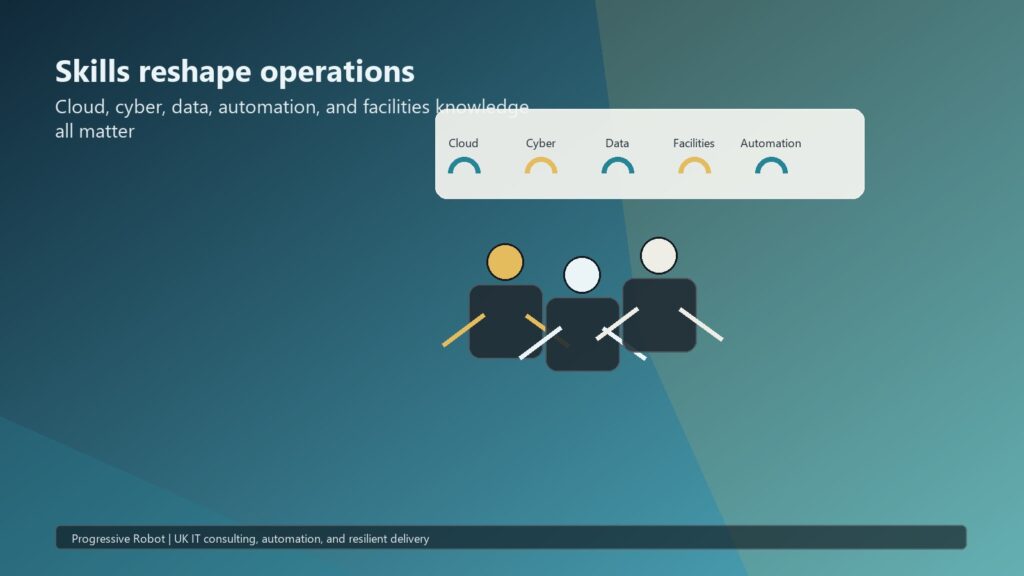
The Data Center Challenge is also a people problem. Running modern IT infrastructure requires a mix of cloud engineering, network design, cyber security, automation, observability, platform operations, supplier management, data governance, and, in some environments, electrical and mechanical awareness. Few organisations have all of that depth internally.
Government skills research shows the pressure clearly. The UK cyber security labour market report estimates a cyber security workforce of around 143,000 people and a net annual shortfall of about 3,800 people. It also reports that 49% of businesses had a basic technical cyber security skills gap and 30% had an advanced skills gap. Data skills research found UK businesses recruiting for 178,000 specialist data roles and up to 234,000 roles requiring hard data skills, while many firms struggled to recruit people with the right combination of skills.
These findings matter because data centre decisions increasingly involve security, data, automation, and cloud choices at once. A team that can rack servers may not be ready to manage cloud identity risk. A software team that can ship features may not understand storage tiering, backup immutability, or network egress costs. A procurement team may understand price but not lock-in or operational resilience.
The Data Center Challenge is not only about hiring more people. It is about designing an operating model that does not depend on rare knowledge being constantly available at short notice.
That means splitting work into four categories.
| Work category | Recommended ownership |
|---|---|
| Strategic architecture | Keep enough internal ownership to make informed decisions |
| Commodity operations | Automate or outsource where service levels are clear |
| Security-critical controls | Retain clear accountability even if delivery is supported by partners |
| Specialist deep work | Use partners, consultants, or managed providers with knowledge transfer |
This model prevents two common failures. The first is false self-sufficiency, where an organisation keeps infrastructure in-house but no longer has the depth to maintain it safely. The second is blind outsourcing, where the organisation buys a service but loses the internal capability to challenge suppliers, verify controls, or plan exits.
Skills shortages also affect succession planning. Many legacy estates rely on a small number of experienced people who know the system history. If those people leave, retire, or become unavailable during an incident, delivery risk increases. Documentation, automation, and cross-training are not optional extras; they are resilience controls.
The Data Center Challenge should therefore trigger a skills map. List the critical platforms, the people who understand them, the partners involved, the runbooks available, and the skills needed for recovery. If a service has no credible second person or partner route, it is a risk even if it is currently stable.
A realistic Data Center Challenge response accepts that skills resilience is as important as technical resilience.
Cloud and colocation choices need new criteria
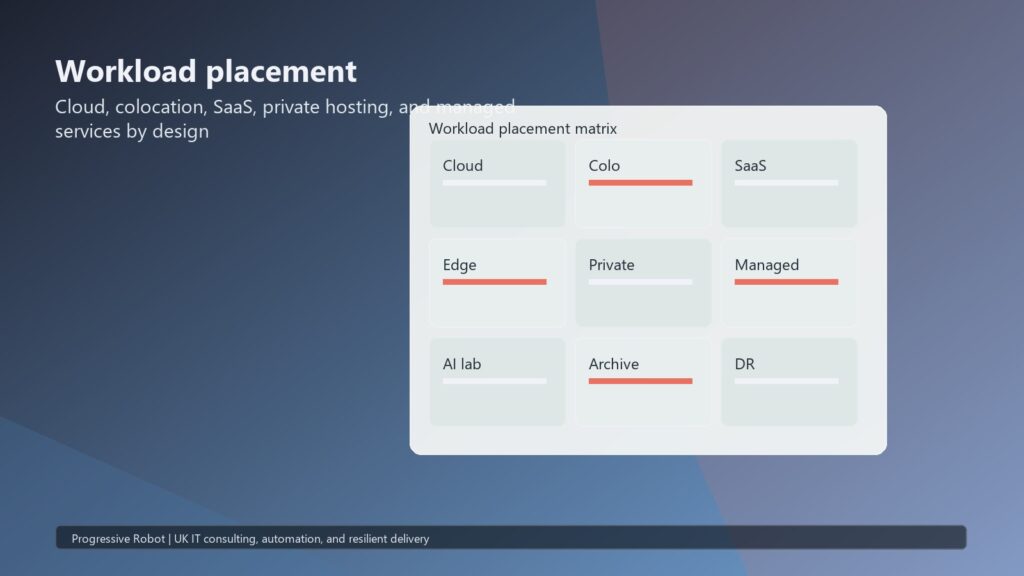
Cloud strategy used to be presented as a destination. The Data Center Challenge makes it a placement discipline. Public cloud, private cloud, colocation, SaaS, edge hosting, and managed platforms each have strengths. The wrong question is which one is best in general. The better question is which one is best for this workload, at this stage, with these constraints.
Public cloud remains powerful for elasticity, managed services, global reach, experimentation, and modern application delivery. It can also create unpredictable costs, data egress charges, identity complexity, and skills demands. Colocation can offer control, predictable capacity, and high-performance connectivity, but it may require stronger supplier management, hardware planning, and longer commitments. SaaS can remove infrastructure burden, but it creates vendor dependency and data portability questions.
The Data Center Challenge requires a workload placement framework.
| Workload trait | Better fit may be |
|---|---|
| Highly variable demand | Public cloud or managed platform with scaling controls |
| Stable high utilisation | Colocation, private cloud, reserved cloud capacity, or committed managed service |
| Sensitive data with strict controls | Carefully governed cloud, private environment, or specialist sovereign option |
| Low-latency operational system | Edge, local hosting, or network-optimised colocation |
| Legacy application with hardware dependency | Modernisation plan, specialist hosting, or controlled transition environment |
| AI experimentation | Cloud or managed AI platform with strict usage guardrails |
| AI production at scale | Architecture review across compute, data, security, power, and cost |
This is not a one-time exercise. Workloads change. A proof of concept can become a production service. A database can grow until backup windows break. A cheap storage decision can become expensive when analytics teams start reading from it constantly. A regional hosting choice can become problematic if regulation, latency, or resilience needs change.
The Data Center Challenge also changes how organisations should handle legacy systems. Some legacy workloads are stable and low risk. Others silently consume specialist time, old hardware, expensive support, and inefficient infrastructure. The question is not whether every legacy system should be rewritten. The question is whether each one has a realistic future operating model.
Procurement should support this placement discipline. Contracts should include portability, data export, security evidence, energy and sustainability information where available, clear service levels, incident notification duties, and commercial controls for growth. A low headline price is not a saving if it creates expensive exit work later.
This is why the Data Center Challenge belongs in procurement templates as well as architecture diagrams.
For many organisations, the answer will be hybrid by design rather than hybrid by accident. Hybrid by design has clear roles for each platform. Hybrid by accident is what happens when old systems, urgent cloud projects, SaaS subscriptions, and supplier contracts accumulate without a unifying architecture.
The Data Center Challenge rewards deliberate placement.
Automation and observability become capacity multipliers
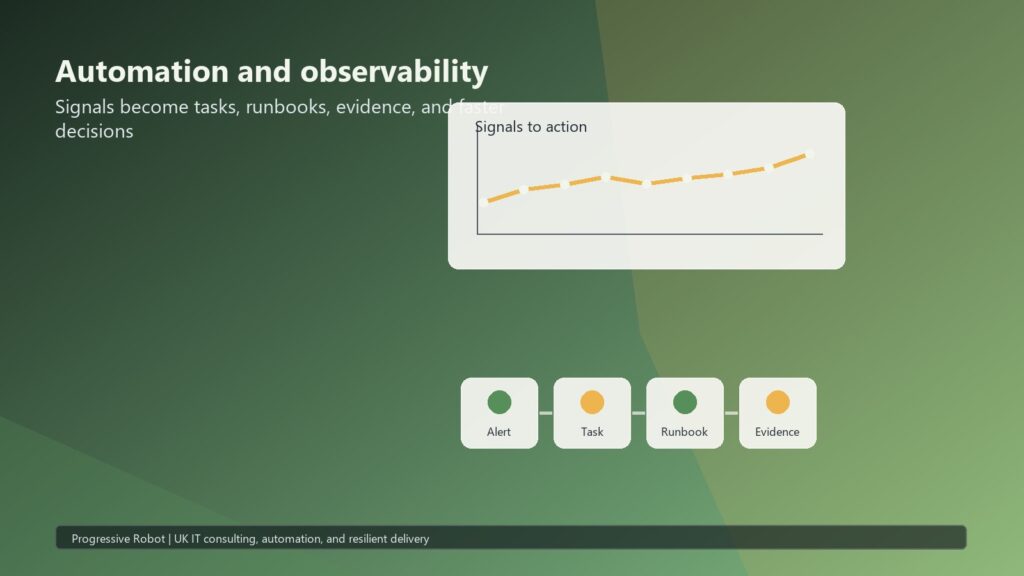
When power is expensive and skilled people are scarce, the best infrastructure teams stop wasting human attention on repeatable work. The Data Center Challenge makes automation and observability central to delivery capacity.
Automation should not be confused with removing judgement. Good automation handles routine checks, repeatable builds, evidence collection, patch orchestration, capacity alerts, cost reports, backup verification, user access reviews, and exception routing. Human experts still decide architecture, risk acceptance, recovery priorities, and unusual incidents.
Observability is equally important. Many organisations have monitoring, but fewer have a joined-up view of cost, performance, energy-sensitive workloads, capacity, security signals, and supplier service health. Without that view, teams discover problems late and spend expensive engineering time reconstructing what happened.
The Data Center Challenge calls for practical automation in five areas.
- Provisioning: use templates, infrastructure as code, policy checks, and approved patterns.
- Cost control: alert on unusual spend, idle resources, oversized services, and untagged assets.
- Security hygiene: automate vulnerability visibility, patch workflows, certificate checks, and access reviews.
- Resilience: test backups, recovery steps, failover routes, and dependency maps.
- Reporting: turn technical signals into service-level dashboards that leaders can understand.
This is where workflow automation helps. The goal is to connect the operational steps that sit between people and platforms: approvals, reminders, exception lists, audit evidence, escalation paths, and recurring reviews. A cost anomaly should create a task. A failed backup should create an incident. A supplier notice should update the risk log. A new project should trigger a workload placement checklist.
The next layer is intelligent support. Autonomous AI agents can help operations teams summarise logs, triage alerts, prepare change notes, find missing documentation, and draft runbook updates. They should be governed carefully, especially around access to sensitive systems, but they can reduce the administrative burden on scarce specialists.
The Data Center Challenge makes this valuable because every saved hour matters. A senior engineer should not spend half a day collecting screenshots for a review if a controlled workflow can gather evidence automatically. A cloud architect should not manually chase teams for tagging compliance every month if policy and alerts can do it continuously.
For teams under Data Center Challenge pressure, automation is not a luxury project. It is a way to protect scarce expert attention.
Automation also improves consistency. In a skills-constrained environment, consistency is a safety feature. It means a process does not depend entirely on which person is on shift.
Resilience planning must include suppliers and facilities risk
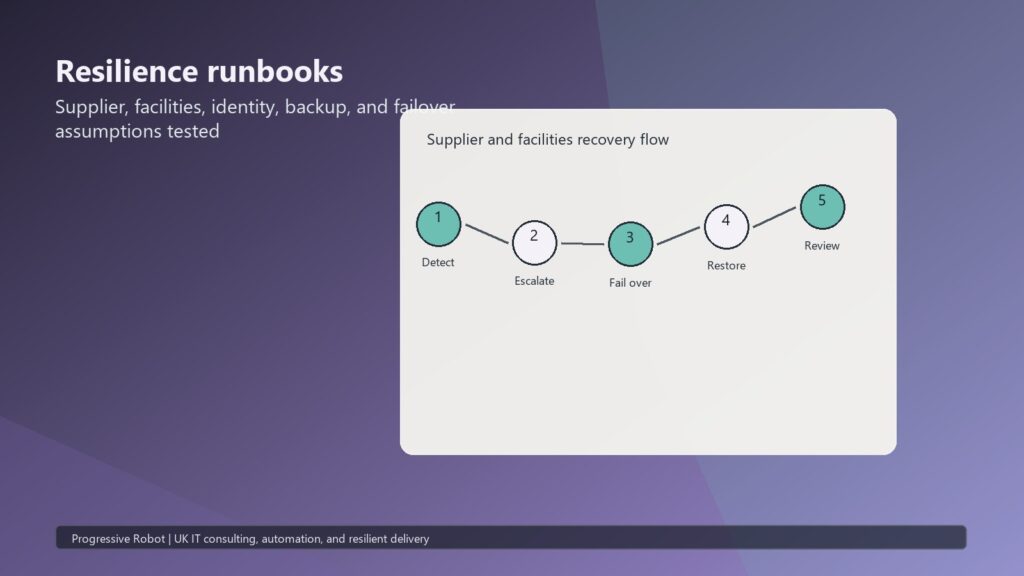
The Data Center Challenge widens the definition of resilience. Traditional disaster recovery often focused on restoring servers or switching to a secondary site. Modern resilience has to include cloud control planes, identity providers, DNS, network carriers, SaaS vendors, colocation facilities, managed service partners, cyber tooling, backup platforms, and the people who know how to coordinate recovery.
This matters because failure rarely respects organisation charts. A supplier outage can look like an application issue. An identity problem can block access to recovery tools. A cyber incident can force systems offline even when the underlying infrastructure is healthy. A data centre power event can expose weak application failover. A missing engineer can slow down every step.
The Data Center Challenge should push organisations to test assumptions.
| Assumption | Test |
|---|---|
| Backups are working | Restore a sample and measure time to usable service |
| The supplier will notify us | Check contract terms, contact paths, and escalation routes |
| Cloud regions give resilience | Confirm application, data, identity, and network failover design |
| Documentation is sufficient | Ask another engineer or partner to follow the runbook |
| The team can respond | Run tabletop exercises during realistic staffing conditions |
| Costs are controlled during recovery | Model failover costs and emergency capacity charges |
Supplier management needs more depth. Organisations should know which providers host critical systems, where data is located, what subcontractors matter, what recovery commitments exist, how incidents are communicated, and what evidence can be reviewed. This does not mean every supplier needs a lengthy audit every month. It means critical suppliers need a proportionate control model.
Facilities risk also deserves attention. For colocation and private environments, ask about power redundancy, cooling, physical security, maintenance windows, carrier diversity, fire suppression, access procedures, and capacity expansion. For cloud and SaaS, ask equivalent questions through service architecture, contract commitments, certifications, and incident history.
The Data Center Challenge is strongest when it links technical resilience to business priorities. Recovery time objectives should be based on service impact, not guesswork. Recovery point objectives should reflect data loss tolerance. Testing should involve business owners, not just infrastructure teams.
Resilience is not a document. It is a practised capability.
A 90-day plan for the Data Center Challenge
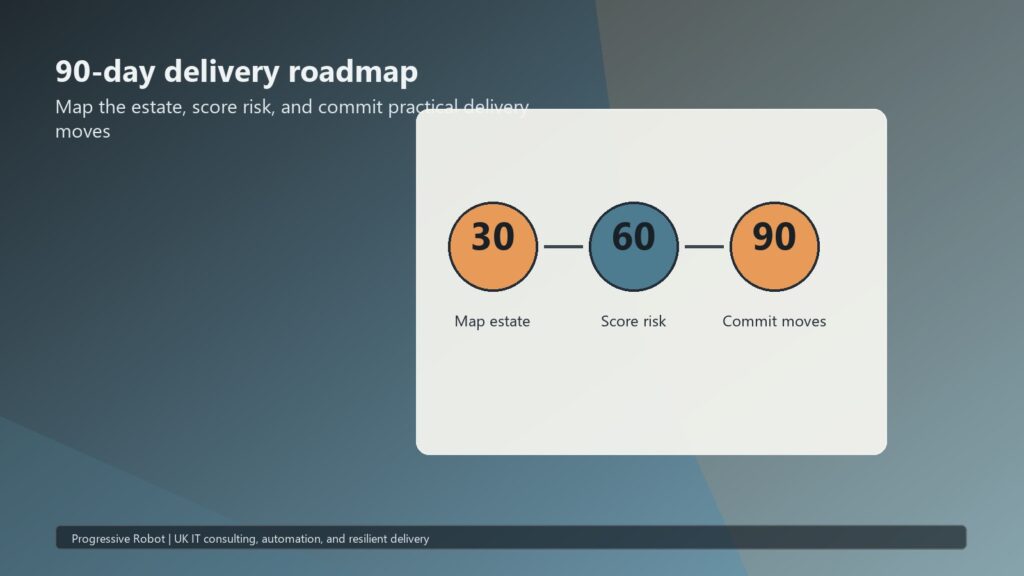
The Data Center Challenge can feel too large if it is treated as one transformation project. A better starting point is a 90-day diagnostic and action plan that gives leaders a clear view of risk, cost, capacity, and skills.
Use the first 30 days to map the estate. List the important services, where they run, who owns them, what they cost, which suppliers are involved, and what recovery expectations apply. Include cloud accounts, SaaS platforms, colocation contracts, on-premise rooms, backup tools, monitoring platforms, and identity dependencies. Do not aim for perfect detail before creating the first version. The goal is a usable operating picture.
Use days 31 to 60 to score risk and opportunity. Identify systems with high energy or compute cost, unclear ownership, weak recovery, poor documentation, unsupported technology, supplier lock-in, or scarce skills. Match these risks to business importance. A small risk on a critical service may matter more than a large inefficiency in an archive.
Use days 61 to 90 to decide delivery moves. Some actions will be quick: right-size cloud resources, turn off unused environments, document recovery contacts, add monitoring, update supplier lists, or schedule a restore test. Others will need programmes: application modernisation, data lifecycle redesign, colocation migration, cloud landing zone repair, managed service selection, or training.
| Phase | Output | Practical actions |
|---|---|---|
| Days 1 to 30 | Estate map | Catalogue services, suppliers, locations, costs, owners, and recovery targets |
| Days 31 to 60 | Risk and opportunity score | Rate energy exposure, skills dependency, resilience, security, and lock-in |
| Days 61 to 90 | Delivery roadmap | Prioritise quick wins, contract decisions, modernisation candidates, and skills plans |
The Data Center Challenge should also create a standing governance rhythm. Monthly cost and capacity reviews are useful. Quarterly resilience checks are better than annual paperwork. Supplier reviews should be tied to criticality. Skills reviews should identify single-person dependencies before they become incidents.
A practical roadmap might include these seven moves:
- Create a critical service register that links business services to infrastructure and suppliers.
- Build an energy-aware workload register for high-cost compute, storage, and AI use.
- Review cloud, colocation, and SaaS contracts for growth, exit, and resilience terms.
- Test backup restoration and incident escalation for the most important services.
- Identify single-person skills dependencies and create knowledge-transfer plans.
- Automate recurring operational evidence, cost checks, and exception workflows.
- Agree a workload placement framework for future projects.
This approach makes the Data Center Challenge manageable. It turns a broad infrastructure trend into a set of decisions the organisation can actually make.
The strongest organisations will not wait until energy, capacity, or skills pressure forces a rushed choice. They will use the next planning cycle to make infrastructure visible, measurable, and governable.
FAQs about the Data Center Challenge
What is the Data Center Challenge?
The Data Center Challenge is the combined pressure of rising compute demand, high energy costs, power capacity constraints, resilience expectations, and specialist skills shortages. It affects where organisations host workloads, how they manage suppliers, and how they deliver reliable IT services.
Why does the Data Center Challenge matter in the UK?
It matters because the UK economy depends heavily on digital infrastructure while energy costs, grid capacity, AI demand, and cyber resilience pressures are all increasing. The UK government has also classified data centres as Critical National Infrastructure, which underlines their importance to public and private services.
Does moving to cloud solve the Data Center Challenge?
No. Cloud can help with scalability, managed services, and resilience, but it does not remove cost, energy, security, supplier, or skills issues. The Data Center Challenge requires workload placement, governance, and cost control rather than a single hosting answer.
How do high energy costs affect IT delivery?
High energy costs can influence hosting prices, colocation charges, hardware decisions, cloud commitments, and workload design. IT teams need to identify waste, right-size systems, manage storage growth, and include energy-sensitive architecture in planning.
What skills are most important for modern data centre decisions?
Useful skills include cloud architecture, cyber security, networking, automation, observability, supplier management, data governance, cost optimisation, and resilience planning. Some organisations will also need facilities, power, and cooling expertise through internal staff or specialist partners.
How should SMEs respond to the Data Center Challenge?
SMEs should start with a simple estate map, identify critical services, check supplier dependencies, control cloud spend, test backups, and use managed services where internal skills are limited. The Data Center Challenge is not only for large enterprises; smaller firms can be more exposed because they have fewer specialist staff.
What should IT leaders do first?
Start by mapping critical services to hosting locations, suppliers, costs, recovery targets, and internal owners. Then identify the biggest risks: high-cost workloads, single-person dependencies, weak backups, unclear contracts, and systems that cannot scale or recover cleanly.
Sources
- Data centres to be given massive boost and protections from cyber criminals and IT blackouts
- AI Opportunities Action Plan
- AI Opportunities Action Plan: government response
- AI Growth Zones
- Electricity networks: connections action plan
- Gas and electricity prices in the non-domestic sector
- International non-domestic energy prices
- Cyber security skills in the UK labour market 2025
- Quantifying the UK Data Skills Gap










