
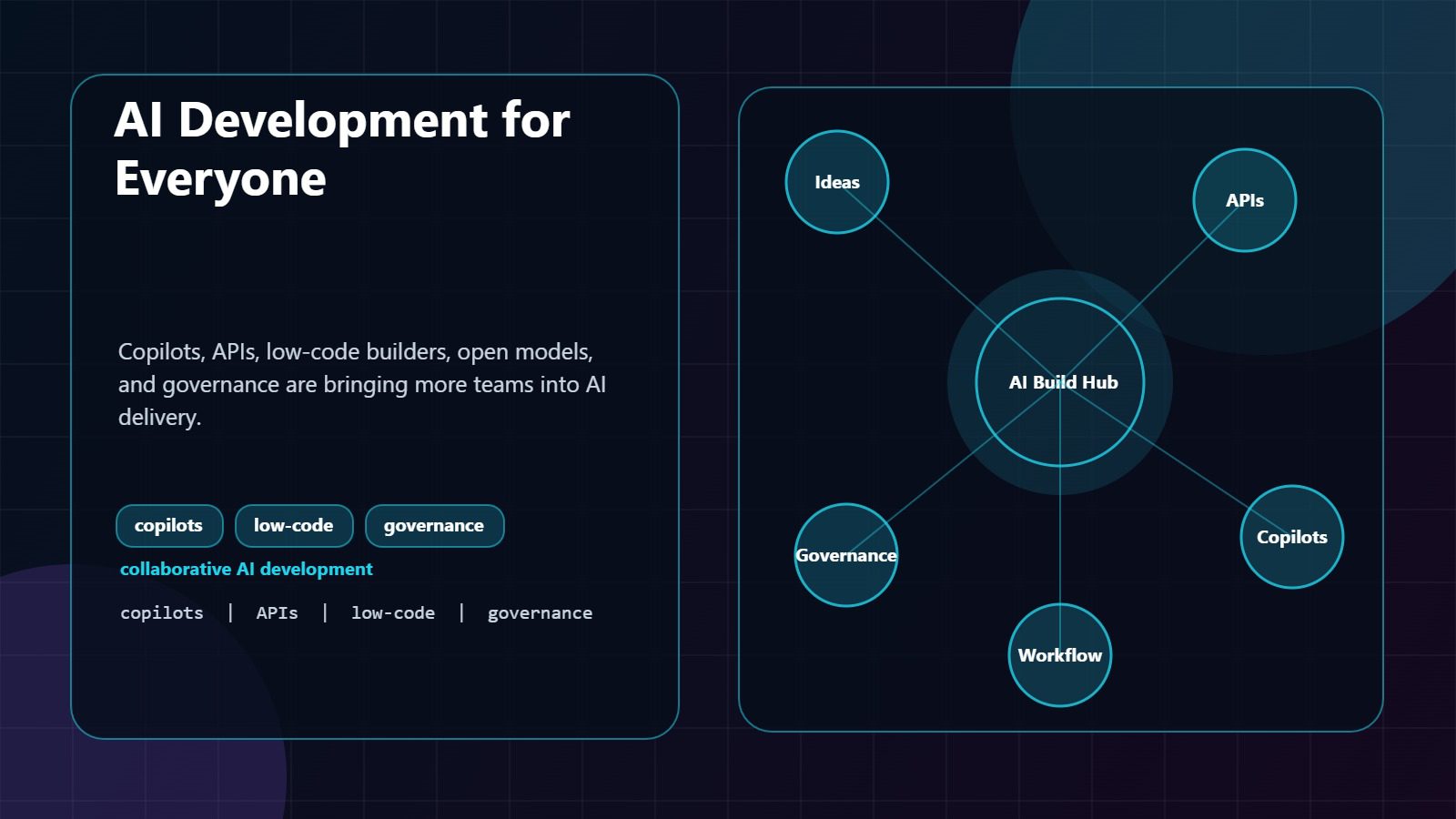
Democratization of AI development is accelerating because useful AI systems are no longer built only by specialized research labs or large data science teams. Better APIs, open models, cloud platforms, coding copilots, low-code builders, and reusable agent frameworks are giving more people the ability to turn business knowledge into working AI applications.
That shift does not mean every employee becomes a machine learning engineer. It means the distance between an idea and a working prototype is shrinking. A product manager can describe a support workflow, an operations leader can map an approval process, and a developer can assemble models, retrieval, tools, and automation faster than before.
For organizations building an AI strategy, the democratization of AI development is both an opportunity and a management challenge. The companies that benefit most will make experimentation easier while still controlling data, security, quality, and governance.
| Shift | What changes for organizations |
|---|---|
| Copilots | More employees can draft code, formulas, prompts, and workflows |
| APIs | Teams can add AI features without training foundation models |
| Low-code tools | Business experts can prototype automations directly |
| Open models | Builders can experiment with more deployment and customization options |
| Governance | Leaders need stronger controls as AI creation spreads |
Democratization of AI development at a glance
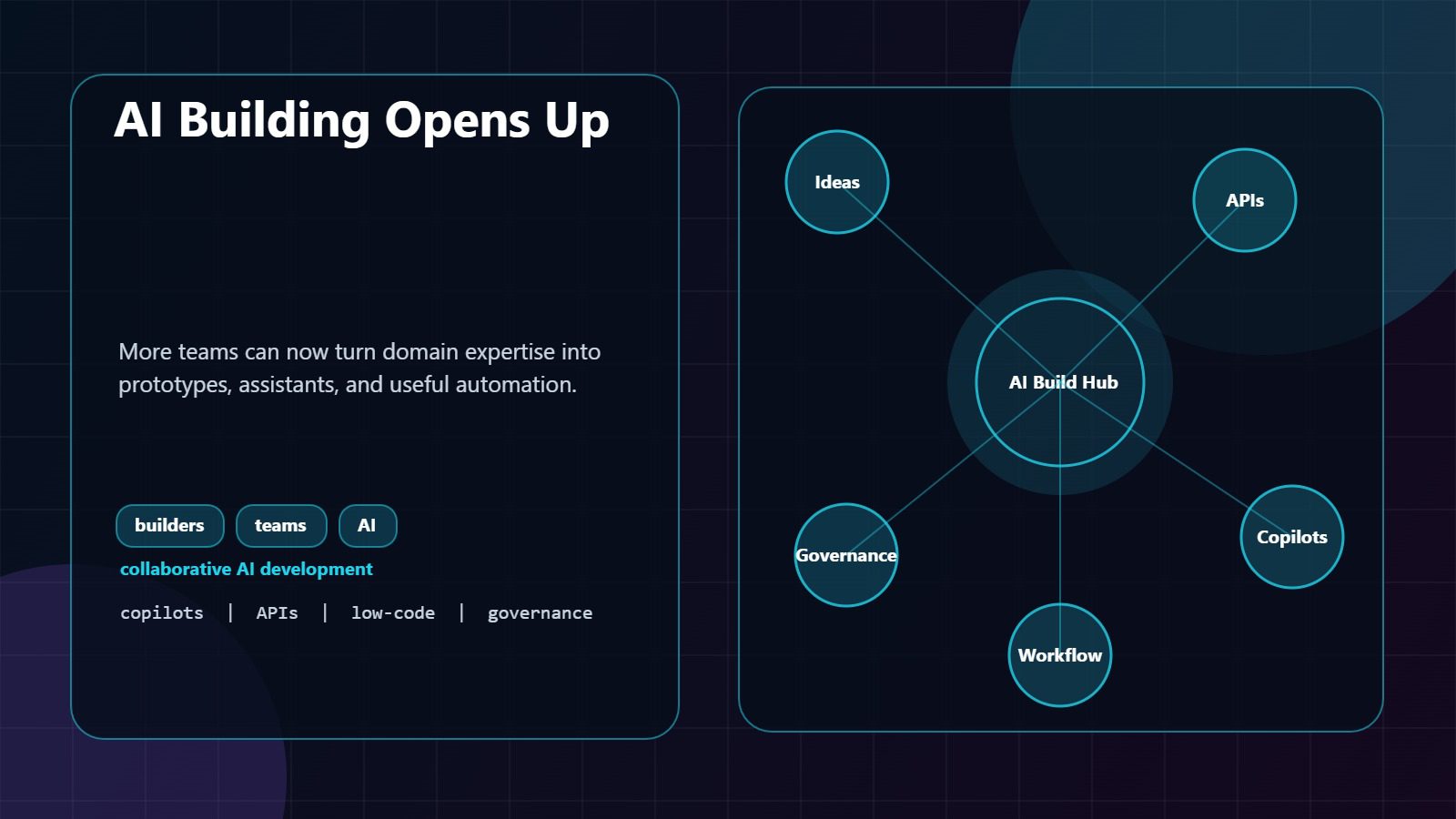
Democratization of AI development means more people can participate in designing, building, testing, and improving AI-enabled systems. The work is no longer limited to teams that can train large models from scratch or manage complex machine learning infrastructure alone.
The practical version is simpler. A sales team can prototype lead scoring with approved data. A support team can build a knowledge assistant. A finance team can automate document review. A developer can add natural language search to an internal tool by combining an API, a vector database, and a secure workflow.
This matters because AI value often depends on domain knowledge. The person who understands a claims process, customer escalation, manufacturing exception, or procurement approval may not be the person who knows model architecture. Democratization of AI development helps those groups work together instead of waiting for every idea to move through a narrow technical queue.
The result is a broader builder ecosystem. Data scientists still matter. Software engineers still matter. But business analysts, automation teams, product managers, designers, and operations leaders can now contribute more directly to AI delivery.
Why AI development is moving beyond specialist teams
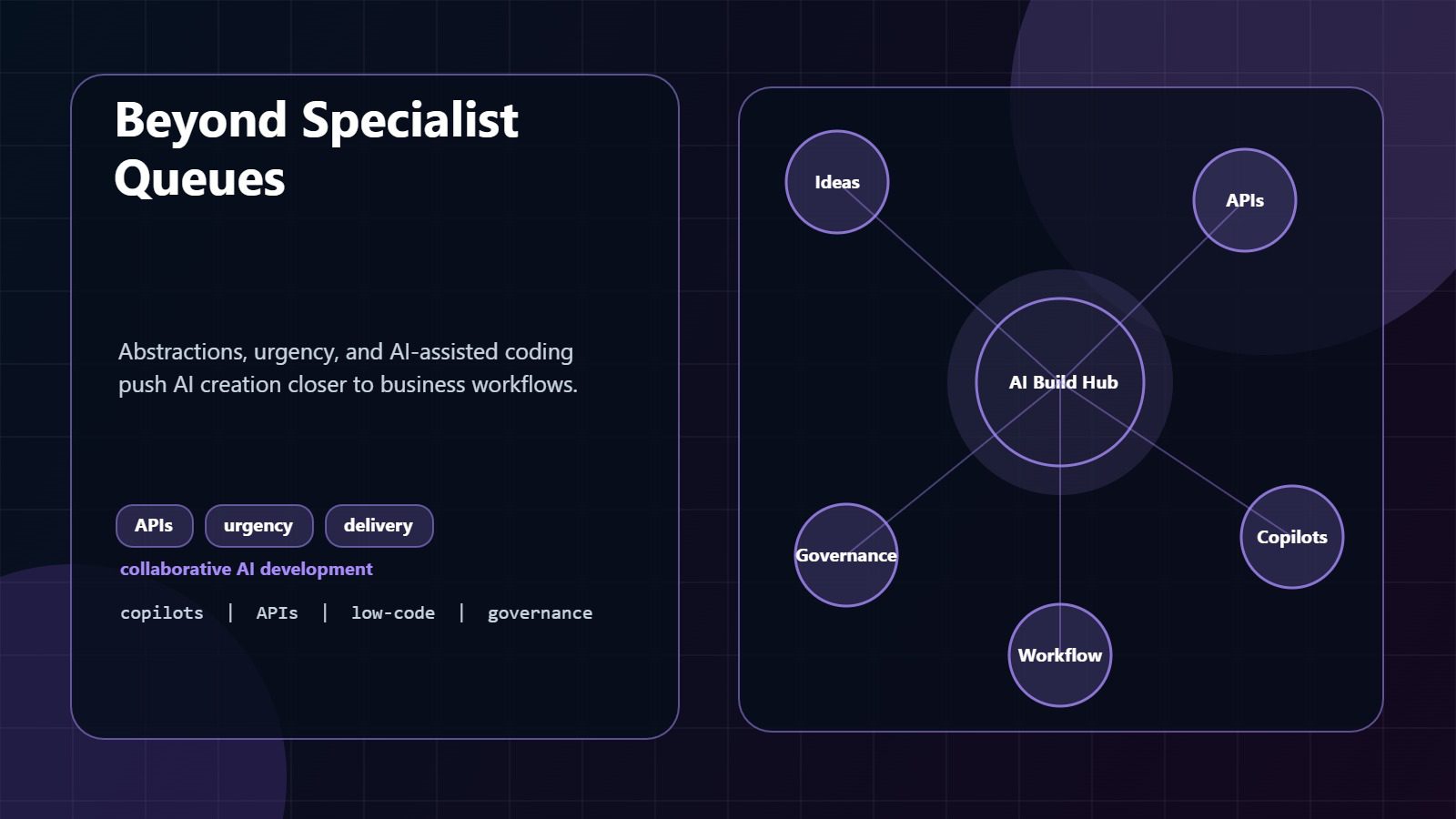
The first force behind democratization of AI development is abstraction. Modern tools hide much of the model complexity behind interfaces that are easier to use. Instead of designing neural networks from the ground up, teams can call model APIs, configure prompts, connect documents, and embed AI inside existing applications.
The second force is urgency. Business teams see AI opportunities in customer service, reporting, operations, marketing, compliance, software delivery, and knowledge management. Central AI teams cannot manually build every internal assistant, dashboard, and workflow fast enough.
The third force is developer acceleration. AI coding assistants, reusable components, test generation, documentation helpers, and application scaffolding make it faster to build prototypes. The GitHub Octoverse has repeatedly highlighted how AI is changing the way developers work, collaborate, and contribute to software projects.
For Artificial Intelligence (AI) and Machine Learning (ML) programs, this means the center of gravity is changing. The question is no longer only, "Can the AI team build a model?" The question is, "Can the organization help many teams build responsibly on top of AI capability?"
Low-code, no-code, and copilots lower the first barrier
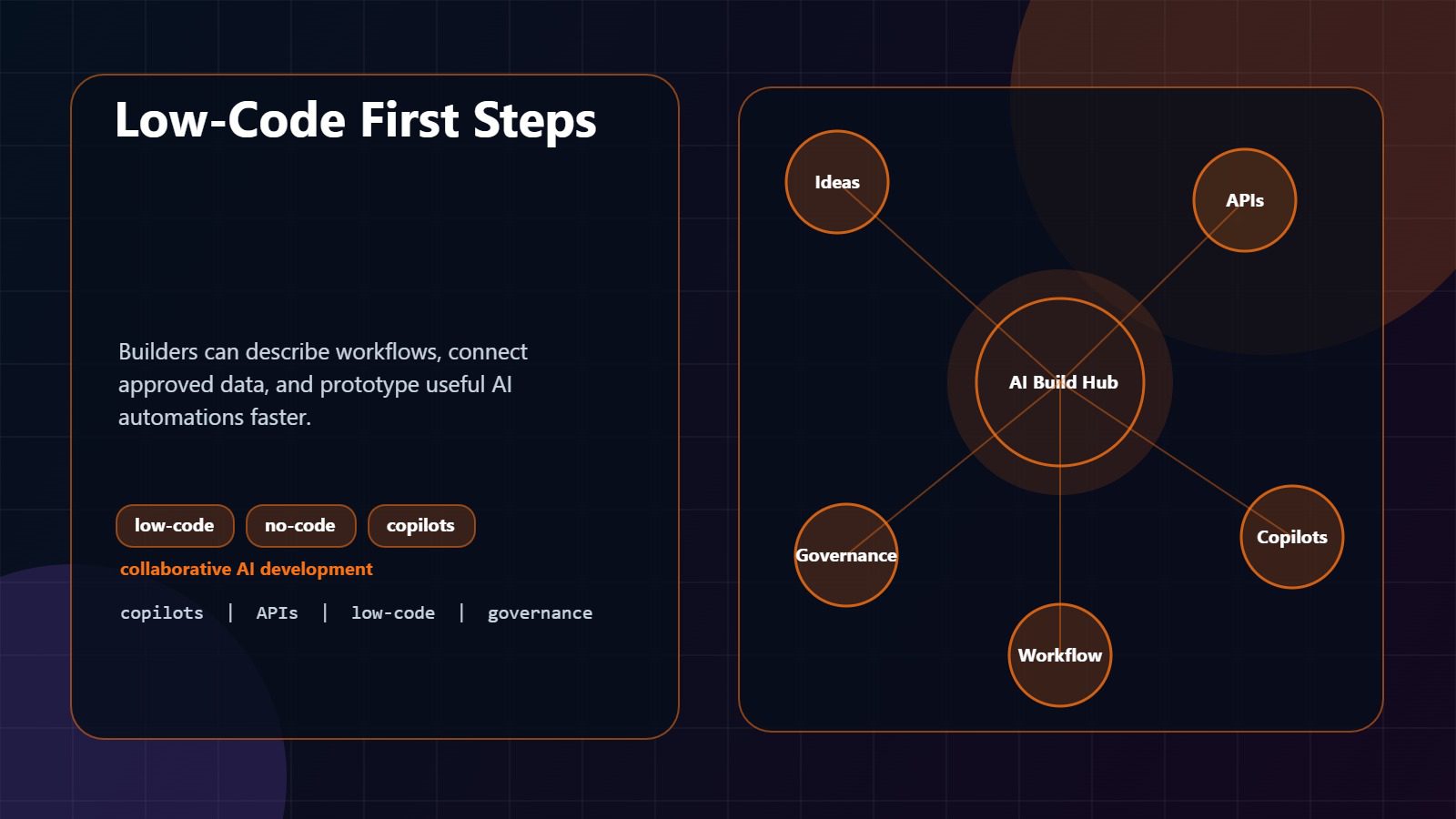
Low-code platforms, no-code automation tools, and copilots are making the democratization of AI development visible to everyday teams. A user can describe a workflow, connect a form, summarize a document, classify requests, route approvals, or generate a draft without starting from a blank code editor.
This is powerful because many useful AI systems are not frontier research problems. They are structured business problems with messy handoffs. A customer message needs classification. A contract clause needs review. A report needs summarization. A ticket needs routing. A spreadsheet needs cleanup. A meeting needs follow-up tasks.
Copilots also change how professional developers work. They can speed up boilerplate, explain unfamiliar code, draft tests, suggest refactors, and help teams explore APIs. That does not eliminate engineering judgment. It raises the importance of review, architecture, testing, and security because more code can be produced faster.
The best organizations will treat these tools as force multipliers, not shortcuts around discipline. Democratization of AI development works when the people closest to the process can prototype, but the organization still has standards for quality, privacy, and maintainability.
APIs, open models, and reusable frameworks speed experimentation
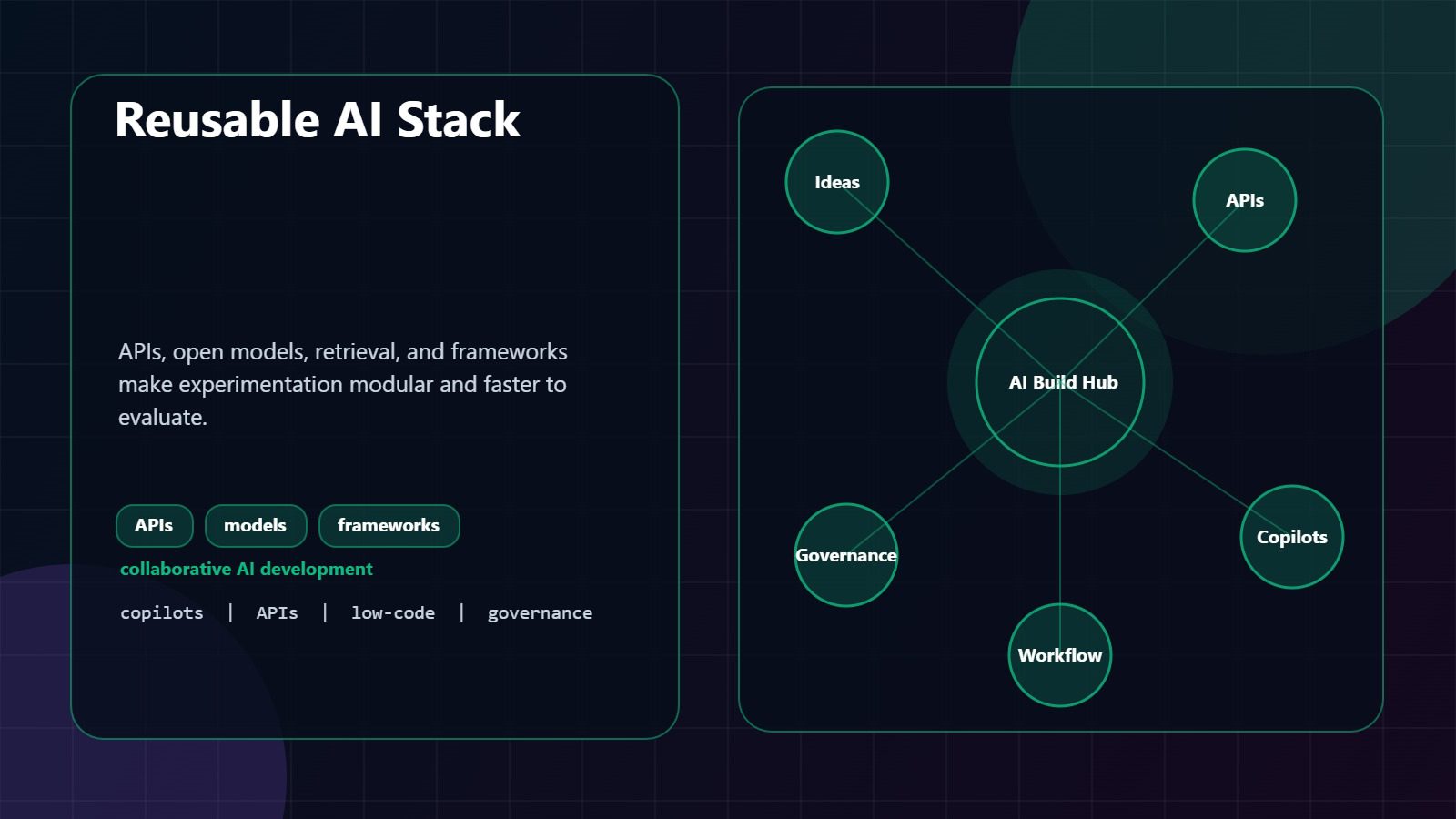
A major reason democratization of AI development is accelerating is the rise of accessible building blocks. Teams can now combine model APIs, retrieval systems, vector search, orchestration frameworks, browser tools, evaluation tools, and open-source components to create useful systems without owning every layer.
APIs make advanced capability available on demand. Open models give teams more control over deployment, tuning, cost, privacy, and specialization. Reusable frameworks help developers connect prompts, tools, memory, and workflow state into systems that can complete multi-step tasks.
This modular stack makes experimentation cheaper. A team can test whether AI improves a process before committing to a large platform investment. If the prototype works, engineering can harden the architecture, add monitoring, improve retrieval, connect secure data sources, and integrate the system into production workflows.
However, speed can create sprawl. When every team can test new tools, leaders need visibility into what is being built, what data is being used, which vendors are involved, and whether outputs affect customers, employees, or regulated decisions.
Business teams become AI builders, not just requesters
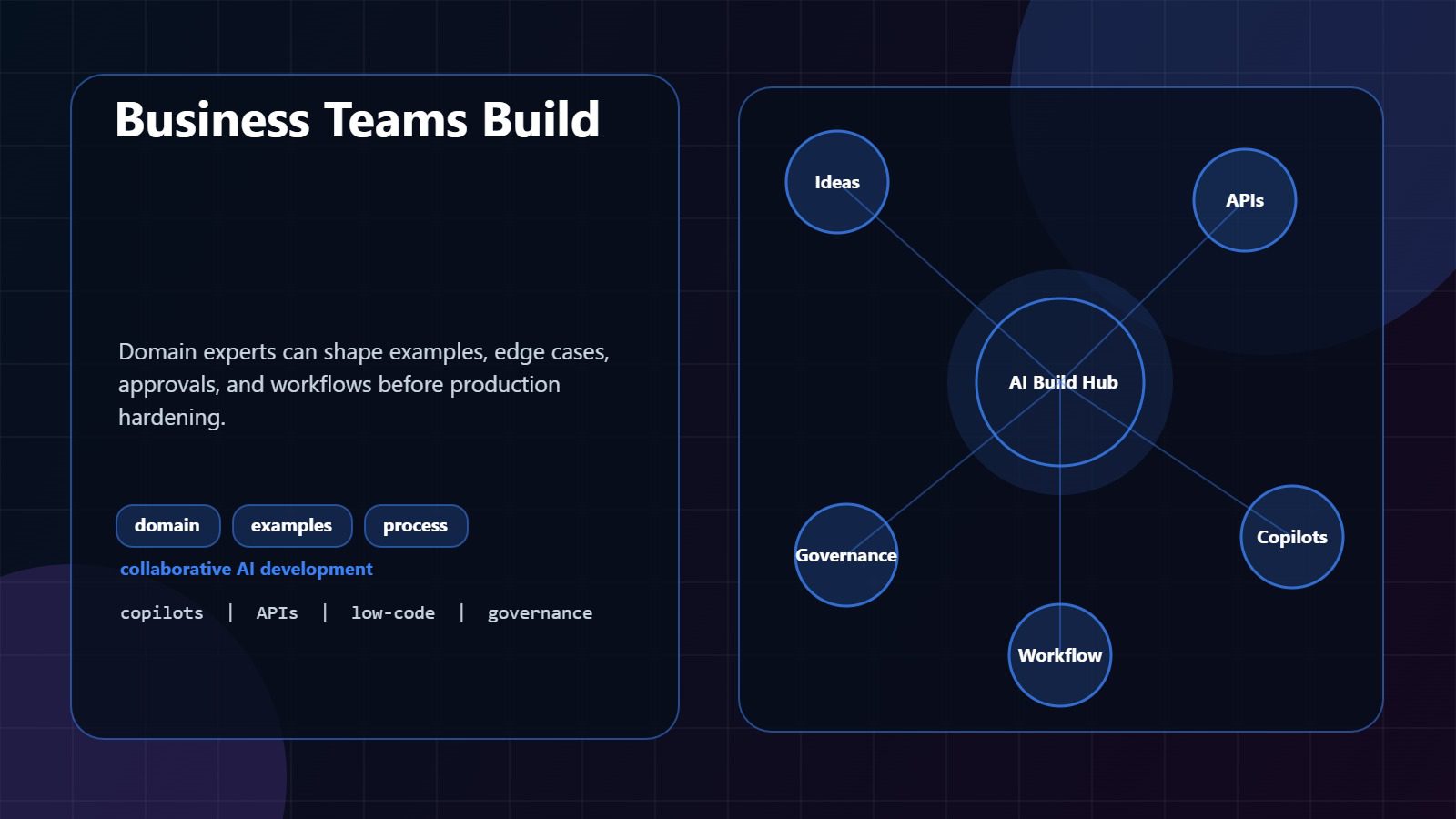
The democratization of AI development changes the role of business teams. Instead of writing a request and waiting for technical delivery, domain experts can help shape the system directly. They can define examples, label edge cases, describe exceptions, test outputs, and refine workflows.
This matters because AI systems fail when they miss context. A model may write fluent text but misunderstand policy. It may classify a case correctly most of the time but fail on the rare exception that matters most. It may automate a step but ignore the approval rule that protects the business.
Business teams know those details. They understand the customer language, risk thresholds, escalation paths, seasonal patterns, and operational trade-offs. When they become active builders, AI applications are more likely to match real work instead of demo scenarios.
This is where democratization of AI development connects with business process automation. The goal is not to add AI everywhere. The goal is to redesign processes so AI handles repeatable work, humans handle judgment, and systems capture evidence along the way.
Governance must scale with broader AI creation
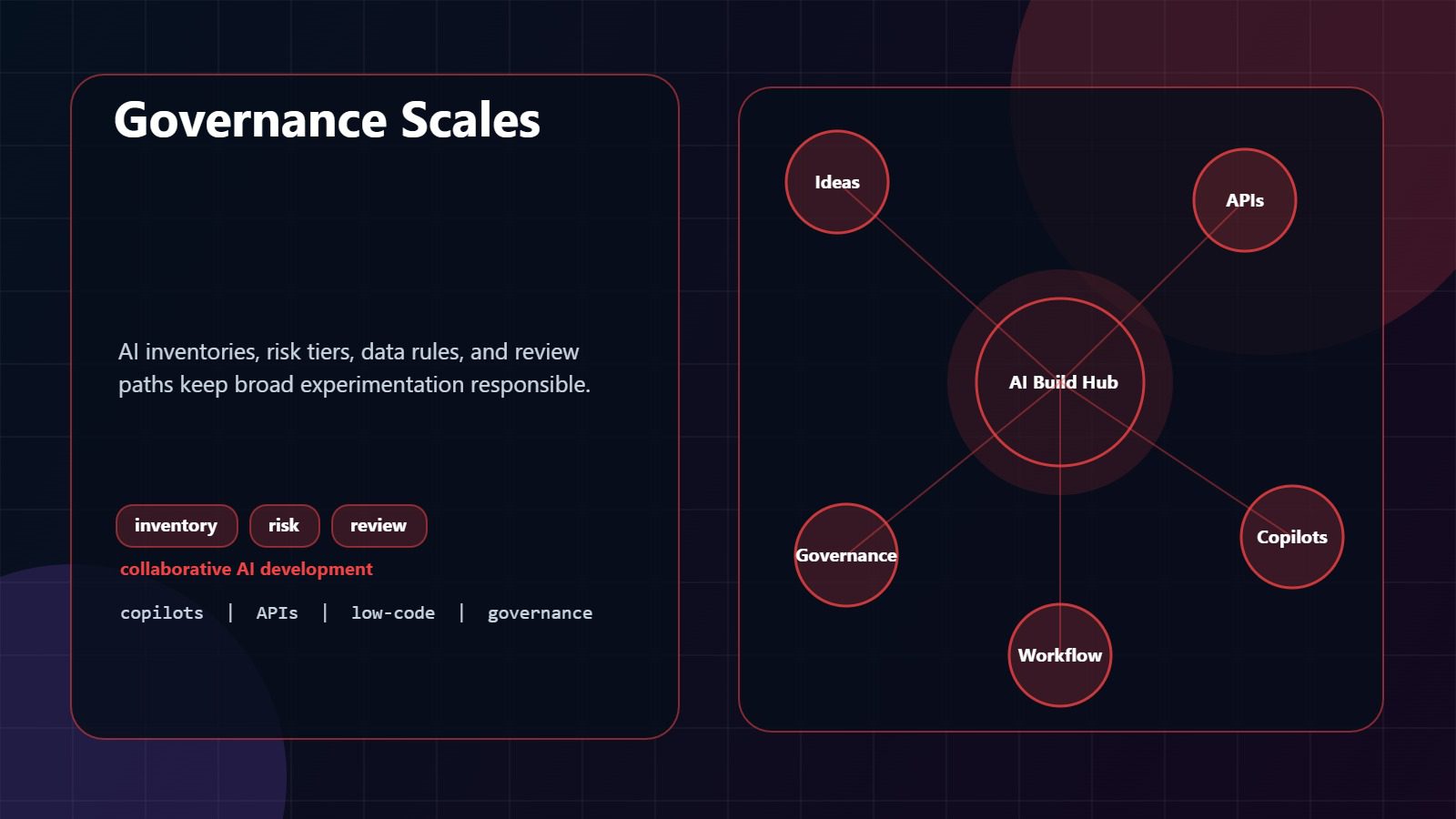
The biggest risk in democratization of AI development is not that more people build. The risk is that more people build without shared rules. Untracked AI tools can expose sensitive data, create inconsistent customer experiences, generate unreliable outputs, or bypass security and compliance review.
Governance should not stop experimentation. It should make safe experimentation easier. Teams need approved tools, data rules, model usage policies, review paths, documentation templates, monitoring expectations, and clear risk tiers. A simple internal assistant should not face the same review burden as a high-risk customer decision system.
The NIST AI Risk Management Framework is useful because it treats AI risk management as an ongoing practice involving governance, mapping, measurement, and management. That mindset fits the current moment: AI development is spreading, so oversight must become repeatable.
A practical governance model includes an AI inventory, named owners, data classification, vendor review, evaluation criteria, human approval points, audit trails, and incident response. Democratization of AI development only scales when leaders can see what exists and intervene when risk rises.
How leaders can accelerate AI development safely
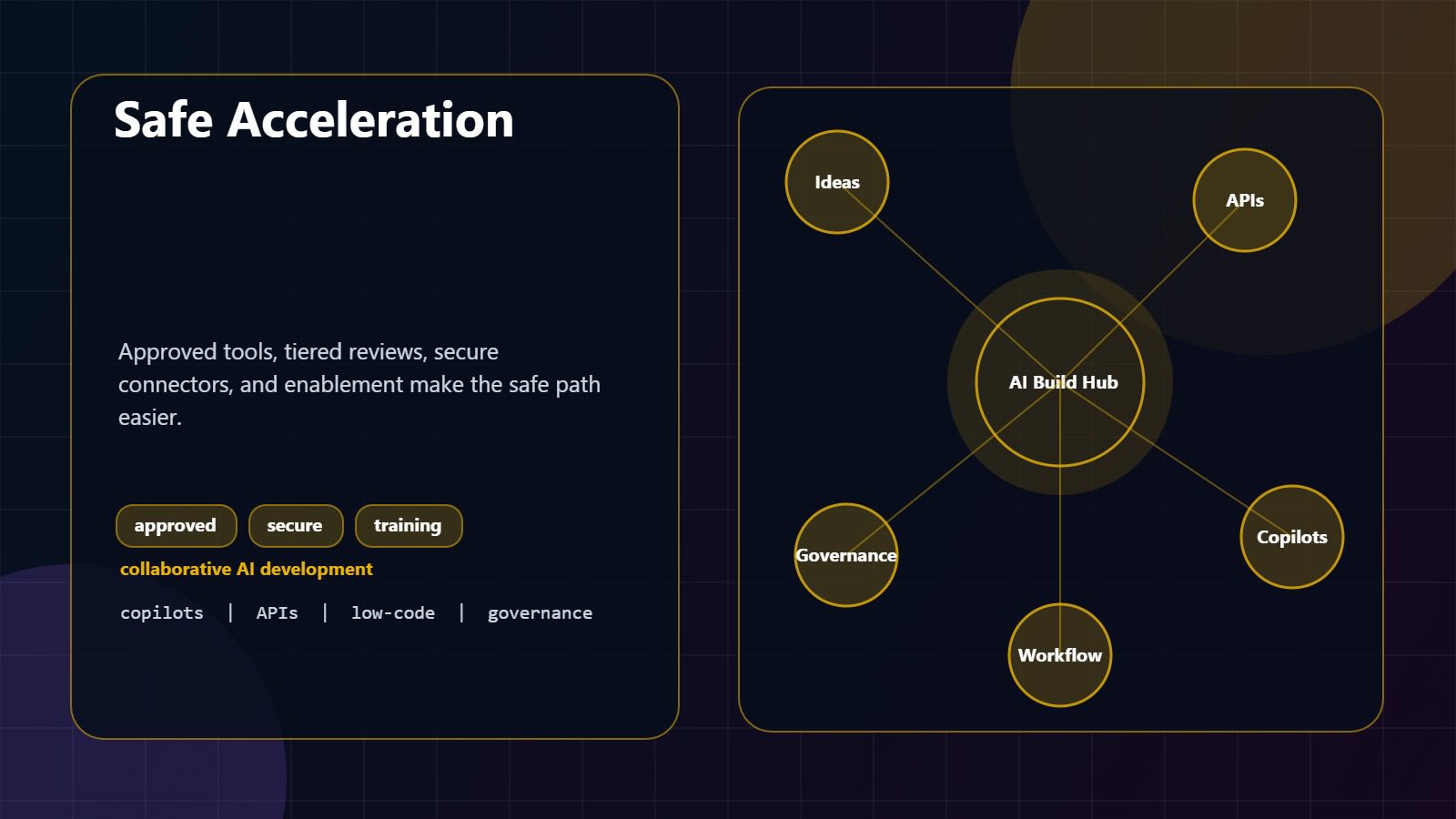
Leaders should start by making the approved path easier than the unofficial path. If employees have to fight procurement, security, and architecture for months, they will experiment with whatever tool is easiest. A better approach is to provide sanctioned platforms, reusable templates, secure data connectors, and clear escalation rules.
Next, create a tiered operating model. Low-risk prototypes can move quickly in sandboxes. Internal productivity tools can follow lightweight review. Systems that affect customers, finances, employment, health, legal obligations, or critical operations need deeper evaluation and human oversight.
Then connect AI creation to workflow automation. A successful prototype should not live forever as a manual side project. It should become part of a managed workflow with ownership, monitoring, support, rollback plans, and measurable outcomes.
Finally, invest in enablement. Train employees on prompt design, data handling, evaluation, tool limitations, security basics, and responsible AI. Democratization of AI development is not just a technology trend. It is a capability-building program that changes how the organization turns ideas into systems.
What the next wave means for software teams
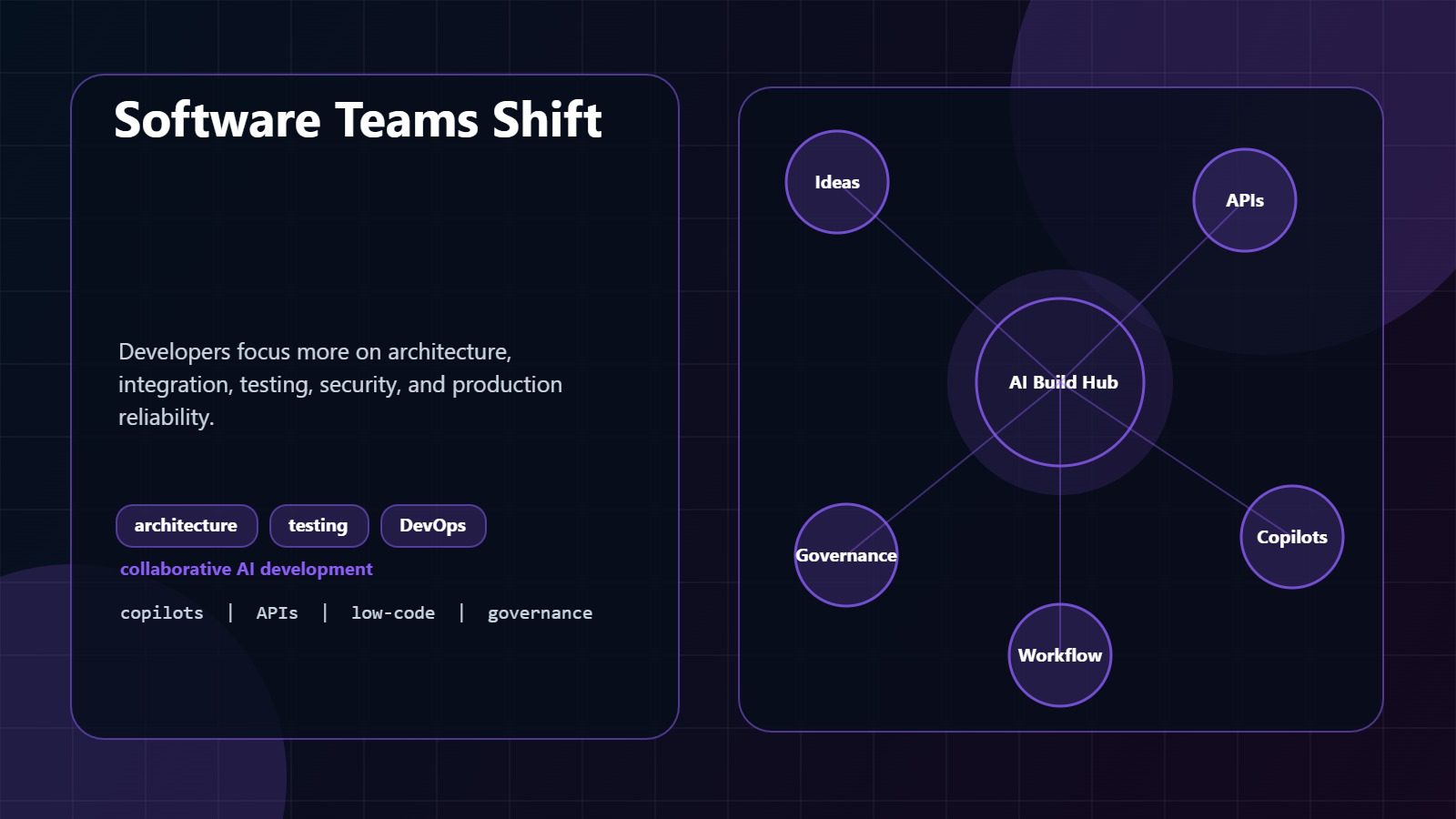
For software teams, democratization of AI development will change priorities. Developers may spend less time writing repetitive scaffolding and more time designing architectures, integrations, tests, security controls, and review systems for AI-assisted work.
They will also become partners to citizen builders. A business team may create the first prototype, but engineering must help decide what should be productionized, which data sources are safe, how the system should be monitored, and how failures should be handled.
This creates a useful division of labor. Business users contribute context and workflow expertise. Developers contribute reliability, scalability, security, and maintainability. AI specialists contribute model selection, evaluation, retrieval design, and governance patterns.
Organizations should also revisit their DevOps services and delivery practices. As AI-generated code and AI-built workflows increase, continuous integration, automated testing, code review, observability, and deployment discipline become even more important.
Democratization of AI development FAQ
What does democratization of AI development mean?
Democratization of AI development means more people can help create AI-enabled tools, workflows, and applications. It happens when APIs, copilots, low-code tools, open models, templates, and platforms reduce the technical barriers to building with AI.
Does this replace professional developers?
No. It changes the work. Professional developers remain essential for architecture, security, integration, performance, testing, maintainability, and production operations. Democratization of AI development gives more teams the ability to prototype and contribute domain knowledge.
What are the biggest benefits?
The biggest benefits are faster experimentation, more domain expertise in AI projects, shorter delivery queues, better process automation, and more practical use cases. Teams can test ideas quickly before investing in full production systems.
What are the main risks?
The main risks are data leakage, weak evaluation, shadow AI tools, inconsistent outputs, poor security, unclear ownership, compliance gaps, and prototypes becoming production systems without proper review.
How should companies govern citizen AI builders?
Companies should provide approved tools, training, templates, data rules, risk tiers, review workflows, inventories, and escalation paths. Governance should guide builders toward safe patterns rather than blocking all experimentation.
Which teams should start first?
Start with teams that have repeatable workflows, clear data boundaries, measurable outcomes, and low-to-medium risk. Support operations, internal knowledge management, reporting, document processing, and back-office automation are often practical starting points.
What is the main takeaway?
The main takeaway is that democratization of AI development can unlock faster innovation, but only if it is paired with governance, architecture, and enablement. The winning organizations will let more people build while making responsible delivery the default.
Democratization of AI development is not a passing slogan. It is the next operating model for AI adoption. As tools become easier to use, the advantage will shift to organizations that combine broad participation with strong engineering, clear governance, and measurable business outcomes.
If your organization wants to move from isolated AI experiments to practical AI delivery, now is the time to create the safe path for more builders. Start with one workflow, give teams approved tools, measure the results, and scale what works through a responsible AI operating model.
More AI coverage: explore Progressive Robot's AI Models, Tools & Releases hub — hands-on reviews, setup guides and benchmarks in one place.










