

Microsoft Dynamics 365 vs SAP is one of the most important ERP decisions for organisations modernising finance, supply chain, manufacturing, projects, commerce, service, and enterprise reporting. Both vendors offer mature cloud platforms, embedded artificial intelligence, workflow automation, analytics, and extensive partner ecosystems. Their strengths, however, come from different operating models.
Microsoft Dynamics 365 is a modular family of AI-powered ERP and CRM applications connected closely with Microsoft 365, Power Platform, Power BI, Dataverse, Azure, and Copilot. Microsoft describes Dynamics 365 as a portfolio that connects teams, processes, and data across finance, supply chain, sales, and service. SAP centres its cloud ERP strategy on SAP S/4HANA Cloud Public Edition and SAP Cloud ERP Private, supported by SAP Business Technology Platform, SAP Business Data Cloud, SAP Analytics Cloud, industry solutions, and Joule. SAP describes its public-cloud ERP as a flexible solution with embedded AI across finance, supply chain, HR, and sales.
The Microsoft Dynamics 365 vs SAP choice should not be reduced to brand reputation or a checklist of modules. ERP success depends on process ownership, data quality, implementation discipline, integration architecture, user adoption, and the organisation’s willingness to standardise how work is performed.
A professional-services company may value the Microsoft ecosystem because employees already work in Teams, Outlook, Excel, and Power BI. A multinational manufacturer may place greater value on production complexity, global localisation, plant operations, and established SAP processes. Another company may retain SAP as the enterprise core while using Microsoft for CRM, productivity, analytics, or subsidiary operations.
This guide compares the platforms across finance, supply chain, manufacturing, artificial intelligence, analytics, integration, deployment, implementation, usability, global operations, total cost, and long-term flexibility. It also provides a practical selection roadmap based on business evidence rather than vendor demonstrations alone.
Microsoft Dynamics 365 vs SAP: Quick Verdict
There is no universal winner in Microsoft Dynamics 365 vs SAP. Microsoft is often the stronger starting point for organisations that want modular ERP, close Microsoft 365 integration, Power Platform extensibility, familiar analytics, and a path that can scale from Business Central to enterprise finance and supply-chain applications.
SAP is often the stronger starting point for organisations that need deep global process standardisation, complex manufacturing, extensive industry functionality, broad localisation, or continuity from a significant SAP estate.
A disciplined Microsoft Dynamics 365 vs SAP evaluation should begin with operating priorities rather than software preferences.
| Decision area | Microsoft Dynamics 365 | SAP Cloud ERP |
|---|---|---|
| Typical fit | Microsoft-centric, modular, growth-oriented organisations | Complex, multinational, manufacturing-intensive organisations |
| Main ERP products | Business Central, Finance, Supply Chain Management, Project Operations | SAP S/4HANA Cloud Public Edition and SAP Cloud ERP Private |
| Productivity environment | Microsoft 365, Teams, Outlook, Excel, Power BI | SAP applications, Fiori, SAP Analytics Cloud, SAP Business Data Cloud |
| Artificial intelligence | Copilot and Dynamics 365 agents | Joule, Business AI, and Joule agents |
| Low-code and workflow | Power Apps, Power Automate, Copilot Studio | SAP Build, SAP BTP, Joule Studio |
| Deployment approach | Modular cloud applications and phased expansion | Standardised public cloud or adaptable private cloud |
| Pricing visibility | Public list pricing for many products | Commercial quotation based on scope and edition |
| Strongest advantage | Microsoft ecosystem and modular adaptability | Global process, manufacturing, and industry depth |
| Main risk | Fragmentation without architecture and governance | Cost and complexity when scope or customisation grows |
Understanding the Two ERP Portfolios
What Microsoft Dynamics 365 Includes
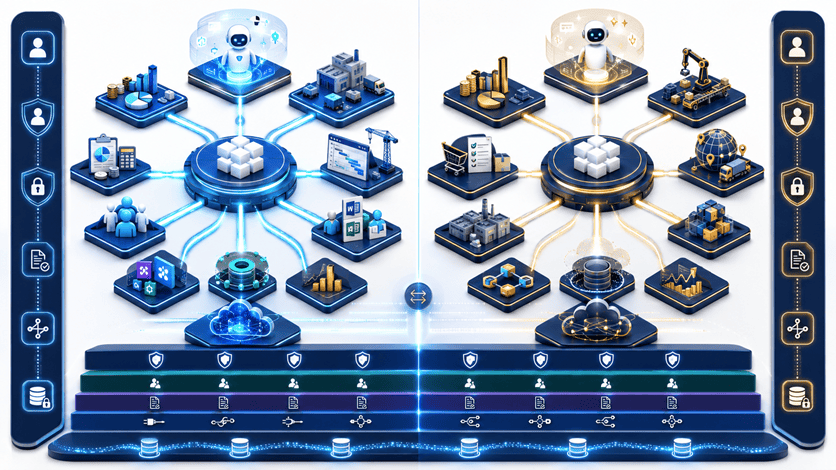
Microsoft Dynamics 365 is a family of applications designed around different functions and organisational sizes. Business Central combines finance, purchasing, inventory, sales, projects, service, and operations for small and midsize businesses. Dynamics 365 Finance supports more complex financial environments, while Supply Chain Management covers planning, procurement, production, warehousing, inventory, assets, and logistics. Project Operations supports project-based organisations, and the wider portfolio includes sales, service, commerce, and human-resources capabilities. Microsoft currently positions Business Central as an AI-powered ERP for small and midsize businesses.
This modular structure is central to Microsoft Dynamics 365 vs SAP. Microsoft allows a business to adopt selected applications and expand over time. The advantage is flexibility. The risk is fragmented data, security, reporting, and workflow if each application is implemented without an enterprise architecture.
What SAP Cloud ERP Includes
SAP’s modern ERP portfolio is centred on SAP S/4HANA Cloud. SAP S/4HANA Cloud Public Edition is the ready-to-run public-cloud option designed around standardised processes and continuous innovation. SAP Cloud ERP Private provides greater flexibility for organisations with complex requirements, established SAP processes, or a need to preserve more of an existing investment. SAP describes the two offerings as a ready-to-run cloud ERP and a tailored-to-fit private-cloud ERP.
SAP extends the ERP core through Business Technology Platform, Integration Suite, SAP Build, Business Data Cloud, Analytics Cloud, industry solutions, procurement, planning, warehouse, transport, and human-capital products. SAP states that BTP supports application development, automation, integration, data, analytics, and AI across SAP and third-party environments.
In Microsoft Dynamics 365 vs SAP, SAP’s strength often comes from the depth of the complete enterprise portfolio rather than one isolated application.
Microsoft Dynamics 365 vs SAP Feature Comparison
| Capability | Microsoft Dynamics 365 | SAP |
| Financial management | Strong enterprise finance plus Business Central options | Deep global finance, controlling, compliance, and group processes |
| Procurement | Purchasing, sourcing, vendor collaboration, approvals | Broad source-to-pay processes and procurement ecosystem |
| Supply chain | Planning, inventory, warehousing, production, assets, logistics | Extensive design-to-operate and supply-chain capabilities |
| Manufacturing | Discrete, process, lean, and mixed-mode support | Strong complex and multinational manufacturing support |
| Project operations | Connected project sales, delivery, resources, and finance | Strong project and service processes across SAP products |
| CRM | Native Dynamics 365 sales and service applications | SAP Sales Cloud and wider customer-experience products |
| Analytics | Power BI and Microsoft data ecosystem | SAP Analytics Cloud and SAP Business Data Cloud |
| AI | Copilot and Dynamics 365 agents | Joule, Business AI, and Joule agents |
| Integration | Dataverse, Azure, Power Platform, APIs, connectors | SAP BTP, Integration Suite, APIs, events, business content |
| Extension | Power Apps, Power Automate, Copilot Studio, Azure | SAP Build, ABAP Cloud, BTP services, Joule Studio |
| Deployment | Modular cloud applications | Public-cloud and private-cloud ERP |
| Localisation | Broad global support | Extensive localisation and multinational support |
The table provides orientation, but a serious Microsoft Dynamics 365 vs SAP selection must test actual business scenarios. Microsoft Dynamics 365 vs SAP should be demonstrated against the same data, volumes, controls, and user roles.
Module names do not prove that a system can handle the organisation’s transaction volumes, approval rules, tax requirements, product structures, warehouse processes, or regulatory obligations.
Finance Comparison
Dynamics 365 Finance
Dynamics 365 Finance supports general ledger, accounts payable, accounts receivable, fixed assets, budgeting, cash, tax, credit and collections, subscription billing, consolidation, and financial analysis. Its strongest differentiator is often proximity to Excel, Teams, Power BI, Power Platform, and the wider Microsoft environment.
Microsoft currently lists Dynamics 365 Finance at $210 per user per month and Finance Premium at $300 per user per month in the United States, paid yearly, while noting that regional pricing and taxes can vary. The published price improves transparency, but a realistic business case must also include implementation, data migration, reporting, storage, integration, environments, support, and AI consumption.
In the Microsoft Dynamics 365 vs SAP finance comparison, Microsoft is frequently attractive when finance wants strong controls combined with familiar productivity tools and modular adoption.
SAP Finance
SAP Cloud ERP supports record-to-report, procure-to-pay, order-to-cash, assets, treasury, revenue, tax, compliance, product costing, and group-level financial processes. SAP is particularly strong when finance must support many legal entities, plants, countries, accounting requirements, and high transaction volumes.
SAP may also be the natural option when the organisation already has SAP finance processes, master data, controls, reporting, and skills. Its process depth becomes more valuable as intercompany, manufacturing-cost, regulatory, and localisation requirements become more complex.
Finance Verdict
The Microsoft Dynamics 365 vs SAP finance decision should be tested with the real chart of accounts, close calendar, allocations, intercompany transactions, tax scenarios, billing models, product costing, and statutory reporting.
Microsoft may have the advantage when productivity integration and modularity dominate. SAP may have the advantage when global finance complexity and standardisation dominate.
Supply Chain and Manufacturing

Dynamics 365 Supply Chain Management
Dynamics 365 Supply Chain Management supports demand planning, sourcing, procurement, production, inventory, warehousing, order management, transportation, asset management, and operational visibility.
Microsoft’s 2026 release wave continues to expand supplier communication, planning, warehousing, and AI-assisted operational experiences. Microsoft describes the product as supporting operations from product definition and demand forecasting through production, warehousing, transportation, and asset maintenance.
The product can be a strong fit when supply-chain teams also rely on Teams, Power BI, Power Platform, Azure, and Dynamics 365 Sales. In Microsoft Dynamics 365 vs SAP, this ecosystem alignment may reduce the number of separate tools needed for collaboration and analysis.
SAP Supply Chain and Manufacturing
SAP supports planning, procurement, production, quality, maintenance, warehousing, logistics, transportation, and product processes through its ERP core and wider supply-chain portfolio. It is frequently shortlisted by multinational manufacturers with complex plants, bills of material, product costing, quality, traceability, maintenance, and regulatory requirements.
SAP’s advantage increases when the organisation already uses SAP planning, procurement, warehouse, transport, network, or product-lifecycle products. The wider portfolio can support a highly standardised industrial operating model across countries and business units.
Supply-Chain Verdict
The Microsoft Dynamics 365 vs SAP result can be close for standard manufacturing, distribution, and warehousing. Dynamics 365 is strong for modular transformation and Microsoft-aligned operations. SAP deserves deeper consideration for highly complex manufacturing, global networks, extensive industry requirements, and established SAP supply chains.
The evaluation should demonstrate forecast-to-plan, source-to-pay, plan-to-produce, warehouse-to-ship, quality, maintenance, traceability, and exception-management scenarios with representative volumes and data.
This is where Microsoft Dynamics 365 vs SAP becomes a process-fit decision rather than a marketing comparison.
Artificial Intelligence: Microsoft Copilot vs SAP Joule
Microsoft Copilot and Agents
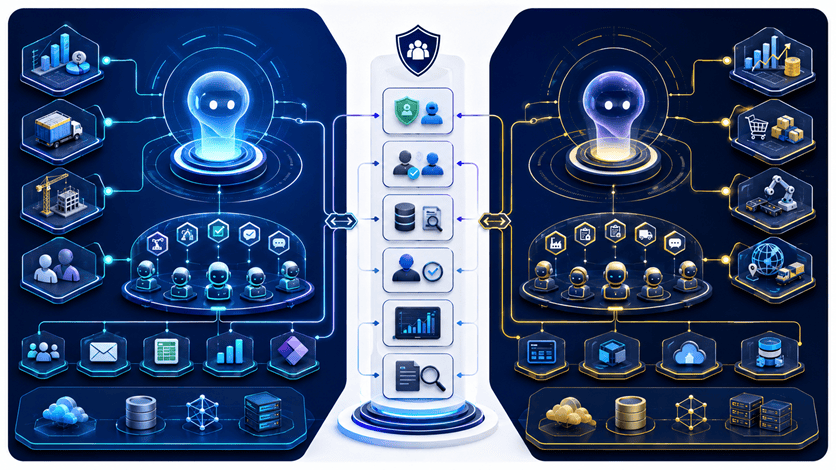
Microsoft embeds Copilot and agentic capabilities across Dynamics 365, Microsoft 365, Power Platform, and Copilot Studio.
Dynamics 365 AI can analyse data, automate tasks, and guide decisions across sales, service, finance, and supply chain. Microsoft’s 2026 release wave continues to extend agentic experiences across finance, supply chain, commerce, HR, projects, sales, and service.
Microsoft’s advantage in the Microsoft Dynamics 365 vs SAP AI comparison is the ability to bring ERP context into the productivity tools where many employees already work. Copilot Studio also allows organisations to build governed custom agents, while Azure and Power Platform provide integration and orchestration.
SAP Joule and Business AI
SAP Joule supports natural-language navigation, information retrieval, analytical insight, and supported transactional tasks.
SAP currently documents Joule capabilities for S/4HANA Cloud Public Edition, while noting that additional entitlement and authorisation may be required for some features. SAP also documents the ability to retrieve information about supported business objects and navigate enterprise applications through natural language.
SAP is expanding Joule through business agents and developer capabilities grounded in SAP process and data context. SAP Business Data Cloud is positioned as a governed data foundation that preserves business semantics for analytics and AI.
AI Verdict
The Microsoft Dynamics 365 vs SAP AI comparison should focus on task accuracy, authorised data access, source evidence, refusal behaviour, regional availability, licensing, auditability, and human approval.
Microsoft may lead where AI must work across Microsoft productivity and low-code tools. SAP may lead where the most valuable context already sits inside complex SAP processes and data.
Analytics, Planning, and Data
Microsoft Analytics Ecosystem
Dynamics 365 connects closely with Power BI and Microsoft’s broader data services. This can be valuable when the company already uses Power BI for executive reporting, operational analysis, semantic models, and self-service analytics.
The advantage in Microsoft Dynamics 365 vs SAP is not merely the availability of charts. It is the possibility of connecting ERP analysis with Teams, Excel, Power Platform, Azure, and Microsoft governance tools.
The organisation must still define where operational reporting, enterprise analytics, planning, data products, and AI grounding will live. In practice, Microsoft Dynamics 365 vs SAP also becomes a decision about the future enterprise data architecture.
SAP Analytics Ecosystem
SAP Analytics Cloud combines business intelligence and enterprise planning, while SAP Business Data Cloud is designed to unify governed SAP and third-party data.
SAP states that Business Data Cloud supplies semantically rich data products grounded in business-process definitions and provides context for applications and agents.
SAP can be especially attractive when operational, financial, planning, and AI workloads need to retain SAP relationships and semantics.
Analytics Verdict
In Microsoft Dynamics 365 vs SAP, Microsoft often fits organisations committed to Power BI and Microsoft data services. SAP often fits organisations where SAP operational data and planning context dominate.
The evaluation should compare replication, semantic consistency, planning, latency, governance, external data, and the cost of operating parallel analytics stacks.
Integration and Extensibility
Microsoft Power Platform and Azure
Power Apps, Power Automate, Dataverse, Copilot Studio, Azure services, APIs, and connectors can extend Dynamics 365 with workflows, portals, approvals, applications, integrations, and agents.
This flexibility can accelerate delivery for Microsoft-oriented teams. The risk is uncontrolled low-code growth. A weakly governed Microsoft Dynamics 365 vs SAP programme may underestimate environments, custom tables, flows, connectors, security roles, managed solutions, support ownership, and platform consumption.
SAP Business Technology Platform
SAP BTP provides integration, development, automation, data, analytics, and AI services across SAP and third-party systems.
SAP Integration Suite is positioned as an integration platform that connects applications, data, processes, and agents through APIs and events.
SAP also promotes clean-core extensions so that the organisation can differentiate without making future upgrades unnecessarily difficult.
Extensibility Verdict
The Microsoft Dynamics 365 vs SAP decision depends partly on existing skills and governance. Microsoft-focused teams may move faster with Power Platform, Azure, Dataverse, and .NET. SAP-focused teams may gain more from BTP, Integration Suite, SAP Build, ABAP Cloud, and SAP business semantics.
The goal should not be maximum customisation. The goal should be the smallest maintainable extension set that supports genuine differentiation.
A successful Microsoft Dynamics 365 vs SAP programme protects upgradeability on whichever platform is selected.
Deployment, Upgrades, and Flexibility
Dynamics 365 Approach
Dynamics 365 allows organisations to adopt separate applications and expand over time. Business Central can support growing organisations or subsidiaries, while Finance, Supply Chain Management, and Project Operations support larger enterprise requirements.
This modularity can support phased transformation. It can also create fragmented data and support models if the business treats each product as a separate project.
SAP Public and Private Cloud
SAP Cloud ERP Public Edition prioritises fit-to-standard processes and continuous public-cloud innovation. SAP Cloud ERP Private provides greater adaptability and a path for organisations migrating substantial on-premises SAP investments. SAP describes the two options as ready-to-run cloud ERP and tailored-to-fit private-cloud ERP.
This is a central Microsoft Dynamics 365 vs SAP difference. SAP buyers must decide how much process variation genuinely creates value and whether preserving existing customisation justifies private-cloud complexity.
User Experience and Adoption
Dynamics 365 can reduce context switching for employees who already use Outlook, Excel, Teams, and Power BI. Familiar Microsoft patterns may shorten adoption time for selected finance, sales, service, and management roles.
SAP uses Fiori and role-based applications to simplify access to complex processes, while Joule supports conversational navigation and assistance. SAP can deliver strong usability when roles, workflows, and Fiori experiences are designed around real work rather than technical transactions.
The Microsoft Dynamics 365 vs SAP usability test should be role-specific. A warehouse worker, buyer, maintenance technician, finance controller, project manager, and executive need different devices and workflows.
The better user experience is the one that removes unnecessary steps while preserving control and data quality. Microsoft Dynamics 365 vs SAP should therefore be tested with end users, not assessed only by project teams.
Global Operations and Industry Fit
SAP has a strong position in multinational manufacturing, regulated industries, complex supply chains, and global process standardisation. Its public and private cloud products support broad finance, procurement, manufacturing, supply-chain, and localisation requirements.
Dynamics 365 also supports global finance, supply chain, commerce, projects, and industry solutions through Microsoft and its partner ecosystem. It may be particularly attractive to international organisations that prefer Microsoft’s productivity, cloud, analytics, and low-code stack.
The Microsoft Dynamics 365 vs SAP global-fit assessment should verify statutory reporting, tax, electronic documents, currencies, languages, legal entities, intercompany processes, data residency, sector regulation, and local support.
General claims about global capability are not enough; the exact product edition must support the countries and processes in the rollout. Microsoft Dynamics 365 vs SAP localisation evidence should be collected country by country.
Pricing and Total Cost of Ownership
Microsoft Pricing Visibility
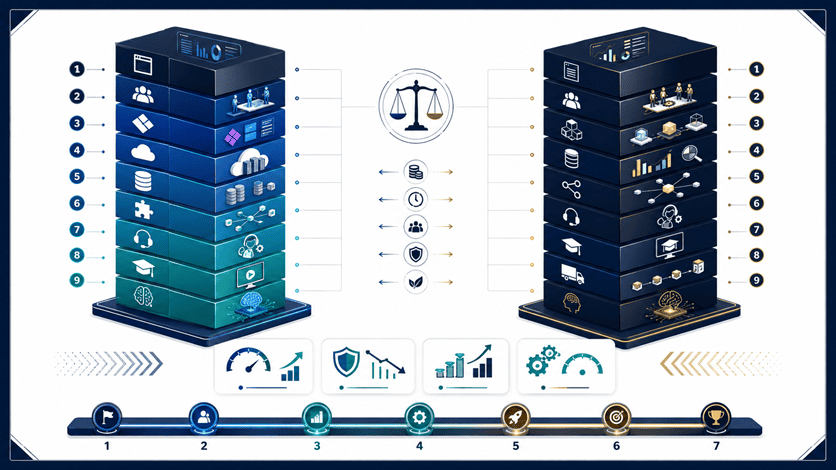
Microsoft publishes list pricing for many Dynamics 365 products.
Dynamics 365 Finance currently lists at $210 per user per month and Finance Premium at $300 per user per month in the United States, paid yearly, with regional variation. Supply Chain Management pricing also includes premium plans and Copilot-credit considerations.
Public pricing improves initial transparency, but it does not represent the full transformation cost.
SAP Commercial Pricing
SAP’s cloud ERP pricing is commonly established through a commercial proposal based on the selected edition, users, scope, infrastructure, and related products.
SAP’s official ERP package pages direct buyers to request exact pricing.
Full Cost Model
A realistic Microsoft Dynamics 365 vs SAP business case should include subscriptions, implementation services, internal staff, data migration, interfaces, extensions, environments, analytics, AI consumption, testing, training, change management, cutover, support, upgrades, and operational disruption.
Dynamics 365 may offer a more accessible entry point through Business Central or a phased application rollout. SAP may justify a larger programme where the business needs complex global processes, manufacturing depth, extensive localisation, or continuity from an established SAP estate.
The correct comparison is a five-to-seven-year total cost of ownership, not a single licence figure.
Microsoft Dynamics 365 vs SAP cost modelling should also include internal operating capacity and the cost of future change.
Implementation Complexity and Risk
Dynamics 365 Risks
Dynamics projects can fail when modularity becomes fragmentation. Common risks include weak Dataverse governance, uncontrolled Power Platform development, poor environment strategy, excessive custom workflows, insufficient ERP expertise, weak master data, and inadequate end-to-end testing.
SAP Risks
SAP projects can fail when the organisation over-scopes transformation, preserves too many legacy customisations, delays process decisions, underestimates data migration, or imposes global standards without local ownership.
Shared Risks
Both platforms require strong executive sponsorship, process ownership, data stewardship, architecture, integration testing, security, training, cutover planning, and post-go-live support.
The most important Microsoft Dynamics 365 vs SAP implementation question is whether the organisation can make timely decisions and sustain the target operating model after the implementation team leaves.
Microsoft Dynamics 365 vs SAP success is ultimately an organisational capability question as much as a software question.
Microsoft Dynamics 365 vs SAP Decision Matrix
| Business situation | Likely starting point | Reason |
| Growing organisation using Microsoft 365 | Dynamics 365 Business Central | Familiar tools, modular scope, accessible entry point |
| Enterprise service or project business | Dynamics 365 Finance and Project Operations | Strong productivity and project integration |
| Complex multinational manufacturer | SAP Public or Private Edition | Manufacturing, localisation, and global process depth |
| Existing SAP ECC environment | SAP Cloud ERP Private often has an advantage | Greater continuity of process, data, and skills |
| Fit-to-standard public-cloud strategy | Compare Dynamics 365 and SAP Public Edition | Business-process fit determines the winner |
| Power Platform and Azure strategy | Dynamics 365 | Native alignment with Microsoft services |
| SAP BTP and SAP data strategy | SAP | Native process and business-context alignment |
| Composable enterprise architecture | Either platform | Depends on system boundaries and integration design |
This Microsoft Dynamics 365 vs SAP matrix is a starting point. It should not replace fit-to-standard workshops, reference checks, solution demonstrations, and a properly weighted business case.
Microsoft Dynamics 365 vs SAP should be scored against documented priorities rather than general impressions.
How to Choose Between Microsoft Dynamics 365 and SAP
Define Business Outcomes
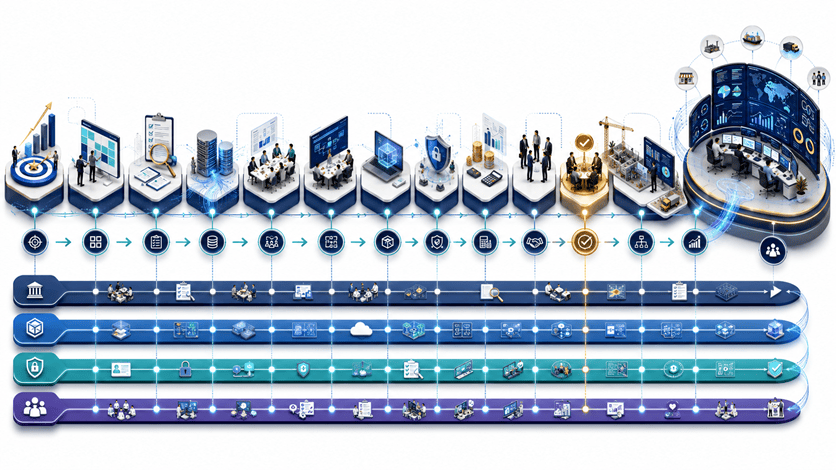
Begin with measurable outcomes such as reducing the financial close, improving forecast accuracy, lowering inventory, increasing on-time delivery, improving project margin, or replacing unreliable spreadsheets.
The Microsoft Dynamics 365 vs SAP scorecard should connect every requirement to an operational or financial result.
Map End-to-End Processes
Document record-to-report, source-to-pay, order-to-cash, plan-to-produce, warehouse-to-deliver, project-to-profit, asset-to-maintain, and service processes.
Separate global standards from genuine local or industry differentiation.
Assess the Current Technology Estate
Review ERP, CRM, analytics, custom applications, integrations, spreadsheets, data quality, security, licences, technical debt, and internal skills.
Existing investment can create an advantage for one platform, but it should not excuse poor future fit.
Run Equal Fit-to-Standard Workshops
Require Microsoft and SAP partners to demonstrate the same priority scenarios using the same assumptions and representative data.
Classify each requirement as standard configuration, extension, third-party solution, integration, roadmap feature, or unsupported need.
Test Data, Integration, and Security
A polished demonstration does not prove that the platform can handle real volumes, master-data problems, identity requirements, reporting logic, interfaces, or regulatory controls.
Microsoft Dynamics 365 vs SAP testing should therefore include realistic failure cases as well as normal transactions. Test the highest-risk scenarios before finalising the implementation scope.
Evaluate the Partner
Compare industry experience, senior-team availability, architecture quality, references, delivery governance, change-management capability, support model, and willingness to challenge unnecessary customisation.
Build the Business Case
Compare cost, time to value, implementation risk, process benefits, operational savings, user adoption, strategic flexibility, and avoided technical debt.
A strong Microsoft Dynamics 365 vs SAP business case names the people responsible for achieving each benefit after go-live.
Frequently Asked Questions
Is Microsoft Dynamics 365 Better Than SAP?
Neither platform is universally better. Microsoft Dynamics 365 vs SAP is a fit decision rather than a universal ranking.
Dynamics 365 may be better for Microsoft 365 integration, modular adoption, Power Platform, and organisations seeking a flexible path from midsize to enterprise ERP. SAP may be better for complex global manufacturing, extensive industry processes, localisation, or continuity from an existing SAP estate.
Is Dynamics 365 Cheaper Than SAP?
Dynamics 365 often has a lower and more transparent entry price, especially through Business Central.
Total cost depends on scope, implementation, data, integration, support, analytics, customisation, and AI consumption.
Which ERP Is Easier to Implement?
A focused Business Central or modular Dynamics rollout may be faster than a large SAP programme.
SAP Public Edition can also support a faster fit-to-standard implementation when the organisation accepts standard processes. Complexity depends more on scope and decision discipline than vendor name.
Which Platform Is Better for Manufacturing?
SAP often has an advantage for highly complex, multinational, industry-intensive manufacturing.
Dynamics 365 Supply Chain Management remains a strong option for many discrete, process, warehouse, and distribution environments, especially when Microsoft alignment matters.
Which Platform Has Better AI?
Microsoft offers Copilot and agents across Dynamics 365 and Microsoft productivity tools. SAP offers Joule and agents grounded in SAP process and data context.
The better option depends on use case, data, ecosystem, availability, governance, and measured accuracy.
Can Dynamics 365 and SAP Work Together?
Yes. Microsoft Dynamics 365 vs SAP can also be a coexistence architecture rather than a replacement decision.
Some enterprises keep SAP as the ERP core while using Microsoft for CRM, productivity, analytics, automation, or subsidiary operations. Coexistence requires clear system ownership, data governance, identity, integration, reconciliation, monitoring, and support.
Which Platform Is Better for a Midsize Business?
Business Central is often a strong fit for a midsize business that wants connected finance and operations with Microsoft tools.
SAP Public Edition may be stronger where the company has complex manufacturing, rapid international expansion, or a strategic SAP direction.
Should an Existing SAP Customer Move to Dynamics 365?
Only when the future business case outweighs migration cost and risk.
The company should compare process fit, customisation debt, data, integrations, skills, user experience, AI strategy, support, and vendor dependence.
Final Verdict
The final Microsoft Dynamics 365 vs SAP choice should be based on evidence from real processes, users, data, controls, and total cost.
Microsoft Dynamics 365 vs SAP should also be reviewed against the organisation’s long-term technology and skills strategy.
Microsoft Dynamics 365 is compelling when the organisation wants modular ERP, Microsoft 365 integration, Power Platform extensibility, Power BI alignment, visible pricing, and the ability to select Business Central or enterprise applications according to scale.
SAP is compelling when the organisation requires complex global process standardisation, deep manufacturing and supply-chain support, extensive localisation, strong SAP data context, or continuity from a major SAP environment.
The right Microsoft Dynamics 365 vs SAP decision begins with business outcomes, capability maps, fit-to-standard workshops, data and integration testing, and a realistic implementation plan.
It should resist recreating every legacy customisation and should measure success through operational improvements after go-live.
Progressive Robot helps organisations assess ERP requirements, compare platforms, redesign processes, plan integrations, and manage implementation risk. Explore the ERP consultant guide, read about Business Central, review composable ERP consulting, or contact Progressive Robot to discuss an ERP selection roadmap.