

Enterprise AI Agent Governance has rapidly become one of the most important discussions surrounding enterprise artificial intelligence. While organizations are enthusiastically deploying autonomous AI agents to automate workflows, improve productivity, analyze business information, assist employees, and make operational decisions, governance frameworks have struggled to evolve at the same pace. The result is an expanding gap between what AI agents are technically capable of doing and the organizational controls needed to manage them responsibly.
Unlike traditional software systems that execute predefined instructions, AI agents increasingly demonstrate autonomous reasoning, long-term planning, tool usage, memory, external API integration, document generation, code execution, and workflow orchestration. These capabilities enable organizations to automate highly complex business processes, but they also introduce new operational, security, compliance, and accountability challenges that existing governance policies were never designed to address.
Many enterprises already maintain mature governance programs covering cybersecurity, privacy, software development, regulatory compliance, identity management, risk assessment, and cloud infrastructure. However, Enterprise AI Agent Governance extends far beyond these traditional disciplines. Autonomous AI systems continuously interpret instructions, retrieve organizational knowledge, communicate with external systems, make recommendations, invoke tools, and sometimes execute actions without direct human involvement. Governing these dynamic behaviors requires new policies, monitoring techniques, and technical safeguards.
Another factor driving governance complexity is the rapid evolution of generative AI. Large language models continue improving at an extraordinary pace, allowing organizations to deploy AI agents capable of understanding natural language, reasoning across multiple business domains, summarizing large document collections, interacting with enterprise applications, and supporting customer-facing services. While these advancements create significant business value, they also expand organizational risk if governance mechanisms fail to keep pace.
The governance challenge becomes even greater when multiple AI agents collaborate. Modern enterprise environments increasingly deploy specialized agents responsible for customer support, software engineering, knowledge retrieval, financial reporting, cybersecurity operations, human resources, procurement, compliance monitoring, and workflow automation. These interconnected agents exchange information, delegate tasks, and coordinate decisions across business functions. Without effective Enterprise AI Agent Governance, organizations may struggle to maintain visibility into how autonomous decisions are made and whether those decisions comply with business policies.
Regulators worldwide are also increasing scrutiny of enterprise AI deployments. Governments, industry regulators, and standards organizations continue developing frameworks that address AI transparency, accountability, explainability, fairness, privacy, intellectual property, and human oversight. Organizations implementing autonomous AI agents must therefore balance innovation with responsible governance to maintain customer trust and regulatory compliance.
Ultimately, Enterprise AI Agent Governance represents far more than policy documentation. It encompasses technical architecture, operational controls, organizational accountability, continuous monitoring, identity management, security enforcement, compliance verification, human oversight, and lifecycle management. Enterprises that establish comprehensive governance frameworks today will be significantly better prepared to scale AI safely while reducing long-term operational and regulatory risk.
This comprehensive guide explores where Enterprise AI Agent Governance has not yet caught up, examines why governance gaps continue emerging, analyzes enterprise risks, discusses practical governance strategies, and evaluates how organizations can prepare for the next generation of autonomous artificial intelligence.
Key Takeaways
- Enterprise AI Agent Governance is evolving more slowly than AI agent capabilities.
- Autonomous AI introduces governance challenges beyond traditional software controls.
- AI agents require new approaches to accountability, monitoring, authorization, and compliance.
- Human oversight remains essential for high-impact enterprise decisions.
- Organizations that invest early in governance will be better positioned to deploy AI responsibly.
What Is Enterprise AI Agent Governance?

Enterprise AI Agent Governance refers to the policies, technical controls, operational processes, organizational responsibilities, and compliance mechanisms used to ensure autonomous AI agents operate safely, securely, transparently, and consistently with business objectives.
Rather than focusing only on controlling language model outputs, Enterprise AI Agent Governance manages how AI agents access enterprise information, interact with external systems, execute workflows, use business tools, retain memory, collaborate with other agents, and support organizational decision-making.
An effective governance framework helps organizations maximize AI benefits while minimizing operational, regulatory, ethical, and cybersecurity risks.
Why AI Governance Has Become More Complex
Traditional enterprise software generally follows predictable business logic.
AI agents behave differently.
Modern autonomous agents may:
- Interpret natural language instructions.
- Plan multi-step workflows.
- Retrieve organizational knowledge.
- Access enterprise applications.
- Execute business tasks.
- Generate software.
- Analyze documents.
- Collaborate with other AI agents.
These dynamic capabilities require Enterprise AI Agent Governance frameworks that continuously evaluate both technical behavior and organizational risk rather than relying solely on static security policies.
Organizations can align their AI governance practices with internationally recognized frameworks such as the National Institute of Standards and Technology (NIST) AI Risk Management Framework, which provides guidance for managing artificial intelligence risks.
Why Governance Is Struggling to Keep Pace
Artificial intelligence evolves significantly faster than enterprise governance programs.
Organizations often deploy AI agents within months, while governance policies, compliance reviews, security assessments, legal approvals, and organizational training may require much longer implementation cycles.
This creates governance gaps in areas such as:
- Accountability.
- Authorization.
- Transparency.
- Monitoring.
- Risk management.
- Policy enforcement.
- Compliance.
- Human oversight.
Closing these gaps will become increasingly important as enterprise AI adoption accelerates.
How Enterprise AI Agent Governance Works

Enterprise AI Agent Governance works by combining organizational policies, technical safeguards, identity management, security controls, continuous monitoring, compliance validation, and human oversight into a unified governance framework. Rather than treating AI agents as ordinary software applications, Enterprise AI Agent Governance recognizes that autonomous systems can reason, make decisions, interact with external tools, retrieve sensitive information, and execute complex workflows with varying degrees of independence.
Unlike traditional governance programs that primarily focus on user permissions or application security, Enterprise AI Agent Governance must continuously evaluate what an AI agent is attempting to do, why it is performing that action, whether it has sufficient authorization, whether the action aligns with organizational policy, and whether human approval should be required before execution.
Modern enterprise AI platforms increasingly incorporate governance directly into the AI lifecycle, ensuring every request, decision, tool invocation, and workflow execution can be monitored, audited, and evaluated against organizational policies.
Governance Architecture
Every successful Enterprise AI Agent Governance program begins with a well-designed governance architecture.
This architecture typically defines:
- AI agent responsibilities.
- Business objectives.
- Security boundaries.
- Data access policies.
- Human approval requirements.
- Monitoring procedures.
- Compliance obligations.
- Audit mechanisms.
Rather than allowing unrestricted autonomy, governance architecture establishes clear operational boundaries within which AI agents can safely operate.
Identity and Authorization
Identity management is one of the most important components of Enterprise AI Agent Governance.
Every AI agent should possess a clearly defined digital identity that determines:
- Which systems it may access.
- Which business functions it supports.
- Which users it represents.
- Which tools it may execute.
- Which data it may retrieve.
- Which actions require approval.
- Which permissions it inherits.
- Which activities are prohibited.
Strong identity-based authorization prevents AI agents from exceeding their intended responsibilities.
Least-Privilege Access
Enterprise AI Agent Governance increasingly follows the principle of least privilege.
Rather than granting broad permissions, organizations should provide AI agents only the minimum level of access required to perform their assigned tasks.
Examples include:
- Read-only database access.
- Limited document retrieval.
- Restricted API permissions.
- Controlled cloud resources.
- Approved business applications.
- Temporary elevated privileges.
- Time-limited credentials.
- Task-specific authorization.
Restricting unnecessary permissions significantly reduces operational and cybersecurity risk.
Policy Enforcement
Governance policies should actively guide AI behavior instead of existing only as written documentation.
Enterprise AI Agent Governance typically enforces policies covering:
- Data privacy.
- Confidential information.
- Security procedures.
- Regulatory compliance.
- Ethical AI principles.
- Financial approvals.
- Software deployment.
- Customer communications.
Modern governance engines continuously evaluate whether requested AI actions comply with organizational policies before execution.
Human Oversight
Although autonomous AI continues improving rapidly, Enterprise AI Agent Governance still relies heavily on human supervision.
Organizations commonly require human approval for activities involving:
- Financial transactions.
- Contract approval.
- Infrastructure modification.
- Security policy changes.
- Customer commitments.
- Legal communications.
- Sensitive data access.
- Executive decision making.
Maintaining appropriate human oversight improves accountability while reducing unintended consequences.
Continuous Monitoring
Governance does not end once an AI agent begins operating.
Enterprise AI Agent Governance requires continuous monitoring of:
- Agent decisions.
- Tool usage.
- API requests.
- Workflow execution.
- Resource consumption.
- Authorization events.
- Policy violations.
- Operational anomalies.
Real-time visibility enables organizations to identify unexpected behavior before it develops into larger operational or security incidents.
Audit Logging
Comprehensive audit logging supports transparency throughout the AI lifecycle.
Organizations should record:
- User requests.
- AI reasoning summaries.
- Tool invocations.
- Data sources.
- System responses.
- Approval decisions.
- Configuration changes.
- Security events.
Detailed audit trails simplify compliance reporting while supporting future investigations and governance improvements.
Enterprise Risk Management
Enterprise AI Agent Governance should integrate directly with broader enterprise risk management programs.
Governance teams should regularly evaluate:
- Operational risks.
- Security risks.
- Compliance risks.
- Financial risks.
- Reputational risks.
- Third-party risks.
- Privacy risks.
- AI-specific risks.
Integrating AI governance with enterprise risk management ensures autonomous systems remain aligned with organizational objectives.
Challenges and Limitations of Enterprise AI Agent Governance

Although Enterprise AI Agent Governance continues maturing rapidly, governance frameworks remain significantly behind the capabilities of modern autonomous AI systems. Organizations are deploying increasingly sophisticated AI agents that can reason, plan, execute code, interact with enterprise applications, retrieve proprietary knowledge, coordinate with other AI agents, and automate complex business workflows. However, many governance programs still rely on policies originally designed for conventional software applications or human users.
This mismatch creates governance gaps that affect security, compliance, accountability, operational transparency, and organizational trust. Enterprise AI Agent Governance must therefore evolve continuously to address risks that did not previously exist in traditional enterprise IT environments.
Governance Gaps
One of the largest limitations affecting Enterprise AI Agent Governance is the existence of governance gaps between technological capability and organizational policy.
Many enterprises have successfully implemented AI agents before establishing comprehensive governance programs covering:
- AI ownership.
- Operational accountability.
- Decision approval.
- Risk classification.
- Agent lifecycle management.
- Security responsibilities.
- Compliance verification.
- Performance evaluation.
Without clearly defined governance responsibilities, organizations may struggle to determine who remains accountable for autonomous AI decisions.
Accountability Remains Unclear
Enterprise AI Agent Governance becomes increasingly complicated as AI agents perform more independent activities.
Questions frequently arise regarding accountability:
- Who approved the AI agent?
- Who owns its decisions?
- Who validates outputs?
- Who manages updates?
- Who responds to failures?
- Who approves new capabilities?
- Who monitors compliance?
- Who investigates incidents?
Clearly assigning governance ownership helps organizations avoid uncertainty during operational or regulatory investigations.
Regulatory Uncertainty
Governments and regulatory authorities continue developing artificial intelligence regulations.
As a result, Enterprise AI Agent Governance often operates within an evolving legal environment.
Organizations may need to consider:
- Privacy regulations.
- Industry-specific compliance.
- AI transparency requirements.
- Consumer protection laws.
- Data residency.
- Cross-border processing.
- Intellectual property.
- Emerging AI legislation.
Because regulations continue changing, governance frameworks should remain flexible enough to adapt without requiring complete redesign.
Security Challenges
Autonomous AI agents introduce security considerations beyond those found in traditional enterprise software.
Enterprise AI Agent Governance must address risks including:
- Prompt injection.
- Credential misuse.
- Unauthorized tool access.
- Data leakage.
- Memory poisoning.
- API abuse.
- Privilege escalation.
- Workflow manipulation.
Strong identity management, policy enforcement, monitoring, and least-privilege authorization significantly reduce these risks.
Multi-Agent Complexity
Many enterprises now deploy multiple AI agents rather than a single intelligent assistant.
These agents may exchange information, delegate tasks, coordinate workflows, and collectively support business operations.
This creates additional Enterprise AI Agent Governance challenges involving:
- Agent-to-agent communication.
- Shared permissions.
- Data consistency.
- Workflow validation.
- Responsibility assignment.
- Cross-agent auditing.
- Resource management.
- Security boundaries.
Governance becomes considerably more complex as the number of autonomous agents increases.
Explainability Limitations
Business leaders increasingly require understandable explanations for important AI decisions.
However, complex reasoning models may produce outputs that are difficult to explain completely.
Enterprise AI Agent Governance therefore requires mechanisms supporting:
- Decision transparency.
- Reasoning summaries.
- Data provenance.
- Evidence tracking.
- Confidence indicators.
- Human review.
- Audit documentation.
- Operational traceability.
Improved explainability increases organizational trust while simplifying regulatory compliance.
Human Oversight Challenges
Although organizations increasingly emphasize human-in-the-loop governance, determining the appropriate level of oversight remains difficult.
Too little oversight increases operational risk.
Too much oversight may eliminate many productivity benefits that autonomous AI agents provide.
Enterprise AI Agent Governance must carefully balance:
- Automation.
- Human approval.
- Operational efficiency.
- Regulatory compliance.
- Business agility.
- Risk tolerance.
- Security.
- Accountability.
Finding the correct balance will remain one of the most important governance challenges over the coming years.
Organizational Readiness
Technology often advances faster than organizational processes.
Many organizations deploying AI agents still require improvements in:
- Governance policies.
- Employee education.
- Leadership alignment.
- Risk management.
- Security operations.
- Compliance processes.
- Change management.
- AI literacy.
Successful Enterprise AI Agent Governance depends as much on organizational maturity as technical capability.
Best Practices for Enterprise AI Agent Governance
Organizations can strengthen Enterprise AI Agent Governance by following several practical best practices.
Define Governance Ownership
Clearly assign responsibility for AI agent deployment, monitoring, maintenance, compliance, and lifecycle management.
Apply Least-Privilege Access
Limit every AI agent to only the permissions required for its approved responsibilities.
Require Human Approval for High-Risk Actions
Maintain human oversight for financial, legal, security, infrastructure, and compliance-sensitive decisions.
Continuously Monitor AI Behavior
Track decisions, tool usage, policy compliance, authorization events, and operational anomalies throughout the AI lifecycle.
Regularly Review Governance Policies
As AI capabilities evolve, governance frameworks should evolve alongside them through periodic reviews and continuous improvement.
The Future of Enterprise AI Agent Governance
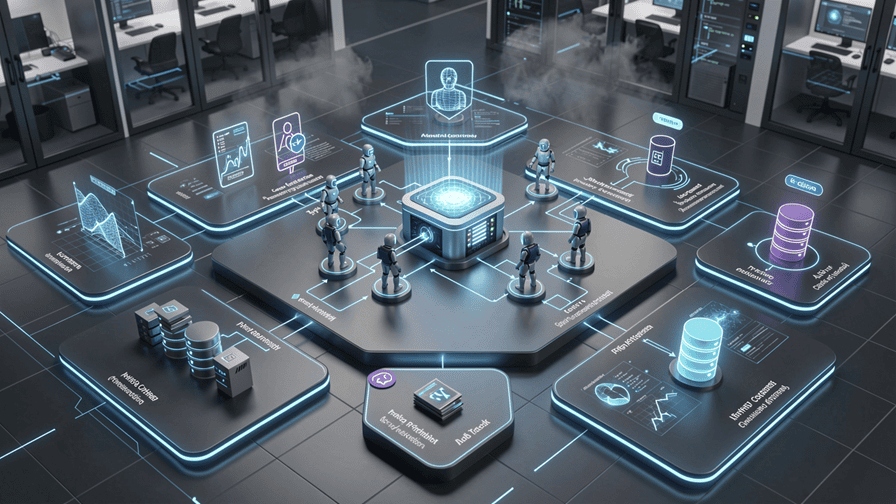
The future of Enterprise AI Agent Governance will be shaped by the increasing autonomy, complexity, and business importance of artificial intelligence systems.
As AI agents become capable of managing larger portions of enterprise operations, governance will move from reactive control mechanisms toward proactive, intelligent governance platforms that continuously monitor and regulate AI behavior.
Future governance environments will likely include automated policy enforcement, AI-powered security monitoring, autonomous compliance validation, advanced audit systems, and real-time risk assessment.
Autonomous Governance Platforms
Traditional governance approaches rely heavily on human reviews, documentation, and periodic assessments.
Future Enterprise AI Agent Governance platforms will increasingly automate governance activities through intelligent monitoring systems capable of:
- Detecting unusual AI behavior.
- Evaluating compliance automatically.
- Identifying security risks.
- Reviewing agent decisions.
- Adjusting permissions dynamically.
- Generating compliance reports.
These platforms will help organizations manage thousands of AI agents operating across different departments and business functions.
AI Agent Identity Management Will Become Critical
As organizations deploy larger numbers of autonomous agents, identity management will become as important for AI systems as it is for human employees.
Future Enterprise AI Agent Governance frameworks will likely include:
- Digital identities for every AI agent.
- Agent authentication systems.
- Permission lifecycle management.
- Behavioral identity monitoring.
- Automated access reviews.
Organizations will need complete visibility into which AI agents exist, what they can access, and what actions they perform.
Increased Regulatory Standards
AI regulations will continue influencing how organizations design and deploy autonomous systems.
Future Enterprise AI Agent Governance will likely require stronger capabilities around:
- Transparency.
- Explainability.
- Accountability.
- Data protection.
- Human supervision.
- Risk reporting.
- Documentation.
Organizations that establish governance maturity early will be better prepared as regulatory expectations become more defined.
AI Agents Will Govern Other AI Agents
As enterprise AI ecosystems expand, organizations may increasingly use specialized governance agents to monitor other AI systems.
These governance-focused AI agents could:
- Review agent behavior.
- Detect policy violations.
- Monitor security events.
- Validate decisions.
- Recommend corrective actions.
- Generate compliance documentation.
This creates a future where AI systems participate directly in maintaining governance standards.
Continuous AI Trust Management
Trust will become one of the most important measurements for enterprise artificial intelligence.
Future Enterprise AI Agent Governance frameworks will move beyond traditional security controls and focus on continuous trust evaluation.
Organizations will evaluate:
- Whether AI agents behave consistently.
- Whether decisions remain aligned with business objectives.
- Whether data usage remains appropriate.
- Whether security controls remain effective.
- Whether AI outcomes meet quality expectations.
Continuous trust management will help enterprises safely expand AI adoption while maintaining confidence among employees, customers, and regulators.
Conclusion
Enterprise AI Agent Governance has become an essential foundation for organizations adopting autonomous artificial intelligence at scale. As AI agents become more capable of reasoning, planning, accessing enterprise systems, and executing complex workflows, traditional governance approaches are no longer sufficient.
Organizations must develop comprehensive governance strategies that address identity management, authorization, security, compliance, monitoring, accountability, human oversight, lifecycle management, and risk control.
The greatest challenge facing enterprises is not simply deploying advanced AI agents but ensuring these systems operate safely, transparently, and responsibly within organizational boundaries.
Effective Enterprise AI Agent Governance enables businesses to capture the productivity benefits of autonomous AI while reducing operational, regulatory, and cybersecurity risks.
Companies that invest in governance frameworks today will be better positioned to manage future AI ecosystems, maintain stakeholder trust, and confidently adopt increasingly powerful autonomous technologies.
As artificial intelligence continues transforming enterprise operations, governance will no longer be an optional discipline. It will become a core requirement for responsible digital transformation and long-term business success.
Enterprise AI Agent Governance Services for Future-Ready Organizations
As enterprises continue adopting autonomous artificial intelligence, having a structured Enterprise AI Agent Governance strategy will become a competitive advantage rather than simply a compliance requirement. Organizations need governance frameworks that allow them to innovate confidently while maintaining security, transparency, accountability, and regulatory alignment.
At Progressive Robot, we help businesses design and implement advanced AI governance strategies that support responsible artificial intelligence adoption. Our AI consulting services help organizations evaluate AI risks, establish governance frameworks, improve security controls, and create scalable AI architectures aligned with business objectives.
Whether your organization is exploring AI agents for automation, customer experience improvement, business intelligence, software development, or operational efficiency, effective governance ensures your AI investments deliver sustainable value while minimizing potential risks.
Ready to build a secure and responsible AI future for your organization? Contact Progressive Robot today to discuss your Enterprise AI Agent Governance requirements.
More AI coverage: explore Progressive Robot's AI Models, Tools & Releases hub — hands-on reviews, setup guides and benchmarks in one place.