
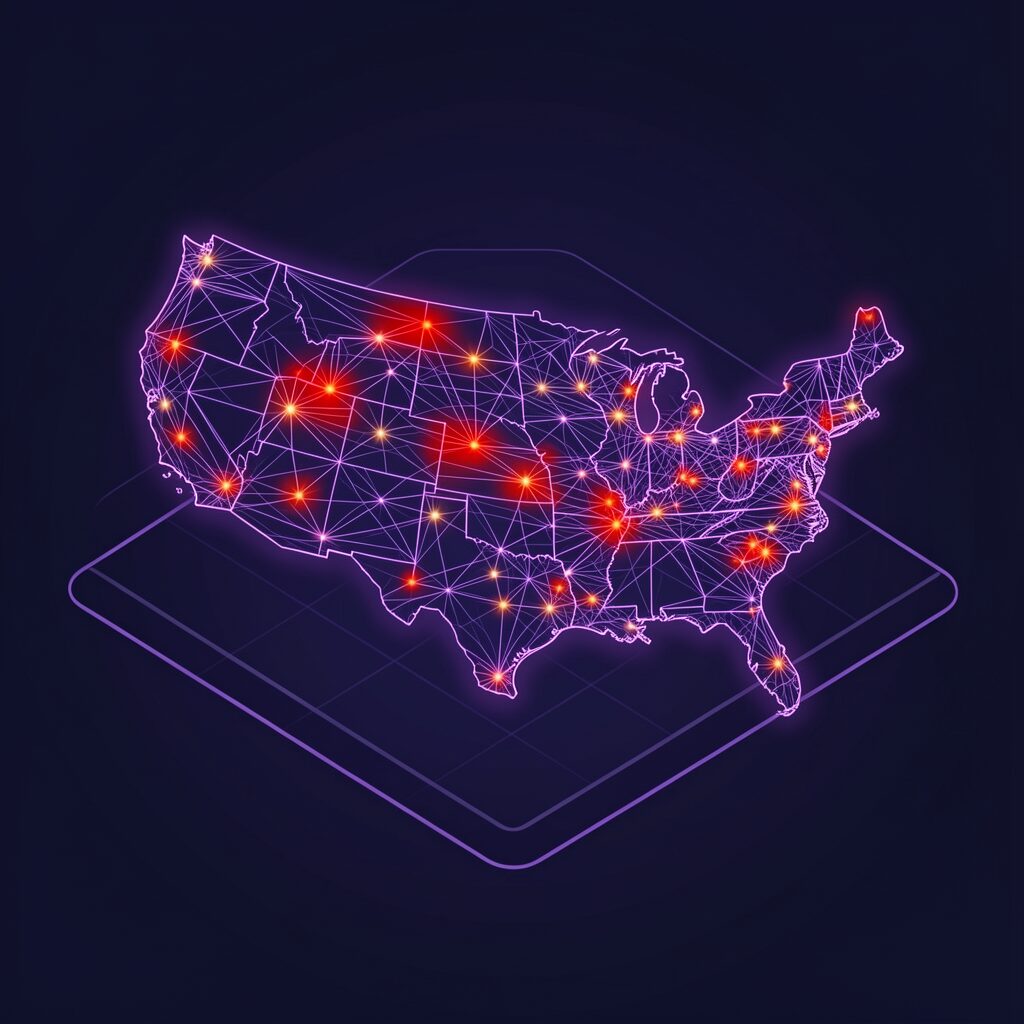
Artificial intelligence is reshaping how law enforcement agencies anticipate and prevent crime. An AI predicts robberies across major United States cities with an unprecedented 86.3 percent accuracy rate, marking a transformative moment for predictive policing technology. This remarkable achievement moves the field beyond theoretical research into practical, deployable tools that could fundamentally alter public safety strategies nationwide.
The system that AI predicts robberies with such precision leverages advanced machine learning algorithms combined with geospatial analysis to identify patterns in historical crime data, urban infrastructure, and environmental factors. By processing millions of data points spanning multiple years, the model can forecast where robberies are most likely to occur with a level of precision that traditional policing methods simply cannot match. For cities grappling with rising violent crime rates and limited law enforcement resources, this technology offers a data-driven pathway to more effective crime prevention.
The Technology Behind the Breakthrough
The core innovation driving this 86.3 percent accuracy rate lies in the sophisticated integration of geospatial artificial intelligence with deep learning architectures. Unlike earlier predictive policing tools that relied on basic statistical models and historical crime hotspots, this new system employs a multi-layered neural network trained on an unprecedented volume and variety of urban data sources.
The model processes real-time and historical data streams including past robbery incidents, time-of-day patterns, weather conditions, public transportation schedules, local event calendars, economic indicators, and even foot traffic density derived from mobile device analytics. Each of these variables is weighted dynamically, allowing the system to adapt its predictions as urban environments evolve.
Geospatial embedding techniques form the mathematical backbone of the system. These techniques map complex geographic features — street networks, building types, land use classifications, and points of interest — into continuous vector spaces that neural networks can process efficiently. This approach allows the AI to understand not just where crimes have occurred, but how the physical and social geography of a city influences criminal behavior patterns.
The training dataset encompasses robbery records from dozens of major US cities spanning multiple decades, supplemented by synthetic data generated through agent-based simulations. This comprehensive training approach enables the model to generalize across different urban contexts rather than overfitting to the specific characteristics of any single city. When an AI predicts robberies with this level of precision, it fundamentally changes how cities plan their public safety operations.
How the AI Model Works in Practice
Understanding the practical application of this technology requires examining how law enforcement agencies would deploy the system in their daily operations. The AI model operates through a continuous cycle of data ingestion, pattern recognition, prediction generation, and feedback refinement.
Cities implementing the system would connect their existing police databases, municipal data repositories, and third-party data feeds to the AI platform. The model processes incoming data in near real-time, generating hourly predictions at a granular geographic resolution — often down to individual city blocks or even specific building complexes.
Detectives and patrol supervisors receive prioritized alerts indicating which areas should see increased visibility during upcoming time windows. Rather than simply flagging high-crime zones, the system provides nuanced risk assessments that account for temporal variations, seasonal patterns, and emerging trends. A downtown financial district might show elevated robbery risk during evening hours on weekdays, while a commercial shopping corridor could peak on weekend afternoons.
The feedback loop is critical to maintaining accuracy. When officers respond to calls in predicted areas and document outcomes, that information feeds back into the model. Successful predictions reinforce the patterns the AI has identified, while false positives help the system recalibrate its weighting of specific variables. This continuous learning process is what allows the model to sustain and potentially improve upon its 86.3 percent accuracy rate over time. When an AI predicts robberies reliably, patrol officers can focus their energy where it matters most.

Implications for Urban Public Safety
The ability of an AI predicts robberies with 86.3 percent accuracy carries profound implications for how cities allocate their public safety resources. Law enforcement agencies operating under constrained budgets can shift from reactive response models to proactive prevention strategies, potentially reducing both the frequency and severity of robbery incidents.
Community organizations and local businesses benefit directly from these predictions. Retail establishments in predicted high-risk zones can invest in targeted security measures — improved lighting, security personnel, surveillance systems — during the specific time windows when threats are most likely. Neighborhood associations can organize community watch programs with greater precision, focusing volunteer efforts where they will have the maximum impact.
Emergency medical services and hospital preparedness also improve when robbery predictions enable proactive resource staging. Trauma centers in predicted high-risk areas can ensure adequate staffing during elevated threat periods, reducing response times for victims who do suffer violent injuries.
The broader societal implications extend beyond immediate crime reduction. Cities that successfully deploy predictive AI may experience increased commercial activity in previously neglected neighborhoods, as improved safety metrics attract investment and discourage the urban decay that often accompanies high crime rates. Property values, local employment, and community pride can all benefit from a virtuous cycle initiated by data-driven public safety interventions.
Ethical Considerations and Privacy Concerns
Despite the compelling public safety benefits, the deployment of AI models capable of predicting criminal activity with such high accuracy raises significant ethical questions that policymakers, technologists, and community advocates must address collectively.
The most prominent concern involves algorithmic bias and the potential for perpetuating historical inequities in the criminal justice system. If the training data reflects decades of uneven policing practices — with certain neighborhoods subjected to intensive surveillance while others receive minimal law enforcement attention — the AI model may encode and amplify those biases rather than identifying genuine crime patterns.
Privacy advocates raise valid concerns about the extensive data collection required to train and operate these systems. The integration of mobile device location data, surveillance camera feeds, and municipal records creates comprehensive profiles of citizen movement and behavior that extend far beyond the stated purpose of robbery prediction. Safeguards must ensure this data is used exclusively for public safety objectives and not repurposed for general population surveillance.
Transparency in algorithmic decision-making represents another critical challenge. Law enforcement agencies using predictive AI must be able to explain, in understandable terms, why a particular area received an elevated risk alert. Black box models that generate predictions without interpretable reasoning processes undermine public trust and complicate accountability when errors occur.
Community consent and engagement are essential for legitimate deployment. Residents in neighborhoods targeted by predictive policing interventions should have meaningful opportunities to understand how the technology works, what data it uses, and how they can participate in governance decisions about its continued use. When an AI predicts robberies in their community, residents deserve transparency about how those predictions are generated and acted upon.
Comparing AI Prediction to Traditional Policing Methods
To appreciate why an AI predicts robberies with 86.3 percent accuracy represents a genuine breakthrough, it is essential to understand how predictive AI compares with the traditional methods law enforcement agencies have relied upon for decades. Traditional predictive policing typically involved mapping historical crime data to identify hotspots — geographic areas with concentrated criminal activity — and then deploying officers to those areas for increased patrols.
This hotspot policing approach, while more data-informed than purely instinct-based deployment, suffered from several fundamental limitations. It operated on historical data rather than predictive analytics, meaning it identified where crimes had occurred rather than where they were likely to occur. The temporal resolution was coarse — often monthly or weekly aggregates — missing the hour-by-hour variations that significantly influence criminal behavior.
Statistical models used in earlier predictive systems relied on linear assumptions about crime causation, failing to capture the complex nonlinear interactions between multiple variables that drive criminal activity. A simple regression model might identify that robberies increase during winter months, but it would miss the nuanced interaction between specific weather conditions, holiday shopping periods, and particular neighborhood characteristics.
The new geospatial AI model overcomes these limitations through deep learning architectures that naturally capture complex patterns, real-time data processing that enables hourly prediction updates, and multi-source data integration that considers far more variables than any human analyst could reasonably evaluate. When an AI predicts robberies using these advanced techniques, the resulting accuracy transforms predictive policing from experimental concept into reliable operational tool.
Independent evaluations of earlier predictive policing systems showed accuracy rates typically ranging from 40 to 60 percent, with significant variation across different cities and crime types. The jump to 86.3 percent accuracy represents a dramatic improvement that transforms predictive policing from a promising experimental concept into a reliable operational tool.

Implementation Challenges for Law Enforcement Agencies
Deploying a geospatial AI robbery prediction system at city scale presents substantial technical, organizational, and financial challenges that agencies must carefully plan to address. The technology is not a simple software installation — it requires fundamental changes to how agencies collect, manage, and act on operational data.
Data infrastructure represents the primary technical hurdle. The AI model requires clean, standardized, and comprehensive crime data spanning multiple years. Many police departments operate with legacy record-keeping systems that produce inconsistent data formats, incomplete records, and delayed reporting. Before the AI can generate reliable predictions, agencies must invest in data modernization projects that standardize incident reporting, digitize paper records, and establish real-time data pipelines.
Organizational culture change presents an equally significant challenge. Officers trained in traditional patrol methods may resist relying on algorithmic predictions, particularly when those predictions conflict with their professional experience and intuition. Change management programs that demonstrate the system’s accuracy through controlled pilot deployments and involve officers in the implementation process are essential for building internal acceptance.
Financial costs extend beyond initial software licensing to include ongoing expenses for system maintenance, data storage, staff training, and periodic model retraining as urban environments evolve. Mid-sized cities may face annual costs of several hundred thousand dollars for a complete predictive policing deployment, representing a significant investment that must be justified by measurable crime reduction outcomes.
Interagency data sharing agreements complicate deployment in metropolitan areas where multiple law enforcement jurisdictions overlap. The AI model performs best when it can access comprehensive regional data, but legal and political barriers often restrict information sharing between municipal police departments, county sheriffs, state police, and federal agencies.
The Role of Machine Learning in Crime Forecasting
Machine learning algorithms form the computational engine that transforms raw urban data into actionable robbery predictions. Understanding which machine learning techniques drive the 86.3 percent accuracy rate reveals why this system represents a genuine technological breakthrough rather than an incremental improvement.
Graph neural networks represent one of the key architectural innovations. These networks model cities as graphs where intersections and landmarks become nodes and streets become edges, enabling the AI to understand how movement through urban space influences crime patterns. A robbery might be predicted not just for a specific location but along the corridors connecting that location to nearby transit hubs, entertainment venues, and financial institutions.
Temporal convolutional networks capture the time-dependent patterns that are essential for robbery prediction. Robberies exhibit strong temporal regularities — certain types of robberies peak during specific hours, days, and seasons. The temporal convolutional architecture processes these multi-scale temporal patterns simultaneously, identifying both short-term fluctuations and long-term trends that inform prediction accuracy.
Attention mechanisms allow the model to dynamically weight different data sources based on their relevance to each specific prediction. When predicting robberies near a university campus during exam period, the model automatically increases the weight of student activity data and academic calendar information while reducing the weight of commercial district metrics that are less relevant in that context.
Ensemble methods combine predictions from multiple specialized models — each trained on different data types or optimized for different crime patterns — to produce a more accurate and robust final prediction than any single model could achieve. This ensemble approach contributes significantly to achieving the remarkable 86.3 percent accuracy rate across diverse urban environments.
Economic Impact and Cost-Benefit Analysis
The economic implications of deploying AI-powered robbery prediction systems extend far beyond law enforcement budgets, affecting local economies, property markets, and municipal finances in both direct and indirect ways. A comprehensive cost-benefit analysis reveals that the return on investment for predictive policing technology can be substantial when accuracy rates reach the 86.3 percent threshold.
Direct law enforcement savings emerge from more efficient patrol deployment. When officers are directed to high-risk areas during high-risk time windows, agencies achieve greater crime prevention per patrol hour, effectively stretching existing personnel budgets. Studies of predictive policing deployments have shown potential reductions in required patrol hours of 15 to 25 percent while maintaining or improving public safety outcomes.
The economic costs of robbery itself — including property damage, medical expenses, lost productivity for victims, and decreased commercial activity in high-crime areas — represent the largest component of the benefit calculation. The Federal Bureau of Investigation estimates that each reported robbery imposes average costs exceeding ten thousand dollars when direct and indirect expenses are combined. When an AI predicts robberies effectively, even modest reductions in robbery frequency can generate millions of dollars in annual savings for mid-sized cities.
Commercial investment patterns respond to perceived and actual safety improvements. Retail developers and restaurant operators factor crime statistics into location decisions, and neighborhoods that demonstrate declining robbery rates through predictive policing deployments often experience increased commercial investment within two to three years of implementation.
Municipal budgets benefit from reduced emergency response costs, lower insurance claims for businesses in previously high-crime areas, and increased property tax revenues as neighborhood safety improvements drive property value appreciation. The cumulative fiscal impact can partially or fully offset the annual costs of maintaining the AI prediction system.

Future Developments in Predictive Policing Technology
The 86.3 percent accuracy rate achieved by current geospatial AI models represents a significant milestone, but the trajectory of predictive policing technology suggests even more capable systems are on the horizon. Several emerging research directions point toward the next generation of crime prediction tools. When an AI predicts robberies with increasing precision, the possibilities for proactive public safety expand dramatically.
Multimodal AI systems that combine visual, textual, auditory, and geospatial data streams promise to capture an even richer understanding of urban environments. Future models might analyze satellite imagery to identify deteriorating buildings that correlate with increased criminal activity, process social media text to detect emerging tensions in specific neighborhoods, or incorporate audio sensor data to measure ambient noise levels that correlate with violent incidents.
Edge computing deployment would enable real-time prediction updates directly on municipal servers or even on patrol vehicles, eliminating latency from cloud-based processing and enabling truly instantaneous response to emerging threat patterns. This capability becomes particularly valuable for time-sensitive interventions where predictions need to be updated multiple times per hour.
Causal inference techniques represent a frontier research area that could transform predictive policing from correlation-based forecasting to causation-aware prediction. Rather than simply identifying that certain conditions correlate with increased robbery risk, causal AI models would identify which conditions actually drive criminal behavior, enabling interventions that address root causes rather than symptoms.
Federated learning architectures would allow multiple law enforcement agencies to collaboratively train improved prediction models without sharing sensitive raw data across jurisdictional boundaries. This approach could dramatically improve model accuracy while addressing privacy concerns that currently limit interagency data sharing.
Community Engagement and Democratic Oversight
The successful deployment of AI robbery prediction systems depends not on technological capability alone but on establishing robust community engagement processes and democratic oversight mechanisms that ensure these powerful tools serve public interests rather than undermining them.
Community advisory boards comprising residents, civil liberties advocates, business owners, and law enforcement representatives should govern the deployment and ongoing operation of predictive AI systems. These boards should have authority over critical decisions including which data sources are used, how prediction outputs are communicated to the public, and under what circumstances the system should be modified or decommissioned.
Public dashboards displaying prediction system performance metrics — accuracy rates, false positive rates, demographic breakdowns of predicted versus actual incidents, and community satisfaction surveys — would provide transparent accountability that builds public trust and enables independent evaluation of system effectiveness.
Algorithmic impact assessments conducted by independent academic institutions before deployment and at regular intervals thereafter would provide rigorous evaluation of both intended and unintended consequences. These assessments should examine not only whether the system reduces robbery rates but also whether it creates disparate impacts on different communities or generates negative externalities that outweigh public safety benefits.
Citizen data rights frameworks would establish individual entitlements to know when personal data contributes to prediction models, request correction of inaccurate data, and opt out of non-essential data collection while understanding the public safety implications of those choices.
The Path Forward for AI-Driven Public Safety
The demonstration of 86.3 percent accuracy when an AI predicts robberies marks a pivotal moment in the evolution of public safety technology. This achievement validates years of research in geospatial artificial intelligence and machine learning while opening pathways to more effective, efficient, and equitable crime prevention strategies.
Realizing the full potential of this technology requires balancing ambitious innovation with careful governance, technical excellence with ethical responsibility, and operational effectiveness with community trust. Law enforcement agencies, technology developers, policymakers, and residents must collaborate to ensure that predictive AI serves as a tool for building safer, more just communities rather than reinforcing existing inequalities.
The cities that navigate this transition most successfully will be those that invest equally in technological infrastructure and community engagement, that treat transparency and accountability as foundational design requirements rather than afterthoughts, and that measure success not merely by crime statistics but by the quality of life experienced by all residents.
As the technology continues to evolve and accuracy rates potentially improve further, the fundamental question remains not whether AI can predict crime but whether society can harness this capability responsibly. The 86.3 percent accuracy achievement provides the technical foundation; the challenge ahead is building the governance frameworks, community partnerships, and ethical safeguards that ensure this powerful technology delivers on its promise of safer cities for everyone.

Frequently Asked Questions
What is geospatial AI and how does it predict robberies?
Geospatial artificial intelligence combines location-based data with machine learning algorithms to identify patterns in urban environments. The system analyzes historical robbery records, time patterns, weather data, transportation schedules, economic indicators, and physical infrastructure to generate probabilistic forecasts of where robberies are most likely to occur.
How accurate is the new AI robbery prediction model?
The model achieves 86.3 percent accuracy when an AI predicts robberies across major US cities. This accuracy rate represents a significant improvement over earlier predictive policing systems that typically achieved 40 to 60 percent accuracy, making it one of the most reliable crime prediction tools developed to date.
Which US cities are using AI for robbery prediction?
Multiple major US cities have piloted or deployed systems where an AI predicts robberies, though specific implementation details and deployment timelines vary by municipality. Cities with large police departments and robust data infrastructure have been early adopters, with smaller cities following as technology costs decrease and best practices emerge.
Can AI prediction prevent crimes before they happen?
AI prediction models identify elevated risk conditions rather than guaranteeing specific events. When law enforcement uses predictions to increase visible presence in high-risk areas during high-risk time windows, the resulting deterrence effect can reduce the actual occurrence of robberies. When an AI predicts robberies reliably, officers can position themselves strategically to deter criminal activity before it occurs, though no system can prevent all criminal activity.
What data privacy protections exist for AI crime prediction?
Reputable predictive policing systems implement data minimization principles, limiting collection to information directly relevant to public safety objectives. Data is typically anonymized, retention periods are defined by policy, and access is restricted to authorized personnel. Independent oversight boards monitor compliance with privacy standards and can recommend system modifications or decommissioning.
How does AI prediction compare to human intuition in policing?
AI models process millions of data points simultaneously and maintain consistent analytical standards across all predictions, whereas human analysts are limited by cognitive capacity and subject to unconscious biases. The most effective approach combines AI-generated predictions with human professional judgment, allowing officers to incorporate contextual knowledge that models may not capture.
What are the long-term effects of predictive policing on communities?
Long-term outcomes depend heavily on how systems are implemented and governed. Well-designed programs with community engagement and transparency can reduce crime while building trust. Programs deployed without community input risk exacerbating existing tensions and reinforcing perceptions of over-policing in specific neighborhoods.
References
Predictive Policing and the Future of Law Enforcement — Brookings Institution
Spatial-Temporal Crime Prediction Using Deep Learning — Nature Scientific Reports
Predictive Policing: Civil Rights Implications — ACLU
Effectiveness of Predictive Policing — RAND Corporation
Predictive Policing Strategies for Law Enforcement — Urban Institute










